Tempsens Lists at ₹634 on NSE, 111.3% Above IPO Price
Tempsens Instruments began trading on 28 August at ₹634 on NSE against the ₹300 issue price after a ₹650 crore offer in which most proceeds were from an OFS.
What changed
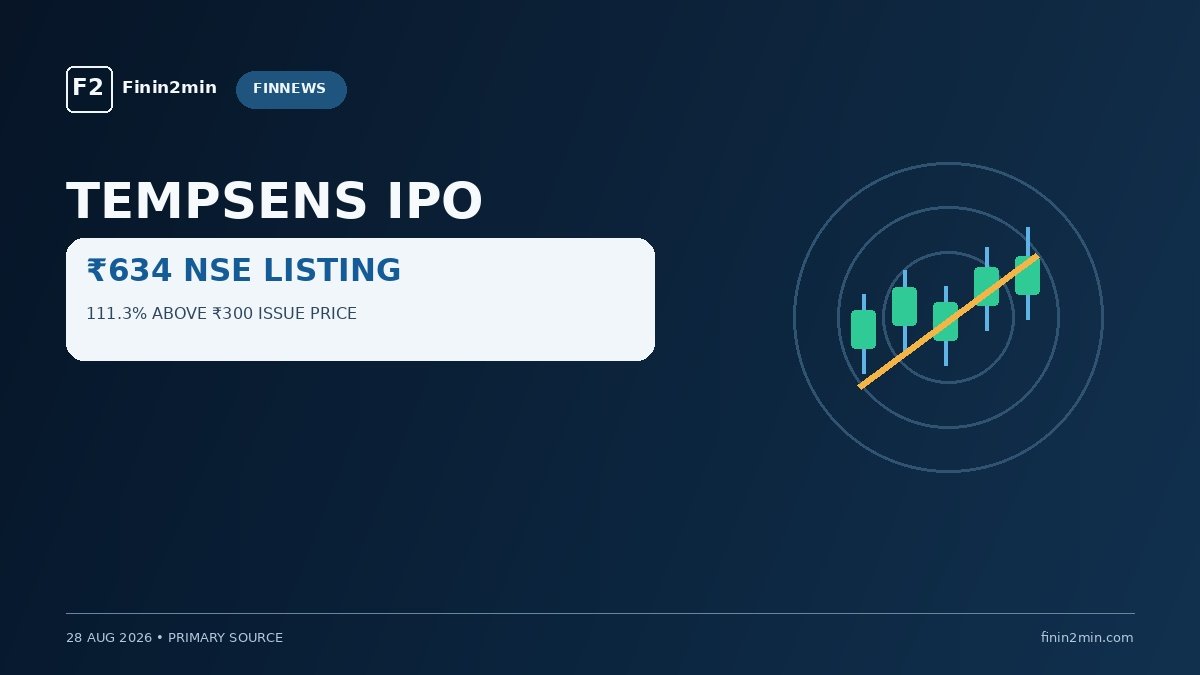
Tempsens Instruments began trading on 28 August at ₹634 on NSE against a ₹300 issue price, an opening premium of about 111.3%.
Why it matters
The market repriced the company sharply, but only the fresh-issue component adds company capital; OFS proceeds belong to selling shareholders and listing gain is not company profit.
Who is affected
IPO allottees, secondary-market investors, selling shareholders, Tempsens and its lenders.
Action required
Track post-listing price discovery, first quarterly results, fresh-proceeds utilisation, debt repayment and capex rather than treating opening premium as future earnings.
Tempsens Instruments (India) made a strong stock-market debut on 28 August 2026, opening at **₹634 on NSE** against its **₹300 issue price** — an opening premium of about **111.3%**.
Finin2min — 2-minute summary
- Tempsens was admitted to trading on NSE and BSE on **28 August 2026**.
- The NSE opening/listing price was **₹634** compared with a ₹300 issue price.
- The opening premium was about **111.3%**.
- The public issue aggregated to **₹650 crore** at the final price.
- Only **₹95 crore** was fresh capital; the majority of the offer was an **offer for sale (OFS)** by existing shareholders.
- OFS proceeds do **not** become cash available to the company.
- A listing gain is a market-pricing event for shareholders; it is not revenue or profit in Tempsens' income statement.
What happened
Tempsens entered the public market after completing its mainboard offer. Official exchange/offer documents identify the security as TEMPSENS, with face value ₹4 and final issue price of ₹300.
An opening at ₹634 means the market immediately valued allotted shares at more than double the issue price.
That is a notable price-discovery event, but it is not the same as a doubling of the company's earnings or book value.
The IPO structure is more important than the ₹650 crore headline
The offer included a **₹95 crore fresh issue** and a much larger OFS by existing shareholders.
This determines where the money goes:
- fresh issue proceeds increase company cash before issue expenses and deployment;
- OFS proceeds belong to selling shareholders.
Saying "Tempsens raised ₹650 crore for expansion" would therefore overstate the cash that went to the company.
What the fresh money can change
Offer documents allocate fresh proceeds toward company purposes including capital expenditure and repayment/prepayment of certain borrowings, with residual funds for general corporate purposes within the disclosed framework.
Using equity to repay debt can reduce interest expense and leverage, but the longer-term value depends on how efficiently the company deploys capex.
Investors should focus on:
- utilisation of new capacity;
- growth in temperature sensing, electrical heating and specialised cables;
- interest savings;
- working-capital intensity;
- margins and export performance.
Finance and CA lens: listing gain is not company income
The ₹334 difference between issue price and NSE opening price is a secondary-market valuation change.
For an IPO allottee who sells, tax consequences depend on investor status, holding period and applicable law. For Tempsens itself, the listing premium is **not operating revenue** and does not run through the company's profit and loss account.
Similarly:
- fresh issue proceeds are accounted for within equity/cash subject to issue-expense treatment;
- OFS consideration belongs to selling shareholders;
- market capitalisation is an investor valuation measure, not a balance-sheet asset of the issuer.
Why the premium raises the delivery bar
A first trade more than 100% above issue price means the market has immediately set a substantially higher valuation reference.
Post-listing investors therefore need to ask whether future earnings, cash generation and returns on capital can support that valuation.
Relevant operating variables include customer concentration, raw-material costs, inventory, receivables, project/OEM cycles and the returns generated by fresh capex.
Price discovery after listing
The listing price is only the first market-clearing reference. Newly listed stocks can show high turnover and volatility as IPO demand, short-term trading and longer-term investors interact.
Finin2min therefore separates:
**issue price → listing price → subsequent traded price → business performance**.
They influence each other but are not interchangeable.
Valuation discipline after a triple-digit debut
A listing premium of more than 100% can change the risk-reward equation for a new buyer. The IPO issue price was set through the offer process; the market price after listing reflects marginal demand and supply and can therefore move well ahead of near-term fundamentals.
A useful post-listing framework is to compare the new market valuation with sustainable earnings, free cash flow and return on capital rather than with the issue price alone. A stock can remain above its IPO price and still become expensive if earnings fail to compound at the rate implied by the new valuation.
The reverse is also true: a volatile first week does not by itself change the operating quality of the business. Investors should separate price discovery from execution on capex, debt reduction, working capital and customer demand.
Fresh proceeds versus market capitalisation
The company's balance sheet receives the fresh-issue proceeds, subject to issue expenses and deployment. It does not receive the increase in market capitalisation created when the share trades above ₹300. That additional market value belongs to shareholders collectively as a valuation outcome, not to the issuer as cash.
Who is affected
IPO allottees, secondary-market investors, selling shareholders, Tempsens, lenders and peers in industrial sensing/heating/cable markets.
What to watch next
Watch the first quarterly results after listing, utilisation of issue proceeds, debt reduction, working-capital trends and whether earnings growth supports the new valuation.
Primary and authoritative sources
- NSE — TEMPSENS official equity quote page: https://www.nseindia.com/get-quotes/equity?symbol=TEMPSENS
- NSE archive — Tempsens final prospectus: https://nsearchives.nseindia.com/corporate/FP_INE1KZI01025_25AUG2026.pdf
- NSE archive — Tempsens draft offer document: https://nsearchives.nseindia.com/corporate/Registration_29092025235356_TIPLDRHP.pdf
Disclaimer
*Finin2min provides financial and educational information and does not constitute investment, tax or legal advice. Readers should use the latest controlling official documents and evaluate their own circumstances before acting.*
View official source →
FinNews is educational and professional reference material, not financial, tax or legal advice. Confirm the current official position from the primary source before acting on any figure, rate, provision or deadline mentioned here.