Augmont IPO: ₹94,186 crore revenue, 0.41% EBITDA margin - what the RHP really says before the ₹825 crore offer
Augmont opens its ₹825 crore IPO on 21 August at ₹750-₹788. A Finin2min RHP review finds rapid profit growth and low leverage, but also razor-thin margins, negative FY26 operating cash flow, 52.09% top-10 customer concentration and a ₹465 crore working-capital requirement.
What changed
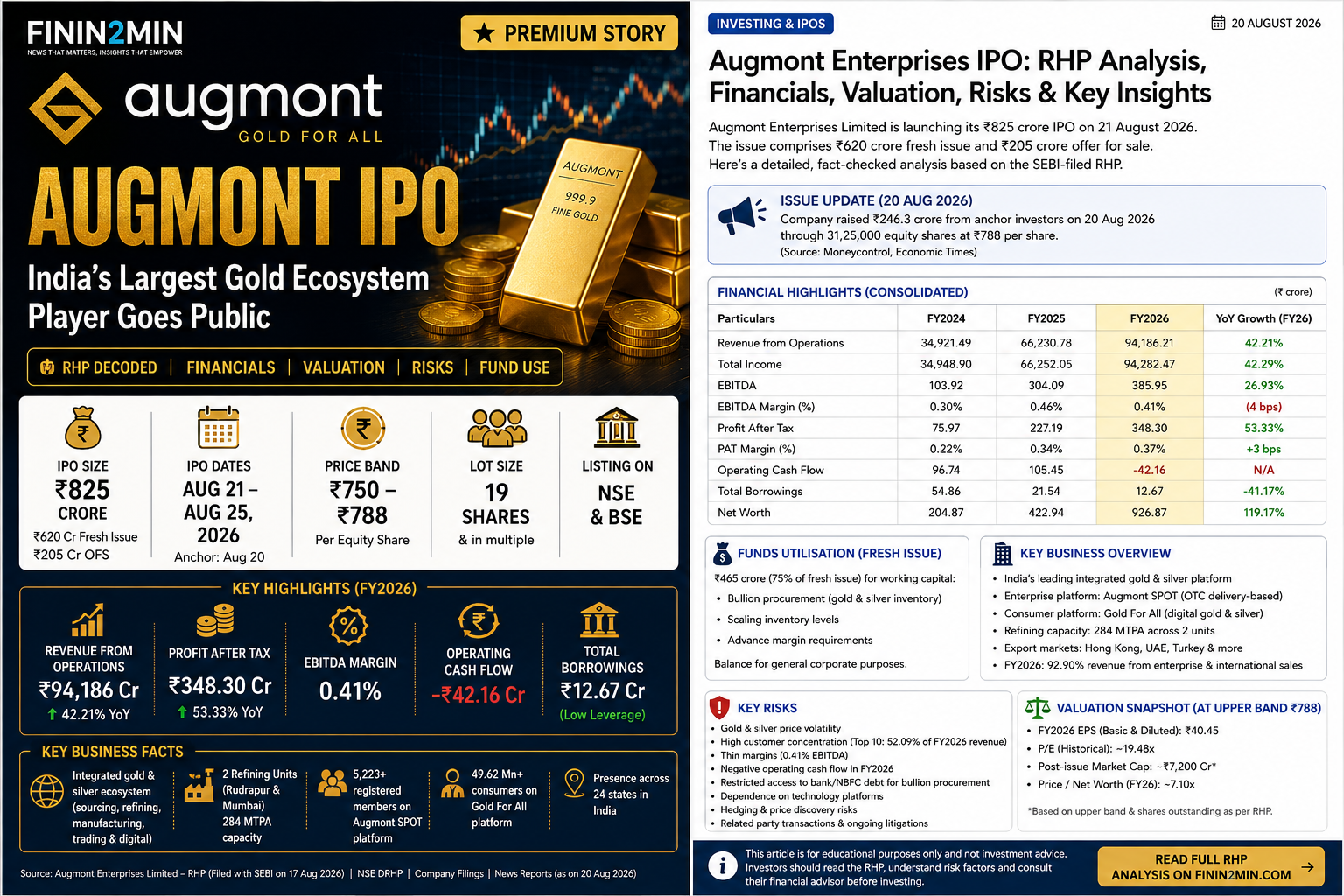
Augmont Enterprises' public offer opens on 21 August 2026 after its RHP dated 17 August. The current offer is up to ₹825 crore, comprising ₹620 crore of fresh issue and ₹205 crore of OFS. The post-RHP price-band announcement fixed ₹750-₹788 with a 19-share lot. On 20 August, contemporaneous reports said the anchor tranche raised about ₹246.3 crore at ₹788 per share.
Why it matters
The RHP shows a distinctive risk-reward profile: FY2026 revenue from operations of ₹94,186.21 crore and PAT of ₹348.30 crore, but only 0.41% EBITDA margin, negative ₹42.16 crore operating cash flow, 52.09% top-10 customer concentration and substantial dependence on working capital. Headline turnover alone can therefore misstate the economics investors need to assess.
Who is affected
Retail, HNI and institutional investors evaluating the Augmont Enterprises IPO; investors tracking India's gold, silver, bullion and digital-gold ecosystem.
Action required
Prospective bidders should read the full RHP, compare historical EPS with post-issue economics rather than relying only on headline P/E, monitor working-capital deployment and cash conversion, and recheck the final Prospectus/exchange notices for final post-offer shareholding and timetable. Do not treat GMP or anchor participation as an assured return signal.
Finin2min Premium RHP Review
Augmont Enterprises is entering the public market with a business profile that can look deceptively simple if investors focus only on its headline turnover. For FY2026, the company reported revenue from operations of ₹94,186.21 crore and profit after tax of ₹348.30 crore. Yet its RHP also reports an EBITDA margin of only 0.41%, a profit margin of 0.37%, negative operating cash flow for FY2026 and top-10 customer concentration of 52.09%.
That combination is the central point of this IPO analysis: Augmont operates at enormous bullion transaction values, but the economics of the business are driven by very thin spreads, working-capital availability, hedging, customer concentration and the return it can earn on incremental capital.
The offer opens for public bidding on 21 August 2026 and closes on 25 August 2026. The post-RHP price-band announcement fixed the band at ₹750-₹788 per share and the minimum bid lot at 19 shares, implying ₹14,972 for one retail lot at the cap price. The RHP itself, dated 17 August 2026, still contains blank placeholders for the price band and share counts; therefore those offer terms should be treated as subsequent offer communications, not figures extracted from the RHP.
Latest update: anchor book completed on 20 August
Contemporaneous reports published after the RHP say Augmont allocated 31.25 lakh shares to anchor investors at ₹788 each, raising about ₹246.3 crore ahead of the public issue. Multiple reports agree on the allocation size, price and amount. However, publications differ on whether the allocation was made to 14 or 15 institutional investors. Finin2min is therefore not publishing an exact anchor-investor count until it is reconciled with an official allocation filing.
The anchor allocation should not be treated as a prediction of listing performance. It is evidence of institutional participation in the anchor tranche, not a guarantee of subscription levels, listing gains or post-listing returns.
Offer structure: ₹825 crore, with most fresh capital going to working capital
The SEBI-filed abridged prospectus confirms an offer of up to ₹825 crore, comprising a fresh issue of up to ₹620 crore and an offer for sale of up to ₹205 crore.
The OFS is being made by three promoter selling shareholders:
- Namita Ketan Kothari: up to ₹69.40 crore
- Vivek Prithviraj Kothari: up to ₹69.40 crore
- Dimple Mukesh Kothari: up to ₹66.20 crore
- Total OFS: up to ₹205 crore
The company will not receive the OFS proceeds. Those proceeds accrue to the selling shareholders after applicable offer-related expenses and taxes.
Of the fresh issue, ₹465 crore is proposed to fund future working-capital requirements for procurement, maintenance and scaling of inventory and advance-margin requirements for inventory procurement. This equals 75% of the ₹620 crore gross fresh issue. The balance, after offer expenses and subject to the final offer price, is intended for general corporate purposes within the applicable regulatory limit.
This use of proceeds is strategically important. Augmont's RHP itself identifies inability to access debt financing for working-capital requirements as one of its top internal risk factors. The IPO is therefore not primarily a conventional plant-expansion or debt-repayment transaction; a major portion of new equity capital is intended to support the operating balance sheet of a high-value bullion business.
A notable change from the DRHP
The September 2025 DRHP proposed an ₹800 crore offer: ₹620 crore of fresh issue plus ₹180 crore of OFS, split equally at ₹60 crore among the same three promoter selling shareholders.
The August 2026 RHP increases the OFS to ₹205 crore while keeping the fresh issue unchanged at ₹620 crore. In other words, the ₹25 crore increase in overall IPO size from the DRHP to the RHP comes entirely from additional promoter selling, not additional capital for the company.
This is neither automatically positive nor negative, but it is a material change investors should know when comparing older IPO summaries with the current offer.
What Augmont actually does
Augmont describes itself as an integrated gold and silver platform serving businesses and consumers, with presence across 24 states as of 31 March 2026. Its operations span procurement and refining, bullion trading, digital gold offerings, jewellery manufacturing, international sales and facilitation of gold-backed financial services.
Its two principal customer-facing ecosystems are Augmont SPOT and Augmont Gold For All.
Augmont SPOT is an electronic over-the-counter, delivery-based bullion platform used by businesses including jewellers, bullion dealers and manufacturers with valid GST registrations. The RHP says the platform had more than 5,223 registered members as of 31 March 2026.
Augmont Gold For All serves consumers directly and through alliances. Its offerings include digital purchase, sale and storage of gold and silver, systematic investment plans, old-gold liquidation, coins and technology support for gold loans. The RHP says Augmont had served its digital-gold products to more than 49.62 million registered consumers as of 31 March 2026.
The company also operates two refining units: 144 MTPA of installed capacity at Rudrapur, Uttarakhand, and 140 MTPA at Mumbai, Maharashtra, giving a combined installed capacity of 284 MTPA as of 31 March 2026. It has a jewellery manufacturing unit in Sitapur SEZ, Jaipur, focused primarily on gold chains for international markets.
FY2026 financial snapshot
The figures below are converted from the RHP's ₹ million presentation into ₹ crore.
- Revenue from operations: ₹94,186.21 crore
- Total income: ₹94,282.47 crore
- EBITDA: ₹385.95 crore
- Profit after tax: ₹348.30 crore
- Net worth: ₹926.87 crore
- Total borrowings: ₹12.67 crore
- Operating cash flow: negative ₹42.16 crore
- Basic and diluted EPS: ₹40.45
- Net asset value per share: ₹111.00
- EBITDA margin: 0.41%
- Profit margin: 0.37%
- Debt-to-equity: 0.01x
- ROE: 51.04%
- ROCE: 40.27%
Revenue from operations grew 42.21% in FY2026 after growing 89.66% in FY2025. PAT rose from ₹75.97 crore in FY2024 to ₹227.19 crore in FY2025 and ₹348.30 crore in FY2026. On the RHP numbers, FY2024-FY2026 revenue CAGR is approximately 64.2%, while PAT CAGR is approximately 114.1%.
The profit growth is strong. But the margin structure is unusual enough that investors should not evaluate Augmont like a typical consumer brand or manufacturing company.
Why ₹94,186 crore of revenue does not mean a conventional ₹94,000 crore business
Bullion trading records the value of precious metal sold as revenue. When the underlying commodity is expensive, revenue can become extremely large even if the economic spread retained by the intermediary is small.
That is visible in Augmont's FY2026 numbers. EBITDA of ₹385.95 crore on revenue of ₹94,186.21 crore translates to a 0.41% EBITDA margin. PAT of ₹348.30 crore translates to a 0.37% profit margin on total income.
For investors, the more useful questions are therefore not only 'how fast is revenue growing?' but also:
- How stable are trading and operating spreads?
- How effectively is gold and silver price risk hedged?
- How much capital is required to support additional turnover?
- Does incremental working capital produce attractive incremental profit?
- How well does reported profit convert into operating cash flow?
A small change in spreads can have a disproportionate effect on profit when the base margin is measured in fractions of one percentage point.
Revenue growth versus physical operating KPIs: the important nuance
The RHP provides physical operating KPIs that make the FY2026 growth story more informative.
- Gold sold on Augmont SPOT: 53.41 MT in FY2026 versus 61.84 MT in FY2025, down about 13.6%
- Silver sold on Augmont SPOT: 1,049.05 MT versus 1,035.22 MT, up about 1.3%
- Gold sold through international sales: 6.63 MT versus 11.52 MT, down about 42.4%
- Gold refined: 13.34 MT versus 15.08 MT, down about 11.5%
- Transactions handled on Augmont Gold For All: 54.93 million versus 35.72 million, up about 53.8%
This does not mean Augmont's overall bullion quantity sold declined: the full RHP's management discussion states that FY2026 revenue growth was primarily driven by higher product sales, including increased gold and silver bullion sold, increased jewellery sales and higher gold prices. What the KPI table does show is that individual physical measures can move very differently from headline turnover.
The practical takeaway is that revenue should not be used as a direct proxy for physical market-share gains. Investors need to separate volume, gold-price realisations, product mix and transaction economics.
Customer concentration increased sharply in FY2026
The RHP identifies customer concentration as a major risk.
The top five customers accounted for 46.32% of FY2026 revenue from operations, compared with 28.89% in FY2025 and 29.43% in FY2024.
The top ten customers accounted for 52.09% of FY2026 revenue, compared with 35.72% in FY2025 and 36.63% in FY2024. The company also states that it does not execute long-term agreements with its customers.
This makes customer retention and diversification important post-listing monitoring items. Strong turnover growth is more valuable when it is supported by a broadening customer base rather than increasing dependence on a handful of counterparties.
Revenue concentration remains overwhelmingly enterprise-led
Augmont's enterprise sales through Augmont SPOT plus international sales accounted for 92.90% of FY2026 revenue from operations. The comparable figures were 95.72% in FY2025 and 95.88% in FY2024.
That percentage has fallen modestly, which is consistent with a growing consumer ecosystem, but it remains extremely high.
This matters because Augmont is often discussed in the market as a digital-gold or consumer precious-metals story. The RHP numbers show that its current revenue profile is still predominantly an enterprise and international bullion business. Digital consumer scale may be strategically valuable, but investors should not confuse registered consumer reach with present revenue mix.
Geography: India remains dominant
FY2026 revenue from operations was approximately ₹88,484.73 crore from India and ₹5,701.49 crore from customers outside India. Overseas revenue therefore represented 6.05% of FY2026 revenue from operations.
The RHP identifies the UAE, Hong Kong and Turkey among overseas markets reported in the geographical revenue table.
Strong return ratios, but cash conversion needs watching
Augmont's FY2026 ROE of 51.04% and ROCE of 40.27% are high, while debt-to-equity of 0.01x and total borrowings of ₹12.67 crore indicate low reported financial leverage.
However, FY2026 operating cash flow was negative ₹42.16 crore despite ₹348.30 crore of PAT. FY2025 operating cash flow was positive ₹105.45 crore and FY2024 was positive ₹96.74 crore.
One negative operating-cash-flow year is not enough to conclude that earnings quality is weak, particularly in a working-capital-heavy commodity business. But it becomes more relevant when the company is simultaneously proposing to deploy ₹465 crore of fresh IPO proceeds into working capital.
Post listing, Finin2min would track the bridge between PAT, inventory, receivables/payables and operating cash flow much more closely than the revenue headline alone.
The working-capital paradox: low debt does not mean low capital intensity
A casual reading of ₹12.67 crore of borrowings may suggest that Augmont needs little external capital. The RHP says otherwise.
One of the top 10 internal risk factors explicitly states that the company cannot access debt financing to finance its working-capital requirements and warns that inability to obtain adequate and cost-effective funding could affect operations, liquidity and financial performance.
This helps explain why the company is raising such a large amount of equity for inventory and advance margins even though reported borrowings are low.
The right question is not simply 'is debt low?' It is 'how efficiently can the company recycle working capital into profitable bullion turnover without eroding spreads or cash conversion?'
Valuation: about 18.5x-19.5x historical FY2026 EPS, with an important caveat
The RHP reports FY2026 basic and diluted EPS of ₹40.45.
Using the announced price band:
- ₹750 / ₹40.45 = approximately 18.54x historical FY2026 EPS
- ₹788 / ₹40.45 = approximately 19.48x historical FY2026 EPS
Using FY2026 NAV of ₹111 per share, the band also corresponds to approximately 6.76x-7.10x historical NAV.
These are simple historical ratios using RHP per-share numbers. They should not be confused with a post-issue forward valuation. The fresh issue creates additional shares and additional capital; the eventual valuation should be judged against the earnings generated after that capital is deployed.
This distinction matters especially here because ₹465 crore is being raised to support additional working capital. If that capital produces high incremental returns while margins remain stable, dilution can be absorbed by future earnings growth. If the incremental capital merely inflates turnover without adequate spread and cash generation, the outcome is very different.
Promoter shareholding: use the RHP, not conflicting aggregator numbers
Promoters collectively held 77,448,478 equity shares, representing 92.75% of the pre-offer paid-up equity share capital, at the date of the RHP.
The filed RHP leaves post-offer promoter holdings blank and says they are to be populated at the Prospectus stage based on the actual offer price, subscription and basis of allotment.
Several third-party IPO pages currently show different post-offer promoter percentages. Finin2min is not reproducing any of those figures as a final fact before the final prospectus/allotment data resolves the number.
Recent share transaction history
The RHP discloses a weighted-average acquisition cost of ₹595.23 for all equity shares transacted during the one year preceding the RHP, with transactions ranging from ₹40.15 to ₹991 per share.
The three promoter selling shareholders have a disclosed weighted-average historical acquisition cost of ₹1.86 per share for their holdings.
The ₹1.86 figure should not be used mechanically to calculate a promoter 'return' from the IPO because long holding periods, bonus issues, splits and corporate actions can significantly alter historical acquisition-cost comparisons. The one-year transaction data is more relevant for understanding recent private-market pricing, though it too does not determine fair value.
Litigation: distinguish cases against Augmont from cases filed by Augmont
The RHP's litigation summary is more benign than a simple count of all proceedings might suggest.
As of the RHP date, the company disclosed no criminal proceedings against it, no material civil proceedings against it and no actions by statutory or regulatory authorities against it. It disclosed eight tax proceedings against the company with an aggregate quantified amount of ₹135.10 million, or about ₹13.51 crore.
Separately, Augmont itself had initiated three criminal proceedings and four material civil proceedings, with the table showing an aggregate amount involved of ₹582.39 million for proceedings by the company. Those should not be presented as liabilities against Augmont.
The RHP's most important risks
Finin2min considers the following RHP risks particularly relevant to valuation and post-listing monitoring:
- Technology and data-security dependence across Augmont SPOT and Augmont Gold For All
- Gold and silver price volatility affecting demand, inventory values and cash flow
- Enterprise and international sales concentration at 92.90% of FY2026 revenue
- Procurement risk, including sanctions, import duties and export controls affecting bullion sourcing
- Recent equity issuances at prices that may be below the offer price
- Dependence on price-discovery systems and technology
- Top-10 customer concentration of 52.09% with no long-term customer agreements
- Hedging strategy and execution risk
- Restrictions on debt financing for working-capital requirements
- Related-party transaction and potential conflict-of-interest risk
None of these risks proves the IPO is unattractive. But together they show why the company should be evaluated as a high-turnover, low-margin precious-metals intermediary and platform rather than purely as a consumer fintech or jewellery-growth story.
Finin2min assessment: the five numbers that matter after listing
The strongest features in the RHP are rapid PAT growth, a large integrated precious-metals ecosystem, low reported leverage, high ROE/ROCE and rapidly rising Gold For All transaction volumes.
The counterweights are equally clear: 0.41% EBITDA margin, negative FY2026 operating cash flow, high customer concentration, reliance on enterprise/international revenue and substantial working-capital requirements.
For Finin2min, five metrics will decide whether the IPO capital creates lasting shareholder value:
- EBITDA spread/margin after the fresh capital is deployed
- Operating cash-flow conversion versus reported PAT
- Customer concentration, especially the top-five and top-10 shares
- Return generated on the ₹465 crore working-capital deployment
- Physical bullion/product volumes versus revenue growth driven by metal prices
If Augmont can scale transaction volumes and consumer activity while protecting margins, improving cash conversion and maintaining high returns on incremental capital, the IPO funding can support meaningful earnings growth. If turnover rises mainly because gold prices rise while spreads, cash conversion or customer diversification weaken, the ₹94,000 crore revenue headline will be far less informative than it appears.
What investors should verify before bidding
- Read the full RHP risk-factor and objects-of-offer sections, not only issue summaries.
- Treat ₹94,186 crore as bullion turnover economics, not as a conventional high-margin revenue base.
- Use the ₹40.45 RHP EPS only as a historical reference; do not equate 19.48x with a post-issue forward P/E.
- Monitor operating cash flow and working-capital deployment after listing.
- Do not use unregulated grey-market premium as a substitute for fundamental valuation.
- Recheck the final Prospectus and exchange/registrar notices for final share counts, post-offer promoter ownership, allotment and listing schedule.
Quick FAQ
What is the Augmont IPO size?
Up to ₹825 crore, comprising a ₹620 crore fresh issue and a ₹205 crore OFS.
What is the Augmont IPO price band?
₹750-₹788 per equity share, as announced after the RHP filing.
What is the lot size?
19 shares. At ₹788, one lot costs ₹14,972.
When does the IPO open and close?
The public offer opens on 21 August 2026 and closes on 25 August 2026. The RHP scheduled anchor bidding for 20 August 2026.
How much will Augmont use for working capital?
₹465 crore of the fresh-issue proceeds is proposed for working-capital requirements covering procurement, inventory scaling and advance margins.
What was FY2026 profit?
Restated consolidated PAT was ₹348.30 crore on revenue from operations of ₹94,186.21 crore.
Is Augmont debt free?
No. The RHP reports total borrowings of ₹12.67 crore as of 31 March 2026, although leverage is low at 0.01x debt-to-equity.
What is the historical P/E at the upper price band?
About 19.48x using the RHP's FY2026 EPS of ₹40.45. This is a historical calculation and is not a post-issue forward P/E.
Is Augmont mainly a digital-gold company?
Not on current revenue mix. Enterprise sales through Augmont SPOT plus international sales contributed 92.90% of FY2026 revenue from operations.
What is Finin2min's view on GMP?
GMP is unofficial, unregulated and can cha
View official source →
FinNews is educational and professional reference material, not financial, tax or legal advice. Confirm the current official position from the primary source before acting on any figure, rate, provision or deadline mentioned here.