U.S. Services ISM Rises to 55.4; New Orders Hit 60.9 While Employment Remains Below 50
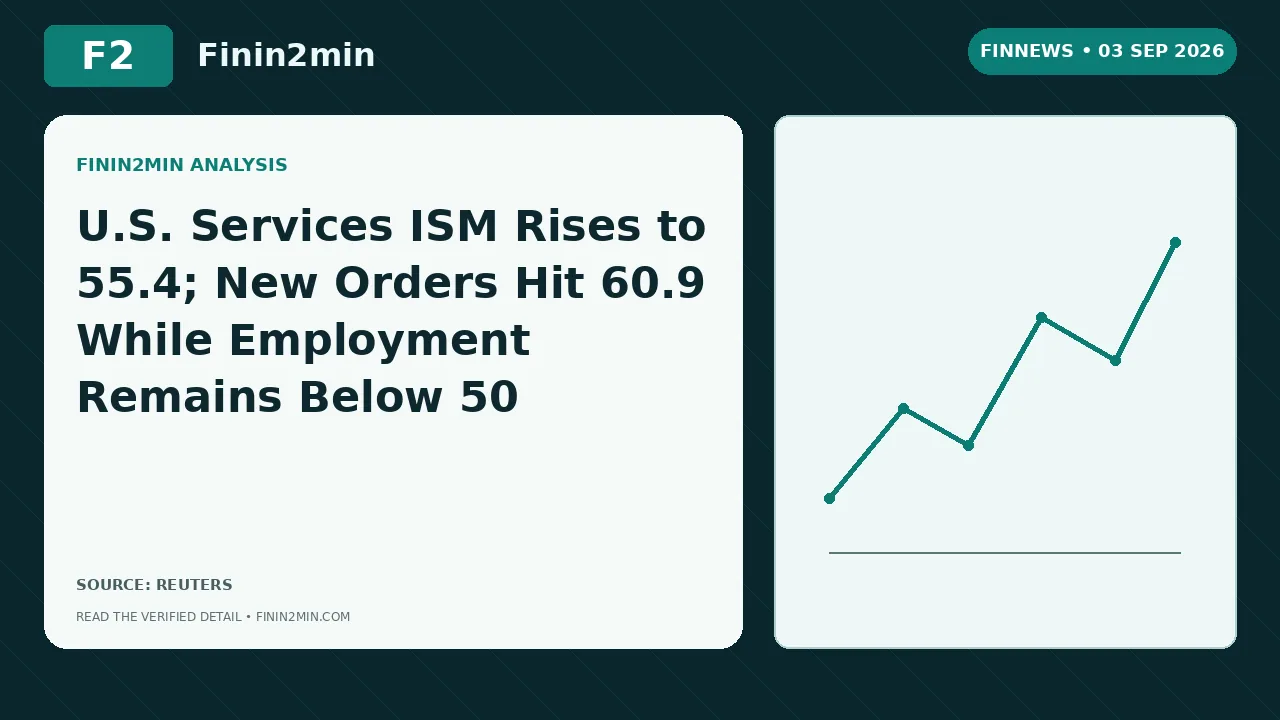
U.S. services activity strengthened in August, with the ISM services index rising to 55.4 and new orders reaching 60.9, even as the employment component remained in contraction territory.
What changed
U.S. services demand strengthened, complicating the inflation-versus-growth trade-off for the Fed.
Why it matters
Strong demand and elevated prices support the case for caution on easing, while sub-50 employment suggests the labour picture is not uniformly hot. Markets will need to reconcile these mixed signals with payrolls and inflation.
Who is affected
Global investors, U.S.-exposed exporters, commodity markets and central-bank watchers.
Action required
Use the sub-indices—not only the headline—to assess rate implications.
Finin2min 2-minute summary
U.S. services activity strengthened in August, with the ISM services index rising to 55.4 and new orders reaching 60.9, even as the employment component remained in contraction territory.
**What changed:** U.S. services demand strengthened, complicating the inflation-versus-growth trade-off for the Fed.
**Why it matters:** Strong demand and elevated prices support the case for caution on easing, while sub-50 employment suggests the labour picture is not uniformly hot. Markets will need to reconcile these mixed signals with payrolls and inflation.
**Who is affected:** Global investors, U.S.-exposed exporters, commodity markets and central-bank watchers.
**Action required:** Use the sub-indices—not only the headline—to assess rate implications.
What happened
U.S. services activity strengthened in August, with the ISM services index rising to 55.4 and new orders reaching 60.9, even as the employment component remained in contraction territory. The development is included in this FinNews batch because it changes the current market, regulatory, legal, tax or corporate-finance picture rather than merely repeating an earlier headline. Where the event is still a consultation, speech, intraday market observation or reported court development, that status is stated explicitly so readers do not confuse it with a final operative rule or completed market close.
Key verified facts
- ISM services PMI rose to 55.4 from 54.1.
- Consensus expectations were around 54.2.
- New orders rose to 60.9, the strongest since February 2023.
- Prices paid were 72.6 while employment was 47.8.
Finin2min analysis
- New orders above 60 signal strong near-term demand momentum.
- Prices paid above 70 keeps service inflation risk in focus.
- Employment below 50 is a counterweight and may indicate productivity or cautious hiring.
The most useful way to read this development is to separate the **headline**, the **transmission channel** and the **decision point**. The headline tells us what happened. The transmission channel explains how it can affect cash flows, funding, valuation, compliance or risk. The decision point is what a reader should actually change—or deliberately avoid changing—until more evidence arrives.
For this story, the immediate signal is important, but it should not be extrapolated mechanically. Strong demand and elevated prices support the case for caution on easing, while sub-50 employment suggests the labour picture is not uniformly hot. Markets will need to reconcile these mixed signals with payrolls and inflation. That is why Finin2min treats the development as an input into a broader decision framework rather than as a trading or compliance instruction.
India and stakeholder lens
Global investors, U.S.-exposed exporters, commodity markets and central-bank watchers. The practical impact will vary by balance sheet, sector, time horizon and existing hedges or controls. Indian readers should also consider second-order effects through the rupee, domestic liquidity, interest rates, imported inflation, regulatory implementation and demand conditions where relevant.
Accounting, finance and risk lens
For CFOs, macro releases affect budgets through demand, funding cost, FX, commodities and tax assumptions. A headline indicator should be translated into scenario ranges rather than copied directly into forecasts.
Policy signals can change quickly; separate announced intent, consultation, operative rule and actual implementation.
A useful internal control is to record three things next to the headline: (1) the controlling source, (2) whether the item is final/operative or still developing, and (3) the financial or compliance variable that would cause management to change course.
What could change the view
- Strong demand can delay disinflation.
- Employment weakness may broaden.
- Survey data can diverge from hard data.
What to watch next
- U.S. payrolls
- CPI/PCE
- Service inflation
- Fed September meeting
Finin2min Q&A
### What is the main takeaway?
Strong demand and elevated prices support the case for caution on easing, while sub-50 employment suggests the labour picture is not uniformly hot. Markets will need to reconcile these mixed signals with payrolls and inflation.
### What should an investor, CFO or compliance team do now?
Use the sub-indices—not only the headline—to assess rate implications.
### What is the most important source?
The controlling source for this article is **Reuters**: https://www.reuters.com/business/strong-demand-boosts-us-services-sector-activity-august-2026-09-03/. For regulatory and court matters, readers should rely on the final official instrument or certified order where available. For market reports, the cited wire/source and timestamp define the observation window.
Source and methodology
**Primary/controlling source used:** Reuters — https://www.reuters.com/business/strong-demand-boosts-us-services-sector-activity-august-2026-09-03/
**Source reference:** Reuters / ISM services report, 3 Sep 2026
**Research cut-off:** 2026-09-03 22:35 IST
Finin2min cross-checks material numbers against the identified source and preserves the source tier. Reuters-sourced facts are labelled as wire facts; secondary reports are not silently promoted to primary sources. Unofficial IPO GMP is excluded. Market values observed before a foreign cash-market close are labelled intraday or mid-session rather than as a close.
Disclaimer
This material is for general information and education. It is not investment, tax, legal or accounting advice. Readers should verify operative law, exchange filings, regulatory directions and their own facts before acting.
Read wire report →
FinNews is educational and professional reference material, not financial, tax or legal advice. Confirm the current official position from the primary source before acting on any figure, rate, provision or deadline mentioned here.