RBI Foreign-Currency Measures Draw $136.37 Billion; FCNR(B) Deposits Contribute $127.22 Billion
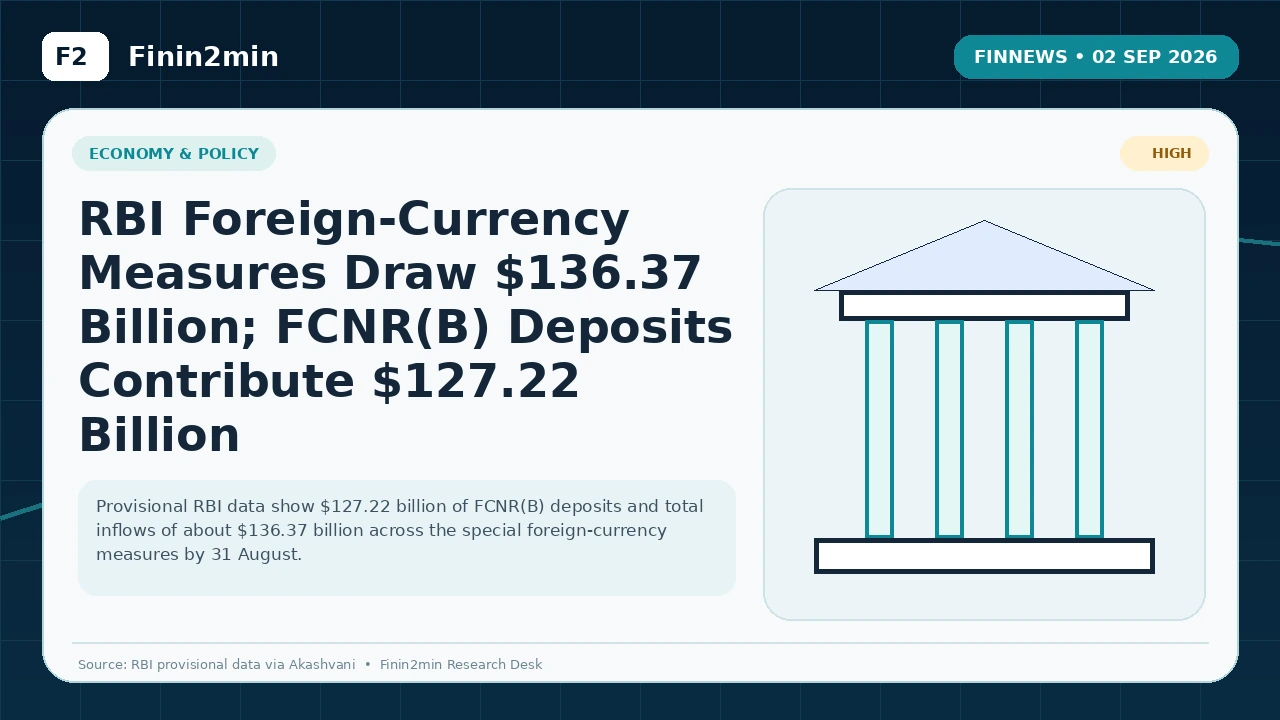
Provisional RBI data show $127.22 billion of FCNR(B) deposits and total inflows of about $136.37 billion across the special foreign-currency measures by 31 August.
What changed
Banks mobilised $127.22 billion through FCNR(B) deposits, with total inflows including OFCBs and ECBs reaching about $136.37 billion.
Why it matters
The scale materially strengthens India's near-term external funding buffer and helps the RBI manage rupee volatility, but the resulting rupee liquidity creates a second-order sterilisation challenge.
Who is affected
Banks, depositors, the RBI, bond markets, money markets, importers, exporters and external borrowers.
Action required
Track reserve accumulation, the RBI forward book, liquidity absorption through VRRR/OMO tools and how banks deploy or hedge the inflows.
Finin2min 2-minute summary
Provisional RBI data show $127.22 billion of FCNR(B) deposits and total inflows of about $136.37 billion across the special foreign-currency measures by 31 August.
**What changed:** Banks mobilised $127.22 billion through FCNR(B) deposits, with total inflows including OFCBs and ECBs reaching about $136.37 billion.
**Why it matters:** The scale materially strengthens India's near-term external funding buffer and helps the RBI manage rupee volatility, but the resulting rupee liquidity creates a second-order sterilisation challenge.
**Who is affected:** Banks, depositors, the RBI, bond markets, money markets, importers, exporters and external borrowers.
**Action required:** Track reserve accumulation, the RBI forward book, liquidity absorption through VRRR/OMO tools and how banks deploy or hedge the inflows.
What happened
Banks mobilised $127.22 billion through FCNR(B) deposits, with total inflows including OFCBs and ECBs reaching about $136.37 billion. The development is relevant because it changes the information set for investors, businesses, taxpayers or policy watchers today. Finin2min has treated the controlling source named below as the factual anchor and has kept interpretation separate from the reported or officially disclosed event.
The correct way to read this story is to distinguish the headline from the mechanism. The scale materially strengthens India's near-term external funding buffer and helps the RBI manage rupee volatility, but the resulting rupee liquidity creates a second-order sterilisation challenge. That distinction matters because markets and compliance decisions can be distorted when a target, proposal, reported plan or legal development is treated as if it were already a completed cash flow, final rule or settled long-term outcome.
Key verified facts
- Akashvani reported FCNR(B) inflows of about $127.2 billion using RBI data.
- OFCBs contributed roughly $5.26 billion and ECBs about $3.89 billion in the same provisional tally.
- The FCNR(B) swap window has closed, while facilities for some other borrowing categories remain available later in 2026.
- The inflows exceeded earlier market expectations by a wide margin.
Finin2min analysis
Policy announcements should be separated into three layers: the stated objective, the implementation mechanism and the measurable economic effect. Headline investment potential, cooperation agendas or rating signals are meaningful, but they do not equal committed cash, notified law or realised output.
The second-order effects often matter most. Foreign inflows can support the currency but create domestic liquidity; data-centre investment can accelerate AI capacity but increase power and grid requirements; trade cooperation can lower friction only when banking, customs and logistics channels actually change.
Finin2min therefore focuses on the transmission path and the next observable milestone. The most useful follow-up indicators are usually official notifications, filed documents, auction outcomes, commissioned capacity, capital flows, utilisation rates and balance-sheet data.
India and stakeholder lens
Banks, depositors, the RBI, bond markets, money markets, importers, exporters and external borrowers. should focus on the direct exposure first and the narrative second. The immediate impact can come through prices, funding cost, legal obligations, operational controls, disclosure requirements or capital allocation. The medium-term impact depends on whether the announced development persists and whether implementation produces measurable results.
For finance teams and investors, a useful discipline is to ask four questions: **What is legally or contractually binding? What is only proposed or reported? What hits cash flow or P&L, and when? What evidence would falsify the current thesis?** Those questions reduce the risk of overreacting to a headline while still recognising genuinely material changes.
Accounting, finance and risk lens
Announced amounts should not be confused with recognised income, realised cash, enterprise value or final liability. Market prices can move before accounting consequences become visible. Likewise, a regulatory or judicial event can require operational changes before it affects reported financial statements.
Where foreign exchange, interest rates or commodity prices are involved, scenario analysis is more useful than a point estimate. Where a legal or compliance issue is involved, the primary document and its effective date should control. Where an IPO or corporate action is involved, investors should reconcile the offer/filling document with the latest audited financials and cash-flow statement.
What could change the view
- A later official notification, court order, exchange filing or central-bank release that changes the operative facts.
- Material movement in oil, yields, currencies or market liquidity where macro transmission is relevant.
- A change in implementation dates, eligibility, issue structure, record date or other transaction terms.
- New audited or filed financial information that changes the economic interpretation.
- A correction by the primary source.
What to watch next
Track reserve accumulation, the RBI forward book, liquidity absorption through VRRR/OMO tools and how banks deploy or hedge the inflows.
Readers should also monitor the next primary-source milestone rather than relying only on follow-up commentary. The value of the story will increasingly depend on execution, not on repetition of the initial headline.
Finin2min Q&A
Is the headline number or announcement final?
Only to the extent the cited source makes it final. Targets, potential investment, reported plans, management guidance, proposed rules and court-report summaries have different legal and financial status. Finin2min does not treat them as interchangeable.
Does this automatically mean investors or taxpayers should act?
No. The development can be material without dictating a single action. Portfolio decisions require suitability and valuation analysis; tax and legal decisions require facts, eligibility and professional review where appropriate.
What is the most important source?
**RBI provisional data via Akashvani** — Akashvani report citing RBI provisional data, 2 Sep 2026. That source should be checked for the controlling facts before a material decision is taken.
Source and methodology
Primary/discovery source: RBI provisional data via Akashvani
Source URL: https://newsonair.gov.in/rbis-forex-swap-facility-draws-over-136-billion/
Research cut-off: 2026-09-02 22:50 IST
Finin2min separates verified event facts from analysis. Where the controlling official document could not be directly retrieved, the source tier is labelled accordingly and the article avoids upgrading secondary reporting into a primary-source claim.
Disclaimer
This material is for information and education only. It is not investment, tax, legal or financial advice. Markets, regulations and litigation can change quickly. Verify the latest official source and obtain professional advice before acting on a material decision.
Read secondary report →
FinNews is educational and professional reference material, not financial, tax or legal advice. Confirm the current official position from the primary source before acting on any figure, rate, provision or deadline mentioned here.