When Compliance Becomes a Trap: What the ₹5.5 Crore Hindustan Coca-Cola Order Actually Teaches Us
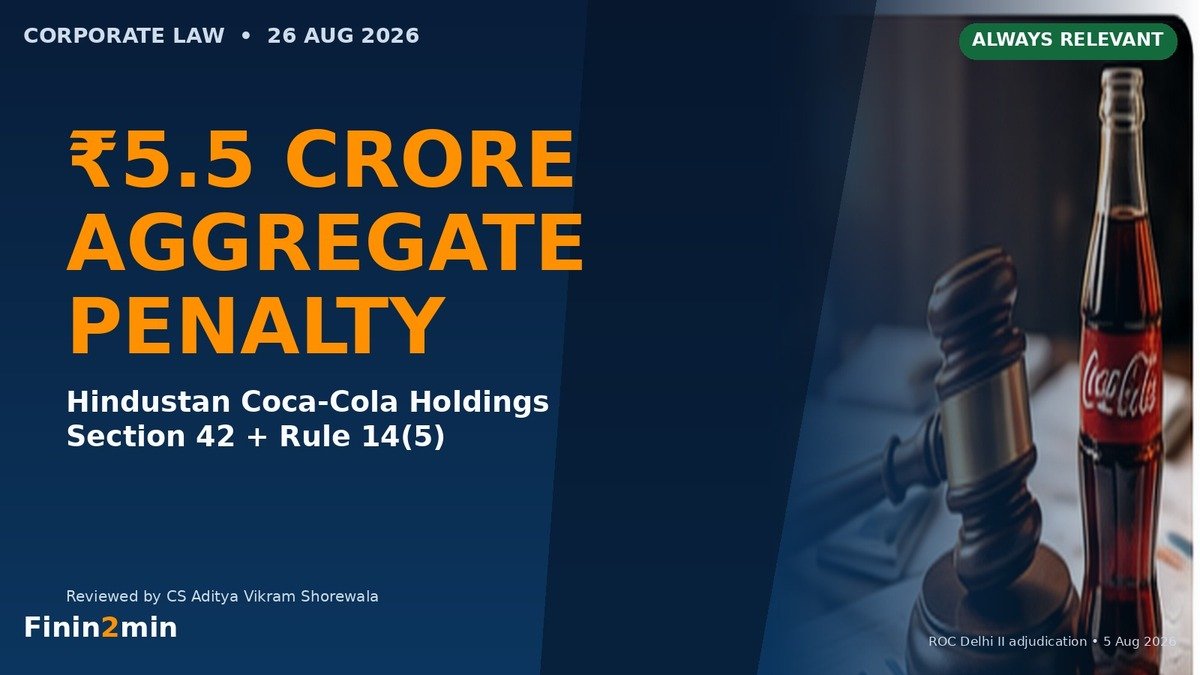
ROC Delhi II imposed ₹5.5 crore of aggregate penalties after subscription money for one allottee was remitted from another group entity’s bank account. The case shows why Rule 14(5) payment-source controls matter even in commercially genuine group transactions.
What changed
ROC Delhi II adjudicated a historical private-placement payment-route mismatch and imposed ₹5.5 crore of aggregate penalties across five penalised persons/entities.
Why it matters
Rule 14(5) requires the subscription payment trail to reconcile with the actual subscriber. A group-company remittance can therefore create statutory exposure even where the commercial transaction itself is genuine.
Who is affected
Companies raising capital through private placements or preferential allotments, promoters, directors, CFOs, Company Secretaries, CAs and transaction counsel.
Action required
Before accepting private-placement money, reconcile the subscriber legal name, remitting bank-account holder, approved amount, allotment records and preserved bank evidence; separately test Section 42, Rule 14, Section 62 and FEMA/RBI requirements where relevant.
A group-company payment route in a 2019 preferential allotment led ROC Delhi II to impose ₹5.5 crore of aggregate penalties. The case is a sharp reminder that private-placement compliance must reconcile the subscriber, remitter, bank trail and statutory record before funds are accepted.
Finin2min Summary - the case in 2 minutes
- Hindustan Coca-Cola Holdings Private Limited approved a preferential allotment on 30 March 2019. The ROC order records an aggregate issue of 1,03,27,04,999 equity shares to identified allottees.
- For 31,48,71,754 shares allotted to Bharat Coca-Cola Overseas Holdings Pte. Ltd. (BCCOH), subscription money was remitted from the bank account of another group entity, Hindustan Coca-Cola Overseas Holdings Pte. Ltd. (HCCOH).
- Rule 14(5) requires private-placement subscription payment to come from the bank account of the person subscribing, with the company retaining the bank-account record.
- ROC Delhi II treated the mismatch as a contravention of Rule 14(5) read with Section 42. After a physical hearing on 25 June 2026, the order dated 5 August 2026 imposed ₹5.5 crore in aggregate penalties across five penalised persons/entities.
- The company itself was penalised ₹1.5 crore. Two directors were penalised ₹1 crore each; two other directors had nil monetary penalty. Two promoter entities were penalised ₹1 crore each.
- The compliance lesson is narrow but important: commercial group ownership does not substitute for the subscriber-bank-account trail required by the rule.
What actually happened?
The order is best understood as a private-placement money-trail case, not as a finding that an investor or the underlying funds were fraudulent.
According to ROC Delhi II's adjudication order, the company approved a preferential allotment of 1,03,27,04,999 equity shares on 30 March 2019 to certain allottees including BCCOH and HCCOH. The order records that BCCOH did not maintain a bank account in its own name. As a result, the subscription amount relating to 31,48,71,754 shares allotted to BCCOH was remitted by HCCOH on BCCOH's behalf.
That produced the mismatch that drove the proceedings:
Subscriber / allottee
Bharat Coca-Cola Overseas Holdings Pte. Ltd. (BCCOH)
Bank account used to remit
Hindustan Coca-Cola Overseas Holdings Pte. Ltd. (HCCOH)
The company had received the consideration, but the statutory banking trail did not match the subscriber named for that allotment. The company itself later filed a suo motu adjudication application under Section 454 in relation to the procedural deviation.
The rule that mattered: Rule 14(5)
Rule 14(5) of the Companies (Prospectus and Allotment of Securities) Rules, 2014 is designed to preserve a clean identity-and-money trail in a private placement. In substance, it requires the subscription payment to be made from the bank account of the person subscribing to the securities and requires the company to keep a record of the bank account from which the subscription was received.
ROC's reasoning was therefore straightforward: the allottee was BCCOH, but the payment came from HCCOH's bank account. The fact that both entities were part of the same corporate group did not create an exception to the banking requirement recorded in Rule 14(5).
Why “Coca-Cola was fined ₹5.5 crore for using the wrong bank account” is incomplete
The viral shorthand compresses several legally relevant details. ₹5.5 crore is not the penalty imposed on Hindustan Coca-Cola Holdings alone. It is the aggregate of penalties imposed across the company, two directors and two promoter entities.
| Noticee / person | Order outcome | Penalty |
|---|---|---|
| Hindustan Coca-Cola Holdings Private Limited | Penalty imposed | ₹1.50 crore |
| Daisy Khanna | Nil monetary penalty | ₹0 |
| Sridhar Raman | Penalty imposed | ₹1.00 crore |
| Lagan Shastri | Nil monetary penalty | ₹0 |
| Sonali Khanna | Penalty imposed | ₹1.00 crore |
| BCCOH - promoter entity | Penalty imposed | ₹1.00 crore |
| HCCOH - promoter entity | Penalty imposed | ₹1.00 crore |
| Aggregate monetary penalties | ₹5.50 crore | |
The order also directs the notified officers/noticees to rectify the default and pay applicable penalties within 90 days of receipt. Penalties imposed on officers in default are directed to be paid from their personal sources/income.
A technical point worth getting right: Section 42(10) says “whichever is lower”
Section 42(10), in the post-2017-amendment framework applicable to the 2019 event, states that where a company makes an offer or accepts monies in contravention of Section 42, the company, its promoters and directors may be liable to a penalty extending to the amount raised through the private placement or ₹2 crore, whichever is lower, together with the statutory refund consequence described in that subsection.
This also explains why the ₹5.5 crore headline should not be converted into a general rule that every third-party remittance automatically produces a ₹5.5 crore liability. The order adjudicated liability across multiple noticees on its facts. Future cases may differ in parties, facts, statutory version, mitigation and adjudication outcome.
What the order does - and does not - establish
What it does establish
ROC Delhi II treated receipt from an entity other than the subscriber as a Rule 14(5) / Section 42 compliance breach on these facts and imposed monetary penalties on the company, two directors and two promoter entities.
What it does not establish
It is not a court precedent declaring that every group-company remittance, every third-party securities payment or every bank-account mismatch will attract the same aggregate penalty.
Equally important, the order as reproduced does not record a finding that the investor was fictitious, that the funds were proceeds of fraud, or that money was diverted. The safest description is that the adjudication concerned a statutory payment-route mismatch in a private-placement transaction.
Why this matters beyond one Coca-Cola group transaction
Private placements often involve sophisticated groups, treasury centres, holding companies, cross-border investors and compressed deal timelines. That is exactly why a basic legal-control failure can be expensive: commercial teams may think in terms of group economics, while the Companies Act process is built around the identity of the specific subscriber and the evidence attached to that subscriber.
A parent, affiliate or treasury entity may be economically connected to the subscriber. But where the rule calls for payment from the subscriber's own bank account, group relationship alone does not replace the required payment trail.
The broader governance lesson is not that regulation should ignore genuine commercial transactions. It is that transaction design has to build the legal mechanics in before closing. A compliance defect discovered years later is harder to cure, more expensive to explain and more likely to create director-level exposure.
The CA / CS control: reconcile five things before accepting money
For a private placement or preferential issue routed through Section 42, finance and secretarial teams should treat the subscriber-bank reconciliation as a pre-receipt control rather than a post-closing file check.
- Subscriber identity: exact legal name in the approval, PAS-4 / application and allotment records.
- Remitter identity: bank account holder must reconcile with the subscribing person where Rule 14(5) applies.
- Amount trail: application money received should reconcile to the securities, price and allotment approved.
- Bank evidence: preserve bank statement, remittance advice, FIRC / cross-border evidence where relevant.
- Board and member approvals: verify the applicable Section 42 / Section 62 and Rule 14 approval trail before receipt and allotment.
- PAS filings: maintain the private-placement record and complete the current return-of-allotment requirements on time.
- Separate account controls: separately test Section 42's requirements on where application money is held and how it may be used.
- Cross-border overlay: for non-resident subscribers, separately reconcile FEMA / RBI reporting and pricing requirements; Companies Act compliance does not replace FEMA compliance.
What if the subscriber does not maintain its own bank account?
That is a deal-structuring issue to resolve before remittance, not a reason to assume that another group entity can simply pay on the subscriber's behalf. If the intended subscriber cannot satisfy the payment mechanics, the company should pause the receipt, obtain transaction-specific legal/company-secretarial advice and examine whether the structure, subscriber or route needs to change under the law applicable on that date.
Trying to “regularise” the issue after allotment is inherently weaker than designing a compliant payment route at the outset.
Proportionate enforcement: the policy question behind the headline
The case also raises a legitimate policy discussion. Strong private-placement controls serve a real purpose: they protect the identity trail, deter undisclosed funding routes and support regulatory transparency. At the same time, business confidence also depends on predictable consequences, clear remediation paths and an adjudication process that distinguishes the seriousness of different kinds of breach.
Those ideas are not opposites. Ease of doing business does not mean reducing statutory discipline; it means making compliance understandable, administrable and proportionate while keeping the audit trail strong.
For Corporate India, however, the practical takeaway is immediate: until the law says otherwise, a transaction's commercial genuineness is not a substitute for satisfying the process prescribed for accepting private-placement money.
Finin2min conclusion
The ₹5.5 crore number is attention-grabbing, but it is not the most useful lesson from the Hindustan Coca-Cola Holdings order.
The useful lesson is that private-placement compliance is an identity chain: identified subscriber → subscriber's bank account → traceable payment → compliant allotment record. If one link does not match, a transaction that is commercially understandable can still become a statutory problem.
For CFOs, CAs, Company Secretaries and Boards, the best response is not more paperwork for its own sake. It is one hard pre-closing control: do not accept the money until the subscriber, remitter, approvals, amount and evidence all tell the same story.
FAQs
Why did ROC Delhi II impose penalties in this case?
Because the order records that money for securities allotted to BCCOH was remitted from HCCOH's bank account. ROC treated that as contrary to Rule 14(5), which requires payment from the bank account of the person subscribing to the securities.
Was Hindustan Coca-Cola Holdings alone fined ₹5.5 crore?
No. The company was penalised ₹1.5 crore. The balance came from ₹1 crore each imposed on two directors and two promoter entities. Two other directors had nil monetary penalty.
Does the order mean every third-party payment attracts ₹5.5 crore?
No. The amount is the aggregate result of this adjudication across multiple noticees. Section 42(10), the facts, the number of liable persons, the applicable statutory version and the adjudicating authority's reasoning must be examined in each case.
Is this a final judicial precedent?
No. It is an ROC adjudication order under Section 454. The order states that an appeal may be filed before the Regional Director, Delhi within 60 days of receipt.
Can a parent or group company pay for another group entity's private-placement subscription?
Where Rule 14(5) applies, the rule requires payment from the bank account of the person subscribing. A group relationship should not be assumed to create an exception. Transaction-specific advice should be taken before funds move.
Primary law and source trail
✓ Source status: statutory framework cross-checked; ROC order facts validated against the publicly accessible order reproduction. For professional reliance, verify the certified / MCA e-Adjudication record.
Related Finin2min resources
View official source →
FinNews is educational and professional reference material, not financial, tax or legal advice. Confirm the current official position from the primary source before acting on any figure, rate, provision or deadline mentioned here.