UPI Charges from 15 October 2026: 0.4% MDR, GST Impact, Exemptions & Practical Examples
UPI is not becoming chargeable for ordinary users. The new framework introduces a merchant-side Merchant Discount Rate (MDR) only for select person-to-merchant payments above ₹2,000, while preserving zero charges for P2P transfers, small-value payments and protected small merchants. Here is the one-stop guide to exactly who pays, how much, when GST applies and how businesses should account for it.
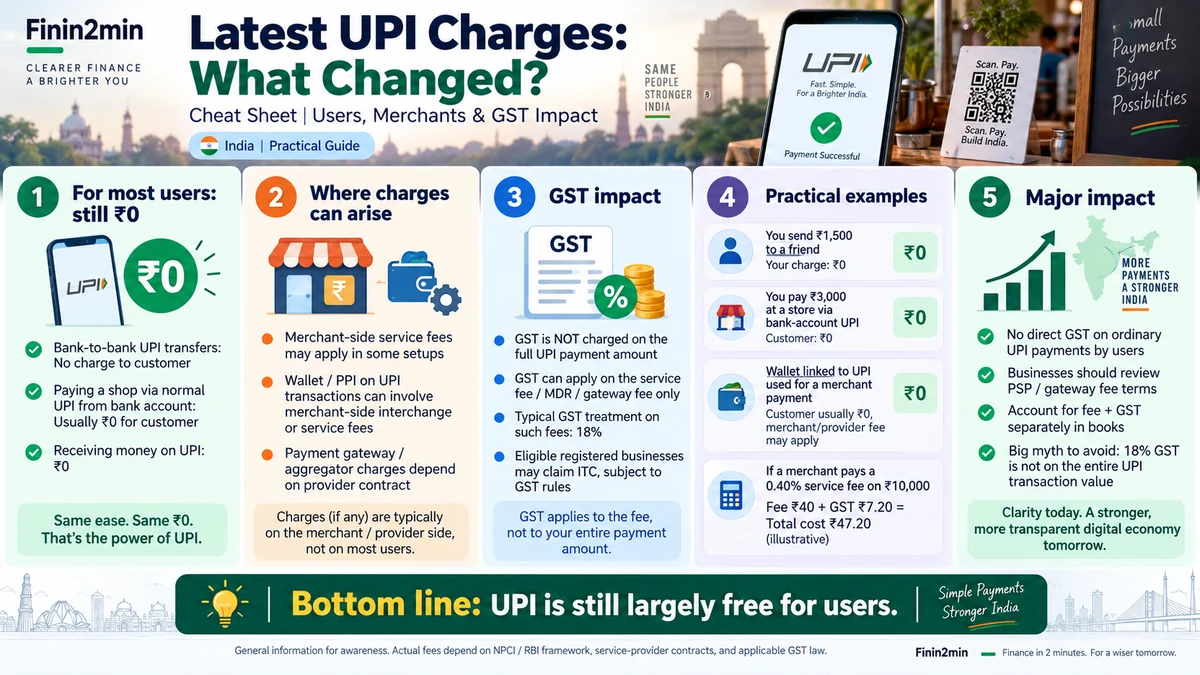
- Sending money to friends/family/self via UPI: ₹0 MDR, irrespective of amount, subject to normal transaction limits.
- Customer paying any merchant: the customer should not be charged MDR or a UPI platform fee.
- Normal P2M merchant payment up to ₹2,000: zero MDR.
- Normal P2M merchant payment above ₹2,000: merchant-side MDR of 0.4%.
- ₹75,000 and above: MDR is capped at ₹300 per transaction.
- Protected small/P2PM merchants: zero MDR even if an individual payment exceeds ₹2,000, provided the merchant remains correctly classified in the exempt P2PM tier.
- Essential/thin-margin categories: specified categories such as railways, telecom, insurance, fuel, agricultural inputs and certain public utilities get a concessional flat MDR, generally ₹5 for qualifying transactions above ₹2,000.
- Capital-market payments: 0.02% MDR, capped at ₹300.
- UPI AutoPay/mandates: the official FAQ says prescribed MDR under this framework does not apply to automated recurring standing instructions.
- GST: 18% applies to the MDR/payment-processing service fee under the position stated as of 19 September 2026. It is not 18% on your ₹5,000 or ₹50,000 UPI payment.
- ITC: an eligible GST-registered merchant may claim input tax credit on GST charged on MDR, subject to normal GST conditions. Unregistered persons, composition taxpayers and businesses with restricted/exempt-credit situations may bear the GST as a real cost.
1. What exactly changed in UPI charges?
India's zero-MDR regime for notified UPI payments had, for years, meant that ordinary bank-account-to-bank-account UPI payments did not carry a merchant discount rate. In 2026, the legal framework was changed to allow a more targeted charging model while keeping users and a large share of small-merchant payments protected.
The Ministry of Finance first clarified in August 2026 that the amendment to section 10A of the Payment and Settlement Systems Act, 2007 was an enabling framework rather than a blanket charge on users. On 15 September 2026, the final merchant-side MDR structure was announced, with implementation from 15 October 2026.
The official position is simple: the new charge is not a tax collected by the Government or NPCI. MDR is a commercial payment-acceptance charge distributed within the payment ecosystem, including banks and payment-service/application providers, to support infrastructure, cyber-security, resilience and customer service.
| Transaction type | MDR from 15 Oct 2026 | Who bears it? | Customer charged? |
|---|---|---|---|
| P2P: person to person | ₹0 | Nobody | No |
| Self-transfer between own UPI-linked accounts | ₹0 | Nobody | No |
| Normal P2M up to ₹2,000 | ₹0 | Nobody | No |
| Normal P2M above ₹2,000 but below ₹75,000 | 0.40% | Merchant/payment ecosystem | No |
| Normal P2M ₹75,000 or more | ₹300 cap | Merchant/payment ecosystem | No |
| P2PM protected small merchant | ₹0 while eligible | Nobody | No |
| Specified essential/thin-margin category above ₹2,000 | Generally flat ₹5 where specified | Merchant/payment ecosystem | No |
| Capital-market payment | 0.02%, capped ₹300 | Merchant/payment ecosystem | No |
| UPI AutoPay / recurring mandate | No prescribed MDR under the official FAQ | — | No |
| RuPay credit card / credit line on UPI | Separate credit-product rules | As per applicable credit framework | Not governed by this new direct-account MDR table |
2. Who pays the new UPI MDR?
The economic charge sits inside the merchant payment ecosystem. A consumer scanning a merchant QR and paying ₹5,000 from a bank account should still see the same ₹5,000 debit—not ₹5,020, not ₹5,023.60 and not ₹5,000 plus “18% GST on UPI”.
If yes, MDR is ₹0. Friends, family, personal contacts and self-transfers remain free.
If yes, zero MDR continues while the merchant remains within the exempt classification.
If yes, MDR is ₹0 even for a large merchant.
Use the applicable special flat/capped MDR rather than blindly applying 0.4%.
Apply 0.4%; at ₹75,000 and above the MDR is capped at ₹300.
Apply 18% to the MDR/service fee under the currently stated position, then assess ITC eligibility.
What about the customer?
The official DFS/NPCI FAQ says UPI app providers must not levy a platform fee or other charge for UPI payments under this framework, and enterprise merchants cannot pass MDR to buyers while accepting UPI. The consumer should pay the posted price.
What about UPI limits?
Do not confuse transaction limits with fee thresholds. Bank/NPCI daily or category-specific limits are risk-management controls. They do not mean a user becomes chargeable after a particular number or value of UPI transactions.
3. Small merchants: the P2PM protection is more important than the ₹2,000 number
The official FAQ recognises a Person-to-Person-Merchant (P2PM) category for small vendors. A small merchant receiving up to ₹1 lakh per month through UPI QR into the qualifying account can remain on mandatory zero MDR.
This means a protected street vendor or small shop does not automatically become chargeable merely because one customer pays ₹3,500. MDR applicability depends on the merchant-account classification.
According to the official FAQ, acquiring banks/payment service providers monitor inward UPI credits. Merchants with inward UPI receipts above ₹1 lakh per month for three consecutive months are formally transitioned from the protected P2PM classification into P2M.
GST registration is not a condition for getting the P2PM zero-MDR protection. The zero-MDR classification is based on the merchant/payment-account parameters, not on whether the shop has a GSTIN.
4. Special UPI MDR categories
Essential and thin-margin sectors
The official framework provides a flat MDR for specified categories above ₹2,000. The Finance Ministry specifically identifies sectors including railways, telecommunications, insurance, fuel and agricultural inputs. The NPCI/DFS FAQ also describes specified public utility categories such as electricity, municipal water and piped natural gas as receiving a flat concessional charge.
| Category | Stated MDR treatment | Example above ₹2,000 | GST on fee at 18% |
|---|---|---|---|
| Railways | Flat ₹5 where covered by special category | ₹5 | ₹0.90 |
| Telecom | Flat ₹5 where covered | ₹5 | ₹0.90 |
| Insurance | Flat ₹5 above ₹2,000 | ₹5 | ₹0.90 |
| Fuel | Flat ₹5 above ₹2,000 | ₹5 | ₹0.90 |
| Agricultural inputs | Flat ₹5 where covered | ₹5 | ₹0.90 |
| Public utilities described in FAQ | Flat ₹5 above ₹2,000 | ₹5 | ₹0.90 |
| Education | FAQ places education in designated industry-program treatment with flat-fee/capped structures | Check merchant/acquirer category mapping | Depends on actual fee charged |
Capital markets
Payments relating to mutual funds, securities, stockbrokers and dealers fall under a separate MDR tier of 0.02% of transaction value, capped at ₹300. The official FAQ covers UPI fund transfers for equity, debt-market investments, mutual fund purchases and broker wallet top-ups.
UPI AutoPay and recurring mandates
The official FAQ says automated recurring standing instructions—UPI mandates/AutoPay—do not carry the prescribed MDR transaction charge under this framework. That distinction matters for recurring utility bills, OTT subscriptions and recurring investments. A one-time capital-market payment can be under the 0.02% tier while a recurring investment executed through an eligible UPI AutoPay mandate is treated separately.
RuPay credit card on UPI and credit lines
These are not governed by the new direct bank-account-to-merchant 0.4% MDR rule. Credit-linked UPI transactions operate under separate credit-product rules. Businesses should therefore not assume the 0.4% rate overrides existing card/credit-line economics.
Wallet/PPI on UPI
Do not confuse this 2026 merchant-MDR framework with the separate PPI/wallet-on-UPI ecosystem. NPCI's UPI FAQs continue to state that the customer/PPI holder is not charged for UPI transactions, but merchant/provider-side economics for PPI transactions can follow separate arrangements.
5. GST on UPI MDR: what exactly is taxed?
The biggest source of confusion is the phrase “18% GST on UPI”. That wording is misleading.
Correct: GST applies to the payment-processing/MDR service fee. If MDR is ₹40, 18% GST on that fee is ₹7.20.
For uncapped 0.4% transactions, gross fee before ITC = transaction value × 0.004 × 1.18 = 0.472% of transaction value.
Does the merchant get input tax credit?
For a regular GST-registered merchant, the GST charged on the MDR/payment-processing service can generally be eligible for input tax credit where the service is used in the course or furtherance of business and the ordinary section 16 conditions are met, including possession of a valid tax invoice/document and other statutory requirements.
That means GST may be a cash-flow item rather than a permanent P&L cost for an eligible regular taxpayer. The base MDR itself remains a business expense.
Who may not get full ITC?
- Unregistered merchant: no GST credit mechanism is available; GST on MDR becomes part of the cost.
- Composition taxpayer: composition taxpayers are outside the regular ITC chain and cannot ordinarily claim ITC on inward supplies.
- Business making exempt supplies: credit attributable to exempt supplies can be restricted/reversed under GST rules, so GST on MDR may become a cost wholly or partly.
- Mixed taxable and exempt business: common-input-service credit may need apportionment under section 17/rules.
- Missing/defective invoice or other section 16 failure: ITC can be denied even though GST has been charged.
Does GST apply to the customer's original purchase too?
The customer's purchase continues to attract whatever GST applies to the underlying goods or services under normal GST law. The MDR is a separate payment-processing service supplied within the payment ecosystem. Therefore, two different tax layers can exist:
- GST, if any, on the goods/services sold to the customer; and
- 18% GST on the MDR/payment-processing fee charged to the merchant.
The second layer does not mean the entire UPI settlement value is taxed again at 18%.
6. Practical examples: exact MDR + GST impact
The examples below assume the currently stated 18% GST treatment on MDR. Figures may be rounded by the bank/PSP according to invoice/settlement systems.
| # | Scenario | MDR | GST on MDR | Total merchant-side processing cost | Customer pays extra? |
|---|---|---|---|---|---|
| 1 | You send ₹50,000 to your brother | ₹0 | ₹0 | ₹0 | No |
| 2 | You transfer money between your own UPI-linked bank accounts | ₹0 | ₹0 | ₹0 | No |
| 3 | Large retailer receives ₹1,999 through bank-account UPI | ₹0 | ₹0 | ₹0 | No |
| 4 | Large retailer receives exactly ₹2,000 | ₹0 | ₹0 | ₹0 | No |
| 5 | Normal P2M payment of ₹2,001 | ₹8.004 ≈ ₹8.00 | ₹1.44072 ≈ ₹1.44 | ≈ ₹9.44 | No |
| 6 | Normal P2M payment of ₹3,000 | ₹12.00 | ₹2.16 | ₹14.16 | No |
| 7 | Normal P2M payment of ₹10,000 | ₹40.00 | ₹7.20 | ₹47.20 | No |
| 8 | Normal P2M payment of ₹50,000 | ₹200.00 | ₹36.00 | ₹236.00 | No |
| 9 | Normal P2M payment of ₹74,999 | ₹299.996 ≈ ₹300 | ≈ ₹54 | ≈ ₹354 | No |
| 10 | Normal P2M payment of ₹75,000 | ₹300 cap | ₹54 | ₹354 | No |
| 11 | Normal P2M payment of ₹1,00,000 | ₹300 cap | ₹54 | ₹354 | No |
| 12 | P2PM small merchant receives one ₹5,000 QR payment while still eligible | ₹0 | ₹0 | ₹0 | No |
| 13 | P2PM merchant crosses ₹1 lakh inward UPI receipts for one month only | Depends on account classification; FAQ says transition is monitored over 3 consecutive months above threshold | As applicable | Check PSP classification | No separate MDR to buyer |
| 14 | Merchant receives >₹1 lakh/month via UPI for 3 consecutive months and is transitioned to P2M | 0.4% on normal P2M transactions above ₹2,000 thereafter | 18% on fee | Varies | No |
| 15 | Fuel purchase ₹5,000 | ₹5 flat | ₹0.90 | ₹5.90 | No |
| 16 | Insurance premium ₹50,000 paid by UPI | ₹5 flat | ₹0.90 | ₹5.90 | No |
| 17 | Public utility bill ₹3,000 in covered category | ₹5 flat | ₹0.90 | ₹5.90 | No |
| 18 | One-time mutual fund / capital-market UPI payment ₹50,000 | 0.02% = ₹10 | ₹1.80 | ₹11.80 | No |
| 19 | Capital-market UPI payment ₹1,00,000 | 0.02% = ₹20 | ₹3.60 | ₹23.60 | No |
| 20 | Monthly ₹5,000 mutual fund SIP through qualifying UPI AutoPay mandate | No prescribed MDR under FAQ | ₹0 on prescribed MDR | ₹0 under this MDR framework | No |
| 21 | Regular GST-registered retailer receives ₹10,000 normal P2M payment | ₹40 | ₹7.20 | Cash debit ₹47.20; eligible ITC may reduce net GST cost | No |
| 22 | Unregistered retailer receives same ₹10,000 payment and is not in protected P2PM tier | ₹40 | ₹7.20 | ₹47.20 economic cost | No |
| 23 | Composition taxpayer receives same qualifying ₹10,000 payment | ₹40 | ₹7.20 | ₹47.20; ITC ordinarily unavailable under composition | No |
| 24 | Merchant dealing wholly in exempt supplies | As per merchant category | 18% on MDR | GST credit may be restricted; tax can become cost | No |
| 25 | Customer pays via RuPay credit card linked to UPI | Separate credit-product rules | As per applicable fee structure | Not calculated under the new direct-account 0.4% rule | Check credit-product terms |
Why ₹2,001 can be operationally awkward
The framework creates a hard MDR threshold for normal P2M transactions. A ₹2,000 transaction has zero MDR, while ₹2,001 produces roughly ₹8.00 MDR plus ₹1.44 GST. That is an operational cliff, but it does not authorise the merchant to add that amount to the customer's bill.
Should a merchant split one ₹4,000 sale into two ₹2,000 UPI payments?
Finin2min would not recommend structuring transactions solely to avoid MDR. The official material explains the threshold on a per-transaction basis but does not create a safe harbour for artificial splitting. Merchant-acquirer contracts, monitoring controls and future operational clarifications may address circumvention. Record the commercial sale correctly and follow the acquiring bank/PSP's implementation rules.
7. How should businesses account for MDR and GST?
The accounting should preserve the gross sale value. Do not book only the amount that lands in the bank after fee deduction.
Example: ₹10,000 customer payment; ₹40 MDR; ₹7.20 GST
Assume the underlying sale is ₹10,000 for simplicity and the acquirer settles net of MDR plus GST.
Illustrative books for an eligible regular GST taxpayer:
Bank A/c Dr.                          9,952.80
Payment Processing / MDR Expense Dr.      40.00
Input GST on MDR Dr.                       7.20
      To Customer / Sales Receivable A/c          10,000.00
The input GST ledger is subject to the usual legal requirements for ITC. For an unregistered or ineligible merchant, the GST component would generally be absorbed into payment-processing expense rather than carried as recoverable ITC.
Merchant reconciliation checklist
- Reconcile gross UPI receipts, not merely bank credits.
- Identify P2M, P2PM, special-category and capital-market transactions separately.
- Capture the acquiring bank/payment provider's GST invoice or statement showing MDR and GST.
- Check whether GSTIN is correctly mapped with the acquirer/PSP so the invoice supports ITC.
- For exempt/mixed supplies, evaluate section 17 apportionment/reversal.
- For composition taxpayers, do not book GST on MDR as recoverable ITC.
- Map net settlements to gross sales so turnover is not understated in books/GST returns/income-tax records.
- Build an exception report for unexpected customer-side surcharges or misclassified merchant category codes.
8. What is the real business impact?
No MDR should be charged to the customer, and P2P remains free.
0.4% on qualifying transactions above ₹2,000, capped at ₹300, plus GST on the fee.
Eligible ITC can neutralise the GST component, but not the base MDR.
If they fall outside protected P2PM and incur MDR, there is no ITC mechanism.
Specified categories receive flat/capped rates rather than standard 0.4%.
MDR is intended to fund payment infrastructure, security, resilience and service.
At 0.4%, a retailer with ₹20 lakh of qualifying high-ticket normal P2M receipts in a month could face up to ₹8,000 base MDR before transaction caps and category concessions. GST at 18% would be ₹1,440 on that MDR if the full amount were billed at the headline rate. For an eligible regular GST taxpayer, the ₹1,440 may be available as ITC, leaving ₹8,000 as the core processing cost. Actual results depend heavily on transaction mix, ₹75,000 caps, P2PM status and special categories.
9. Seven myths to avoid
No. P2P remains free; protected P2PM merchants remain zero-MDR; special categories have different rates; AutoPay has separate treatment.
No. MDR is merchant-side under the framework, and the official FAQ says it cannot be passed to the buyer as a separate charge.
No. The stated GST impact is 18% on MDR/payment-processing service fee.
No. ₹2,000 is the normal P2M MDR threshold, not the UPI transfer ceiling.
Not necessarily. The official FAQ says protected P2PM status depends on merchant classification; one larger payment does not itself impose MDR on an eligible P2PM merchant.
No. ITC is subject to statutory conditions and can be restricted for exempt/mixed supplies or other ineligible situations.
The official FAQ expressly restricts UPI app providers from charging a platform fee for payments covered by this framework.
10. UPI charges 2026 — frequently asked questions
Will I pay a UPI charge if I send ₹10,000 to a friend?
No. P2P UPI transfers remain free irrespective of amount, subject to normal bank/NPCI transaction limits.
Will I pay a UPI fee when I buy a ₹10,000 phone?
No separate MDR should be charged to you. For a normal P2M transaction, the merchant may incur ₹40 MDR plus applicable GST on the fee.
Is the 0.4% charge a government tax?
No. The Finance Ministry says MDR is not a tax or charge collected by the Government or NPCI; it is distributed within the payment ecosystem.
Does 18% GST apply on a ₹10,000 UPI payment?
No. Under the current stated position, 18% applies to MDR/service fee. If MDR is ₹40, GST is ₹7.20.
What happens at ₹75,000?
For a normal P2M transaction, 0.4% of ₹75,000 is ₹300. At ₹75,000 and above, ₹300 is the MDR cap per transaction.
Is a street vendor charged if I pay ₹3,000?
If the vendor remains properly classified as a protected P2PM small merchant, the official FAQ says zero MDR continues even for an individual payment above ₹2,000.
How is a P2PM merchant identified?
The official FAQ describes small merchants receiving up to ₹1 lakh per month through UPI QR and says acquiring banks/PSPs monitor the threshold. More than ₹1 lakh of inward UPI credits for three consecutive months triggers transition to P2M.
Does a small merchant need GST registration to get zero MDR?
No. P2PM MDR protection is not conditional on GST registration.
Can a GST-registered merchant claim GST charged on MDR?
Generally yes where the inward payment-processing service is used for business and all normal ITC conditions are met. Credit can be restricted in specific cases.
Can a composition dealer claim ITC on GST charged on MDR?
Ordinarily no. A composition taxpayer is outside the normal ITC chain, so GST on the processing charge can become a cost.
What is the MDR on fuel or insurance payments above ₹2,000?
The official framework provides a flat ₹5 MDR for specified categories including fuel and insurance. At 18% GST, the tax on the ₹5 fee is ₹0.90.
What is the UPI MDR for mutual funds and stockbrokers?
Capital-market transactions are placed in a 0.02% MDR tier, capped at ₹300 per transaction.
Will my mutual fund SIP through UPI AutoPay attract MDR?
The official FAQ states that automated recurring standing instructions/UPI AutoPay do not carry the prescribed MDR under this framework.
Does the new 0.4% rate apply to RuPay credit cards linked to UPI?
No. Credit-linked UPI follows separate credit-product rules; the new 0.4% framework discussed here applies to direct user-bank-account-to-merchant-account UPI transactions.
Can the merchant add “UPI fee” to my bill?
The official FAQ says enterprise merchants cannot pass MDR charges to buyers while accepting UPI. Consumers should pay the posted price.
Could the GST treatment change before 15 October?
It could be revisited if the GST Council recommends relief and a legal notification follows. As of 19 September 2026, the stated position is 18% GST on MDR with ITC available to eligible registered merchants.
11. Finin2min practical checklist before 15 October 2026
- Consumers: do not accept claims that “18% GST is now charged on UPI amount”.
- Merchants: confirm your P2M/P2PM and Merchant Category Code classification with your acquirer.
- Finance teams: update settlement reconciliation to capture gross receipt, MDR, GST and net bank credit separately.
- GST teams: ensure GSTIN is correctly recorded with the bank/PSP and that a compliant invoice/statement is available for ITC.
- Tax-exempt / mixed-supply businesses: model section 17 credit reversals before assuming GST on MDR is fully recoverable.
- Composition taxpayers: budget MDR plus GST as cost where applicable.
- Retail chains/e-commerce: configure the ₹2,000 threshold, ₹75,000 cap and special category rates correctly.
- Special-category merchants: validate exact category mapping instead of allowing the system to default to 0.4%.
- All businesses: review the final GST position again after any GST Council meeting/notification before go-live.
Primary and supporting sources
- Department of Financial Services, Ministry of Finance — Official FAQs dated 15 September 2026: Merchant Discount Rate (MDR) on Select UPI (P2M) Transactions.
- Press Information Bureau, Ministry of Finance — 15 September 2026: UPI Continues to Remain Free for Peer to Peer Transactions and 96% of Merchant Transactions.
- Press Information Bureau, Ministry of Finance — 8 August 2026: No Charges for UPI Users.
- NPCI — UPI FAQs: UPI customer, merchant and PPI FAQs.
- CBIC — Input Tax Credit rules/guidance: Input Tax Credit.
- GST-on-MDR position reported from a senior Finance Ministry official, 18 September 2026: Indian Express report. This is relevant because a specific GST Council relief notification had not been identified as of the article's review date.
Disclaimer: This Finin2min explainer is for general educational and informational purposes and reflects the official UPI MDR framework and stated GST position available up to 19 September 2026. Actual merchant classification, MDR billing, GST invoice treatment and ITC eligibility can depend on the acquiring bank/payment service provider, merchant category, GST registration status, nature of outward supplies and subsequent notifications. Businesses should verify their implementation with their bank/PSP and tax adviser before relying on a particular accounting or GST treatment.