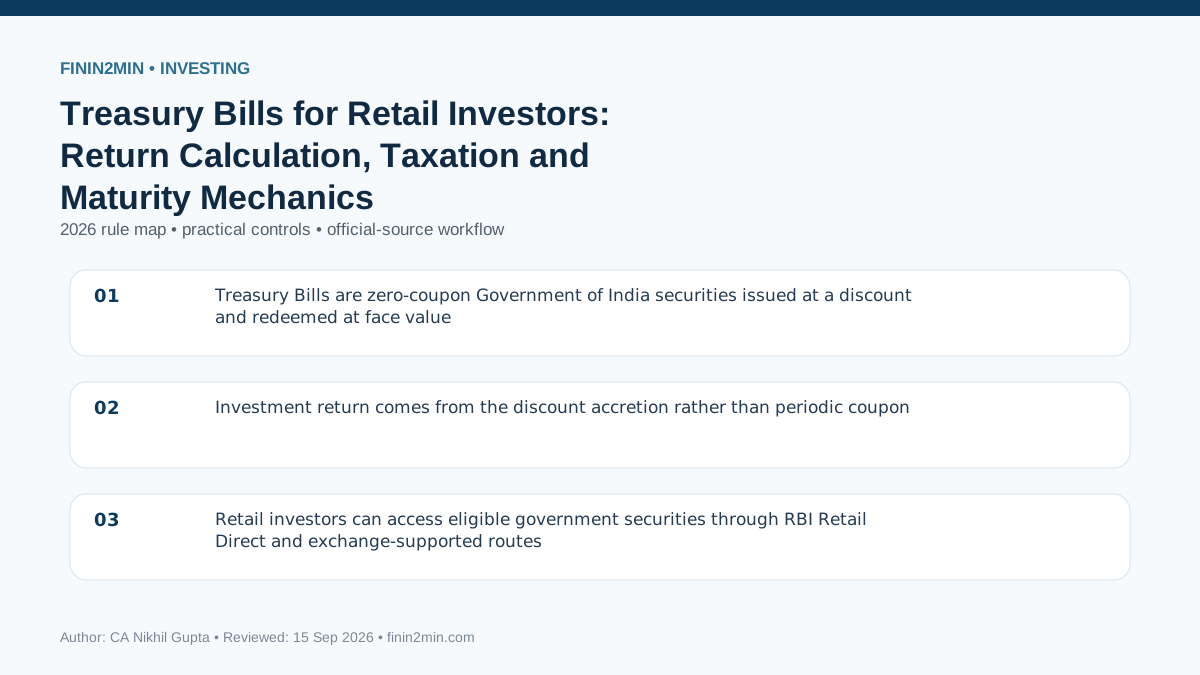
Treasury Bills are short-term Government of India securities commonly issued for 91, 182 or 364 days. They do not pay a periodic coupon; the investor buys below face value and receives face value at maturity.
Current rule and what decides the result
Treasury Bills are zero-coupon Government of India securities generally issued for 91, 182 or 364 days. They are bought at a discount and redeemed at face value, so the investor's rupee return is the maturity amount minus purchase price rather than a coupon payment. RBI Retail Direct allows eligible retail investors to participate in the non-competitive primary-market segment, with a ₹10,000 minimum and prescribed multiples. An investor who sells before maturity is exposed to market-price/yield movement; Government credit does not mean a guaranteed secondary-market sale price.
Key rules to apply
- RBI Retail Direct allows eligible retail investors to participate in the non-competitive segment with a minimum investment of ₹10,000, but the price/yield is market-determined and a pre-maturity sale can produce a gain or loss.
- Regular Treasury Bills are issued in short maturities such as 91, 182 and 364 days; auction schedules and notified amounts vary.
- Return comes from the discount between purchase price and face value, not from a semi-annual coupon.
- RBI’s Retail Direct FAQ specifies a ₹10,000 minimum for primary-market G-Sec/T-bill participation, with further investment in the applicable multiples.
- Retail investors can bid without specifying a competitive yield and receive allotment at the auction’s weighted outcome, subject to the scheme.
- At maturity, the face value is credited through the account/settlement mechanism; there is no coupon-reinvestment step.
364-day T-bill held to maturity
A retail investor receives ₹1,00,000 face value at maturity after paying ₹93,500 in the auction. The rupee return is ₹6,500. A simple holding-period return is 6.95% (₹6,500 ÷ ₹93,500), while annualised yield conventions used in the market can differ. Tax reporting should follow the investor’s tax character and current capital/business-income rules rather than treating the ₹6,500 as a tax-free coupon.
Sale before maturity
An investor buys ₹5 lakh face value of a 182-day T-bill for ₹4.82 lakh but needs cash after 60 days. If market yields have risen, a buyer may offer only ₹4.80 lakh. Selling produces a ₹2,000 economic loss even though the Government will pay face value at final maturity. Holding to maturity and selling early are therefore different return paths.
How to apply it step by step
- Choose the tenor—91, 182 or 364 days—based on the cash-flow date.
- Use Retail Direct/non-competitive bidding and check the notified auction calendar.
- Place bids in the permitted minimum/multiple and maintain settlement funds.
- Record face value, allotted price and settlement date.
- If holding to maturity, calculate rupee discount return from cost to face value.
- If considering early sale, check current secondary-market yield/price and liquidity.
- Classify tax treatment based on whether the T-bill is held as capital asset or trading stock in the taxpayer’s circumstances.
- Reconcile maturity/sale proceeds with Retail Direct/bank and return records.
Common mistakes and edge cases
- Calling the discount a periodic coupon.
- Using face value as purchase cost.
- Assuming sovereign credit eliminates interim market-price risk.
- Comparing quoted yield with an FD rate without matching yield convention and tax.
- Ignoring settlement/cash requirements for auction bids.
FAQs
Do T-bills pay interest coupons?
No. Return comes from buying below face value and receiving/selling at a higher amount.
What are common maturities?
Government of India T-bills are commonly issued for 91, 182 and 364 days.
What is the Retail Direct minimum?
RBI Retail Direct materials specify ₹10,000 for primary-market participation, with applicable multiples.
Can I sell before maturity?
Yes if there is a market, but the sale price can be above or below cost.
Are T-bill returns tax-free?
No automatic tax exemption should be assumed; apply the taxpayer’s current income/capital classification.
Why can a Government security lose money before maturity?
Its market price moves inversely with yields and can also reflect liquidity/remaining maturity.
Related Finin2min guides
- Treasury Bills vs Dated Government Securities: Maturity, Return and Price Risk
- Government Securities and Treasury Bills: Tax Risk Controls for Active Investors and HNIs
- Stock Pledging by Promoters: What Retail Investors Should Check | Finin2min Investor Protection
- Promoter Pledging: Investor Checklist
- SME IPO Due Diligence Checklist
- SME IPO Due Diligence
- Buyback Tender Offer: What Retail Investors Should Understand | Finin2min Investor Protection
- Buyback Tender Offers Explained