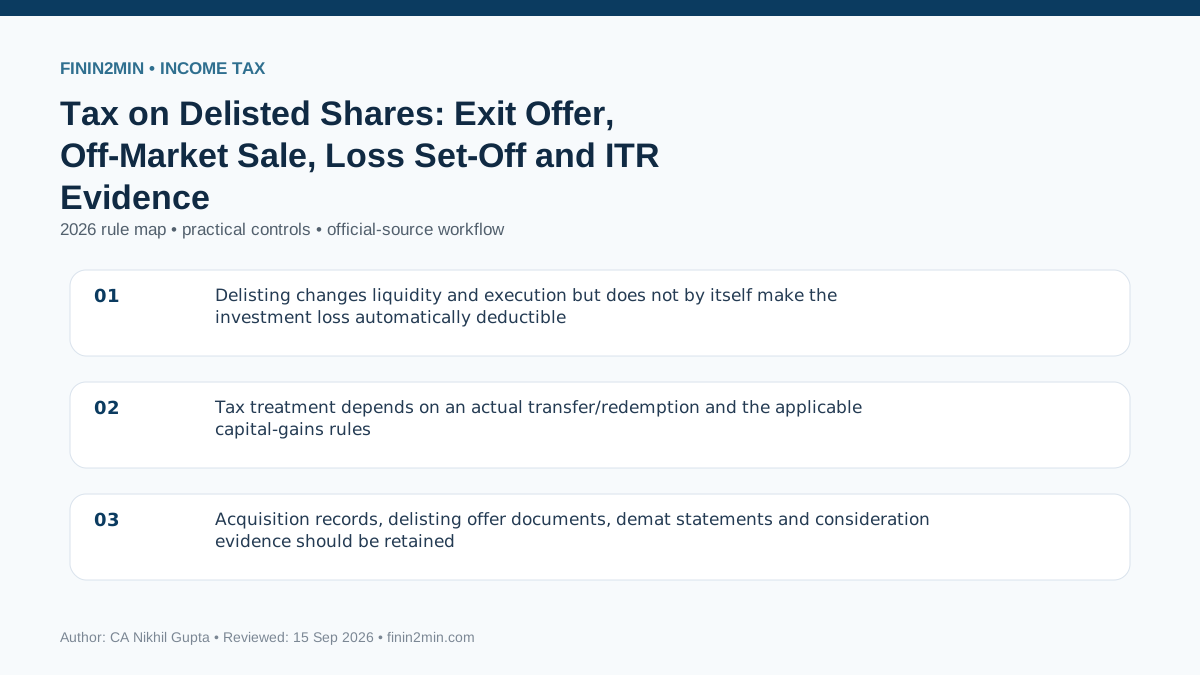
A share that was once listed can become an unlisted security after delisting. Tax depends on the nature of the transfer when you actually sell—not the status on the original purchase date alone.
Current rule and what decides the result
Delisting changes the exit mechanism, not the need to compute capital gains. Shares sold in a delisting exit offer, an off-market transaction or a later unlisted-share sale require actual sale consideration, cost and holding period to be computed under the applicable capital-gains rules. The listed-equity concessional regime may not apply when its STT/market conditions are not satisfied. A capital loss is useful only if correctly classified, reported in the return within the loss-carry-forward framework and supported by transaction/bank/demat evidence.
Key rules to apply
- Exit-offer tender, off-market sale and later sale of unlisted shares can have different STT and special-rate consequences, while capital-loss set-off follows the short-term/long-term classification of the actual loss.
- Determine whether the share is listed on a recognised exchange when the transfer occurs; delisting can move the asset outside listed-equity mechanics.
- For unlisted shares under the post-2024 framework, the 24-month holding threshold is important for long-term classification.
- The special listed-equity LTCG regime requires statutory conditions including STT/listed-asset criteria; do not apply it automatically to an off-market post-delisting sale.
- Long-term gains outside section 112A can fall under section 112’s 12.5% post-23 July 2024 framework subject to the provision and taxpayer facts.
- Short-term capital loss can generally set off against STCG or LTCG; long-term capital loss is restricted to LTCG, with carry-forward subject to return-filing rules.
Delisting exit offer at a gain
An investor bought 1,000 listed shares for ₹180 each and tenders them in a delisting exit offer for ₹310 each after holding them for several years. Sale consideration is ₹3.10 lakh and historical cost is ₹1.80 lakh before any applicable adjustments, giving a ₹1.30 lakh economic gain. The investor must test the tax provision applicable to that exit mechanism rather than automatically applying section 112A merely because the shares were listed when purchased.
Off-market sale after delisting at a loss
After delisting, another investor sells 2,000 shares privately for ₹60 each. The shares cost ₹95 each, so the economic loss is ₹70,000 before transfer costs. The contract note/off-market instruction, buyer details, bank receipt and demat debit are crucial because there may be no exchange contract note or STT record. The loss must be correctly classified and disclosed if the investor wants to use set-off/carry-forward rules.
How to apply it step by step
- Identify whether sale occurred through the exchange, delisting offer or off-market after delisting.
- Gather original purchase dates/cost and corporate-action adjustments.
- Determine whether STT/listed-equity concession conditions are actually met for the disposal.
- Compute sale value, transfer costs and gain/loss with the correct holding-period classification.
- For off-market deals, preserve agreement, bank receipt and demat debit/credit evidence.
- Report capital loss in the correct ITR schedule within the filing framework if carry-forward is intended.
- Reconcile the transaction with AIS/broker/depository data; off-market items may not appear consistently.
- Keep delisting notices/exit-offer documents to explain the transaction years later.
Common mistakes and edge cases
- Applying listed-equity rates just because the share used to be listed.
- Estimating off-market sale value without transaction evidence.
- Ignoring corporate actions that changed cost/quantity.
- Missing the return filing requirements needed to carry forward a capital loss.
- Assuming a delisted share with no buyer can be written off for tax automatically.
FAQs
Is a delisting exit offer tax-free?
No. It is a disposal and capital-gains rules must be applied to the actual exit.
Does section 112A always apply to a formerly listed share?
No. The statutory conditions, including the nature of the disposal and STT requirements, must be tested.
Can a delisted-share loss be carried forward?
Potentially, if it is a recognised capital loss and the return/loss-carry-forward conditions are met.
What proves an off-market sale?
Agreement/consideration evidence, bank receipt and depository records are especially important.
Can I claim a loss merely because the share is illiquid?
Not merely because value has fallen; there normally must be a recognised transfer or another specific tax event.
Should I keep the delisting notice?
Yes. It helps establish why and how the exit occurred.
Related Finin2min guides
- Offer for Sale (OFS): Cost Basis, Loss Set-Off and Exit Planning
- Tender Offer Buybacks: Cost Basis, Loss Set-Off and Exit Planning
- Rental Income From Two Properties: ITR Rules, Interest and Loss Set-Off
- Index Options: Cost Basis, Loss Set-Off and Exit Planning
- Arbitrage Funds: Cost Basis, Loss Set-Off and Exit Planning
- Zero-Coupon Bonds: Cost Basis, Loss Set-Off and Exit Planning
- Target Maturity Funds: Cost Basis, Loss Set-Off and Exit Planning
- Crypto Airdrops, Forks and Gifts: Cost Basis, Loss Set-Off and Exit Planning