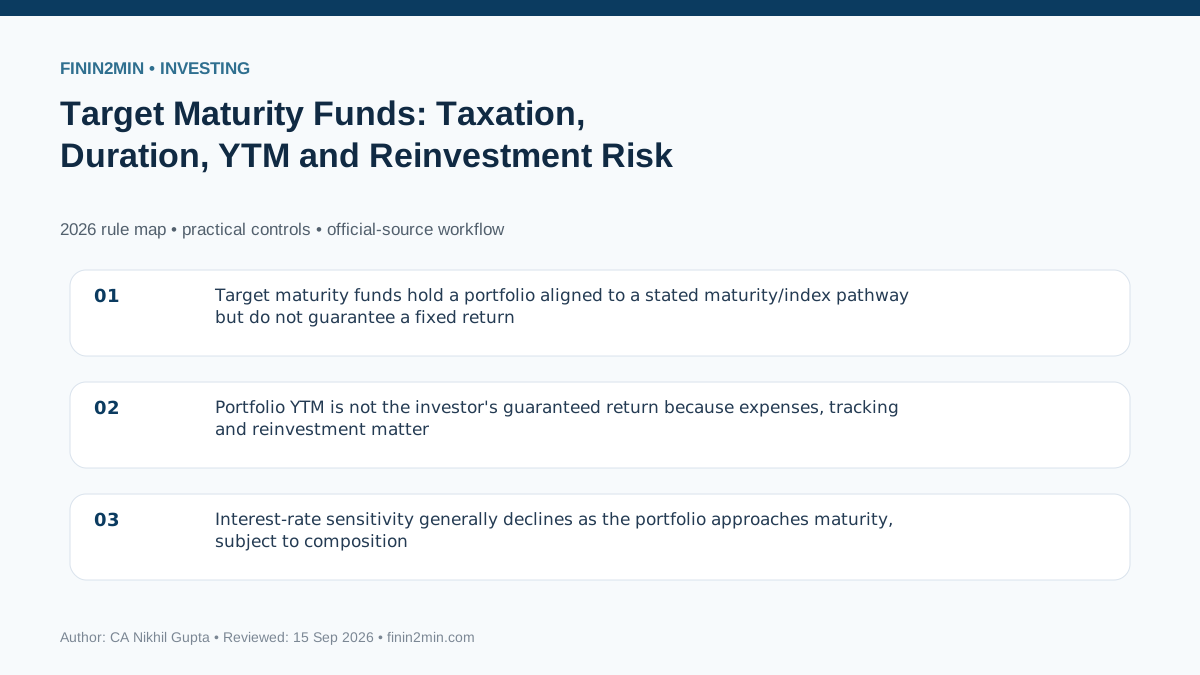
A target maturity fund is a passive debt scheme designed to track a specified bond index with a stated maturity date. Its portfolio duration generally declines as the target date approaches, which can make interest-rate risk more predictable for investors whose horizon matches the scheme.
Current rule and what decides the result
A target maturity fund (TMF) usually holds bonds that mature near a stated index/target year, but the target date is not a guaranteed return date. Investor outcome depends on the purchase NAV, portfolio yield, expenses, credit events, tracking difference and whether the investor holds through the target. For tax, classify the scheme under the current mutual-fund capital-gains rules; debt-heavy schemes acquired under the specified-mutual-fund regime can be deemed short term even when held for years. YTM is a portfolio yield indicator, not the investor's promised annual return.
Key rules to apply
- But the displayed YTM is not a promised return: expenses, tracking difference, credit events, cash flows and reinvestment can change the realised result.
- SEBI’s passive-fund framework standardises target-maturity indices and limits new target-maturity launches to maturities up to 15 years.
- Portfolio YTM is an indicative yield based on current holdings/prices and assumptions; it is not an assured maturity return.
- As bonds age toward the common target date, portfolio duration typically reduces, lowering sensitivity to rate changes if the portfolio is broadly held to maturity.
- Government/SDL/PSU mixes have different credit/spread behaviour; tracking error and cash management can make fund returns diverge from the index.
- Debt-oriented mutual-fund units acquired on/after the section 50AA start date can be deemed short-term; from 1 April 2026 the specified-fund definition focuses on >65% debt/money-market exposure.
Hold-to-target estimate
A TMF has a disclosed portfolio YTM of 7.2%, modified duration of 3.7 years and expense ratio of 0.25%. An investor puts ₹10 lakh into the fund four years before its target. A rough pre-tax planning estimate might start near the portfolio YTM less expenses, but it is not a guaranteed 6.95% return: defaults, cash drag, index rebalancing, reinvestment of coupons and the investor's purchase NAV can move the realised CAGR. The correct use of YTM is as a scenario input, not a fixed-deposit promise.
Early exit during rate rise
An investor buys ₹8 lakh of a 2031 target-maturity fund and exits after one year when market yields have risen sharply. Even though the bonds still mature near 2031, the fund NAV can be below the investor's purchase NAV because longer-duration bond prices fall when yields rise. The investor may realise a capital loss on exit; the target year does not protect an early seller from mark-to-market risk.
How to apply it step by step
- Read the index methodology and actual portfolio, not only the target year in the fund name.
- Check YTM, modified duration, average maturity, credit quality and concentration.
- Estimate expected holding period and whether you can remain invested through the target year.
- Classify the scheme under current mutual-fund tax rules before modelling post-tax return.
- Stress-test a 1%–2% yield move to understand interim NAV volatility.
- Review expense ratio and tracking difference because both reduce investor return from portfolio yield.
- Check reinvestment/cash management as bonds mature before the final target.
- Compare the post-tax outcome with deposits, direct bonds and other debt funds at the same risk horizon.
Common mistakes and edge cases
- Treating YTM as a guaranteed CAGR.
- Assuming the target year removes credit or interest-rate risk.
- Ignoring the tax classification of a debt-heavy mutual fund.
- Buying a long-duration TMF for money needed in one year.
- Comparing a gross portfolio YTM with a post-tax bank deposit return.
FAQs
Is TMF return guaranteed at the target date?
No. The portfolio is designed around a maturity profile, but mutual-fund returns are market-linked.
What does YTM tell me?
It is the portfolio yield implied by current bond prices and cash flows, useful for scenarios but not a promise.
Can NAV fall before maturity?
Yes. Interest-rate and credit-spread moves can produce interim gains or losses.
Does holding to target remove all risk?
It reduces some duration uncertainty but not default, tracking, expense, liquidity or reinvestment risk.
How are TMFs taxed?
Tax depends on the scheme’s current legal classification; debt-heavy specified funds can have gains deemed short term.
Who should avoid TMFs?
An investor who may need the money well before the target or cannot tolerate interim NAV movement should be cautious.
Related Finin2min guides
- Target Maturity Funds: Bond-Ladder Logic, Duration and Maturity Risk
- Target Maturity Funds
- Debt Mutual Funds: Credit Risk vs Duration Risk Explained
- Debt Funds: Credit vs Duration
- Debt Funds: Credit vs Duration
- Target Maturity Funds: Scenario Analysis for Investors and Family Offices
- Target Maturity Funds: Cost Basis, Loss Set-Off and Exit Planning
- Sector Funds and Thematic Funds: Concentration Risk Explained | Finin2min Investor Protection