Stock audit
Stock Audit Checklist: Inventory Count, Lender Drawing Power and Red Flags
By Finin2min Editorial Desk · Reviewed by CA Nikhil Gupta · Last reviewed 9 October 2026
📄 Download the PDF edition (free sign-in)
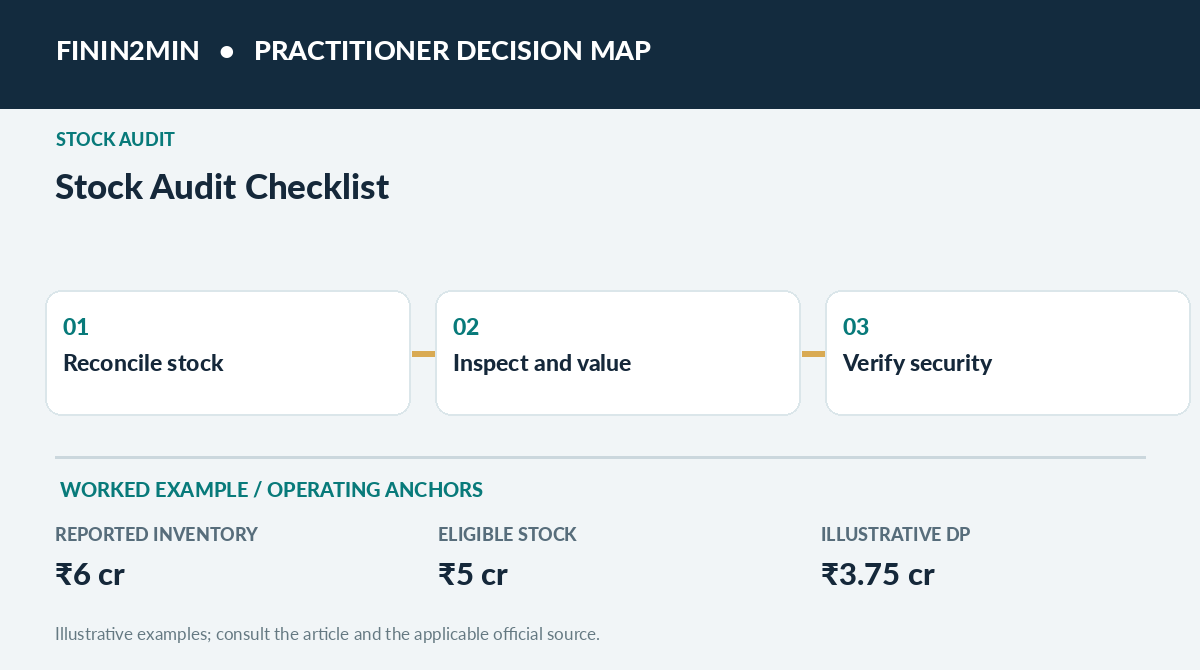
At-a-glance reference table
| Borrowing-base component | Example amount | Treatment |
|---|---|---|
| Book stock | ₹6.00 crore | Starting inventory |
| Obsolete + customer-owned | (₹1.00 crore) | Illustrative exclusions |
| Eligible stock | ₹5.00 crore | Subject to sanction |
| 25% illustrative margin | (₹1.25 crore) | Not a universal bank rule |
| Stock drawing power portion | ₹3.75 crore | Before other adjustments |
Plan the count and secure the population
Obtain the inventory master by SKU, warehouse, bin, ownership type and valuation method. Reconcile the stock ledger to the general ledger on the cut-off date. Separately identify goods in transit, goods held by a third-party warehouse, consignment stock, returnable packaging, slow-moving items, pledged inventory and goods belonging to suppliers or customers.
Observe management's count instructions: count teams should not be responsible for recording stock movements they could conceal, and movements during the count should be frozen or controlled. Perform both floor-to-sheet and sheet-to-floor tests. The former addresses completeness of recording; the latter helps establish existence. Photograph damaged goods where permitted, record tag numbers and compare test-count differences with management's final reconciliation.
Example: valuation and drawing power
A factory reports book inventory of ₹6 crore, including ₹60 lakh of obsolete goods and ₹40 lakh of customer-owned consignment materials. Those quantities cannot automatically be treated as good eligible bank collateral. If the lender's sanctioned formula allows eligible stock after prescribed exclusions and a 25% margin, an illustrative net eligible stock of ₹5 crore supports stock drawing-power contribution of ₹3.75 crore. Actual drawing power must use the signed sanction terms; the 25% in this example is not an RBI universal minimum.
Where the lending arrangement permits eligible receivables, add them only after exclusions for over-age, disputes, related parties or uninsured balances specified by the facility terms. Deduct any applicable trade-creditors or other adjustments that the sanction formula requires. Never assume a one-size-fits-all debtor-age limit; some limits relate to 90 days, 120 days or other contract-specific periods.
Physical quantity, condition and custody checks
Inspect receipt and dispatch gates, goods received notes, material issue slips, production wastage and near-year-end dispatch documents. High-value portable inventory needs stronger control testing and independent evidence than easily observed bulk items. In-process goods require a stage-of-completion basis that reconciles to production records. For goods stored with logistics providers obtain third-party confirmations and assess their reliability.
Check hazardous, perishable, serial-numbered and regulated stock using appropriate specialists where required. Damaged or technically outdated items may have carrying values that exceed net realisable value. Management's estimate should be challenged with subsequent sales, technical inspections, historical wastage or independent market evidence, not merely the original purchase invoice.
Lender stock statement reconciliation
Compare monthly or quarterly stock statements submitted to banks with the books: gross inventory, eligible receivables, creditors, overdue items, valuation adjustments, insurance and charge details. A consistent unreconciled overstatement of eligible stock is a lending and control risk even if the statutory financial statements were otherwise reconciled. Record statement dates and whether the lender has given specific variations to the formula.
Reconcile GST turnover and stock flows where useful, but remember that GST returns do not directly prove physical stock. Link raw material receipts, production consumption, wastage, finished goods dispatch and closing quantity. Check bill-of-material accuracy and unexplained negative stock quantities in the ERP.
Red flags and audit response
Warning signs include a high percentage of manual stock adjustments, goods appearing in two warehouses, repetitive round-number counts, unusual stock growth despite falling revenue, pending insurance renewal, frequent stock statement restatements and warehouse access limited to management-selected areas. None alone proves fraud. Evaluate each through evidence and adjust test procedures, including unpredictability and third-party confirmation where justified.
A useful exception register includes SKU, source document, system count, physical count, rate, variance value, cause, finance adjustment, legal ownership and management resolution. This keeps counting differences separate from pricing and pledge eligibility issues.
Report and evidence pack
The report should explain the engagement objective, location, period, count methodology, scope limitations, sampled SKUs, reconciliation findings, valuation exceptions, insurance and charge documentation, borrowing-base calculation and recommendations. Include signed count sheets, stock exports, warehouse confirmations, bank sanction extracts, submitted stock statements, age-wise debtor schedule, inspection photos subject to policy and management responses.
Do not certify 'all stock exists' merely because the sampled items agreed. Do not certify drawing power without access to the operative facility terms. The final conclusion should reflect actual work and any limitation affecting its usefulness to the intended bank or borrower.
Insurance, charges and third-party locations
Where the lender has a hypothecation charge over inventory, inspect the registered charge details and relevant loan documents. Verify that insurance cover, insured locations, risks and sum insured are consistent with bank covenants and the actual stock position. Inventory temporarily held at a job worker or third-party logistics warehouse requires direct corroboration of location, quantity and ownership; a signed internal spreadsheet is not the same as an independent custodian acknowledgment.
When margins and drawing power are recomputed, make a bridge from the borrower's statement to the audited or management accounts and then to bank eligibility rules. Report significant valuation reservations clearly, as gross inventory may be large but readily realisable stock quite small. If records are only available after the inspection date, assess cut-off changes before treating the updated balances as evidence for the earlier date.
Questions readers ask
Is physical verification alone a complete stock audit?
No; valuation, rights, recording, cut-off and collateral terms also matter.
Is 25% always the required bank stock margin?
No; this illustration must be replaced with the sanctioned margin.
Can customer-owned stock count toward borrower's collateral?
Not automatically; ownership and sanction terms are critical.
Does GST turnover prove stock?
No, it is a reconciliation signal, not physical verification.
Can an external auditor skip attendance because management counted stock?
SA 501 requires assessment of attendance and evidence requirements based on the circumstances.
Should warehouse differences be netted?
Investigate positive and negative differences individually before any permitted aggregation.
Official sources
- ICAI Guidance Note on Audit of Inventories
- ICAI SA 501 on inventory attendance
- ICAI Guidance Note on Audit of Banks 2026 edition
Related reading on Finin2min
- Tax Audit Preparation Checklist for SMEs
- Statutory Audit Checklist for CFOs
- Inventory Count Difference After Year-End Sale
- Audit Adjustment Tracker Checklist
- Companies Act, 2013 study guide hub
Disclaimer: Educational information, not individual tax, legal, accounting or investment advice. Check the current law, standards and notifications for the relevant period and take professional advice before acting.