Standard Costing Variance Analysis: Material, Labour and Overheads
📄 Download the PDF edition (free sign-in)
What matters in two minutes
- Standard costing compares a credible benchmark for actual output with actual material, labour and overhead usage. It should explain causes, not merely label differences favourable or adverse.
- For materials, separate price from usage variance; for labour, separate rate from efficiency and consider idle time explicitly.
- Keep formula sign conventions consistent. A negative variance can be adverse in one model and a favourable sign in another: labels must resolve the ambiguity.
- A “favourable” purchasing variance can coexist with poor quality, longer manufacturing time and unhappy customers.
- Investigate materiality and controllability before assigning blame to purchasing, production, HR or sales.
At-a-glance reference table
| Variance | Formula basis | Result |
|---|---|---|
| Material price | 10,500 kg × (₹120 − ₹126) | ₹63,000 A |
| Material usage | ₹120 × (10,000 − 10,500) | ₹60,000 A |
| Labour rate | 2,700 h × (₹400 − ₹420) | ₹54,000 A |
| Labour efficiency | ₹400 × (2,500 − 2,700) | ₹80,000 A |
Set a standard that belongs to the output
A standard material usage of two kilograms per unit means that for 5,000 actual good units the allowed input is 10,000 kilograms, subject to how normal process loss is built into the standard. It does not mean use the 8,000 kilograms allowed for the original sales budget if production volume actually changed. Store standard versions with effective dates; changes in specification, supplier or routing should not rewrite history without a controlled policy.
A good standard card includes bill of materials, expected yield, employee grade and allowed hours, planned hourly rates, machine-hour consumption and variable/fixed overhead drivers. Obtain sign-off from engineering and operations. Finance cannot independently invent optimal performance assumptions and then expect operational managers to own every variance.
Worked material variances
Take an actual output of 5,000 units. Standard material is 2 kg per unit at ₹120/kg. The standard quantity for actual output is therefore 10,000 kg, and standard material cost ₹12,00,000. Actual purchases and usage for the same cost population are 10,500 kg at ₹126/kg, giving actual cost ₹13,23,000. Using standard minus actual sign convention:
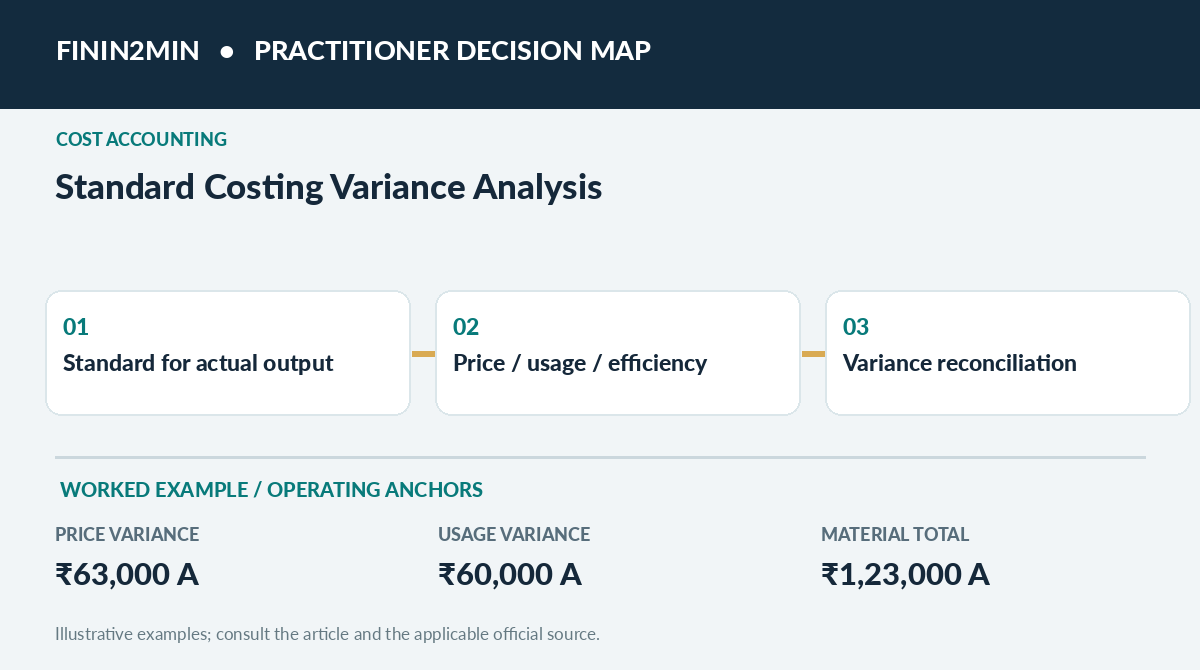
- Price variance: Actual quantity × (standard price − actual price) = 10,500 × (₹120 − ₹126) = ₹63,000 adverse.
- Usage variance: Standard price × (standard quantity for actual output − actual quantity) = ₹120 × (10,000 − 10,500) = ₹60,000 adverse.
- Total material cost variance: ₹12,00,000 − ₹13,23,000 = ₹1,23,000 adverse.
The two parts reconcile: ₹63,000 + ₹60,000 = ₹1,23,000. This reconciliation is an important integrity test. If the purchase price variance is calculated on purchases while usage uses material issued, opening/closing inventory timing creates a separate reconciliation requirement. Do not claim the totals must match without aligning the quantity population.
Labour rate and efficiency
Assume standard labour requirement is 0.50 hours per completed unit at ₹400/hour: 2,500 standard hours for 5,000 units. Actual hours are 2,700 at an average ₹420/hour. Standard labour cost is ₹10,00,000 and actual labour cost ₹11,34,000. Rate variance is 2,700 × (₹400 − ₹420) = ₹54,000 adverse. Efficiency variance is ₹400 × (2,500 − 2,700) = ₹80,000 adverse. The ₹1,34,000 combined variance matches the gap between standard and actual labour cost.
Now investigate whether overtime premiums, a temporary skilled workforce or unplanned downtime caused the difference. A higher labour rate may fund more skilled work that improves yield or delivery; examining labour variance alone could reach the wrong managerial conclusion. If paid idle time is identified, separate and define its treatment so efficiency variance is not distorted through a hidden denominator choice.
Overhead variances require a sound denominator
Variable overhead can be assessed using allowed activity, actual activity and actual spending. Spending variance and efficiency variance are meaningful only when the selected driver causes the overhead. Fixed overhead introduces budget and volume/capacity analyses; under-absorption from lower activity is not necessarily evidence of wasteful purchasing. Do not attribute a demand collapse to the factory manager simply because the fixed overhead volume variance is adverse.
For example, a machine shop with a budgeted fixed factory overhead of ₹10 lakh at 5,000 machine hours, but only 4,000 hours of production, will report lower overhead absorption at the standard rate of ₹200/hour. Explain capacity/demand first and separately compare actual fixed overhead spend with budget. Altering the rate after observing production undermines the usefulness of the standard.
Root-cause analysis that changes decisions
Link material price differences to negotiated terms, supplier mix and purchasing dates; usage to scrap, moisture, rejected batches, machine calibration and engineering changes; labour rate to skills, overtime and rostering; labour efficiency to downtime, setups and learning curves. Show the financial effect in rupees but also report physical drivers: kilograms scrapped, hours lost, batches reworked, orders delayed.
Escalate trends rather than isolated rounding differences. A variance threshold might use both an absolute amount and a percentage of standard cost so small departments are not constantly investigated and large surprises are not ignored. Assign one owner and a due date to each significant root cause.
Why “favourable” needs context
A ₹20,000 favourable material price variance from a cheaper supplier may trigger ₹90,000 additional rework and ₹30,000 in customer returns. The purchasing metric is favourable, but total economics are adverse. Build a second-level bridge to quality, delivery, warranty, returns and cash impact. Similarly, production running unusually long batches can improve hourly efficiency while creating slow-moving stock. Management should reward contribution and reliability rather than gaming one standard.
Typical implementation mistakes
Applying budgeted output rather than actual output to the allowed quantity, mixing inventory purchases and usage, failing to version rates, ignoring material mix, treating idle time inconsistently and not reconciling variance components to total cost are common causes of unreliable dashboards. Test formulas on a small example before scaling to thousands of SKUs.
Frequently asked questions
What is material price variance? Actual quantity multiplied by the difference between standard and actual unit prices, under a clearly stated sign convention.
Why use actual output in usage variance? To compare resource consumption fairly at the volume actually made.
Can a favourable variance still be bad? Yes, if it increases downstream waste, service failures or inventory risk.
Should standards be changed every month? Change on a documented policy and when meaningful operational assumptions change; do not rewrite history merely to eliminate variances.
What is the purpose of a fixed overhead volume variance? To expose the effect of production activity versus the selected normal or budget activity basis, not to measure spending alone.
How should price and usage reconcile? With matched quantity populations and timing, their sum should equal the material total cost variance.
Professional information: This article explains accounting and finance concepts using illustrative amounts. Check the applicable standards, entity classification, source amendments, contracts and professional advice for your actual reporting year or transaction.