SRA-C09 - 7 provisions

Perpetual and Mandatory Injunctions, Damages and Refusal Grounds

Specific Relief Act, 1963

Full local statutory textFinin2min implementation editionCA Nikhil Gupta and Kajri Singh

Download chapter PDFDownload one-page cheat sheet

Finin2min Summary - Chapter in 2 Minutes

Purpose

This unit converts perpetual and mandatory injunctions, damages and refusal grounds into statutory, transaction, evidence and remedy decisions.

Who is covered

Businesses, contracting parties, partners, buyers, sellers, principals, agents and litigants affected by this chapter.

Main obligations

Read the transaction documents and actual conduct against every statutory limb, exception and connected law.

Key timelines

Record event, breach, refusal, notice, acknowledgment and filing dates; apply the correct Limitation Act article.

Forms and evidence

Use the chapter evidence checklist and State/UT forms where registration or public notice applies.

Top risk

Wrong classification, missing authority, weak evidence, ineffective notice, unverified State process or wrong remedy.

Remedy

Preserve rights, mitigate loss, quantify exposure and confirm forum, arbitration, limitation and interim relief.

Finin2min takeaway

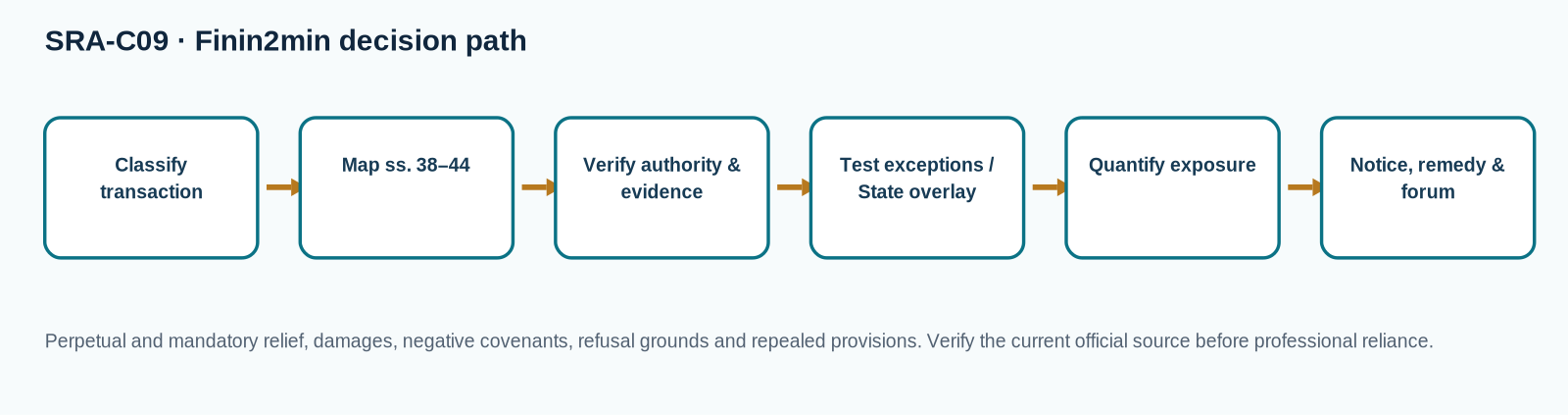
Classify - map law - verify authority - prove performance - quantify consequence - select remedy and forum.

Section-by-section provision map

ProvisionTitleStatusDecision theme
s.38Perpetual injunction when grantedoperativebreach and remedies
s.39Mandatory injunctionsoperativebreach and remedies
s.40Damages in lieu of, or in addition to, injunctionoperativebreach and remedies
s.41Injunction when refusedoperativebreach and remedies
s.42Injunction to perform negative agreementoperativebreach and remedies
s.43[Repealed.]repealedcommercial rights and obligations
s.44[Repealed.]. THE SCHEDULE. THE SPECIFIC RELIEF ACT, 1963repealedbreach and remedies

Legal status, amendments and source protocol

Act: Specific Relief Act, 1963; Act 47 of 1963; commencement 1 March 1964.

Source protocol: Complete central provision text is reproduced locally. Retained official India Code PDF extract. Official India Code and Gazette instruments prevail if any discrepancy is identified.

Full statutory text and Finin2min decode

Section 38 - Perpetual injunction when granted
Local statutory-text source control: Retained official India Code PDF extract. Official India Code source prevails.

Current statutory text

38. Perpetual injunction when granted.—(1) Subject to the other provisions contained in or referred to by this Chapter, a perpetual injunction may be granted to the plaintiff to prevent the breach of an obligation existing in his favour, whether expressly or by implication. (2) When any such obligation arises from contract, the court shall be guided by the rules and provisions contained in Chapter II. (3) When the defendant invades or threatens to invade the plaintiff’s right to, or enjoyment of, property, the court may grant a perpetual injunction in the following cases, namely:— (a) where the defendant is trustee of the property for the plaintiff; (b) where there exists no standard for ascertaining the actual damage caused, or likely to be caused, by the invasion; (c) where the invasion is such that compensation in money would not afford adequate relief; (d) where the injunction is necessary to prevent a multiplicity of judicial proceedings.

Finin2min clause-by-clause decode

ClauseStatutory requirementFinin2min meaningEvidence/control
Main rule38. Perpetual injunction when granted.—Test this main limb within the breach and remedies framework. Operational focus: 38. perpetual injunction when granted.—.Contract/deed, authority, chronology, notices, performance and payment records tied to this limb.
(1)Subject to the other provisions contained in or referred to by this Chapter, a perpetual injunction may be granted to the plaintiff to prevent the breach of an obligation existing in his favour, whether expressly or by implication.Test this (1) within the breach and remedies framework. Operational focus: subject to the other provisions contained in or referred to by this chapter, a perpetual injunction may be.Contract/deed, authority, chronology, notices, performance and payment records tied to this limb.
(2)When any such obligation arises from contract, the court shall be guided by the rules and provisions contained in Chapter II.Test this (2) within the breach and remedies framework. Operational focus: when any such obligation arises from contract, the court shall be guided by the rules and provisions contained.Contract/deed, authority, chronology, notices, performance and payment records tied to this limb.
(3)When the defendant invades or threatens to invade the plaintiff’s right to, or enjoyment of, property, the court may grant a perpetual injunction in the following cases, namely:—Test this (3) within the breach and remedies framework. Operational focus: when the defendant invades or threatens to invade the plaintiff’s right to, or enjoyment of, property, the court.Contract/deed, authority, chronology, notices, performance and payment records tied to this limb.
(a)where the defendant is trustee of the property for the plaintiffTest this (a) within the breach and remedies framework. Operational focus: where the defendant is trustee of the property for the plaintiff.Contract/deed, authority, chronology, notices, performance and payment records tied to this limb.
(b)where there exists no standard for ascertaining the actual damage caused, or likely to be caused, by the invasionTest this (b) within the breach and remedies framework. Operational focus: where there exists no standard for ascertaining the actual damage caused, or likely to be caused, by the.Contract/deed, authority, chronology, notices, performance and payment records tied to this limb.
(c)where the invasion is such that compensation in money would not afford adequate reliefTest this (c) within the breach and remedies framework. Operational focus: where the invasion is such that compensation in money would not afford adequate relief.Contract/deed, authority, chronology, notices, performance and payment records tied to this limb.
(d)where the injunction is necessary to prevent a multiplicity of judicial proceedings.Test this (d) within the breach and remedies framework. Operational focus: where the injunction is necessary to prevent a multiplicity of judicial proceedings.Contract/deed, authority, chronology, notices, performance and payment records tied to this limb.

Finin2min implementation explanation

Section 38 is a breach and remedies provision dealing with perpetual injunction when granted. Identify the actor, trigger, cumulative or alternative conditions, provisos, exceptions and legal consequence before reaching a conclusion.

Implementation control: Identify breach, causation, remoteness, mitigation, stipulated sums, restitution, interest and remedy election. Preserve a reproducible claim and defence working.

Section-level practical application

Transaction test

Apply this provision to the event-date facts and record every satisfied, disputed or inapplicable limb.

Consequence and remedy

Identify how it changes validity, title, authority, liability, payment, rejection, recovery, registration, evidence or relief.

Section 39 - Mandatory injunctions
Local statutory-text source control: Retained official India Code PDF extract. Official India Code source prevails.

Current statutory text

39. Mandatory injunctions.—When, to prevent the breach of an obligation, it is necessary to compel the performance of certain acts which the court is capable of enforcing, the court may in its discretion grant an injunction to prevent the breach complained of, and also to compel performance of the requisite acts.

Finin2min clause-by-clause decode

ClauseStatutory requirementFinin2min meaningEvidence/control
Main rule39. Mandatory injunctions.—When, to prevent the breach of an obligation, it is necessary to compel the performance of certain acts which the court is capable of enforcing, the court may in its discretion grant an injunction to prevent the breach complained of, and also to compel performance of the requisite acts.Test this main limb within the breach and remedies framework. Operational focus: 39. mandatory injunctions.—when, to prevent the breach of an obligation, it is necessary to compel the performance of.Contract/deed, authority, chronology, notices, performance and payment records tied to this limb.

Finin2min implementation explanation

Section 39 is a breach and remedies provision dealing with mandatory injunctions. Identify the actor, trigger, cumulative or alternative conditions, provisos, exceptions and legal consequence before reaching a conclusion.

Implementation control: Identify breach, causation, remoteness, mitigation, stipulated sums, restitution, interest and remedy election. Preserve a reproducible claim and defence working.

Section-level practical application

Transaction test

Apply this provision to the event-date facts and record every satisfied, disputed or inapplicable limb.

Consequence and remedy

Identify how it changes validity, title, authority, liability, payment, rejection, recovery, registration, evidence or relief.

Section 40 - Damages in lieu of, or in addition to, injunction
Local statutory-text source control: Retained official India Code PDF extract. Official India Code source prevails.

Current statutory text

40. Damages in lieu of, or in addition to, injunction.—(1) The plaintiff in a suit for perpetual injunction under section 38, or mandatory injunction under section 39, may claim damages either in addition to, or in substitution for, such injunction and the court may, if it thinks fit, award such damages. (2) No relief for damages shall be granted under this section unless the plaintiff has claimed such relief in his plaint: Provided that where no such damages have been claimed in the plaint, the court shall, at any stage of the proceedings, allow the plaintiff to amend the plaint on such terms as may be just for including such claim. (3) The dismissal of a suit to prevent the breach of an obligation existing in favour of the plaintiff shall bar his right to sue for damages for such breach.

Finin2min clause-by-clause decode

ClauseStatutory requirementFinin2min meaningEvidence/control
Main rule40. Damages in lieu of, or in addition to, injunction.—Test this main limb within the breach and remedies framework. Operational focus: 40. damages in lieu of, or in addition to, injunction.—.Contract/deed, authority, chronology, notices, performance and payment records tied to this limb.
(1)The plaintiff in a suit for perpetual injunction under section 38, or mandatory injunction under section 39, may claim damages either in addition to, or in substitution for, such injunction and the court may, if it thinks fit, award such damages.Test this (1) within the breach and remedies framework. Operational focus: the plaintiff in a suit for perpetual injunction under section 38, or mandatory injunction under section 39, may.Contract/deed, authority, chronology, notices, performance and payment records tied to this limb.
(2)No relief for damages shall be granted under this section unless the plaintiff has claimed such relief in his plaint:Test this (2) within the breach and remedies framework. Operational focus: no relief for damages shall be granted under this section unless the plaintiff has claimed such relief in.Contract/deed, authority, chronology, notices, performance and payment records tied to this limb.
Provided thatwhere no such damages have been claimed in the plaint, the court shall, at any stage of the proceedings, allow the plaintiff to amend the plaint on such terms as may be just for including such claim.Test this provided that within the breach and remedies framework. Operational focus: where no such damages have been claimed in the plaint, the court shall, at any stage of the.Contract/deed, authority, chronology, notices, performance and payment records tied to this limb.
(3)The dismissal of a suit to prevent the breach of an obligation existing in favour of the plaintiff shall bar his right to sue for damages for such breach.Test this (3) within the breach and remedies framework. Operational focus: the dismissal of a suit to prevent the breach of an obligation existing in favour of the plaintiff.Contract/deed, authority, chronology, notices, performance and payment records tied to this limb.

Finin2min implementation explanation

Section 40 is a breach and remedies provision dealing with damages in lieu of, or in addition to, injunction. Identify the actor, trigger, cumulative or alternative conditions, provisos, exceptions and legal consequence before reaching a conclusion.

Implementation control: Identify breach, causation, remoteness, mitigation, stipulated sums, restitution, interest and remedy election. Preserve a reproducible claim and defence working.

Section-level practical application

Transaction test

Apply this provision to the event-date facts and record every satisfied, disputed or inapplicable limb.

Consequence and remedy

Identify how it changes validity, title, authority, liability, payment, rejection, recovery, registration, evidence or relief.

Section 41 - Injunction when refused
Local statutory-text source control: Retained official India Code PDF extract. Official India Code source prevails.

Current statutory text

41. Injunction when refused.—An injunction cannot be granted— (a) to restrain any person from prosecuting a judicial proceeding pending at the institution of the suit in which the injunction is sought, unless such restraint is necessary to prevent a multiplicity of proceedings; (b) to restrain any person from instituting or prosecuting any proceeding in a court not sub- ordinate to that from which the injunction is sought; (c) to restrain any person from applying to any legislative body; (d) to restrain any person from instituting or prosecuting any proceeding in a criminal matter; (e) to prevent the breach of a contract the performance of which would not be specifically enforced; (f) to prevent, on the ground of nuisance, an act of which it is not reasonably clear that it will be a nuisance; (g) to prevent a continuing breach in which the plaintiff has acquiesced; (h) when equally efficacious relief can certainly be obtained by any other usual mode of proceeding except in case of breach of trust; 1[(ha) if it would impede or delay the progress or completion of any infrastructure project or interfere with the continued provision of relevant facility related thereto or services being the subject matter of such project.] (i) when the conduct of the plaintiff or his agents has been such as to disentitle him to be the assistance of the court; (j) when the plaintiff has no personal interest in the matter.

Finin2min clause-by-clause decode

ClauseStatutory requirementFinin2min meaningEvidence/control
Main rule41. Injunction when refused.—An injunction cannot be granted—Test this main limb within the breach and remedies framework. Operational focus: 41. injunction when refused.—an injunction cannot be granted—.Contract/deed, authority, chronology, notices, performance and payment records tied to this limb.
(a)to restrain any person from prosecuting a judicial proceeding pending at the institution of the suit in which the injunction is sought, unless such restraint is necessary to prevent a multiplicity of proceedingsTest this (a) within the breach and remedies framework. Operational focus: to restrain any person from prosecuting a judicial proceeding pending at the institution of the suit in which.Contract/deed, authority, chronology, notices, performance and payment records tied to this limb.
(b)to restrain any person from instituting or prosecuting any proceeding in a court not sub- ordinate to that from which the injunction is soughtTest this (b) within the breach and remedies framework. Operational focus: to restrain any person from instituting or prosecuting any proceeding in a court not sub- ordinate to that.Contract/deed, authority, chronology, notices, performance and payment records tied to this limb.
(c)to restrain any person from applying to any legislative bodyTest this (c) within the breach and remedies framework. Operational focus: to restrain any person from applying to any legislative body.Contract/deed, authority, chronology, notices, performance and payment records tied to this limb.
(d)to restrain any person from instituting or prosecuting any proceeding in a criminal matterTest this (d) within the breach and remedies framework. Operational focus: to restrain any person from instituting or prosecuting any proceeding in a criminal matter.Contract/deed, authority, chronology, notices, performance and payment records tied to this limb.
(e)to prevent the breach of a contract the performance of which would not be specifically enforcedTest this (e) within the breach and remedies framework. Operational focus: to prevent the breach of a contract the performance of which would not be specifically enforced.Contract/deed, authority, chronology, notices, performance and payment records tied to this limb.
(f)to prevent, on the ground of nuisance, an act of which it is not reasonably clear that it will be a nuisanceTest this (f) within the breach and remedies framework. Operational focus: to prevent, on the ground of nuisance, an act of which it is not reasonably clear that it.Contract/deed, authority, chronology, notices, performance and payment records tied to this limb.
(g)to prevent a continuing breach in which the plaintiff has acquiescedTest this (g) within the breach and remedies framework. Operational focus: to prevent a continuing breach in which the plaintiff has acquiesced.Contract/deed, authority, chronology, notices, performance and payment records tied to this limb.
(h)when equally efficacious relief can certainly be obtained by any other usual mode of proceeding except in case of breach of trust; 1[Test this (h) within the breach and remedies framework. Operational focus: when equally efficacious relief can certainly be obtained by any other usual mode of proceeding except in case.Contract/deed, authority, chronology, notices, performance and payment records tied to this limb.
(ha)if it would impede or delay the progress or completion of any infrastructure project or interfere with the continued provision of relevant facility related thereto or services being the subject matter of such project.]Test this (ha) within the breach and remedies framework. Operational focus: if it would impede or delay the progress or completion of any infrastructure project or interfere with the.Contract/deed, authority, chronology, notices, performance and payment records tied to this limb.
(i)when the conduct of the plaintiff or his agents has been such as to disentitle him to be the assistance of the courtTest this (i) within the breach and remedies framework. Operational focus: when the conduct of the plaintiff or his agents has been such as to disentitle him to be.Contract/deed, authority, chronology, notices, performance and payment records tied to this limb.
(j)when the plaintiff has no personal interest in the matter.Test this (j) within the breach and remedies framework. Operational focus: when the plaintiff has no personal interest in the matter.Contract/deed, authority, chronology, notices, performance and payment records tied to this limb.

Finin2min implementation explanation

Section 41 is a breach and remedies provision dealing with injunction when refused. Identify the actor, trigger, cumulative or alternative conditions, provisos, exceptions and legal consequence before reaching a conclusion.

Implementation control: Identify breach, causation, remoteness, mitigation, stipulated sums, restitution, interest and remedy election. Preserve a reproducible claim and defence working.

Section-level practical application

Transaction test

Apply this provision to the event-date facts and record every satisfied, disputed or inapplicable limb.

Consequence and remedy

Identify how it changes validity, title, authority, liability, payment, rejection, recovery, registration, evidence or relief.

Section 42 - Injunction to perform negative agreement
Local statutory-text source control: Retained official India Code PDF extract. Official India Code source prevails.

Current statutory text

42. Injunction to perform negative agreement.—Notwithstanding anything contained in clause (e) of section 41, where a contract comprises an affirmative agreement to do a certain act, coupled with a negative agreement, express or implied, not to do a certain act, the circumstance that the court is unable to compel specific performance of the affirmative agreement shall not preclude it from granting an injunction to perform the negative agreement: Provided that the plaintiff has not failed to perform the contract so far as it is binding on him. 2* * * * * 1. Ins. by Act 18 of 2018, s. 13 (w.e.f. 1-10-2018). 2. Sections 43 and 44 rep. by the Repealing and Amending Act, 1974 (56 of 1974), s. 2 and the First Schedule (w.e.f. 20-12-1974). 1[THE SCHEDULE [See sections 20A and 41 (ha)] Category of projects and Infrastructure Sub-Sectors Sl. No. Category Infrastructure Sub-Sectors 1. Transport (a) Road and bridges (b) Ports (including Capital Dredging) (c) Shipyards (including a floating or land-based facility with the essential features of waterfront, turning basin, berthing and docking facility, slipways or ship lifts, and which is self-sufficient for carrying on shipbuilding/repair/breaking activities) (d) Inland Waterways (e) Airports (f) Railway Track, tunnels, viaducts, bridges, terminal infrastructure including stations and adjoining commercial infrastructure (g) Urban Public Transport (except rolling stock in case of urban road transport) 2. Energy (a) Electricity Generation (b) Electricity Transmission (c) Electricity Distribution (d) Oil pipelines (e) Oil/Gas/Liquefied Natural Gas (LNG) storage facility(including strategic storage of crude oil) (f) Gas pipelines (including city gas distribution network) 3. Water and Sanitation (a) Solid Waste Management (b) Water supply pipelines (c) Water treatment plants (d) Sewage collection, treatment and disposal system (e) Irrigation (dams, channels, embankments, etc.) (f) Storm Water Drainage System (g) Slurry pipelines 4. Communication (a) Telecommunication (Fixed network including optic fibre/wire/cable networks which provide broadband/internet) (b) Telecommunication towers (c) Telecommunications and Telecom Services 1. Ins. by Act 18 of 2018, s. 14 (w.e.f. 1-10-2018). Sl. No. Category Infrastructure Sub-Sectors 5. Social and Commercial Infrastructure (a) Education Institutions (capital stock) (b) Sports infrastructure (including provision of Sports Stadia and Infrastructure for Academies for Training/Research in Sports and Sports- relating activities) (c) Hospitals (capital stock including Medical Colleges, Para Medical Training Institutes and Diagnostic Centres) (d) Tourism infrastructure viz. (i) three-star or higher category classified hotels located outside cities with population of more than one million; (ii) ropeways and cable cars (e) Common infrastructure for industrial parks and other parks with industrial activity such as food parks, textile parks, Special Economic Zones, tourism facilities and agriculture markets (f) Post-harvest storage infrastructure for agriculture and horticulture produce including cold storage (g) Terminal markets (h) Soil-testing laboratories (i) Cold chain (including cold room facility for farm level pre-cooling, for preservation or storage of agriculture and allied produce, marine products and meat) (j) Affordable Housing (including a housing project using at least 50% of the Floor Area Ratio (FAR)/Floor Space Index (FSI) for dwelling units with carpet area of not more than 60 square meters Explanation.—For the purposes of this sub-clause, the term “carpet area” shall have the same meaning as assigned to it in clause (k) of section 2 of the Real Estate (Regulation and Development) Act, 2016 (16 of 2016).]

Finin2min clause-by-clause decode

ClauseStatutory requirementFinin2min meaningEvidence/control
Main rule42. Injunction to perform negative agreement.—Notwithstanding anything contained in clauseTest this main limb within the breach and remedies framework. Operational focus: 42. injunction to perform negative agreement.—notwithstanding anything contained in clause.Contract/deed, authority, chronology, notices, performance and payment records tied to this limb.
(e)of section 41, where a contract comprises an affirmative agreement to do a certain act, coupled with a negative agreement, express or implied, not to do a certain act, the circumstance that the court is unable to compel specific performance of the affirmative agreement shall not preclude it from granting an injunction to perform the negative agreement:Test this (e) within the breach and remedies framework. Operational focus: of section 41, where a contract comprises an affirmative agreement to do a certain act, coupled with a.Contract/deed, authority, chronology, notices, performance and payment records tied to this limb.
Provided thatthe plaintiff has not failed to perform the contract so far as it is binding on him. 2* * * * * 1. Ins. by Act 18 of 2018, s. 13 (w.e.f. 1-10-2018). 2. Sections 43 and 44 rep. by the Repealing and Amending Act, 1974 (56 of 1974), s. 2 and the First Schedule (w.e.f. 20-12-1974). 1[THE SCHEDULE [See sections 20A and 41Test this provided that within the breach and remedies framework. Operational focus: the plaintiff has not failed to perform the contract so far as it is binding on him. 2*.Contract/deed, authority, chronology, notices, performance and payment records tied to this limb.
(ha)] Category of projects and Infrastructure Sub-Sectors Sl. No. Category Infrastructure Sub-Sectors 1. TransportTest this (ha) within the breach and remedies framework. Operational focus: ] category of projects and infrastructure sub-sectors sl. no. category infrastructure sub-sectors 1. transport.Contract/deed, authority, chronology, notices, performance and payment records tied to this limb.
(a)Road and bridgesTest this (a) within the breach and remedies framework. Operational focus: road and bridges.Contract/deed, authority, chronology, notices, performance and payment records tied to this limb.
(b)Ports (including Capital Dredging)Test this (b) within the breach and remedies framework. Operational focus: ports (including capital dredging).Contract/deed, authority, chronology, notices, performance and payment records tied to this limb.
(c)Shipyards (including a floating or land-based facility with the essential features of waterfront, turning basin, berthing and docking facility, slipways or ship lifts, and which is self-sufficient for carrying on shipbuilding/repair/breaking activities)Test this (c) within the breach and remedies framework. Operational focus: shipyards (including a floating or land-based facility with the essential features of waterfront, turning basin, berthing and docking.Contract/deed, authority, chronology, notices, performance and payment records tied to this limb.
(d)Inland WaterwaysTest this (d) within the breach and remedies framework. Operational focus: inland waterways.Contract/deed, authority, chronology, notices, performance and payment records tied to this limb.
(e)AirportsTest this (e) within the breach and remedies framework. Operational focus: airports.Contract/deed, authority, chronology, notices, performance and payment records tied to this limb.
(f)Railway Track, tunnels, viaducts, bridges, terminal infrastructure including stations and adjoining commercial infrastructureTest this (f) within the breach and remedies framework. Operational focus: railway track, tunnels, viaducts, bridges, terminal infrastructure including stations and adjoining commercial infrastructure.Contract/deed, authority, chronology, notices, performance and payment records tied to this limb.
(g)Urban Public Transport (except rolling stock in case of urban road transport) 2. EnergyTest this (g) within the breach and remedies framework. Operational focus: urban public transport (except rolling stock in case of urban road transport) 2. energy.Contract/deed, authority, chronology, notices, performance and payment records tied to this limb.
(a)Electricity GenerationTest this (a) within the breach and remedies framework. Operational focus: electricity generation.Contract/deed, authority, chronology, notices, performance and payment records tied to this limb.
(b)Electricity TransmissionTest this (b) within the breach and remedies framework. Operational focus: electricity transmission.Contract/deed, authority, chronology, notices, performance and payment records tied to this limb.
(c)Electricity DistributionTest this (c) within the breach and remedies framework. Operational focus: electricity distribution.Contract/deed, authority, chronology, notices, performance and payment records tied to this limb.
(d)Oil pipelinesTest this (d) within the breach and remedies framework. Operational focus: oil pipelines.Contract/deed, authority, chronology, notices, performance and payment records tied to this limb.
(e)Oil/Gas/Liquefied Natural Gas (LNG) storage facility(including strategic storage of crude oil)Test this (e) within the breach and remedies framework. Operational focus: oil/gas/liquefied natural gas (lng) storage facility(including strategic storage of crude oil).Contract/deed, authority, chronology, notices, performance and payment records tied to this limb.
(f)Gas pipelines (including city gas distribution network) 3. Water and SanitationTest this (f) within the breach and remedies framework. Operational focus: gas pipelines (including city gas distribution network) 3. water and sanitation.Contract/deed, authority, chronology, notices, performance and payment records tied to this limb.
(a)Solid Waste ManagementTest this (a) within the breach and remedies framework. Operational focus: solid waste management.Contract/deed, authority, chronology, notices, performance and payment records tied to this limb.
(b)Water supply pipelinesTest this (b) within the breach and remedies framework. Operational focus: water supply pipelines.Contract/deed, authority, chronology, notices, performance and payment records tied to this limb.
(c)Water treatment plantsTest this (c) within the breach and remedies framework. Operational focus: water treatment plants.Contract/deed, authority, chronology, notices, performance and payment records tied to this limb.
(d)Sewage collection, treatment and disposal systemTest this (d) within the breach and remedies framework. Operational focus: sewage collection, treatment and disposal system.Contract/deed, authority, chronology, notices, performance and payment records tied to this limb.
(e)Irrigation (dams, channels, embankments, etc.)Test this (e) within the breach and remedies framework. Operational focus: irrigation (dams, channels, embankments, etc.).Contract/deed, authority, chronology, notices, performance and payment records tied to this limb.
(f)Storm Water Drainage SystemTest this (f) within the breach and remedies framework. Operational focus: storm water drainage system.Contract/deed, authority, chronology, notices, performance and payment records tied to this limb.
(g)Slurry pipelines 4. CommunicationTest this (g) within the breach and remedies framework. Operational focus: slurry pipelines 4. communication.Contract/deed, authority, chronology, notices, performance and payment records tied to this limb.
(a)Telecommunication (Fixed network including optic fibre/wire/cable networks which provide broadband/internet)Test this (a) within the breach and remedies framework. Operational focus: telecommunication (fixed network including optic fibre/wire/cable networks which provide broadband/internet).Contract/deed, authority, chronology, notices, performance and payment records tied to this limb.
(b)Telecommunication towersTest this (b) within the breach and remedies framework. Operational focus: telecommunication towers.Contract/deed, authority, chronology, notices, performance and payment records tied to this limb.
(c)Telecommunications and Telecom Services 1. Ins. by Act 18 of 2018, s. 14 (w.e.f. 1-10-2018). Sl. No. Category Infrastructure Sub-Sectors 5. Social and Commercial InfrastructureTest this (c) within the breach and remedies framework. Operational focus: telecommunications and telecom services 1. ins. by act 18 of 2018, s. 14 (w.e.f. 1-10-2018). sl. no. category.Contract/deed, authority, chronology, notices, performance and payment records tied to this limb.
(a)Education Institutions (capital stock)Test this (a) within the breach and remedies framework. Operational focus: education institutions (capital stock).Contract/deed, authority, chronology, notices, performance and payment records tied to this limb.

Finin2min implementation explanation

Section 42 is a breach and remedies provision dealing with injunction to perform negative agreement. Identify the actor, trigger, cumulative or alternative conditions, provisos, exceptions and legal consequence before reaching a conclusion.

Implementation control: Identify breach, causation, remoteness, mitigation, stipulated sums, restitution, interest and remedy election. Preserve a reproducible claim and defence working.

Section-level practical application

Transaction test

Apply this provision to the event-date facts and record every satisfied, disputed or inapplicable limb.

Consequence and remedy

Identify how it changes validity, title, authority, liability, payment, rejection, recovery, registration, evidence or relief.

Section 43 - [Repealed.]
Local statutory-text source control: Retained official India Code PDF extract. Official India Code source prevails.

Current statutory text

Sections 43 and 44 were repealed by the Repealing and Amending Act, 1974 (56 of 1974), section 2 and the First Schedule, with effect from 20 December 1974.

Finin2min clause-by-clause decode

ClauseStatutory requirementFinin2min meaningEvidence/control
Main ruleSections 43 and 44 were repealed by the Repealing and Amending Act, 1974 (56 of 1974), section 2 and the First Schedule, with effect from 20 December 1974.Test this main limb within the commercial rights and obligations framework. Operational focus: sections 43 and 44 were repealed by the repealing and amending act, 1974 (56 of 1974), section 2.Contract/deed, authority, chronology, notices, performance and payment records tied to this limb.

Finin2min implementation explanation

Section 43 is a commercial rights and obligations provision dealing with [repealed.]. Identify the actor, trigger, cumulative or alternative conditions, provisos, exceptions and legal consequence before reaching a conclusion.

Implementation control: Translate the provision into an owner, trigger, approval, evidence, deadline, exception and remedy control, then test connected law and State variation.

Section-level practical application

Transaction test

Apply this provision to the event-date facts and record every satisfied, disputed or inapplicable limb.

Consequence and remedy

Identify how it changes validity, title, authority, liability, payment, rejection, recovery, registration, evidence or relief.

Section 44 - [Repealed.]. THE SCHEDULE. THE SPECIFIC RELIEF ACT, 1963
Local statutory-text source control: Retained official India Code PDF extract. Official India Code source prevails.

Current statutory text

Sections 43 and 44 were repealed by the Repealing and Amending Act, 1974 (56 of 1974), section 2 and the First Schedule, with effect from 20 December 1974.

Finin2min clause-by-clause decode

ClauseStatutory requirementFinin2min meaningEvidence/control
Main ruleSections 43 and 44 were repealed by the Repealing and Amending Act, 1974 (56 of 1974), section 2 and the First Schedule, with effect from 20 December 1974.Test this main limb within the breach and remedies framework. Operational focus: sections 43 and 44 were repealed by the repealing and amending act, 1974 (56 of 1974), section 2.Contract/deed, authority, chronology, notices, performance and payment records tied to this limb.

Finin2min implementation explanation

Section 44 is a breach and remedies provision dealing with [repealed.]. the schedule. the specific relief act, 1963. Identify the actor, trigger, cumulative or alternative conditions, provisos, exceptions and legal consequence before reaching a conclusion.

Implementation control: Identify breach, causation, remoteness, mitigation, stipulated sums, restitution, interest and remedy election. Preserve a reproducible claim and defence working.

Section-level practical application

Transaction test

Apply this provision to the event-date facts and record every satisfied, disputed or inapplicable limb.

Consequence and remedy

Identify how it changes validity, title, authority, liability, payment, rejection, recovery, registration, evidence or relief.

Practical examples and calculations

Chapter scenario

A live transaction raises issues concerning perpetual and mandatory injunctions, damages and refusal grounds. Freeze the event date, map each statutory condition, preserve authority and performance evidence, quantify exposure and choose remedy only after limitation and forum review.

CalculationMethodEvidence
Price / considerationReconcile base amount, GST/tax, credits, retention, deductions and payment terms.Contract, invoice, ledger, tax documents and bank proof.
Loss / compensationSeparate direct loss, consequential loss, avoided cost, mitigation, restitution, interest and stipulated sum.Loss model, market evidence and mitigation log.
Partner settlementReconcile capital, current accounts, loans, drawings, profit share, assets, liabilities and goodwill.Deed, ledgers, bank records and valuation.
LimitationRecord accrual, breach/refusal, notice, acknowledgment, exclusion and filing date.Chronology and limitation memorandum.

Practical transaction application

  1. Identify the transaction, relationship, parties and event date.
  2. Map every provision to the contract/deed and actual conduct.
  3. Record conditions satisfied, disputed, waived, excused or prevented.
  4. Reconcile authority, delivery/performance, acceptance, payment and notices.
  5. Quantify exposure and choose cure, termination, recovery, settlement or litigation strategy.

Authority, consent and execution controls

Authority

  • Correct legal entities and counterparties.
  • Board, partner, power-of-attorney or delegated authority.
  • Ordinary-course and implied-authority limits.
  • Third-party knowledge of restrictions.

Consent

  • Offer, acceptance and agreed version.
  • Capacity, free consent and disclosures.
  • Conditions precedent and approvals.
  • No unauthorised post-execution alteration.

Execution

  • Complete schedules and annexures.
  • Witnessing, attestation and e-sign audit trail.
  • Counterparts, date and place.
  • Original and certified-copy custody.

Stamp duty and registration alerts

Stamp duty is State/UT-specific. Classify the true instrument, place of execution or receipt, consideration and property. Registration is a separate enquiry. Insufficient stamping may require impounding; non-registration may affect property and third-party enforceability.
InstrumentAlert
Commercial agreementDo not default to a generic article if the substance is indemnity, guarantee, security, transfer, lease or another specifically charged instrument.
Partnership deed/reconstitutionCheck capital contribution, immovable property, retirement/dissolution and Registrar filing separately.
Sale of movable goodsCoordinate contract, invoice, GST/e-invoice, transport and sectoral records.
Property-related reliefCheck compulsory registration, title, court fee and decree-registration effects.

Evidence and document-retention checklist

Core file

  • Executed contract or instrument
  • Title and chain documents
  • Readiness and funding evidence
  • Performance and tender record
  • Notice and cure correspondence
  • Expert and valuation material
  • Possession and third-party search
  • Limitation and relief matrix

Electronic evidence

  • Native email/message and metadata.
  • Version history and e-sign certificate.
  • System logs and acknowledgements.
  • Legal hold and defensible export.

Retention

  • Executed originals and amendments.
  • Authority and entity records.
  • Tax, payment and accounting records.
  • Claims and litigation records through final disposal.

Forms, registers and operational records

Record/formControl
No universal Central formRelief is claimed through pleadings and procedural forms under the CPC, court rules and local filing systems.
Readiness and willingness fileMaintain funds, approvals, tender and performance evidence.
Injunction evidence packPreserve threatened act, urgency, balance of convenience and irreparable-harm material.

Performance, delivery and payment controls

StageControlProof
Obligation matrixList each reciprocal obligation, owner, due date, dependency and consequence.Signed matrix tied to contract sections.
Delivery/performanceRecord dispatch, carrier, title/risk point, milestones, inspection and acceptance/rejection.Delivery documents, certificates and correspondence.
PaymentReconcile invoice, tax, credit, retention, set-off, due date and bank receipt.Invoice, e-invoice, ledger and bank proof.
Change/cureUse authorised variation and cure procedures; avoid informal waiver.Change order, approval and cure closure.

Breach, loss, mitigation and remedy framework

  1. Identify the exact obligation and legally material breach.
  2. Confirm causation, remoteness, foreseeability and proof of loss.
  3. Record mitigation, avoided cost and substitute performance.
  4. Test damages, price, restitution, lien, stoppage, accounts, dissolution, specific performance, injunction, rescission, rectification, cancellation or declaration.
  5. Check remedy election, double recovery, caps/exclusions and public policy.

Limitation and forum controls

ControlAnalysis
AccrualClassify cause of action and record breach, refusal, knowledge, demand and continuing-obligation dates.
LimitationApply the correct article; test acknowledgment, part-payment, exclusion and disability.
JurisdictionCheck territorial/pecuniary rules, Commercial Courts threshold, exclusive forum and special court.
Interim reliefAssess preservation, injunction, receiver, security and evidence protection.
Appeal/enforcementMap decree/award challenge, execution, interest and cross-border enforcement.

Arbitration and mediation interface

  • Validate agreement, signatories, scope, seat, rules and appointment mechanism.
  • Separate substantive rights from forum selection and identify non-arbitrable issues.
  • Check interim measures, consolidation, joinder and multi-contract issues.
  • Preserve limitation during negotiation or mediation.
  • Record settlement authority, confidentiality, tax, stamp and enforceability.

Company, partnership, GST and tax overlays

OverlayQuestions
Companies ActAuthority, objects, approvals, related-party, loan/guarantee/security and disclosure requirements.
Partnership/LLPDeed/LLP authority, current constitution and public records.
GSTSupply, time/place/value, invoice/e-invoice, ITC, credit note, advance, damages and settlement treatment.
Income tax/TDSWithholding, partner remuneration/interest, capital/revenue, bad debt, settlement and transfer consequences.
IBC/FEMA/consumerMoratorium and avoidance, cross-border payment/governing law, consumer and e-commerce protection.

Binding and foundational judicial principles

AuthorityPrincipleVerification
K. Narendra v. Riviera ApartmentsSpecific performance requires equitable and statutory assessment of the contract, conduct and circumstances.Verify official judgment and later treatment.
N.P. Thirugnanam v. Dr. R. Jagan Mohan RaoReadiness and willingness must be proved continuously where the statute requires it.Verify official judgment and later treatment.
Man Kaur v. Hartar Singh SanghaPersonal knowledge, pleading and proof of readiness and willingness cannot be replaced mechanically by an attorney.Verify official judgment and later treatment.
Dalpat Kumar v. Prahlad SinghTemporary injunction analysis generally examines prima facie case, balance of convenience and irreparable injury.Verify official judgment and later treatment.

Central and State/UT variation alerts

Court fees, pecuniary jurisdiction, special-court notifications, local civil rules and infrastructure designations require location-specific verification.

Use the State/UT variation register in the data folder for the live source checklist.

Chapter-specific decision flowchart

Decision flow for Perpetual and Mandatory Injunctions, Damages and Refusal Grounds

Finin2min Q&A

What decision does SRA-C09 help a business make?

It determines how perpetual and mandatory injunctions, damages and refusal grounds should be classified, documented, performed and enforced under sections 38-44 of the Specific Relief Act, 1963.

Which provision should be read first in SRA-C09?

Begin with section 38 (Perpetual injunction when granted) and then read the connected definitions, exceptions and remedy provisions in sequence.

What is the principal implementation risk in SRA-C09?

Applying a commercial label without proving the statutory conditions for perpetual and mandatory injunctions, damages and refusal grounds, or acting without authority, notice, performance and payment evidence.

Which execution checks are specific to SRA-C09?

Confirm the correct entities, signatory authority, consent, complete annexures, stamp and registration treatment, digital audit trail and approvals relevant to perpetual and mandatory injunctions, damages and refusal grounds.

How should evidence be indexed for SRA-C09?

Link every section in the chapter with the contract or deed, authority, chronology, notices, performance, delivery, payment, loss and remedy evidence supporting it.

What calculation should be retained for SRA-C09?

Retain the relevant price, tax, interest, partner-account, loss, mitigation, restitution or relief working with sources and assumptions, not only the final number.

How does limitation affect SRA-C09?

Classify the precise cause of action associated with perpetual and mandatory injunctions, damages and refusal grounds, record accrual, refusal, notice, acknowledgment and exclusion dates, and apply the correct Limitation Act article.

Can arbitration resolve every dispute arising under SRA-C09?

Arbitration may govern the forum, but it does not validate illegality, remove mandatory rules or make a non-arbitrable subject arbitrable. Check scope, seat and interim relief.

Which tax and entity overlays should be checked for SRA-C09?

Check Companies Act authority and related-party controls, partnership constitution, GST supply and invoice consequences, withholding, accounting and insolvency effects.

What is the final professional sign-off for SRA-C09?

Confirm the current statutory source, section conclusions, State variation, authority, calculation, limitation, remedy, forum and complete evidence trail.

Why is section 44 important to SRA-C09?

Section 44 ([Repealed.]. THE SCHEDULE. THE SPECIFIC RELIEF ACT, 1963) completes the chapter control and must be tested independently.

Official sources and verification status

Source and review trail

Use the current official instrument, portal or regulator publication before acting. This panel separates the category authority from page-specific references.

Primary category
Commercial Contracts & Remedies
Official starting point
www.indiacode.nic.in
Editorial review date
2026-07-19
Content status
Finin2min explanation; official source controls where facts, law, rates, forms or procedures can change.

Page source links