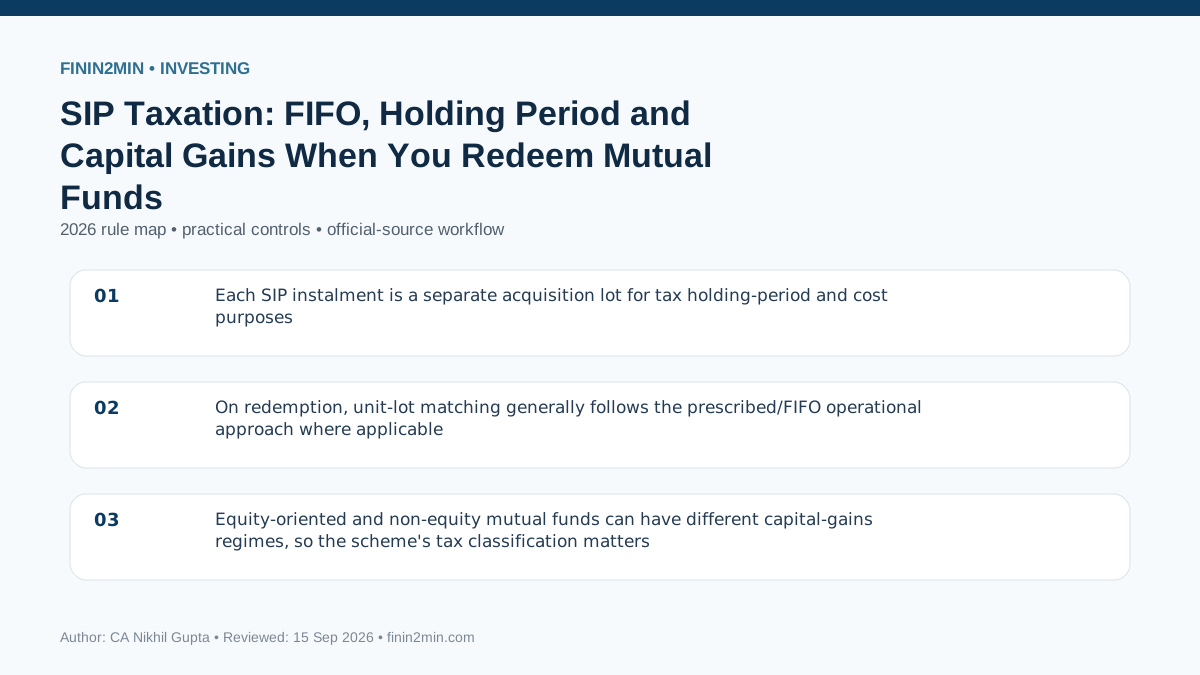
Every instalment buys a separate number of units at that day’s NAV. When units are redeemed, the relevant lot-identification convention—commonly FIFO within the folio—determines which units are treated as sold, and each lot has its own holding period and cost.
Current rule and what decides the result
A SIP is only a purchase method; tax applies lot by lot. Each monthly allotment has its own acquisition date and cost, and partial redemptions must respect the applicable lot-identification/FIFO mechanics for mutual-fund units. The tax rate then depends on what type of fund the redeemed lot belongs to—equity-oriented, specified debt-heavy fund or another unit—and on the holding period of that specific lot. One redemption can therefore contain both long-term and short-term gains even though the investor thinks of it as one SIP.
Key rules to apply
- Monthly SIP instalments create separate acquisition dates, quantities and costs.
- Mutual-fund statements/capital-gains reports commonly apply first-in-first-out within the relevant folio for redemption lot identification.
- For qualifying equity-oriented funds where section 111A applies, transfers on/after 23 July 2024 use the 20% STCG rate.
- Qualifying section 112A LTCG is taxed at 12.5% on aggregate eligible gains exceeding ₹1.25 lakh, subject to STT and statutory conditions.
- Debt-heavy specified mutual funds can be governed by section 50AA; other funds need their own category/holding analysis.
- A switch or systematic withdrawal is still a redemption/transfer of units and creates capital-gains lots even when money is automatically reinvested.
One redemption, two holding periods
An investor puts ₹10,000 a month into an equity-oriented fund for 24 months and then redeems enough units to realise ₹1.8 lakh of cost under FIFO. The earliest lots may have crossed the long-term holding threshold while later lots have not. The AMC statement may show one redemption amount, but the tax working must split the units into long-term and short-term buckets by allotment date, then apply the relevant section 112A/111A treatment to each bucket.
SIP in a specified debt-heavy fund
A taxpayer starts a ₹20,000 monthly SIP in May 2026 in a fund that falls within the post-2026 specified-mutual-fund definition. After 30 months, she redeems part of the holding at a ₹55,000 gain. A long calendar holding does not necessarily create LTCG for the covered lots because the specified-fund rule can deem the gain short term. FIFO still determines which purchase lots were redeemed, but classification controls the tax character.
How to apply it step by step
- Download the capital-gains statement with purchase/allotment dates and units.
- Confirm the tax classification of each scheme for the relevant year.
- Apply FIFO/lot identification to the units actually redeemed.
- Calculate cost and gain for every redeemed lot.
- Split lots into applicable long-term/short-term categories.
- For qualifying equity lots, aggregate annual section 112A gains before using the threshold.
- Reconcile redemption totals with CAS/AMC/bank records and AIS where reported.
- Preserve statements because future redemptions continue from the remaining lot inventory.
Common mistakes and edge cases
- Using the SIP start date for all units.
- Dividing total investment by total units and ignoring lot dates.
- Applying one tax rate to the entire redemption.
- Assuming every non-equity fund has the same post-2026 treatment.
- Forgetting that a switch is a redemption and therefore consumes FIFO lots.
FAQs
Is a SIP taxed differently from a lump-sum investment?
No special “SIP tax” exists; each SIP instalment creates a separate unit lot.
Can one redemption have STCG and LTCG?
Yes, because older and newer lots can fall into different holding-period buckets.
Which units are treated as sold first?
Apply the prescribed/accepted lot-identification method, commonly FIFO for mutual-fund redemption workings.
Does the SIP start date decide long-term status?
No. Each allotment date matters.
Does a fund switch trigger tax?
Yes, the old scheme is generally redeemed before the new scheme is purchased.
What is the best evidence?
AMC/CAS capital-gains statements plus transaction-level purchase and redemption records.
Related Finin2min guides
- SIP Mutual Fund Tax: The FIFO Rule Explained
- Capital Gains Holding Period: 12-Month vs 24-Month Rules
- Switching Between Mutual Funds? Why It Is a Taxable Event, Even Without Withdrawing Cash
- NRI Capital Gains on Indian Shares and Mutual Funds
- NRI Capital Gains on Investments
- Capital Gains on Shares and Mutual Funds: Rates, Records and Checklist
- NRI Capital Gains on Investments
- Shares and Funds: Capital Gains Checklist