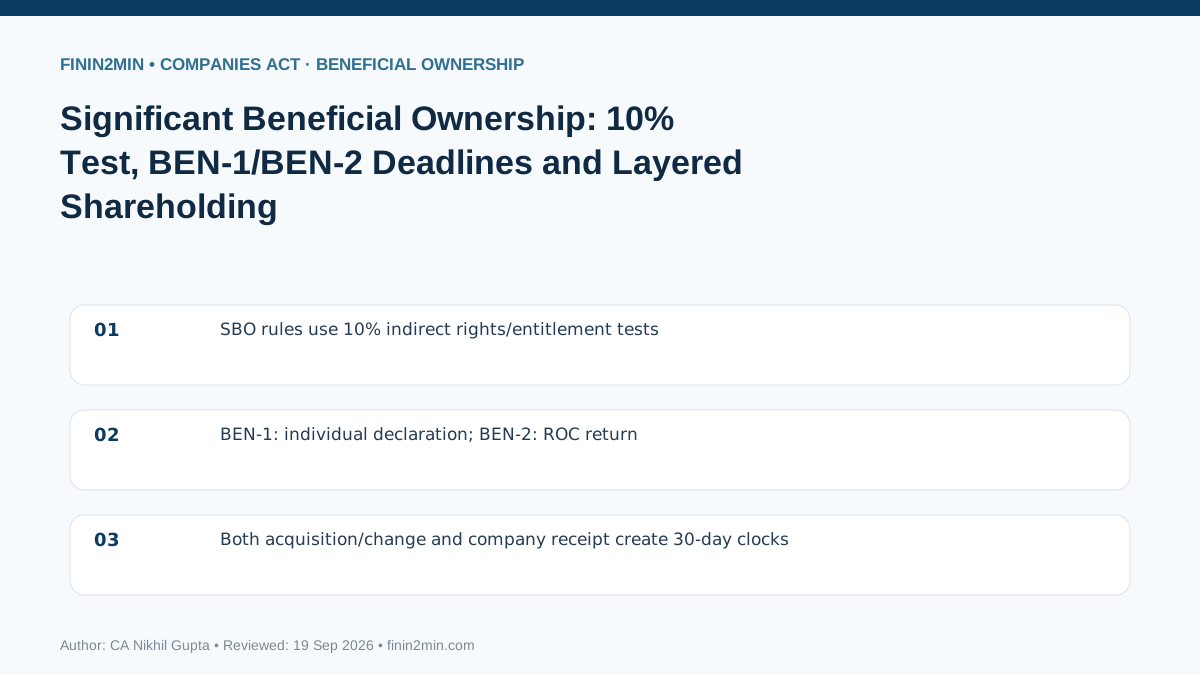
Section 90 compliance is about the natural person behind a corporate, trust or layered member — not merely the name on the register. The SBO Rules use a 10% rights/entitlement threshold for indirect ownership and also capture significant influence or control.
The 10% test is an indirect-ownership test
The Companies (Significant Beneficial Owners) Rules define an SBO as an individual who, acting alone or together or through one or more persons/trusts, has specified rights or entitlements in the reporting company. The prescribed objective thresholds are not less than 10% of shares, voting rights, or the right to receive/participate in distributable dividend or other distribution, where the holding is indirect alone or indirect together with direct holding. A separate limb captures the right to exercise, or actual exercise of, significant influence or control other than through direct holdings alone.
The practical consequence is that a company cannot stop at “Member = ABC Holdings Pte Ltd”. It must trace through ABC Holdings using the rule applicable to that member type until the relevant natural person or prescribed controlling person is identified.
Layered example
Indian Co is 60% owned by HoldCo A. Individual Riya owns 30% of HoldCo A. On a simple multiplication, Riya’s economic chain is 18% of Indian Co (60% × 30%). That arithmetic is a useful screening signal, but the SBO Rules do not rely only on multiplication: they prescribe how indirect rights are attributed depending on whether the member is a body corporate, HUF, partnership, trust or pooled investment vehicle.
If the applicable rule treats Riya as holding the requisite majority stake/control in the member entity and her indirect entitlement in the reporting company crosses the 10% test, BEN-1 analysis is required. If she merely owns a small minority in the upstream entity without the prescribed indirect-right condition, multiplying percentages alone can overstate SBO status.
BEN-1, BEN-2, BEN-3 and BEN-4 — who does what?
| Form/register | Responsibility | Timing/purpose |
|---|---|---|
| BEN-1 | Individual SBO | Declaration to reporting company within 30 days of acquiring SBO status or a change in significant beneficial ownership. |
| BEN-2 | Reporting company | Return to Registrar within 30 days of receiving the BEN-1 declaration, with prescribed fee. |
| BEN-3 | Reporting company | Register of significant beneficial owners maintained by the company. |
| BEN-4 | Reporting company | Notice seeking information where the company has reasonable cause to believe a person knows/holds relevant SBO information. |
The MCA BEN-2 instruction kit also expects portal registration, valid corporate identity data, valid DSC/signatory credentials and mandatory supporting documents. Treat BEN-2 as a corporate-record filing backed by an ownership memo, not as a data-entry exercise.
Reporting company’s duty is proactive
Section 90 and the Rules require the company to take necessary steps to find an SBO. A board cannot defend inaction merely by saying “no BEN-1 was received”. Review the register of members, shareholders agreements, voting arrangements, investment agreements, trust declarations, upstream corporate registers and publicly available ownership information. When reasonable cause exists, BEN-4 is the statutory information-seeking tool.
Build an ownership chart with a “basis” column at every layer: percentage shares, percentage votes, distribution rights, majority stake, trustee/beneficiary/author details for trusts, partnership rights, and any contractual significant influence/control. This makes the conclusion reviewable when investors change.
Restrictions can reach the shares
The Rules contemplate an application to the Tribunal under section 90 where required information is not forthcoming. Restrictions can include transfer restrictions, suspension of dividend rights, suspension of voting rights or another restriction on rights attached to the shares in question. This turns SBO compliance from a filing issue into a governance/cap-table issue during fundraising, dividend declaration or an exit.
Penalty exposure
The current Companies Act text should be checked at the time of default because section 90 penalties have been amended over time. The post-amendment framework commonly applied by MCA adjudication orders imposes monetary penalties on an SBO who fails to declare and separate penalties on the company/officers for failures such as maintaining/filing the required SBO information or taking necessary steps. Recent MCA adjudication material applies a ₹50,000 base penalty plus ₹1,000 per continuing day for the individual, capped at ₹2 lakh, under section 90(10); company/officer exposure under section 90(11) is separately capped.
Do not rely on an old handbook showing imprisonment/fine wording without confirming the amendment in force for the default period. The compliance file should cite the current Act and the actual date range of non-compliance.
Worked compliance timeline
Assume an upstream transaction closes on 10 June and causes an individual to become an SBO of the Indian reporting company. If BEN-1 is required, the individual should file the declaration with the company within 30 days of acquiring SBO status. Suppose the company receives BEN-1 on 5 July; the company then has its own 30-day BEN-2 clock from the date of receipt.
Do not collapse these into a single 30-day deadline from 10 June. The individual’s declaration deadline and the company’s ROC return deadline are separate statutory events supported by separate evidence.
Transaction checklist for CFO/CS teams
- Obtain the post-transaction cap table before signing and at closing.
- Trace every non-individual member through the appropriate Rule 2 pathway.
- Test shares, voting rights, distribution rights and significant influence/control separately.
- Ask whether persons are acting together; document the conclusion.
- Issue BEN-4 where reasonable cause exists and information is incomplete.
- Collect BEN-1 within the statutory timeline from each identified SBO.
- Prepare BEN-2 with the supporting ownership chart and declaration.
- Update BEN-3 and board/compliance records.
- Re-run the test after allotments, transfers, rights issues, trust changes or shareholder-agreement amendments.
How to trace through different member types
The SBO exercise begins with the reporting company’s register of members and then follows the ownership/control chain until the relevant individual is identified. A corporate shareholder requires a look through its ownership chain; a partnership or LLP requires tracing the individuals who hold the relevant economic/control interest through that vehicle; a trust requires identifying the persons specified by the SBO rules for the trust structure. The compliance team should document the path rather than record only the final individual’s name.
For body-corporate chains, do not stop at the first holding company merely because it is incorporated in India or is itself regulated. The core question is whether an individual holds the prescribed indirect right or exercises significant influence/control through one or more layers. If the company concludes no SBO exists, retain the ownership chart and evidence that supports that conclusion.
Layered example. Individual R owns 60% of HoldCo A. HoldCo A owns 20% of the reporting company. R’s indirect economic interest traced through that chain is 12% (60% × 20%). That crosses a 10% indirect beneficial-interest marker. The analysis should then test the other rule conditions/exclusions and capture the BEN-1/BEN-2 obligations; it should not stop at the statement “R is not on our register of members”.
BEN forms: the evidence chain should be internally consistent
| Form / record | Who / purpose | Control point |
|---|---|---|
| BEN-1 | Declaration by the individual SBO to the reporting company | Acquisition/change should be captured within the prescribed 30-day period. |
| BEN-2 | Company’s return to Registrar after receiving the declaration | File within 30 days of receipt of the declaration and match the ownership chart. |
| BEN-3 | Company’s register of significant beneficial owners | Maintain current particulars and update changes. |
| BEN-4 | Notice by the reporting company seeking information | Use when the company knows or has reasonable cause to believe a person may be an SBO / know the SBO chain. |
A filing team should reconcile the percentages, dates and intermediary names across BEN-1, BEN-2, the share register and the ownership chart. A BEN-2 that technically uploads but cannot be reproduced from the underlying cap table is a poor compliance record.
Events that should trigger a fresh SBO review
Do not treat SBO as an annual secretarial checklist. Review the chain when there is a share transfer, rights issue, conversion of instruments, upstream fundraise, merger/demerger, trust restructuring, change in voting arrangement, shareholders’ agreement amendment or change in a holding entity’s cap table. A movement several layers above the Indian reporting company can change the individual’s indirect percentage even though the Indian company issued no shares.
For transactions, make SBO confirmation a condition-precedent/deliverable where the ownership chain is material. Ask for pre- and post-closing organisation charts and a statement of persons with significant influence/control. This turns BEN compliance into a transaction control rather than a forensic exercise after the event.
Restrictions are a governance risk, not just a filing fee
Section 90 gives the company a route to approach the Tribunal where required information is not supplied or is unsatisfactory, with potential restrictions on the shares concerned. The practical risk is therefore larger than a late-form charge: voting, transfer or distribution rights linked to those shares can become part of the dispute. Boards and company secretaries should escalate unanswered BEN-4 notices early and preserve delivery evidence.
Penalty figures and section text have been amended over time. For a live default, verify the current Companies Act text on the date of breach before quoting an amount in a notice or board paper; the article’s filing workflow should not be used as a substitute for that dated legal check.
Do not multiply percentages mechanically when control rights tell a different story
Percentage tracing is a useful first screen, but the SBO rules also capture specified voting/distribution rights and significant influence or control. A shareholders’ agreement, veto right or management arrangement can therefore matter even where a simple multiplication of equity percentages appears below 10%. The compliance file should include shareholder agreements and constitutional documents, not just a spreadsheet of issued shares.
Conversely, a direct holding should not be labelled “indirect SBO” without applying the rule structure. Document which limb is being used—shares, voting rights, distributable dividend/economic interest, or significant influence/control—and how the individual satisfies the indirect-holding condition. That explanation makes BEN filings defensible during due diligence.
SBO FAQs
Is the SBO threshold 25%?
Section 90 permits a prescribed percentage; the SBO Rules prescribe 10% for the key share/vote/distribution rights tests.
Does direct 10% ownership alone always create SBO status?
The Rules focus on indirect holding, alone or together with direct holding, and separately significant influence/control. A purely direct holder is analysed under the specific rule language rather than by a simplistic 10% label.
When is BEN-1 due?
For a person who acquires SBO status or whose SBO changes, within 30 days of the acquisition/change under Rule 3.
When is BEN-2 due?
Within 30 days from the reporting company’s receipt of the declaration.
What is BEN-4?
A notice by the reporting company seeking information about significant beneficial ownership.
Can voting/dividend rights be restricted?
The Rules provide for Tribunal applications seeking restrictions including transfer, dividend and voting-right restrictions in relevant non-compliance cases.
Primary sources
Use the cited instrument or regulator guidance for the proposition described above; check later amendments and transaction-date rules before acting.
Educational information only. Tax, legal, banking and insurance outcomes depend on facts, dates and the instrument/policy in force. Obtain professional advice for material transactions.