80JJAA new employment deduction: 30% claim under section 146
📄 Download the PDF edition (free sign-in)

Finin2min 2-minute summary
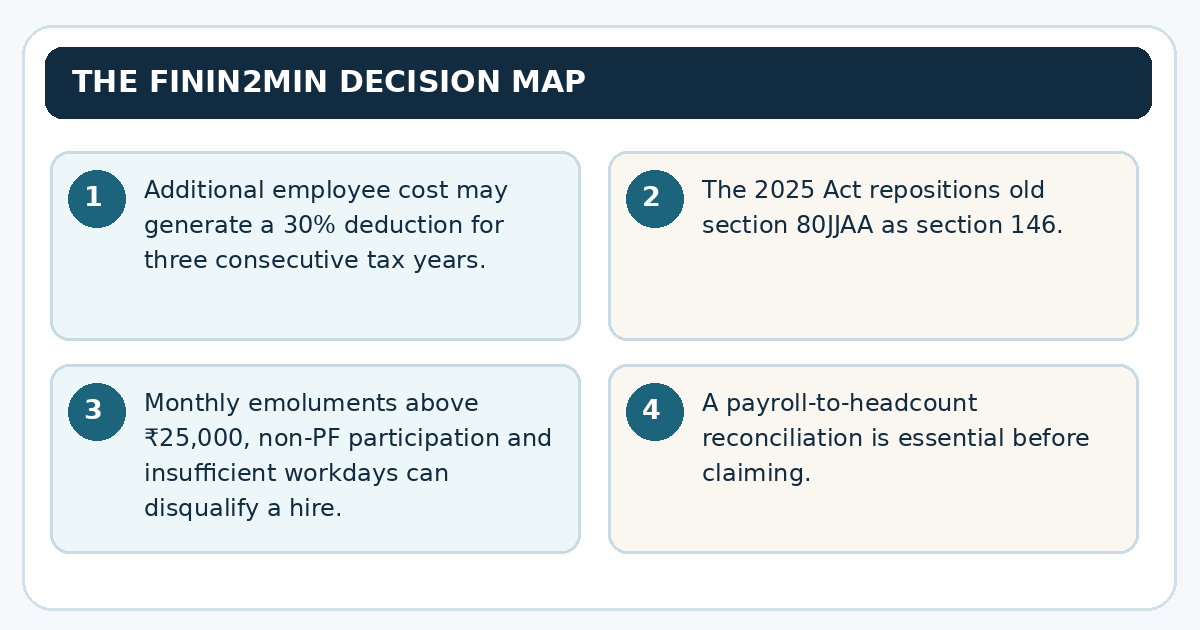
- Additional employee cost may generate a 30% deduction for three consecutive tax years.
- The 2025 Act repositions old section 80JJAA as section 146.
- Monthly emoluments above ₹25,000, non-PF participation and insufficient workdays can disqualify a hire.
- A payroll-to-headcount reconciliation is essential before claiming.
Why a headcount increase is not automatically deductible
Recruiting ten people is not enough to establish an additional-employee deduction. Under section 146 of the Income-tax Act 2025, the taxpayer must be covered by the prescribed tax-audit framework, have business income and satisfy detailed definitions of additional employee and additional employee cost. The rules operate employee by employee. Staff replacement may not increase overall headcount. A costly specialist earning above ₹25,000 monthly falls outside the defined additional employee category, even when genuinely recruited. A claim prepared purely from year-end payroll expense may miss all these filters.
Count people before calculating cost
Build an employee movement register that begins with preceding year-end headcount. Record each joining and leaving date, workdays in the current and immediately succeeding tax year, monthly emoluments, recognised provident fund membership, payment mode, and whether government paid the entire eligible pension contribution. Under section 146, an additional employee generally needs 240 working days; manufacturing of apparel, footwear or leather products has a 150-day threshold. A qualifying employee meeting the day condition in the following tax year can be treated under the statutory deferred-recognition rule. These details matter more than a simple net headcount increase.
What enters the deductible cost base
Emoluments broadly capture remuneration paid or payable for employment. The definition expressly excludes certain statutory employer contributions and termination-related lump sums such as gratuity, severance, leave encashment and analogous benefits. Remove ineligible remuneration and exclude non-qualifying hires before summing the additional employee cost. For an established business, a lack of increase over prior year-end total employee count can make the additional employee cost nil. The statute also disallows the relevant cost when payment conditions are not met. Never base the deduction on the gross HR cost-centre total without these statutory reconciliations.
Worked case: manufacturing compared with services
Assume a qualifying manufacturer of apparel adds six production employees at ₹22,000 monthly pay each. Four complete at least 150 days in the tax year and meet all other conditions; two complete fewer days. If the first four are paid for eight eligible months, their illustrative qualifying emoluments are 4 × ₹22,000 × 8 = ₹7,04,000, giving a tentative annual deduction of ₹2,11,200 at 30%. The other two cannot be included merely because their appointment letters were issued before year-end; review the following-year relaxation. For a software-service business, do not reuse the 150-day cut-off: the ordinary 240-day test applies.
Multi-year claim schedule and attrition
The 30% amount is allowed for three consecutive tax years starting with the year the qualifying employment is provided, subject to the statute. Maintain a separate three-year cohort register for each hiring year rather than recalculating every historical cohort from the latest headcount. The filing year can include current qualifying hires and second- or third-year instalments from earlier cohorts. Work out the timing of deferred employees who meet their days in the next tax year. To avoid double counting, reconcile the three-year deduction register to a unique employee ID and original qualifying cost figure.
Audit trail and accountant report
Section 146 requires a prescribed accountant report before the specified date. HR should certify joiners, leavers, eligibility, PF membership and day counts; payroll should sign off emoluments and bank-payment evidence; the tax function should review section 63 applicability and the three-year computation. Keep PF contribution records, appointment and exit letters, headcount reports, bank transfers, pay register and previous return claims in a single file. Differences between income-tax return schedules, PF ECR and the payroll ledger invite questions; prepare explanations rather than editing source data to force agreement.
Things CFOs should not promise
The deduction is not a refund of 30% of salaries. It reduces taxable business profits when the taxpayer qualifies. Its cash-tax value depends on the relevant tax rate, taxable income and any restrictions under the chosen tax regime. It does not replace labour-law, EPF or payroll-TDS duties. A new hire on high salary may be good for the business and still fail the tax definition. Finance should forecast potential benefit before approving an annual budget but recognise it only after the legal conditions and accountant report are actually satisfied.
The payroll datapoints that change the answer
Consider a company that hires eight employees in March and loses five in April. A snapshot taken on 31 March alone does not answer the three-year deduction claim. The controller must test whether the original employees were additional against the prior year-end base, their individual qualification days, eligible monthly remuneration and recognised PF participation. Where employees fall under the following-year day-count rule, their deduction cohort may begin later than HR expected. HR and tax teams should jointly approve an employee inclusion/exclusion schedule; preserving failed cases with reasons is as important as preserving the successful employee records. This makes tax-audit challenges easier to explain.
Practitioner checklist
- Reconcile starting headcount to approved payroll registers.
- Document statutory day count for each joining employee.
- Exclude remuneration over the monthly statutory ceiling.
- Match PF membership and electronic salary payment evidence.
- Keep three years of cohort claim history.
Frequently asked questions
Section 146 of the Income-tax Act 2025.
No. It is 30% of defined additional employee cost, subject to eligibility.
Yes; the additional employee definition excludes an employee whose total emoluments exceed ₹25,000 per month.
No; it is a specific exception for manufacturing apparel, footwear or leather products.
Yes, statutory exclusion applies when a person does not participate in a recognised provident fund.
Yes, subject to section 146 and correct cohort accounting.
Official sources and statutory trail
Educational information, not individual tax, legal or accounting advice. Verify the period, instrument, eligibility, filings and latest official guidance before acting.