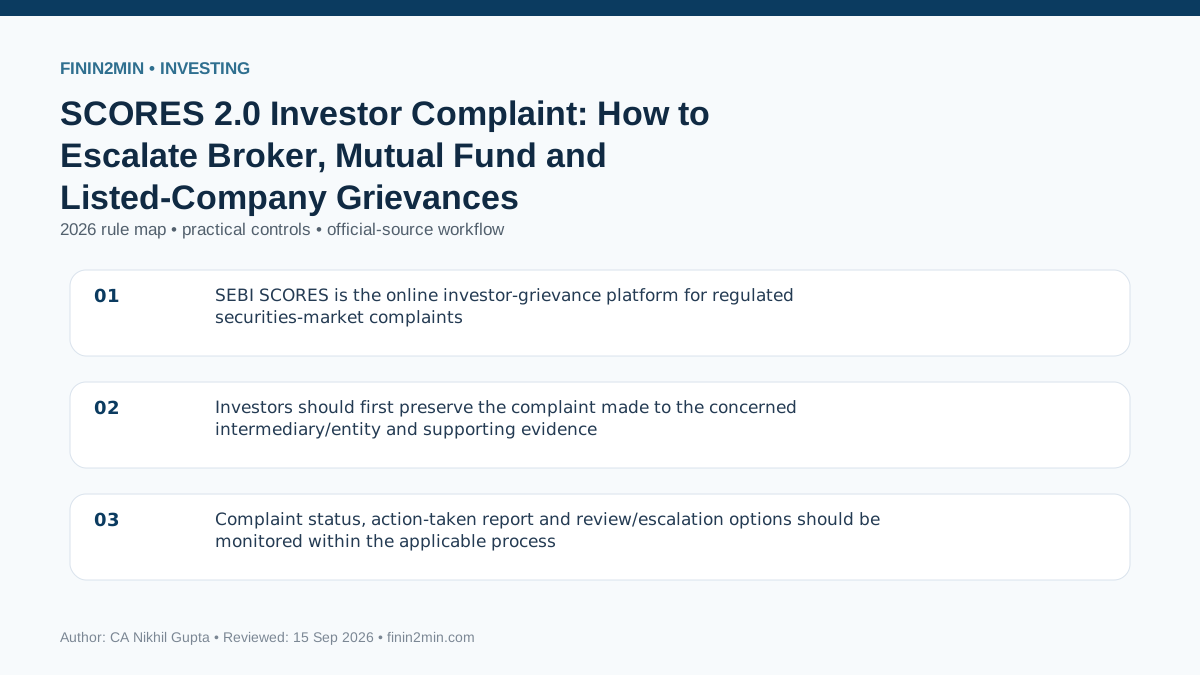
SCORES is SEBI’s online grievance-redress platform for complaints against entities within its regulatory remit. It is not the first step for every problem: the investor should normally first approach the broker, mutual fund, RTA, listed company or other concerned entity.
Current rule and what decides the result
SCORES 2.0 is SEBI's electronic grievance system for complaints against regulated entities, but the investor should normally first approach the broker, AMC, RTA, listed company or other concerned entity. Under the current workflow, the entity is generally expected to submit an Action Taken Report (ATR) within 21 calendar days. The investor then has a 15-day review window if dissatisfied; the designated body has a time-bound first-review stage, and a further review can reach SEBI. SCORES is a grievance/escalation trail, not a substitute for every contractual claim, arbitration or Online Dispute Resolution route.
Key rules to apply
- SCORES then creates a time-bound electronic trail, including an Action Taken Report and review stages if the investor remains dissatisfied.
- Use the regulated entity’s grievance channel first and keep the complaint/ticket number; SCORES is designed to escalate unresolved issues.
- The entity is generally required to submit an Action Taken Report within 21 calendar days on SCORES.
- After the ATR is available, the investor gets a limited review window—15 days under the SCORES 2.0 FAQ—to indicate dissatisfaction and seek review.
- The designated body/reviewing authority gets the prescribed period, including a 10-day stage under the current workflow, to examine the grievance.
- A further review/escalation can reach SEBI under the platform timelines if the investor is still dissatisfied.
Broker complaint escalation
An investor complains to a broker on 1 September about an unauthorised charge and receives no satisfactory response. The investor files SCORES with the original ticket, ledger and email evidence. If the entity uploads an ATR, the investor should read it promptly rather than let the 15-day review window expire. A generic 'resolved' status with no ledger correction can be challenged through the review stage using the exact unresolved amount and evidence.
Mutual-fund service issue
An AMC/RTA rejects a transmission request despite the investor having submitted the prescribed documents. The investor first uses the AMC/RTA grievance channel, then files SCORES with the rejection, folio, acknowledgement and regulatory checklist. If the dispute becomes a monetary/legal dispute that falls within ODR/arbitration, the investor should not assume SCORES itself will adjudicate damages like a court or arbitrator.
How to apply it step by step
- Raise the complaint with the regulated entity first and preserve the ticket/reference number.
- Allow the entity its stated grievance-response time unless urgent regulatory grounds justify escalation.
- File SCORES with concise issue, amount/date and supporting documents.
- Track the ATR and compare it with the exact relief requested.
- If dissatisfied, use the 15-day investor review window rather than letting the complaint close.
- Escalate through the designated-body/SEBI review stages within the displayed deadlines.
- Where appropriate, evaluate ODR/arbitration or other legal routes for adjudicatory relief.
- Download final statuses and correspondence for the evidence file.
Common mistakes and edge cases
- Filing SCORES before contacting the regulated entity without reason.
- Writing a long narrative with no transaction/date/amount evidence.
- Missing the 15-day review window after an ATR.
- Assuming “closed” means the underlying money dispute was adjudicated.
- Using SCORES for an entity outside SEBI’s jurisdiction.
FAQs
Should I contact the broker/AMC first?
Yes, that is ordinarily the first grievance step before SCORES escalation.
How quickly should an ATR be filed?
The current SCORES 2.0 framework generally gives the regulated entity 21 calendar days.
What if I dislike the ATR?
Use the investor review window—generally 15 days—to seek review with specific reasons.
Does SCORES award compensation?
It is primarily a grievance-redress/escalation platform; adjudicatory or ODR remedies can be separate.
What evidence should I upload?
Ticket/reference, statements, contract notes/folio details, emails and the exact relief sought.
Can a complaint reach SEBI review?
Yes, the workflow includes time-bound review/escalation stages when the investor remains dissatisfied.
Related Finin2min guides
- SEBI SCORES Complaint: How Investors Should Escalate Properly
- SEBI SCORES: Complaint Workflow
- SEBI SCORES Complaint File: How Investors Should Document Grievances
- SEBI SCORES: Complaint Workflow
- Mutual Fund Scheme Merger: Cost, Tax Lot and Investor-Choice Checklist
- Mutual Fund Mergers: Investor Checklist, Tax Character and Return-Filing Treatment
- How Mutual Fund NAV Works: Calculation, Myths & What Actually Matters
- How to Choose a Mutual Fund in India: A Practical Checklist