Audit evidence
Audit Sampling under SA 530: Selection, Evaluation and Risk-Based Examples
By Finin2min Editorial Desk · Reviewed by CA Nikhil Gupta · Last reviewed 9 October 2026
📄 Download the PDF edition (free sign-in)
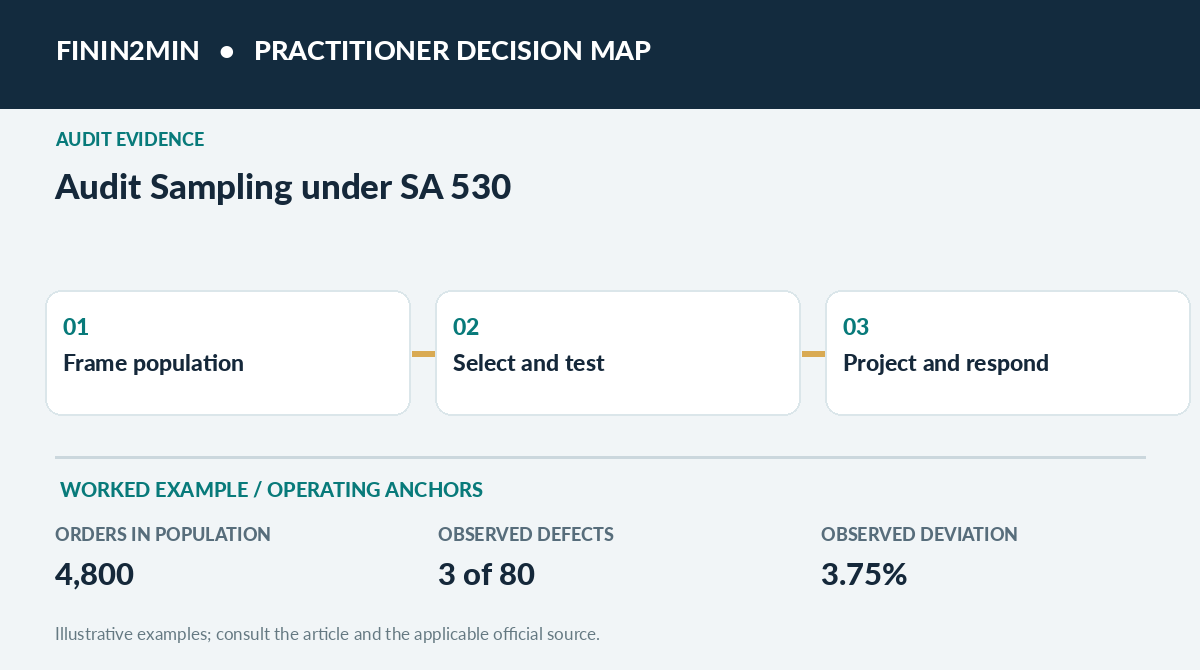
Sampling is an evidence method, not a magic sample-size formula
SA 530 applies when audit procedures are performed on less than 100% of a population so that each sampling unit has a chance of selection. The auditor designs a sample that supports a reasonable conclusion about the population, taking account of the objective, population characteristics, risk, tolerable misstatement or deviation, and likely errors. A calculator may organise inputs but cannot determine sample size uniquely without method-specific assumptions.
Sampling risk is the danger that a conclusion drawn from the selected items differs from the conclusion obtained by testing the population. Non-sampling risk is different: poor test design, misreading a document or ignoring a forged invoice can cause failure even with a large sample. Distinguish statistical approaches, which support a probability-based quantification of sampling risk, from non-statistical professional judgment, which still requires unbiased selection and proper evaluation.
At-a-glance reference table
| Sampling consideration | Interpretation | Follow-up |
|---|---|---|
| 4,800 purchase orders | Population | Reconcile extract |
| 80 selected items | Example method | Document selection |
| 3 deviations | 3.75% observed | Investigate causes |
| Population conclusion | Sampling-risk sensitive | Assess reliance and further work |
Define the objective and population before counting samples
For a purchase-control test, define an exception precisely: for example, absence of evidence of approval before purchase-order release. The population might be all approved purchase orders issued in the period, excluding legitimately cancelled documents only under a documented rule. For a substantive receivables test, the units may be invoice balances or monetary units; decide whether credit balances, disputed debtors or related-party balances require separate treatment.
Check the completeness and reliability of the extract. Sequence gaps, manual entries, excluded warehouses, post-year-end reversals and duplicate transaction identifiers must be investigated before selecting items. A scientifically chosen sample from an incomplete population still generates an unreliable audit conclusion.
Attribute sampling: an illustrative control test
Suppose a manufacturer processed 4,800 purchase orders. A risk assessment determines that a prior approval control is important, but two identified exceptions in a preliminary review raise concern. The auditor decides to test 80 randomly selected orders under an engagement-specific methodology—not because 80 is prescribed by SA 530. Three selected orders lack timely approval, giving an observed deviation rate of 3/80, or 3.75%.
It is wrong to report that the population deviation rate is proven to be exactly 3.75%. A statistical evaluation adds sampling-risk allowance; a non-statistical evaluation judges whether the observed results are consistent with planned reliance. The auditor investigates why each deviation occurred, whether a compensating control genuinely operated, and whether findings require more testing or a changed control-reliance strategy.
Substantive sampling: monetary misstatement
Assume a 200-invoice sample is drawn from an invoiced sales population of ₹18 crore using a documented selection plan. Within the sample, invoices representing ₹2 crore contain net errors of ₹4 lakh. A simplistic ratio projection would be ₹4 lakh / ₹2 crore × ₹18 crore = ₹36 lakh, before risk allowance. This is an illustration of projection mechanics, not an SA 530-approved universal estimate. A ratio estimate may be inappropriate where values are heterogeneous or errors do not behave proportionately.
Evaluate the projected amount against tolerable misstatement, any anomalous-error conclusion and the audit evidence from independently tested high-value items. Investigate the nature and cause of each error; fraud indicators trigger a different response from arithmetic mistakes. Where results are inadequate, extend testing, change substantive procedures or ask management to investigate the population.
Sample selection methods and when they fail
Random-number selection reduces conscious preference if the full population frame is sound. Systematic selection with a random start can be efficient, but a recurring pattern in the source records may align with the interval. Haphazard selection is not equivalent to judgementally choosing the nearest files; it must avoid conscious bias. Block sampling of one week cannot ordinarily be treated as representative of a twelve-month sales population when controls and business conditions change through the year.
The largest or individually significant balances may be tested separately outside a representative sample. Clearly label this targeted testing and avoid implying that conclusions from such items automatically cover the remainder.
Documentation and supervisory review
Retain population parameters and reconciliation, sampling unit, selection rationale, seed or reproducible method, sample IDs, exact evidence requested, deviations, projected misstatements, sampling-risk assessment and final audit response. Reperform calculations independently; ensure that repeated items are counted according to the design. The supervisor should be able to recreate selection and identify why rejected items were replaced.
Stratification and dual-purpose testing
An auditor with ₹25 crore of trade receivables might select all balances above ₹50 lakh for individual testing and sample the remainder by age, size or risk class. This is stratification: it can improve audit efficiency by separating units with distinct error characteristics. However, the inference from the sample applies only to its tested stratum; independently examined items and other strata are evaluated separately. A high-risk disputed balance should not be allowed to disappear inside a broad random pool merely because its amount is below average.
A single invoice may support multiple procedures, such as checking existence and evidence of approval, but the sample design for substantive misstatement is not interchangeable with the sample design for a control-deviation objective. Different populations, deviations and tolerable limits may apply. For work done using computer-assisted techniques, retain the exported population, query filters, extraction date and reproducible selection seed. If controls changed midyear, inspect the implementation date and consider separately testing periods before and after the change.
Questions readers ask
Is a sample of 30 always enough?
No; sufficiency depends on risk, population, test objective and evaluation method.
Can auditors select only the biggest entries?
They can perform targeted tests, but that is not a representative random sample.
Does zero exceptions prove the control never failed?
No, it reduces uncertainty under the selected design but does not prove zero population deviations.
Should fraud risk change sampling?
Often; targeted unpredictability and substantive responses may be necessary.
Can sample conclusions be generalised?
Only within the properly defined population and evaluated method.
Must software create the sample?
No, but the selection should be unbiased and documented.
Official sources
Related reading on Finin2min
- Business ITR Without Tax Audit: Form Selection Guide
- F&O Turnover for Tax Audit: ICAI Method & Examples
- Section 44AD Opt-Out: Five-Year Lockout and Audit Risk
- Tax Audit Bank Reconciliation: High-Risk Items, Cut-Off and Evidence
- Companies Act, 2013 study guide hub
Disclaimer: Educational information, not individual tax, legal, accounting or investment advice. Check the current law, standards and notifications for the relevant period and take professional advice before acting.