Audit methodology
SA 320 Audit Materiality: Benchmark, Performance Materiality and Worked Case
By Finin2min Editorial Desk · Reviewed by CA Nikhil Gupta · Last reviewed 9 October 2026
📄 Download the PDF edition (free sign-in)
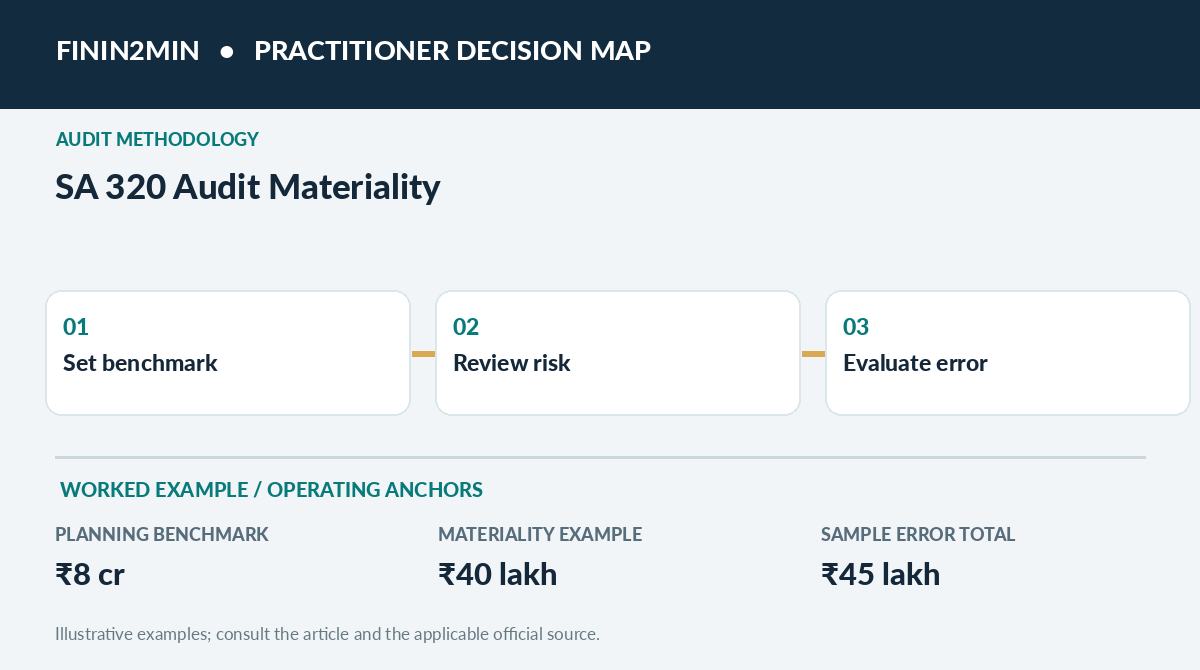
What materiality actually answers
SA 320 addresses the amount or nature of misstatement that could reasonably influence financial-statement users. It does not prescribe a single numerical percentage for every audit. The same ₹5-lakh error may be immaterial to a very large group yet material to a loss-making start-up, debt covenant calculation or director-remuneration disclosure. Materiality is a professional judgment informed by the reporting framework, user needs, benchmark stability and surrounding circumstances.
The auditor establishes overall financial-statement materiality during planning and also considers whether particular classes of transactions, balances or disclosures need a lower threshold. Performance materiality is a smaller amount chosen to reduce the probability that the aggregate of uncorrected and undetected errors exceeds the overall level. SA 450 separately addresses evaluation of identified errors at the end of the audit; a below-threshold item cannot be ignored automatically.
At-a-glance reference table
| Illustrative item | Value | Nature |
|---|---|---|
| Normalised profit before tax | ₹8 crore | Hypothetical benchmark |
| Overall materiality, assumed 5% | ₹40 lakh | Firm judgment, not mandated |
| Performance materiality, assumed 70% | ₹28 lakh | Risk dependent |
| Uncorrected differences total | ₹45 lakh | Requires SA 450 evaluation |
Choosing an appropriate benchmark
Possible benchmarks include profit before tax, total revenue, gross assets, net assets or total expenses. A stable profit-oriented company often directs attention to earnings; a charitable entity may make expenses more relevant; an investment-holding company may require a net-asset or total-asset perspective. Recurrent versus exceptional gains can distort the profit denominator. Explain why the selected base reflects likely users of those particular financial statements.
Some audit firms use percentage ranges as internal starting points, but no illustrative percentage in this article is an ICAI-mandated SA 320 rate. Test whether a selected benchmark makes sense relative to debt covenants, related-party dealings, fraud susceptibility, capital maintenance, liquidity and disclosures that are important by nature rather than size.
Fully worked materiality illustration
Suppose an engineering company earns normalised profit before tax of ₹8 crore. As a hypothetical audit-firm planning assumption, the team selects 5% of that amount, producing overall materiality of ₹40 lakh. Based on prior errors and control risk it chooses performance materiality at 70% of overall materiality: ₹28 lakh. It separately records a proposed clearly-trivial posting threshold of ₹2 lakh. None of these percentages is a statutory safe harbour.
During testing the auditor identifies an uncorrected warranty provision understatement of ₹19 lakh, revenue cut-off overstatement of ₹14 lakh and inventory overstatement of ₹12 lakh. Aggregate misstatement requiring evaluation is ₹45 lakh before considering offsetting effects, qualitative issues and any projection of sampling errors. Even if a single item is smaller than ₹40 lakh, the combined position exceeds the illustrative overall materiality. Discuss adjustments and the implications for opinion and procedures; do not net unrelated errors mechanically.
Account-specific thresholds and risk response
Where management remuneration, regulatory capital, related-party transactions or a sensitive covenant disclosure could influence decisions at a smaller amount, record specific materiality. The audit team should not confuse materiality with tolerable misstatement for one sample or with control-deviation tolerance. Use the assessed risks under SA 315 and response design under SA 330 to determine further testing; a high inherent fraud risk may justify targeted procedures regardless of numerical size.
Planning materiality can be revised when earnings forecasts change or unexpected transactions alter the relevant user benchmark. SA 320 explicitly requires documentation of chosen amounts, factors and later changes. Changes late in the audit may require revisiting sample coverage, analytical expectations and findings already cleared.
Evidence and partner review
The file should contain benchmark alternatives, rationale, annualisation or normalisation adjustments, numerical recalculation, user assumptions, specific materiality decisions, performance materiality, the clearly-trivial threshold if one is used, revisions, accumulated differences and SA 450 conclusions. Link every reporting unit to group materiality decisions where a group audit is involved; do not simply copy the parent figure to every subsidiary.
A spreadsheet becomes risky when a single input hides the reason for the decision. The number is an output of the documented audit approach; it is not a substitute for that approach.
Common mistakes to prevent
Using the client’s desired profit as the benchmark without corroboration; suppressing qualitative errors; failing to aggregate uncorrected differences; treating performance materiality as the amount allowed to remain wrong; and applying the same rate to every business are frequent weaknesses. Another is not revisiting work after the financial statements change substantially near sign-off.
Sensitivity of the benchmark changes the audit plan
If the company's profit unexpectedly falls from ₹8 crore to ₹3 crore because a key product is recalled, continuing to rely automatically on the original ₹40-lakh overall threshold may make the planned procedures insufficient. The audit partner revisits the benchmark and considers whether revenue, gross assets or normalised performance now better represent users' needs; the choice must be justified rather than altered to achieve a desired outcome. A revised smaller materiality may require extending previously completed tests, reviewing uncorrected differences and reassessing the chance of aggregate undetected misstatement.
For group audits, different subsidiaries may have individual component performance-materiality amounts. The aggregation of possible misstatements across components deserves careful planning. A small error repeated across many reporting units can become material for the group even where each component did not trigger local reporting. Materiality can also affect the precision of analytical procedures and how management's estimate bias is assessed.
Questions readers ask
Does SA 320 require 5% of profit?
No. A percentage can be an illustrative methodology only; professional judgment is required.
Is performance materiality the same as overall materiality?
No; it is set lower for planning and audit procedures.
Can a small related-party omission matter?
Yes, nature or context may make it material.
Are all differences below overall materiality acceptable?
No; evaluate aggregation and qualitative circumstances under SA 450.
Must materiality be revised?
When new information would have changed the planning determination, SA 320 requires revision.
Can this worksheet issue an audit conclusion?
No. It supports but cannot replace sufficient appropriate evidence and partner judgment.
Official sources
- ICAI SA 320 text - requirements paragraphs 10-14
- ICAI SA 450 - misstatement evaluation
- ICAI Implementation Guide to Materiality
Related reading on Finin2min
- Sectoral Fund CAGR Performance: Formula, Worked Example &
- Withdrawal under Section 12A: Commercial Impact with Worked Case Scenario
- Homebuyer Creditors: Commercial Impact with Worked Case Scenario
- Relinquishment vs. Realisation of Security: Commercial Impact with Worked Case Scenario
- Companies Act, 2013 study guide hub
Disclaimer: Educational information, not individual tax, legal, accounting or investment advice. Check the current law, standards and notifications for the relevant period and take professional advice before acting.