RBI Raises Repo Rate to 5.50%: What the October 2026 Policy Means for India
The repo rate rose to 5.50% as strong growth, rising inflation risks, surplus liquidity and rapid credit expansion changed the policy outlook.
📄 Download the PDF edition (free sign-in)
Finin2min 2-Minute Summary
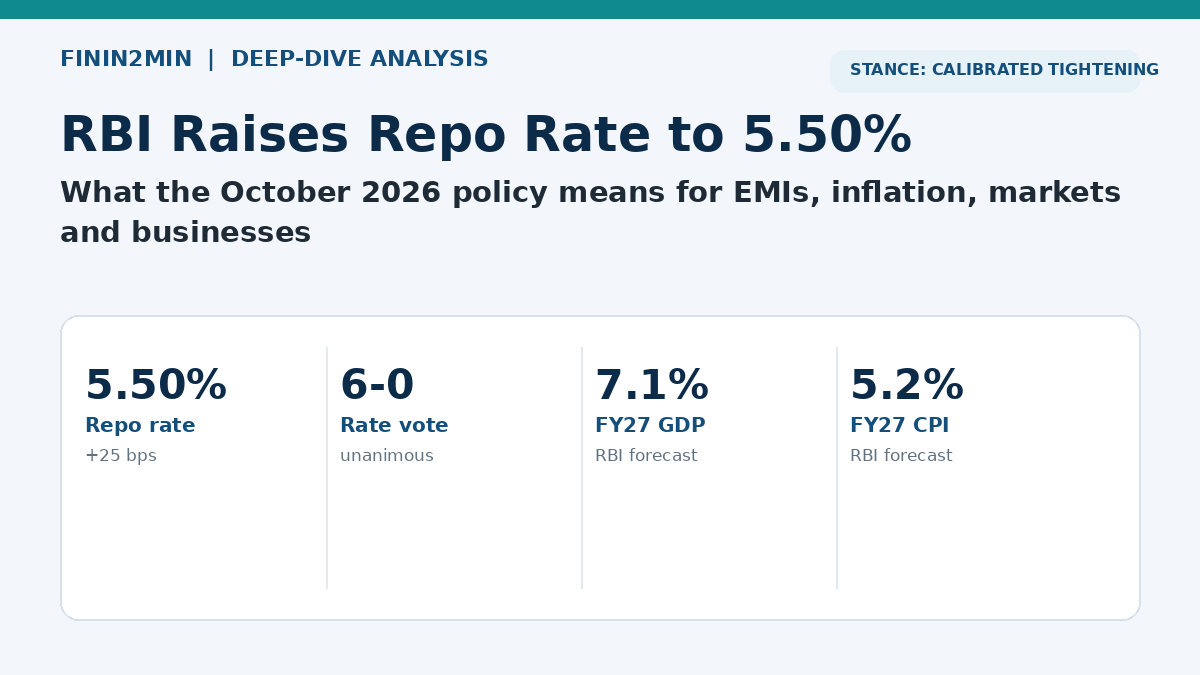
- RBI raised the repo rate by 25 bps to 5.50%. The rate vote was unanimous at 6-0. SDF is 5.25%; MSF and Bank Rate are 5.75%.
- The bigger signal is the stance. The MPC moved from neutral to calibrated tightening. Four members supported that stance; Dr. Nagesh Kumar and Prof. Ram Singh preferred neutral.
- Growth remains strong enough to absorb restraint. RBI raised FY2026-27 real GDP growth to 7.1%, while lifting CPI inflation to 5.2%; Q3 CPI is projected at 6.0% and Q4 at 5.7%.
- Liquidity complicates transmission. The average daily surplus in the system's net LAF position since the August MPC was ₹5.9 lakh crore. RBI is using liquidity operations to keep overnight rates aligned with the policy rate.
- For households and markets, transmission will be uneven. Floating-rate borrowers may face higher costs after contractual resets; FD rates need not rise one-for-one; long-duration bonds and leveraged/rate-sensitive businesses face the clearest first-order pressure.
1. What RBI changed
The Monetary Policy Committee met from 5 to 7 October 2026, chaired by RBI Governor Sanjay Malhotra. It increased the policy repo rate by 25 basis points, from 5.25% to 5.50%. The repo-rate decision was unanimous.
The MPC also changed its stance from neutral to calibrated tightening. The resolution records two members - Dr. Nagesh Kumar and Prof. Ram Singh - as preferring to retain the neutral stance. Put differently, all six backed the rate hike, while four supported the new stance and two preferred neutral.
Official source: RBI MPC Resolution, 7 October 2026.
2. Why RBI acted: the growth-inflation trade-off changed
The decision is best understood as a change in risk balance rather than a reaction to one inflation print. Real GDP grew 7.8% in Q1 FY27, and RBI now projects 7.1% growth for FY27. At the same time, August CPI inflation rose to 4.8%, core inflation to 4.2%, and core excluding precious metals to 2.9%. RBI also noted that about 37% of the weighted CPI basket was recording inflation above 4%.
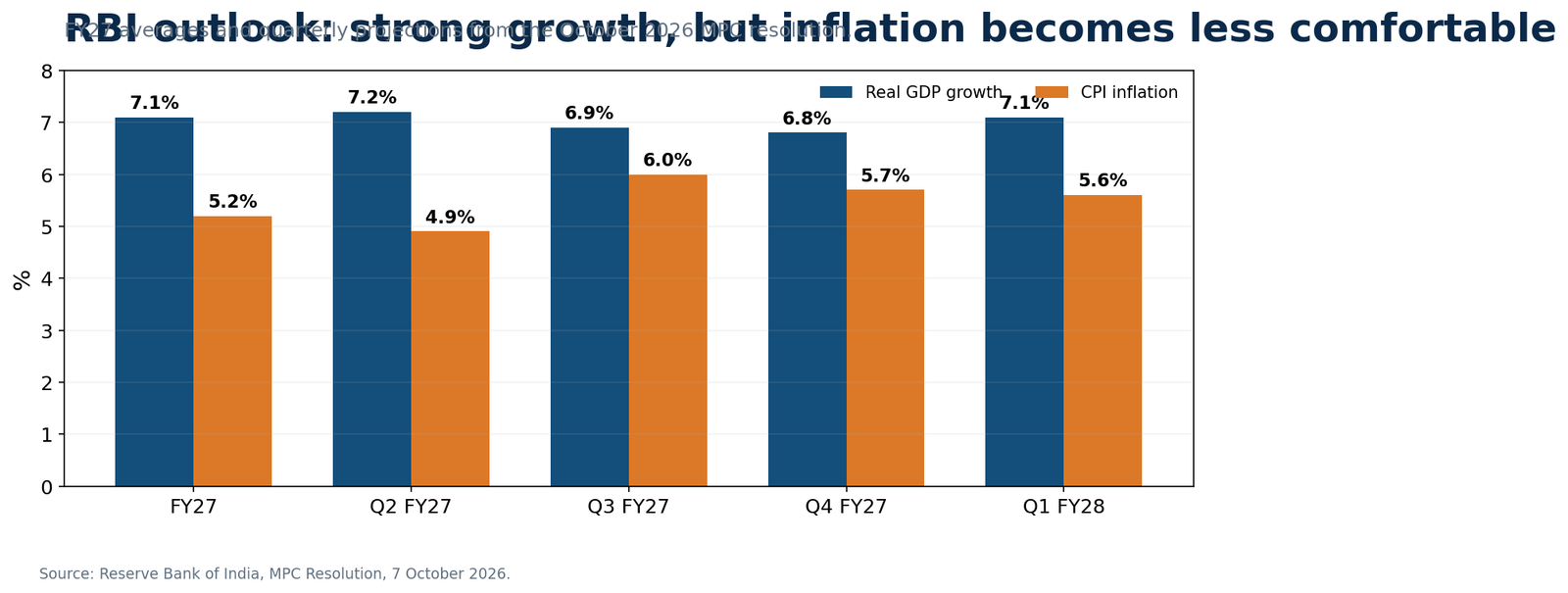
RBI's forecast mix is unusual: growth remains robust, but inflation is expected to become materially less comfortable over the next three quarters.
RBI's FY27 CPI forecast is 5.2%, with Q3 at 6.0% and Q4 at 5.7%. This is why the October move should be seen as preventive re-tightening: the central bank is trying to stop supply shocks from becoming generalised through wages, expectations and broader price-setting.
Food and energy remain important. A deficient southwest monsoon, El Nino conditions and volatile global energy prices can lift headline inflation even though higher interest rates cannot directly create food supply or lower crude prices. Monetary policy instead works on the second-round effects.
Official source: RBI MPC Resolution and Governor's Statement.
How monetary tightening moves through the economy
The repo rate works through several channels and they do not move at the same speed. Household demand is one channel: higher loan rates increase debt service and can make new financed purchases less attractive. This is most visible in housing, automobiles and consumer durables. Existing borrowers feel the effect only when their contractual benchmark resets, so the drag builds over time rather than appearing on policy day.
The second channel is business investment. A higher cost of debt and a higher risk-free benchmark raise the hurdle rate used to evaluate projects. Marginal capex can be deferred, especially where leverage is already high or project cash flows are distant. Strong order books, public infrastructure spending and high capacity utilisation can still offset part of this effect, which is why a 25 bps increase should not be translated mechanically into a GDP forecast.
The third channel is financial conditions. Money-market rates, government bond yields, corporate borrowing costs and equity discount rates can adjust before the full bank-lending transmission is visible. This is also why RBI's focus on the weighted average call rate and liquidity operations matters: the policy signal is stronger when overnight rates are aligned with the repo rate.
Government borrowing and the fiscal channel
Higher policy rates do not reprice India's entire stock of government debt overnight because most outstanding securities have fixed coupons. The fiscal cost enters gradually through new issuance and refinancing. If market yields remain higher for longer, interest expenditure can rise at the margin. Against that cost is the benefit of anchoring inflation expectations: credible price stability can lower long-run risk premia and reduce the chance of a more disruptive tightening later.
Monetary policy also works with lags. New borrowing decisions, loan resets, refinancing and household budgets adjust over several months. The October policy is therefore better interpreted as an attempt to prevent inflation from becoming entrenched while the economy still has enough momentum to absorb modest restraint.
3. Liquidity is the hidden variable
RBI reported that the average daily surplus in the system's net LAF position was ₹5.9 lakh crore since the August MPC meeting. This must be interpreted carefully. It is an operating-liquidity measure based on the Liquidity Adjustment Facility; it is not the same as banks' total excess cash or immediately deployable lending capacity.
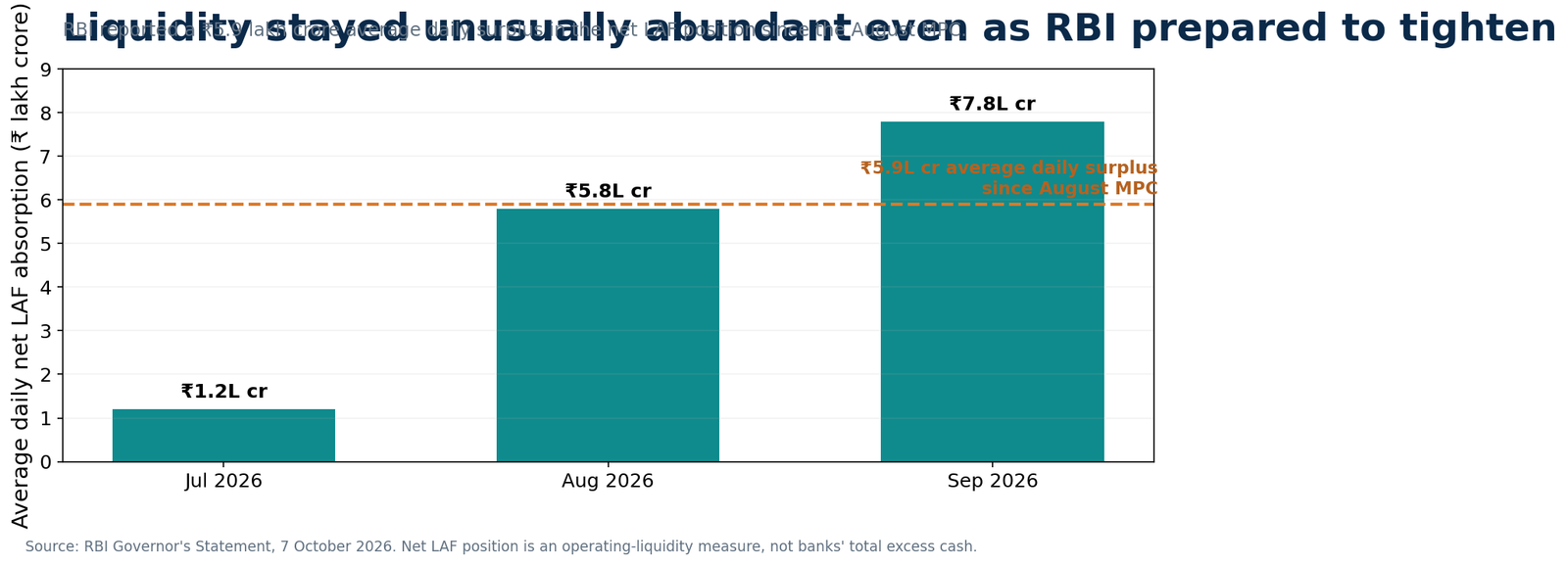
Average daily net LAF absorption rose from ₹1.2 lakh crore in July to ₹5.8 lakh crore in August and ₹7.8 lakh crore in September. The separate ₹5.9 lakh crore number is the average daily surplus since the August MPC.
RBI said the weighted average call rate had generally traded in the lower half of the policy corridor. That matters because a policy-rate hike transmits more effectively when overnight money-market rates stay aligned with the repo rate. RBI therefore signalled continued use of liquidity-management tools, including reverse-repo operations and open-market sales, as required.
Credit conditions also remain strong: bank credit growth was 18.1% year-on-year as of 15 September 2026, versus 10.4% a year earlier. Rapid credit growth is not inherently problematic, but alongside strong GDP growth and abundant liquidity it reduces the case for keeping monetary conditions very easy.
Official source: RBI Governor's Statement, liquidity and financial-market conditions.
4. How the hike reaches borrowers and depositors
A 25 bps repo increase does not mean every loan becomes 25 bps more expensive immediately. Transmission depends on the benchmark, spread and reset terms. External benchmark-linked floating loans can reprice relatively quickly; MCLR-linked or other structures may move differently.
Home-loan illustration
The table below assumes a fresh 20-year loan, reducing-balance amortisation, monthly compounding, full 25 bps transmission from 8.00% to 8.25%, unchanged spread, and no fees or tenure adjustment.
| Loan amount | EMI at 8.00% | EMI at 8.25% | Approx. monthly increase |
|---|---|---|---|
| ₹25 lakh | ₹20,911 | ₹21,302 | ₹391 |
| ₹50 lakh | ₹41,822 | ₹42,603 | ₹781 |
| ₹75 lakh | ₹62,733 | ₹63,905 | ₹1,172 |
| ₹1 crore | ₹83,644 | ₹85,207 | ₹1,563 |
An existing borrower can see a different outcome because outstanding principal, remaining tenure, reset frequency, benchmark, lender spread and the lender's choice between changing EMI and tenure all matter.
What about FDs?
Deposit rates are directionally supported by higher policy rates, but the pass-through need not be immediate or one-for-one. When system liquidity is abundant, banks may have less urgency to compete aggressively for deposits. Existing fixed-rate deposits are unaffected until maturity; new and renewed deposits may reprice as funding needs change.
Borrower checklist
- Identify benchmark and next reset date.
- Compare EMI increase with tenure extension.
- Stress-test affordability at +50 and +100 bps.
- Judge balance transfers on total remaining cost, not only headline rate.
Depositor checklist
- Do not assume an automatic 25 bps FD increase.
- Compare maturity buckets and liquidity needs.
- Consider staggering maturities if rate uncertainty is high.
- Keep credit quality ahead of incremental yield.
5. Bonds, the rupee and equities
Bonds
Bond prices and yields move in opposite directions. A tighter policy path generally creates mark-to-market pressure for existing long-duration bonds because newly issued securities can offer higher yields. Shorter-duration portfolios are less sensitive. For new investors, however, higher yields improve future accrual opportunities once the transition stabilises.
Rupee
A higher policy rate is directionally supportive for the rupee because it improves the relative return on rupee assets. But it is only one input. Crude oil, global yields, the US dollar, portfolio flows and risk sentiment can overwhelm the rate effect on any given day. RBI's foreign-exchange reserves were US$734.6 billion as of 2 October 2026, providing a substantial external buffer.
Equities
Higher rates affect equities through three channels: the discount rate used to value future earnings, corporate interest costs, and household demand after debt service. High-P/E long-duration businesses and heavily leveraged companies are usually more sensitive than cash-generative companies with pricing power.
On 7 October, the Nifty 50 closed at 22,603.05, down 173.05 points or 0.76%. NSE data also show Nifty Auto down 1.58%, FMCG down 0.89%, Bank down 0.13%, Midcap 100 down 0.63%, while Smallcap 100 rose 0.30%. These are session outcomes, not a clean estimate of the RBI effect: crude, global yields, geopolitics, positioning and earnings expectations also influenced markets.
Market close source: National Stock Exchange of India, 7 October 2026. External-sector source: RBI Governor's Statement.
Debt mutual funds and duration
For debt-fund investors, the rate effect is two-sided. If yields rise, existing portfolios with longer duration can record mark-to-market losses because older lower-coupon securities become less valuable. At the same time, higher yields improve the return available on fresh deployment and future reinvestment. The relevant questions are portfolio duration, maturity profile, credit quality and the investor's ability to tolerate interim NAV volatility.
Gold and household asset allocation
Higher real interest rates usually increase the opportunity cost of holding a non-yielding asset such as gold. That does not make gold mechanically bearish. Indian gold prices also reflect the global dollar price, USD/INR, geopolitical risk and inflation expectations. A domestic rate hike can therefore coexist with firm gold prices if currency weakness or global safe-haven demand dominates.
If deposit and high-grade bond yields rise, conservative household savings also obtain a better fixed-income alternative to equities. The effect is rarely immediate because deposit repricing can lag and equity allocations are driven by earnings as well as rates. Still, a higher risk-free return raises the valuation hurdle for expensive equities, particularly companies whose expected cash flows lie far in the future.
6. Industry-wise impact
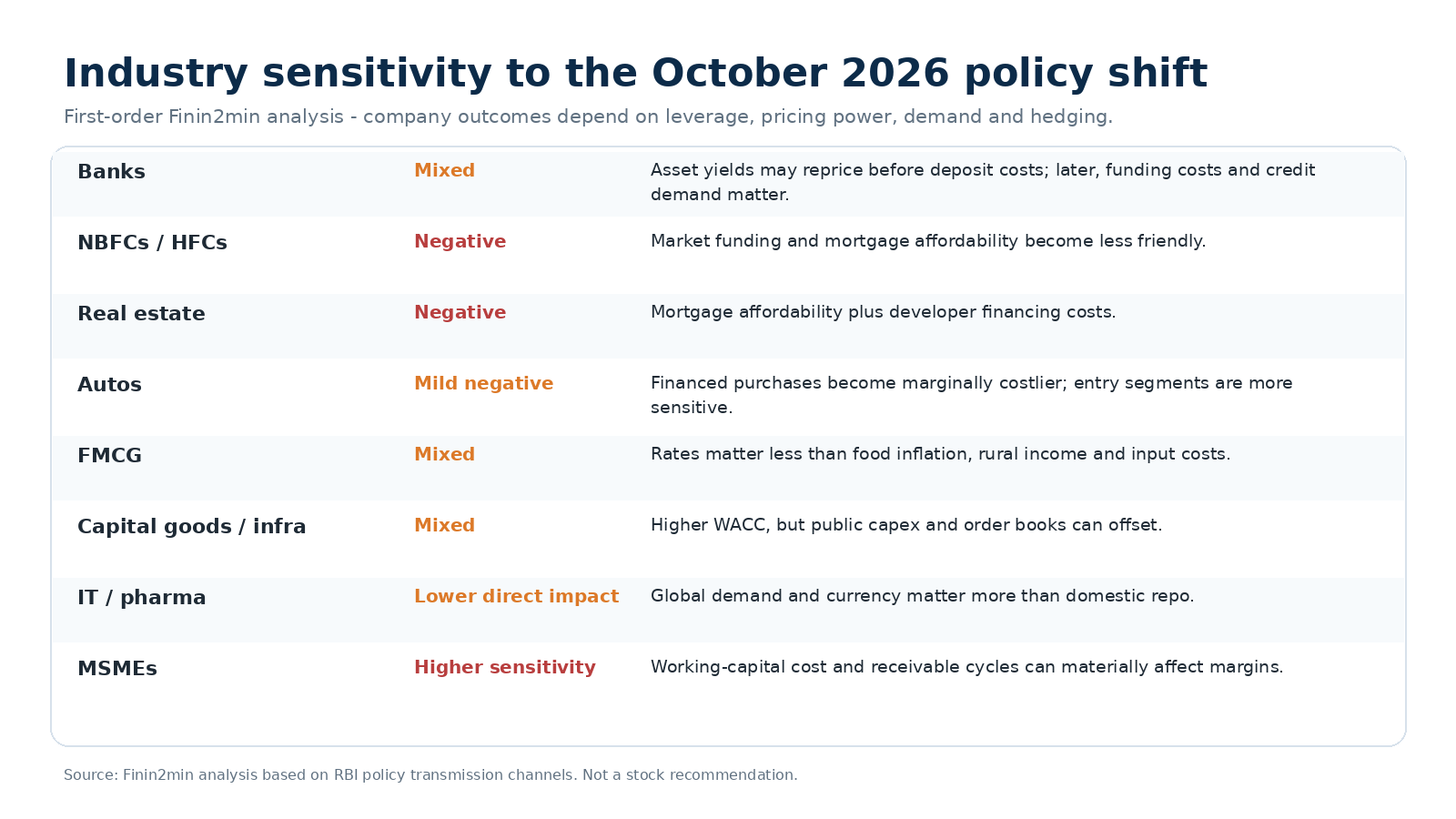
Sector labels are first-order analytical sensitivities, not predictions for individual stocks.
| Sector | First-order impact | What matters most |
|---|---|---|
| Banks | Mixed | Loan yields can reprice before deposits, supporting margins initially; later, deposit costs, slower credit and bond valuation matter. |
| NBFCs / HFCs | Mild negative | Market borrowing costs and housing affordability. |
| Real estate | Negative at the margin | Mortgage affordability and developer financing; premium demand may be less sensitive than affordable housing. |
| Autos | Mild negative | Financing cost for two-wheelers and entry-level cars; income growth can offset some pressure. |
| FMCG / durables | Mixed | Disposable income, food inflation, rural demand and input costs matter more than repo alone. |
| Capital goods / infrastructure | Mixed | Higher WACC versus strong public capex, order books and project cash flows. |
| Power / renewables / telecom | Mild negative for leveraged projects | Long-duration financing and refinancing terms. |
| Airlines / paints / chemicals / tyres | Oil-sensitive | Crude-linked inputs can dominate the direct repo impact. |
| IT services / pharma | Lower direct sensitivity | Global client demand and the rupee are more important. |
| Insurance / AMCs | Mixed | Higher reinvestment yields versus mark-to-market effects and asset-allocation shifts. |
| Startups / high-growth tech | Negative at the margin | Higher discount rates and external-funding costs. |
| MSMEs | Potentially significant | Working-capital cost, receivable days, inventory turns and pricing power. |
Why company-level outcomes can diverge from the sector label
Interest-rate sensitivity is ultimately a balance-sheet question. Two companies in the same industry can react very differently if one has net cash and the other has short-tenor floating debt. The same applies to demand: a premium housing developer with low leverage can be less rate-sensitive than an affordable-housing developer whose buyers depend heavily on mortgage eligibility.
Four filters are especially useful for investors and lenders: net debt to EBITDA, interest coverage, refinancing maturity and pricing power. A fifth is the share of sales that depends on discretionary consumer credit. These filters often explain more than a broad sector label.
Banks need a near-term and medium-term lens
Banks can initially benefit when benchmark-linked loans reprice faster than deposits. That can support asset yields and net interest margins. If the cycle extends, deposit competition normally catches up, bond portfolios can face valuation pressure, credit demand can soften and asset-quality risks become more relevant for stretched borrowers. The same rate increase can therefore be mildly supportive in the first few quarters and less favourable later.
7. Corporate treasury: the CFO playbook
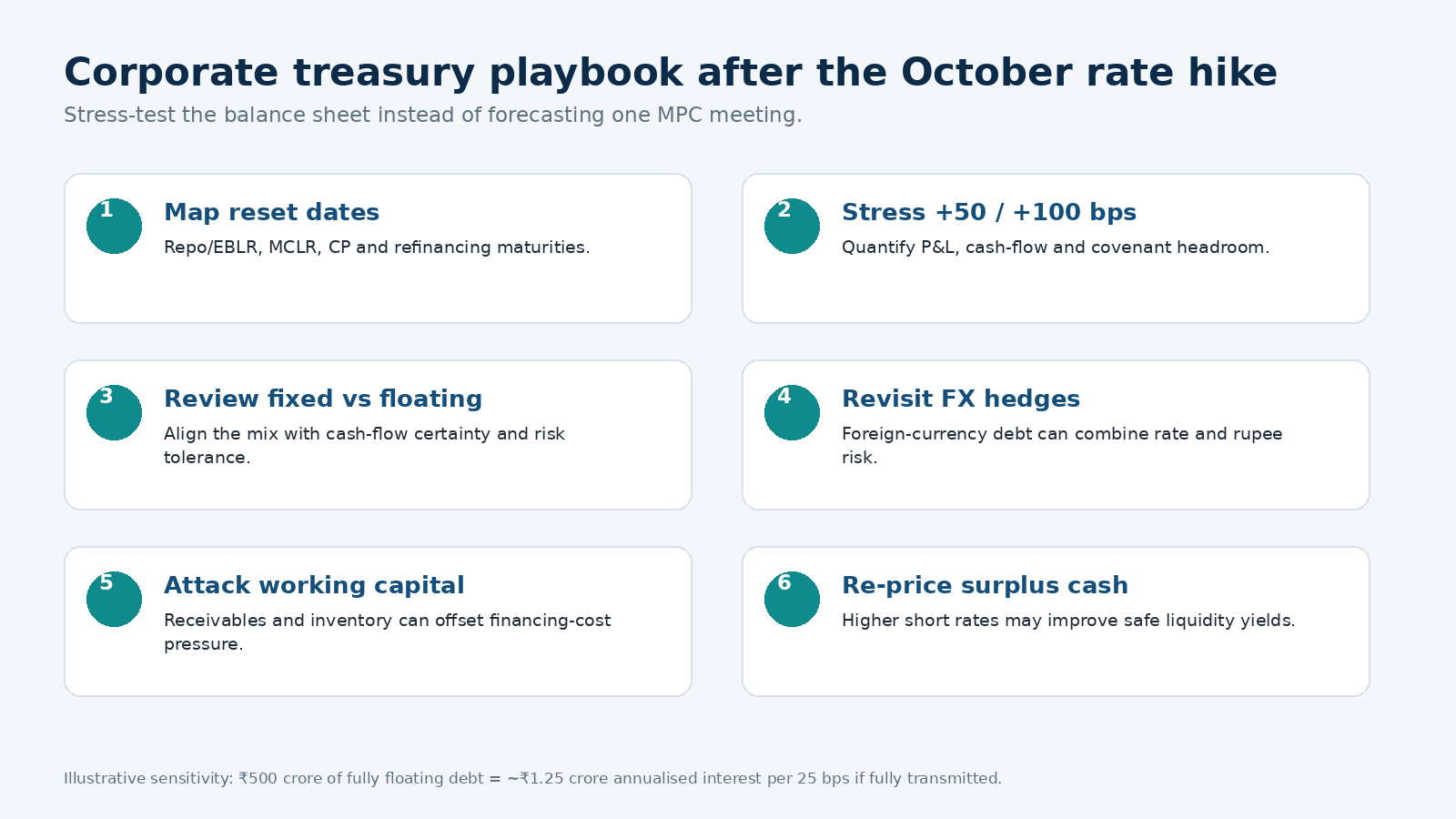
Treasury should stress-test plausible rate paths rather than rely on a single forecast for the next MPC meeting.
For a company with ₹500 crore of fully floating debt, a 25 bps increase equals about ₹1.25 crore of additional annualised interest if fully transmitted for a full year. A 50 bps shock is about ₹2.50 crore; 100 bps is about ₹5 crore.
| Exposure | Immediate treasury question |
|---|---|
| Repo/EBLR-linked debt | When is the next reset and what proportion reprices? |
| MCLR-linked borrowing | What is the historical lag between policy and benchmark repricing? |
| Fixed-rate debt | What amount refinances over the next 6-18 months? |
| Commercial paper | How much rollover risk exists if short rates stay elevated? |
| Foreign-currency debt | Are both interest-rate and FX risks hedged? |
| Capex | Does project IRR and covenant headroom survive +50 / +100 bps? |
| Working capital | Can lower receivable and inventory days offset interest-cost pressure? |
Fixed versus floating: do not turn treasury into a rate bet
A company does not need to forecast every MPC meeting correctly to manage rate risk well. The more robust approach is to define an intentional fixed-floating mix based on cash-flow certainty, covenant headroom, refinancing concentration and risk appetite. A business with thin cash-flow buffers may value certainty more than the possibility of saving a few basis points if rates decline later.
Foreign-currency borrowing should be assessed on an all-in hedged basis. A low foreign coupon can become expensive if currency depreciation or hedge cost is ignored. Treasury dashboards should therefore show interest-reset exposure and FX exposure together rather than in separate silos.
Working capital can be the cheapest hedge
For operating companies, reducing receivable days or excess inventory can create more value than negotiating a small spread reduction. If a business permanently releases ₹100 crore from working capital, the reduction in financing requirement can materially offset higher benchmark rates. The October policy is therefore a prompt to revisit cash-conversion cycles, not merely bank pricing.
A practical stress-test framework
CFOs can build three rate cases: current pricing, +50 bps and +100 bps. For each case, quantify interest expense, EBITDA-to-interest coverage, free cash flow, covenant headroom and refinancing needs. Overlay a weaker-rupee scenario for foreign-currency debt and a slower-collections scenario for working capital. The objective is to identify where the balance sheet becomes uncomfortable before markets force the adjustment.
8. Five-year repo-rate timeline
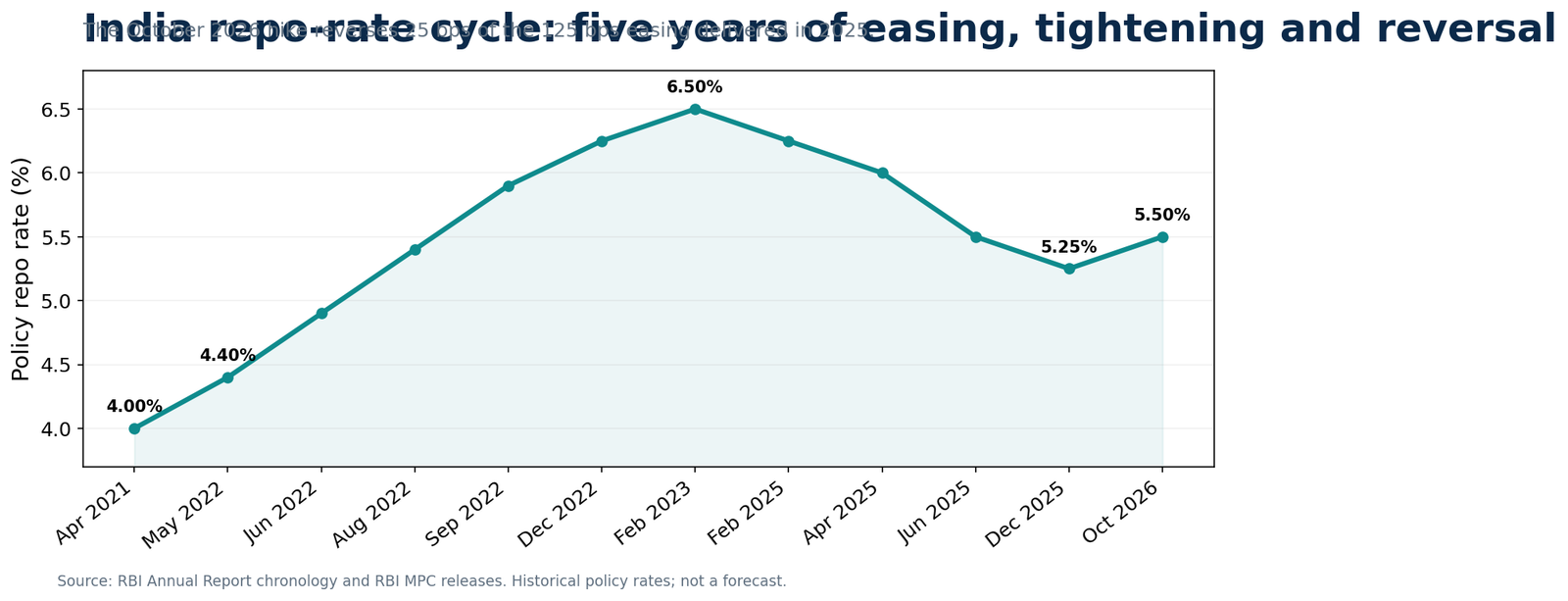
The October 2026 hike is the first increase since February 2023 and reverses part of the 2025 easing cycle.
| Date / phase | Repo after decision | Change | What it marked |
|---|---|---|---|
| 2021-Apr 2022 | 4.00% | - | Pandemic-era accommodation retained. |
| 4 May 2022 | 4.40% | +40 bps | Off-cycle normalisation begins. |
| 8 Jun 2022 | 4.90% | +50 | Inflation response accelerates. |
| 5 Aug 2022 | 5.40% | +50 | Tightening continues. |
| 30 Sep 2022 | 5.90% | +50 | Broad inflation concern. |
| 7 Dec 2022 | 6.25% | +35 | Pace moderates. |
| 8 Feb 2023 | 6.50% | +25 | End of the 250 bps 2022-23 sequence. |
| Apr 2023-Dec 2024 | 6.50% | Hold | Extended pause. |
| 7 Feb 2025 | 6.25% | -25 | Easing starts. |
| 9 Apr 2025 | 6.00% | -25 | Easing continues. |
| 6 Jun 2025 | 5.50% | -50 | Front-loaded cut. |
| 5 Dec 2025 | 5.25% | -25 | 2025 easing totals 125 bps. |
| Feb-Aug 2026 | 5.25% | Hold | Four consecutive holds. |
| 7 Oct 2026 | 5.50% | +25 | First hike since February 2023. |
Historical source: RBI Annual Report chronology plus RBI 2025 and 2026 MPC releases.
9. What happens next: three data-dependent paths
The October decision is a change in direction, but it is not proof that India has entered a long hiking cycle. The next move depends on whether current supply shocks fade or spread into underlying inflation.
| Finin2min scenario | What would support it | Policy implication | Market implication |
|---|---|---|---|
| Inflation cools | Food supply improves, energy eases, core stays contained | Pause becomes more likely | Supportive for duration and rate-sensitive equities |
| Sticky but contained | Inflation stays elevated without clear second-round broadening | Pause with a tightening bias | Yields remain firm; stock selection matters more |
| Inflation broadens | Core rises, currency/oil pressures persist, expectations deteriorate | Further tightening becomes more plausible | Higher yields; pressure on leveraged and long-duration assets |
These scenarios are Finin2min analysis, not RBI forecasts.
10. Developmental and regulatory measures
The October package also contained measures outside the policy rate. RBI announced interoperability among NBFC Account Aggregators, proposed enabling bank deposit information to appear in the Consolidated Account Statement through the AA framework, and said these customer-convenience measures are targeted for implementation by 31 December 2026.
RBI also said it would constitute a Technical Consultative Committee for Financial Markets as a forum for structured engagement on money, government-securities and foreign-exchange markets and related infrastructure.
Official source: RBI Statement on Developmental and Regulatory Policies.
11. Frequently asked questions
Will every floating home loan rise by 25 bps immediately?
No. It depends on the benchmark, spread and contractual reset date. The lender may change EMI, tenure or both.
Does calibrated tightening guarantee another hike?
No. It signals a more inflation-sensitive policy setting. A pause remains possible if incoming data improve.
Why raise rates if food and oil are supply shocks?
RBI cannot directly create supply, but tighter policy can reduce the chance that repeated shocks become embedded in expectations, wages and broader pricing.
Will FD rates rise one-for-one with repo?
No. Deposit pricing depends on each bank's liquidity and funding needs. Abundant system liquidity can slow deposit-rate transmission.
What is the biggest variable for markets now?
There is no single variable. Inflation breadth, crude, liquidity, global yields and earnings jointly determine whether the October move remains an insurance hike or develops into a larger cycle.
Official sources and methodology
- RBI MPC Resolution - 7 October 2026
- RBI Governor's Statement - 7 October 2026
- RBI Statement on Developmental and Regulatory Policies
- RBI Annual Report - policy chronology
- National Stock Exchange - 7 October 2026 market close
EMI values use standard reducing-balance amortisation under the assumptions stated in the household section. Corporate debt sensitivity is simple annualised arithmetic. Sector and scenario conclusions are explicitly Finin2min analysis.