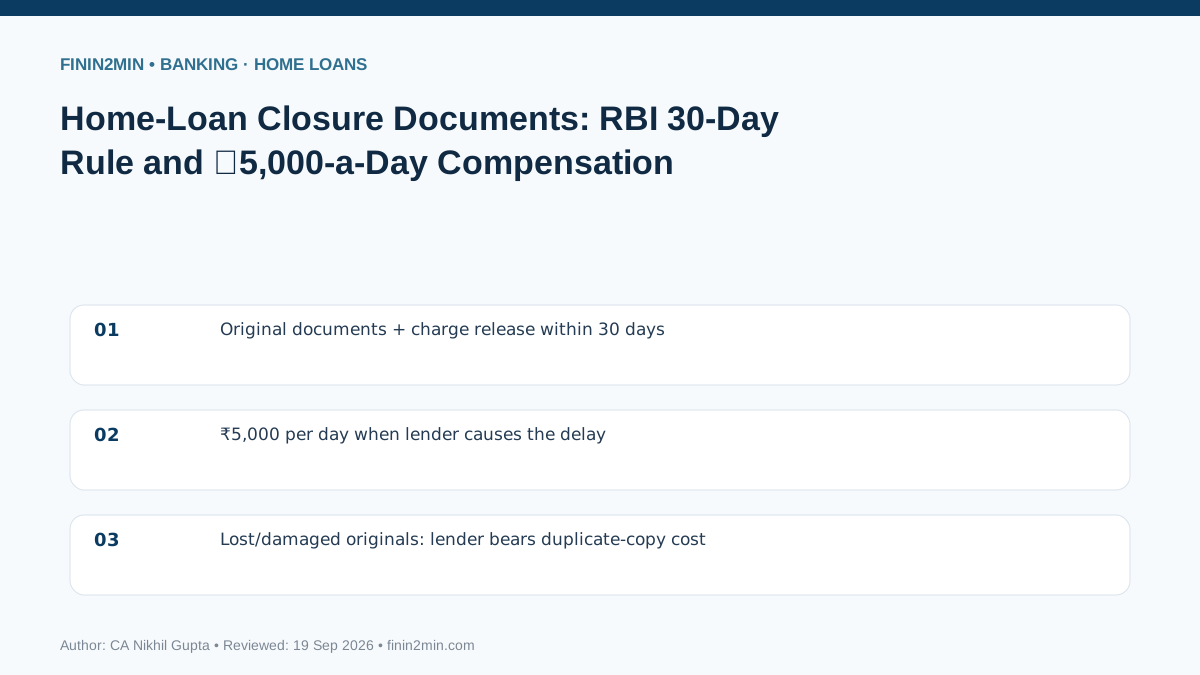
Loan repayment is not the end of a secured-loan file. RBI requires regulated entities to return original movable/immovable property documents and remove registered charges within 30 days after full repayment or settlement, with ₹5,000 per day where delay is attributable to the lender.
RBI’s 30-day obligation after full repayment
RBI’s September 2023 direction on responsible lending requires regulated entities to do two things within 30 days after full repayment or settlement of a personal loan: return the original movable/immovable property documents and remove charges registered with the relevant registry. The direction applies to commercial banks, small finance banks, regional rural banks, local area banks, cooperative banks, NBFCs including housing finance companies, and asset reconstruction companies, subject to the circular’s scope.
The borrower must be allowed to collect originals either from the branch/outlet that serviced the loan or another lender office where the documents are available, according to the borrower’s preference. For sanction letters issued on or after the direction’s effective date, the timeline and place for return should be stated in the sanction letter.
₹5,000 for each day of lender-attributable delay
If the lender does not return the originals or fails to file the charge-satisfaction step with the relevant registry beyond 30 days, it must tell the borrower why. Where the delay is attributable to the regulated entity, RBI prescribes compensation of ₹5,000 for each day of delay.
Example. A housing loan is fully repaid and closed on 1 July. Assume the 30-day period expires and the lender returns the complete original document set 18 days after that permitted period, with the delay attributable to the lender. Compensation = 18 × ₹5,000 = ₹90,000.
The compensation is without prejudice to other rights the borrower may have under applicable law; it is not described as a substitute for every other remedy.
Lost or damaged title documents: a different clock
Loss or damage creates an additional obligation. RBI requires the lender to assist the borrower in obtaining duplicate/certified copies and to bear the associated costs. In that situation the lender gets an additional 30 days to complete the process, so the delay-compensation calculation starts after a total period of 60 days instead of 30 days.
This is why a borrower should inventory the papers handed over at loan origination. A generic “documents received” acknowledgement is much weaker than a schedule listing the sale deed, conveyance deed, allotment letter, possession document, previous-chain deeds, original receipts and any other deposited title paper.
Document return and charge release are separate deliverables
| Deliverable | What to verify |
|---|---|
| Original documents | Every original deposited with the lender is returned, not merely the latest sale deed. |
| Registered charge satisfaction | Mortgage/charge entry is removed or satisfaction is filed with the relevant registry where required. |
| Loan closure/NOC | Account is shown closed with no residual dues, lien or unbilled charge. |
| Credit-bureau reporting | Loan status is subsequently reflected as closed/paid rather than open or overdue. |
| Company borrower charge | If the borrower is a company and a Companies Act charge exists, separately verify MCA charge-satisfaction compliance. |
Borrower procedure from the last EMI to clean title custody
- Before the final payment, ask for a foreclosure/closure statement showing the exact amount and date.
- Pay through a traceable channel and preserve the receipt.
- Obtain an account-closure letter or zero-dues confirmation.
- Send a written request identifying the preferred office for collecting originals.
- Ask the lender for its document inventory and compare it with your own loan-sanction/deposit records.
- At collection, inspect originals page by page for missing sheets, stamping, endorsements and physical damage.
- Sign a receipt only after recording any shortage or damage on the acknowledgement.
- Check the relevant registry/encumbrance record after the lender says the charge is released.
- If the 30-day period is exceeded, ask the lender to state the reason and compute compensation where the delay is attributable to it.
Death of the sole or joint borrower
RBI also requires regulated entities to have a well-laid-out procedure for returning originals to legal heirs if the sole borrower or joint borrowers die. That procedure should be displayed on the lender’s website. Families should therefore ask for the lender’s published deceased-borrower document-release checklist instead of accepting an improvised branch-level list that changes from visit to visit.
Common evidence can include death certificate, claimant identity, succession/nomination/legal-heir documents as applicable and indemnities prescribed under the lender’s approved policy. The exact set depends on title and succession facts.
What counts as lender-attributable delay?
The direction makes attribution important. A lender cannot fairly charge the borrower with delay caused by its own record retrieval, inter-branch movement, misplaced files or internal registry filing. Conversely, if the borrower does not provide a collection preference, refuses a valid handover appointment or must complete a legally necessary claimant document, the causation analysis may differ.
Keep written evidence. An email saying “documents are still in central storage” or “charge satisfaction has not been filed” is far more useful than a phone call when compensation is later disputed.
Escalation file
Start with the lender’s grievance channel. If the complaint is not resolved satisfactorily, RBI’s Integrated Ombudsman framework may be available subject to its maintainability conditions. Attach the closure proof, sanction letter, document list, emails/branch acknowledgements, registry screenshot and your day-count calculation. If documents were lost, add evidence of duplicate/certified-copy costs.
Do not hand over original replacement documents to an intermediary without a receipt. The end state is not merely “loan closed”; it is a clean file in which the borrower possesses the originals and public/registry charge records no longer show an unreleased security interest that should have been satisfied.
The borrower should track two completion dates, not one
The RBI direction requires both return of original movable/immovable property documents and removal of charges registered with any registry. Receiving a “no dues” letter therefore does not necessarily mean the security has been fully released. A borrower should separately record (1) the date every original title/security document is handed back and (2) the date the lender completes the charge-release action that falls within its responsibility.
Which registry matters depends on the security and borrower. A residential mortgage can involve state land/registration records and central security records; a company borrower may also have MCA charge filings. The RBI circular does not turn all those systems into one registry. The closure file should identify the actual charge created at origination and the evidence that it has been released.
Example — partial completion is still a problem. A home loan is fully settled on 1 July. The bank gives the borrower the original sale deed on 20 July but does not complete the relevant registered charge-release action until 12 August. The borrower should not treat 20 July as the sole completion date; the RBI standard covers both return of originals and removal of registered charges within the prescribed 30-day period.
Lost documents: reconstruction is more than a photocopy
If original property papers are lost or damaged due to the regulated entity, the direction requires the lender to assist the borrower in obtaining duplicate/certified copies and to bear the associated cost. The circular gives an additional 30 days for completing that procedure before delayed-return compensation is calculated. In practical terms, the borrower should ask for a written inventory of the missing papers and a reconstruction plan rather than accept an informal statement that “copies are available in the file”.
Depending on the document, reconstruction can involve a certified copy from the registering authority, society/builder records, lender affidavits or other evidence. The exact process varies by state and document type, but the cost caused by the lender’s loss is not meant to be shifted to the borrower under the RBI direction.
Example — lost-deed timeline. If the ordinary 30-day return deadline expires and an original deed has been lost by the lender, the lender gets the additional 30-day window contemplated by the direction to help obtain duplicate/certified copies. If the lender remains responsible for delay beyond the total permitted window, the ₹5,000-per-day rule becomes relevant after that point. The borrower should calculate compensation from the applicable deadline, not automatically from the loan-closing date.
What to collect at the handover desk
- Original-document inventory signed by the borrower and lender representative.
- Loan-account closure/zero-dues confirmation showing the account number.
- Evidence of charge satisfaction/release filing or the lender’s confirmation of its completion.
- Any original insurance assignment, deposit receipt, guarantee or other movable security held by the lender.
- For joint borrowers, written acknowledgement showing who collected the originals.
- For legal-heir cases, the lender’s published procedure and the heirship/succession documents actually relied on.
Photographing or scanning the returned packet before leaving the branch creates a useful contemporaneous record. If an item is missing, record it immediately on the acknowledgement instead of discovering the gap during a future sale.
Which loans are covered by the RBI direction?
The 13 September 2023 direction applies to regulated entities listed in the circular, including commercial banks, specified co-operative banks, NBFCs including housing finance companies, and asset reconstruction companies. It uses the RBI meaning of a personal loan for the scope note, so borrowers should verify the character of the facility rather than assume every business-security document is covered by this compensation rule. The direction applies where release of the documents falls due on or after 1 December 2023.
If the facility sits outside that specific scope, the borrower can still have contractual, registry and general legal rights to obtain security documents; the point is simply not to quote ₹5,000 per day automatically without first confirming that the RBI circular applies to the loan and lender involved.
Loan-closure document FAQs
What is the RBI deadline?
Thirty days after full repayment or settlement for return of originals and removal of registered charges, for cases falling within the direction.
How much compensation applies for qualifying delay?
₹5,000 for each day beyond the permitted period when the delay is attributable to the regulated entity.
What if the lender loses an original deed?
The lender must assist in obtaining duplicate/certified copies and bear associated costs. RBI allows an additional 30 days for this process before the delayed-period compensation is calculated.
Can I choose a different branch to collect documents?
RBI says the borrower should have the option to collect from the servicing outlet/branch or another office of the regulated entity where the documents are available.
Does the ₹5,000 compensation prevent another legal claim?
No. RBI expressly states that the prescribed compensation is without prejudice to rights to other compensation under applicable law.
Is a loan NOC alone enough?
No. A sound closure file also verifies return of every original and satisfaction/removal of any registered charge.
Primary sources
Use the cited instrument or regulator guidance for the proposition described above; check later amendments and transaction-date rules before acting.
Educational information only. Tax, legal, banking and insurance outcomes depend on facts, dates and the instrument/policy in force. Obtain professional advice for material transactions.