Home Loan Tax
Under-Construction Home Loan Tax in 2026: Section 22 and Five Instalments
By CA Nikhil Gupta · Reviewed by CA Nikhil Gupta · Published 14 June 2026 · about 6 minute read
📄 Download the PDF edition (free sign-in)
Finin2min 2-minute summary
Interest incurred on a qualifying home loan before a property is acquired or completed generally does not vanish; it is dealt with through a five-equal-instalment deduction beginning in the year of acquisition/completion, subject to the law and deduction limits for the property. From tax year 2026–27, the operative provision is section 22 of the Income-tax Act, 2025, as amended; for FY 2025–26 / AY 2026–27, section 24 of the 1961 Act remains relevant. A self-occupied property's applicable annual interest cap must include the prior-period instalment; it is not a separate extra ₹2 lakh concession.
Why construction stage changes the timing of relief
A borrower might start paying EMIs in 2024 while receiving possession only in 2027. Bank debits occur in 2024, 2025 and 2026, but the deduction rules recognise a distinct prior-period bucket for qualifying pre-acquisition/construction interest. Amounts allowed under another provision must not be duplicated. The final possession/construction date matters because it determines when the first instalment is recognised. An allotment letter or builder's anticipated completion date is not automatically conclusive evidence of actual completion for tax purposes.
The borrower should request lender interest certificates split by relevant fiscal periods, rather than relying on a single cumulative EMI chart that combines principal, interest and any charges. A property may have multiple co-owners and co-borrowers; interest deduction depends on ownership, actual borrower obligation, payment and other conditions. Merely joining a bank loan as co-applicant does not automatically create equal tax deductions if the person has no qualifying ownership.
The operative 2025 Act provision: section 22
The Income Tax Department's section 22 text provides deduction for qualifying borrowed-capital interest, and section 22(1)(c) spreads prior-period interest over five equal tax-year instalments. The 2026 amendment clarifies that, for qualifying self-occupied property, the aggregate interest ceiling in section 22(2) includes the current-year interest and the prior-period instalment. Subject to the statutory five-year completion and certificate conditions, the self-occupied limit can be ₹2 lakh; the law specifies another lower limit when conditions are not met. Crucially, the cap applies to the combined deduction, not just current interest.
For let-out property, the borrowing-interest computation and losses have separate statutory treatment, while set-off or carry-forward restrictions operate at the total-income computation level. Calling let-out interest 'unlimited tax saving' can mislead because a loss may not produce immediate relief against all other income. Verify the chosen tax regime and the current year's treatment of house-property loss rather than assuming all deductions are available identically under both regimes.
Worked example: ₹3 lakh prior interest and ₹1.8 lakh annual interest
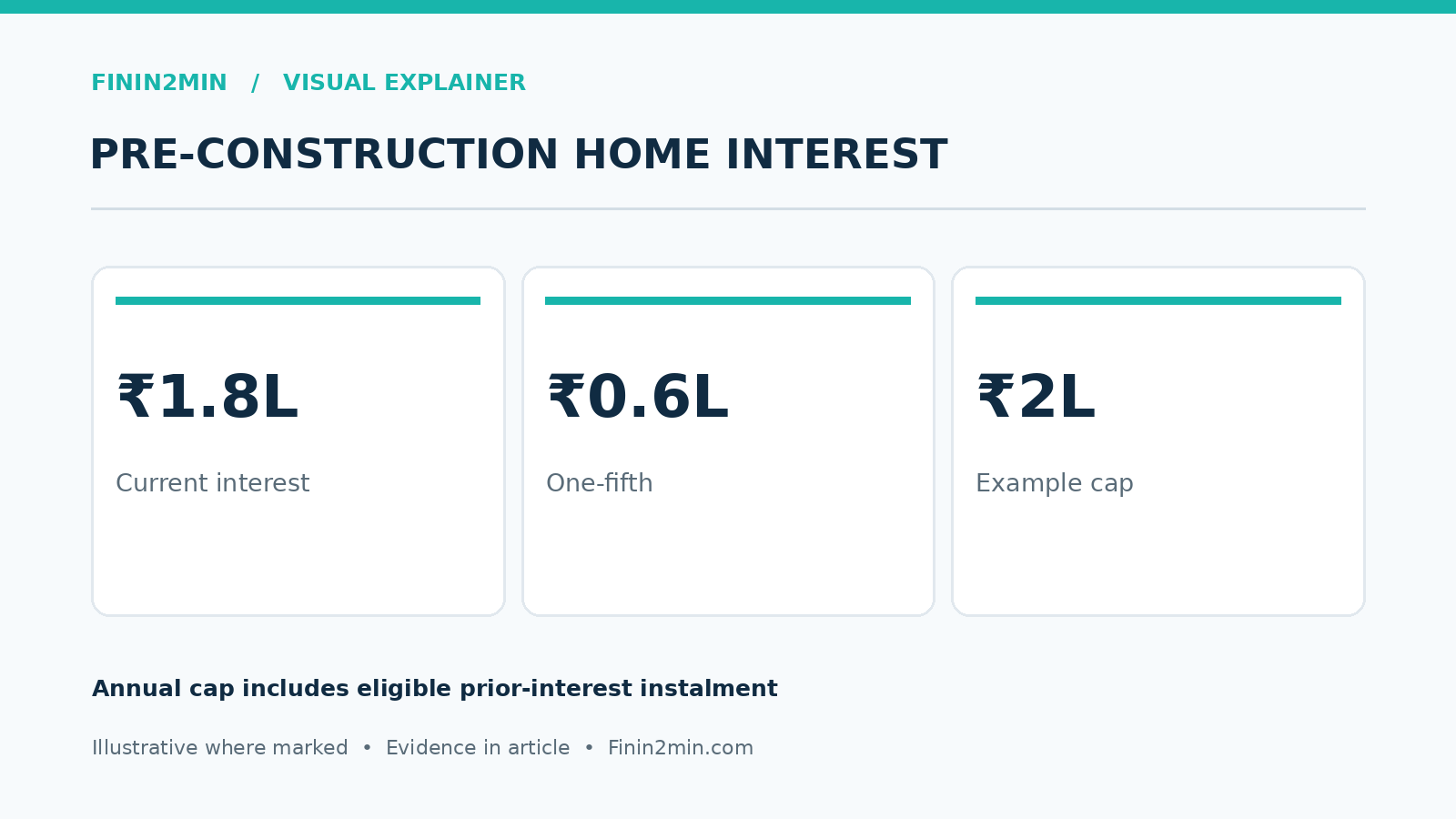
Assume qualifying prior-period interest of ₹3,00,000. One fifth is ₹60,000 a year over five years. In the first year after completion, suppose current interest is ₹1,80,000. The combined notional interest deduction before the cap is ₹2,40,000. For a qualifying self-occupied property under the applicable old-regime conditions with a ₹2 lakh ceiling, the allowable deduction is ₹2,00,000, not ₹2,40,000 or ₹3,80,000. The remaining ₹40,000 is not automatically added to a future year's fifth instalment. This illustrates the significance of the 2026 section 22 clarification.
If instead current interest were ₹1,10,000, adding the ₹60,000 instalment would produce ₹1,70,000, below the example's ₹2 lakh ceiling. The real result can change with a loan refinance, completion beyond the statutory window, mixed self-use/letting, co-ownership and whether the taxpayer elects a regime permitting the deduction.
When possession and construction evidence disagree
Developers may issue possession letters before all municipal completion requirements are finished, or homeowners may occupy a partially completed dwelling. Whether the property is 'constructed' for the relevant statutory provision needs evidence and fact-specific judgment. Keep the possession notice, occupancy/completion certificate where available, builder correspondence, utility connection history and payment record. If a portion is rented out separately, record actual dates and receipts rather than treating the whole property as self-occupied forever.
Principal repayment is a different issue
EMI contains principal and interest. Principal repayment, stamp duty and registration may have separate eligibility under deduction provisions and may be restricted by the tax regime and transaction timing. Do not combine them with the section 22 interest calculation. Principal paid on an under-construction property does not automatically qualify merely because the lender labels it repayment. The underlying conditions need independent testing.
FY 2025–26 return versus tax year 2026–27
For ITR filed for AY 2026–27, based on FY 2025–26 income, cite and compute under the 1961 Act provisions relevant to that previous year. For events and income beginning 1 April 2026, the 2025 Act operates. A Finin2min calculator should ask for the transaction year and explicitly select the correct statute. Showing one combined '2026 tax' rule without the year distinction risks legal and computational error.
Documentation checklist
Keep the loan sanction, disbursement dates, yearly interest certificates, builder documents, completion evidence, co-ownership proof and a cumulative prior-interest schedule. Reconcile prior-period interest to the bank's detailed statement and preserve the five-year deduction register. In a return review, the register should explain which one-fifth amount was claimed, against which year's current interest and why the aggregate statutory cap was observed.
A five-year reconciliation that can be audited
Create one row for each deduction tax year, showing the fixed prior-interest instalment, the actual current-year interest from the lender certificate, the applicable statutory cap and the deduction claimed. For the ₹3 lakh/₹60,000 example, the instalment stays ₹60,000 in each of the five years; it should not be inflated in a later year simply because an earlier year's self-occupied cap restricted relief. Link each year's computation to that tax year's law and the return schedule actually used.
When the property is let out after possession
Rental receipts change the income-from-house-property computation, with annual value, permissible deductions and loss treatment to be reviewed. The facts must show when letting began and whether the property was actually available/used in the relevant period. Do not artificially show a house as rented merely to claim unrestricted interest while no tenancy or genuine rental evidence exists. Keep lease, rent credits, municipal taxes and financing documents aligned with the return.
Calculator design: three yes/no gates before any deduction
Ask whether the person is an owner, whether acquisition/construction is complete, and whether the taxpayer chose a regime permitting the relevant self-occupied deduction. Then collect prior-period interest and current interest separately; test construction period and lender-certificate conditions; apply the combined cap where relevant. Only at the end calculate the effect on tax liability. Displaying a ₹2 lakh 'tax benefit' for ₹2 lakh of interest confuses a deduction from taxable income with a rupee-for-rupee refund.
FAQs
Can I claim the whole pre-construction interest immediately on possession? Generally no; the qualifying prior-period amount is spread over five years.
Is the ₹2 lakh cap added on top of the one-fifth instalment? No. For the relevant self-occupied deduction, the cap applies to the combined interest amount.
Does the new Act erase pre-construction interest relief? No. Section 22 preserves the mechanism subject to current conditions.
Is a bank EMI statement enough evidence? Separate interest schedules and completion/ownership records are often needed.
Official references
- Income Tax Act 2025 section 22 — Section 22(1)(c), 22(2), Finance Act 2026 correction
- Income Tax Act 1961 section 24 — AY 2026-27 historical section 24(b) and explanation
- Income-tax Act 2025 — as enacted, 21 August 2025 — Current law and transitional comparison
Important: Educational information and illustrative modelling only. Eligibility, taxes, insurance cover and legal remedies depend on the relevant dates, documents and facts. Verify operative official instruments and seek qualified advice for material decisions. Investments can lose value; illustrative returns are not assured.