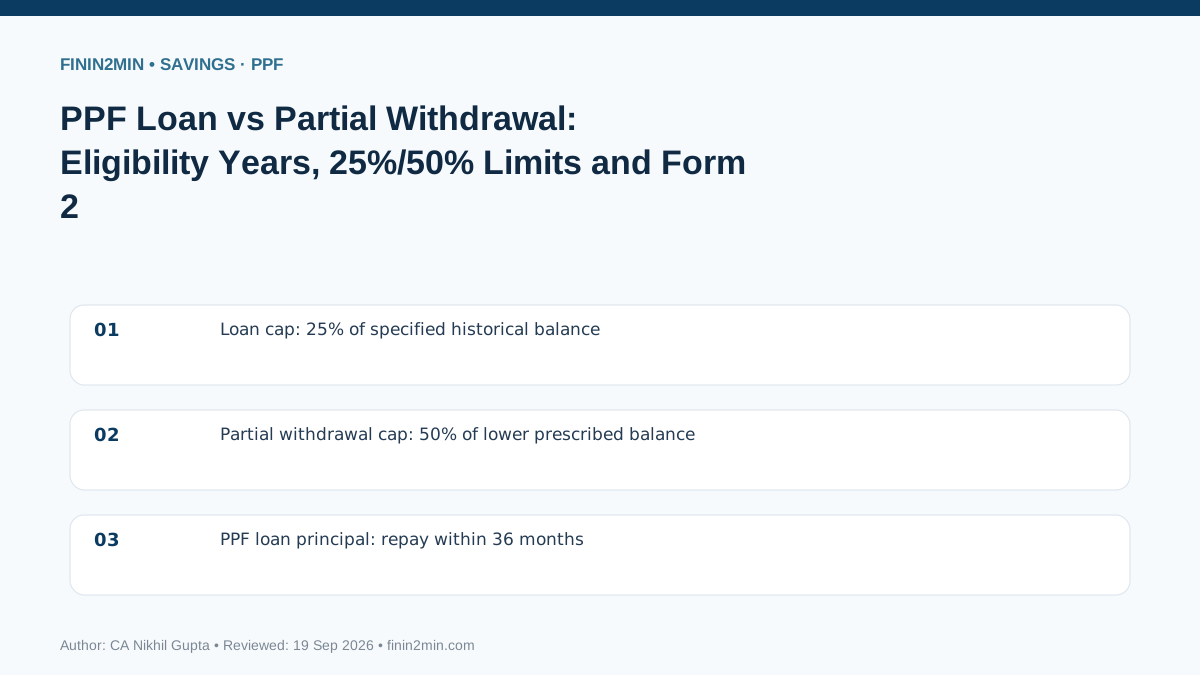
PPF has two different liquidity windows before maturity. Loans are available only in an early-year window and are capped at 25% of a historical balance; partial withdrawal begins later and is capped at 50% of the lower of two specified historical balances.
PPF has a loan window first, then a withdrawal window
Under the Public Provident Fund Scheme, 2019, a loan can be taken after one year has expired from the end of the financial year in which the first subscription was made, but before five years have expired from the end of that opening year. The application is made in Form 2.
Partial withdrawal starts later. After five years have expired from the end of the financial year in which the account was opened, the account holder may apply in Form 2 for a withdrawal, subject to the statutory 50% balance test. A regular account can use these facilities; a discontinued account does not get loan/partial-withdrawal facility until the Scheme conditions are dealt with.
Loan amount: 25% of a two-year-back balance
The maximum loan is 25% of the amount standing to the account holder’s credit at the end of the second financial year immediately preceding the year in which the loan is applied for.
Example — loan cap. An eligible account holder applies for a PPF loan in FY 2026-27. The relevant reference balance is the balance at the end of FY 2024-25. If that balance was ₹6,40,000, maximum loan = 25% × ₹6,40,000 = ₹1,60,000.
A current balance of ₹9 lakh does not raise the statutory cap for that application if the specified historical balance remains ₹6.40 lakh.
Only one loan is permitted in a year, and a fresh PPF loan is not available until the earlier loan plus interest has been repaid in full.
Loan repayment and interest
The principal must be repaid within 36 months from the first day of the month following the month in which the loan is sanctioned. Principal can be paid in one lump sum or instalments. After principal is fully repaid, interest is payable in not more than two monthly instalments at 1% per annum for the period specified by the Scheme.
If the loan is not repaid, or only partly repaid, within 36 months, the outstanding amount attracts 6% per annum instead of 1% for the statutory period beginning from the first day of the month following the month in which the loan was obtained until final repayment.
If ₹1,20,000 remains outstanding past the 36-month deadline, do not continue modelling interest at the concessional 1% loan rate. The Scheme’s default rule switches the outstanding loan to 6% per annum for the specified period. The actual debit is made under the Scheme mechanics, so check the account-office calculation.
Partial withdrawal: 50% of the lower of two balances
For an eligible withdrawal year, calculate two historical balances: (1) the amount standing at the end of the fourth financial year immediately preceding the withdrawal year, and (2) the amount standing at the end of the immediately preceding financial year. The maximum withdrawal is 50% of the lower of those two balances.
Example — withdrawal cap. A withdrawal is requested in FY 2026-27. Assume the PPF balance at 31 March 2023 (end of the fourth year immediately preceding) was ₹5,20,000 and the balance at 31 March 2026 was ₹8,10,000. Lower balance = ₹5,20,000. Maximum partial withdrawal = 50% × ₹5,20,000 = ₹2,60,000.
The facility can be used only once in a year. Any outstanding PPF loan and interest must be paid before the partial withdrawal is availed.
Opening-year examples remove the “third year/seventh year” confusion
Suppose the first PPF subscription is made in FY 2023-24. One year from the end of that year expires on 31 March 2025, so the loan window begins after that point, subject to the historical-balance formula, and remains only until the five-year cut-off is reached. Partial withdrawal becomes available only after five years from the end of FY 2023-24 have expired.
This statutory wording is more reliable than remembering internet shorthand such as “loan from third year” or “withdrawal from seventh year”, because the precise financial-year count matters when an account was opened late in March.
Deposit limits still matter while using liquidity
The Scheme permits annual subscription from ₹500 up to ₹1.5 lakh, in multiples of ₹50. The maximum includes deposits in the individual’s own account and the relevant minor account contribution as provided in the Scheme. A loan is not a substitute for making the minimum annual subscription; if the account becomes discontinued, loan and partial-withdrawal facilities are restricted.
Loan or withdrawal — which preserves compounding better?
A loan eventually returns principal and interest to the prescribed mechanism, whereas a partial withdrawal permanently removes money from the PPF corpus. But the loan is only available in its early statutory window and must be repaid within 36 months. Once the account has moved beyond the loan window, partial withdrawal may be the only pre-maturity liquidity choice other than premature closure for specified grounds.
Run a cash-flow test before withdrawing. Removing ₹2.60 lakh several years before maturity sacrifices future tax-exempt PPF compounding on that amount. If the liquidity need is temporary and the account is still within the loan window, compare the statutory PPF loan cost with an external loan after fees and tax.
Form 2 file checklist
- Confirm the account is regular, not discontinued.
- Identify the exact financial year of the initial subscription.
- For a loan, obtain the end balance of the second immediately preceding FY and compute 25%.
- Check there is no unpaid earlier loan and that no other loan has been taken in the same year.
- For withdrawal, establish the fourth-preceding-year and immediately-preceding-year balances and take 50% of the lower.
- Clear any outstanding loan and interest before withdrawal.
- Submit Form 2 through the account office/channel made available by the bank/post office.
- Retain the sanction/withdrawal advice because it fixes the repayment and account-history trail.
Build the timeline from the financial year of opening
The Scheme does not count loan/withdrawal eligibility by simply adding calendar anniversaries to the account-opening date. It repeatedly measures time from the end of the financial year in which the initial subscription/account opening occurred. This is why two accounts opened months apart in the same financial year can enter the statutory window at the same time.
Example — account opened in FY 2023-24. The opening financial year ends on 31 March 2024. The loan facility becomes available after expiry of one year from that year-end and remains available before expiry of five years from that year-end, subject to the other Scheme conditions. Partial withdrawal becomes available after expiry of five years from that year-end. Instead of memorising “third year” or “seventh year” slogans, write the opening FY and calculate from its 31 March endpoint.
Loan amount and interest: a complete numeric example
Assume a loan application is made in FY 2026-27. The Scheme caps the loan at 25% of the balance at the end of the second year immediately preceding the application year. If the relevant 31 March balance is ₹4,80,000, the maximum Scheme loan is ₹1,20,000.
Suppose ₹1,20,000 is drawn in June and the principal is fully repaid 18 months later. The Scheme requires principal repayment within 36 months from the first day of the month following the sanction month. After principal is repaid, loan interest is paid in no more than two monthly instalments at 1% per annum for the statutory period. If the principal is not fully repaid within 36 months, the Scheme substitutes 6% per annum on the outstanding loan for the specified period instead of 1%. That makes missing the 36-month deadline disproportionately expensive relative to the normal PPF-loan rate.
Only one loan is allowed in a year, and a fresh loan is not available while an earlier loan plus interest remains unpaid. These restrictions make a PPF loan unsuitable as a repeatedly revolving credit line.
Withdrawal formula: always calculate both balance limbs
After the five-year waiting period, Form 2 can be used for a partial withdrawal of up to 50% of the lower of two balances: the balance at the end of the fourth year immediately preceding the withdrawal year, or the balance at the end of the preceding year. The withdrawal can be taken only once in a year, and any outstanding PPF loan plus interest must be cleared first.
Example — lower-of test. A withdrawal is sought in FY 2030-31. Assume the relevant fourth-preceding-year-end balance is ₹7,20,000 and the immediately preceding year-end balance is ₹9,00,000. The lower figure is ₹7,20,000; 50% is ₹3,60,000. The higher ₹9,00,000 balance does not increase the permitted withdrawal to ₹4,50,000.
Do not confuse partial withdrawal with premature closure or post-maturity withdrawal
PPF has separate statutory routes. Ordinary partial withdrawal under paragraph 10 uses the 50%-of-lower-balance formula. Premature closure is a different exceptional facility available only after the prescribed period and for specified grounds such as serious illness, higher education or change in residency status, with the Scheme’s interest reduction. After maturity, the rules change again: an account continued without deposits permits withdrawals within that continuation framework, while an account extended with deposits in five-year blocks is subject to the separate extension withdrawal ceiling.
Therefore, when a bank/post office form says “withdrawal”, identify which statutory stage the account is in. Applying the ordinary pre-maturity 50% formula to a matured extended account can give the wrong answer.
PPF liquidity FAQs
What percentage of PPF balance can I borrow?
Up to 25% of the balance at the end of the second financial year immediately preceding the application year, provided the loan-window conditions are met.
How quickly must a PPF loan be repaid?
Principal must be repaid within 36 months from the first day of the month following the sanction month.
What is the loan interest rate?
The Scheme specifies 1% per annum after principal repayment for a timely loan; an unrepaid/partly repaid loan after 36 months is charged at 6% under the statutory rule.
How is partial withdrawal calculated?
50% of the lower of the balance at the end of the fourth year immediately preceding the withdrawal year and the balance at the end of the preceding year.
Can I take a loan and a withdrawal together?
Outstanding loan principal and interest must be cleared before using the withdrawal facility.
Which form is used?
The PPF Scheme specifies Form 2 for both loan application and partial withdrawal under the relevant paragraphs.
Primary sources
Use the cited instrument or regulator guidance for the proposition described above; check later amendments and transaction-date rules before acting.
Educational information only. Tax, legal, banking and insurance outcomes depend on facts, dates and the instrument/policy in force. Obtain professional advice for material transactions.