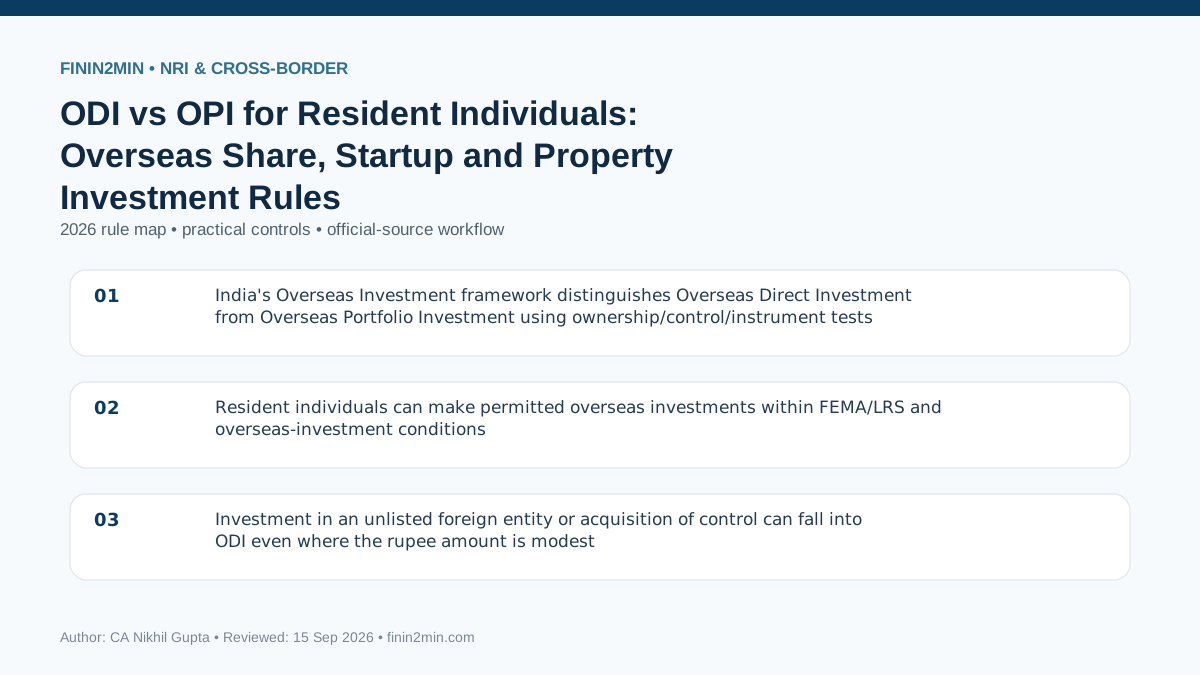
Overseas direct investment (ODI) and overseas portfolio investment (OPI) are not interchangeable labels. Under the 2022 overseas-investment framework, ODI generally captures unlisted foreign equity and specified ownership/control positions in listed foreign entities, while OPI covers other permitted foreign securities.
Current rule and what decides the result
The 2022 overseas-investment framework separates Overseas Direct Investment (ODI) from Overseas Portfolio Investment (OPI). For a resident individual, unlisted foreign equity and specified ownership/control positions in a listed foreign entity can be ODI, while other permitted foreign securities may be OPI. Resident-individual investment must also fit Schedule III and the Liberalised Remittance Scheme where applicable; the LRS ceiling is generally USD 250,000 per financial year for permitted current and capital-account transactions. ODI brings designated-AD-bank, UIN, evidence and reporting obligations that a simple portfolio purchase may not.
Key rules to apply
- A resident individual must also fit the transaction within Schedule III and the Liberalised Remittance Scheme where relevant.
- Investment in unlisted foreign equity and specified listed-equity ownership/control positions is treated as ODI under the OI framework.
- Portfolio holdings outside ODI can qualify as OPI; certain ESOP/sweat/minimum-qualification holdings up to 10% without control are expressly treated as OPI.
- Resident individuals generally operate within the USD 250,000 per financial-year LRS ceiling for permitted current/capital transactions, unless a specific rule permits otherwise.
- ODI reporting is routed through a designated authorised dealer and UIN for the foreign entity; evidence of investment must be submitted within the prescribed period.
- RBI directions require evidence such as share certificates/host-jurisdiction documents within six months of remittance/capitalisation for ODI.
10% listed shareholding without control
An Indian resident buys 8% of a listed US company for USD 40,000 through a permitted route and has no control. On these facts the holding is ordinarily analysed as OPI rather than ODI. If later acquisitions take the investor into an ownership/control position captured by the ODI definition, the compliance character can change; the investor should not keep treating the position as an ordinary brokerage portfolio merely because it began that way.
Unlisted startup investment
A resident individual proposes to invest USD 75,000 for equity in an unlisted Singapore startup. Unlisted foreign equity is an ODI trigger, so the investor should route the transaction through the designated AD bank, check Schedule III eligibility and obtain/complete the relevant ODI reporting and UIN process. The USD 75,000 also consumes part of that financial year’s LRS capacity where LRS is the remittance route.
How to apply it step by step
- Classify the proposed foreign asset before remitting: listed security, unlisted equity, fund unit, debt instrument or property.
- Test whether ownership/control or unlisted-equity features make the investment ODI.
- Check Schedule III restrictions applicable to a resident individual and the foreign entity’s activity.
- Aggregate all LRS remittances for the financial year against the USD 250,000 ceiling.
- For ODI, designate the AD bank and complete UIN/reporting steps before or with the remittance as prescribed.
- Submit evidence of investment, such as share certificates or host-jurisdiction records, within the prescribed six-month period where ODI applies.
- Track income, disinvestment proceeds and repatriation obligations separately from initial remittance compliance.
- Preserve broker/AD bank records for Indian tax foreign-asset and foreign-income reporting.
Common mistakes and edge cases
- Calling every foreign share purchase OPI.
- Assuming LRS permission removes ODI reporting.
- Treating foreign property as “ODI” simply because it is a capital transaction.
- Splitting remittances across banks without aggregating the annual LRS ceiling.
- Ignoring post-investment evidence and reporting after the outward remittance succeeds.
FAQs
Is every investment in an overseas startup ODI?
Unlisted foreign equity is generally within ODI, subject to the detailed resident-individual rules and restrictions.
Can a listed shareholding be ODI?
Yes, where the ownership/control tests in the overseas-investment framework are met.
What is the LRS ceiling for a resident individual?
Generally USD 250,000 per financial year for permitted current and capital transactions, subject to the scheme rules.
Do I need a UIN for ordinary portfolio shares?
The UIN/designated-AD framework is an ODI compliance feature; a straightforward OPI holding is analysed differently.
Can I buy property abroad under LRS?
Permitted immovable-property acquisition is possible under the applicable FEMA/LRS rules, but it is not automatically ODI.
Does FEMA compliance replace Indian tax disclosure?
No. Foreign-asset, foreign-income and tax reporting remain separate obligations.
Related Finin2min guides
- ODI vs LRS: Founder Overseas Investment Decision Guide
- LRS vs. ODI: When Can Resident Individuals Invest in Foreign Startups?
- Ind AS 40: Investment Property — Detailed Guide
- Resident Individual Investment in Overseas Entities: AD-Bank Documentation and Common Rejections
- Overseas Direct Investment (ODI): Strategic vs. Portfolio Investments for Indian Tech Firms
- Resident Individual Investment in Overseas Entities: Banking Channel, Documentation and FEMA Workflow
- ODI Financial Commitment: Equity, Debt, Guarantees, Limits and 2022 Overseas Investment Rules
- Overseas Subsidiary and ODI Checklist for Indian Startups