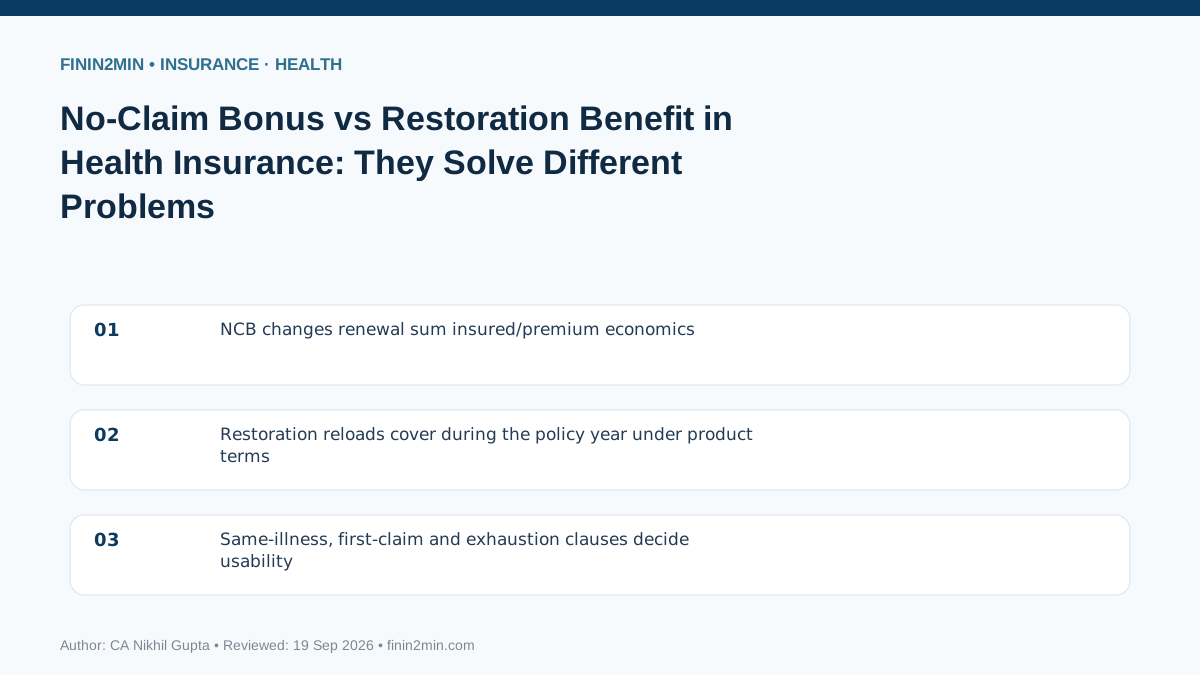
No-Claim Bonus is earned at renewal for claim experience and may increase sum insured or discount renewal premium. Restoration/reinstatement is a product benefit that can reload exhausted or insufficient cover within the policy year, subject to the policy’s own trigger and reuse conditions.
NCB and restoration sit on different timelines
IRDAI describes cumulative bonus as an increase/addition in sum insured without an associated increase in premium. Current health-insurance guidance also allows No Claim Bonus, with policyholder choice/express consent at renewal, to be given as an addition to sum insured and/or a discount in renewal premium.
Restoration is different. It is a product feature in which the insurer restores/reinstates some or all of the base sum insured within the same policy year after defined utilisation conditions are met. IRDAI-filed product wordings show that the exact trigger can vary: some products restore only after exhaustion, some after the available cover becomes insufficient, some exclude the same illness or first claim, and the number of restorations can differ.
Worked example: ₹10 lakh base cover
Assume a policy has ₹10 lakh base sum insured. The product grants a 20% cumulative bonus after a claim-free year, so at renewal the available base-plus-bonus becomes ₹12 lakh, assuming the product wording permits that level and no other adjustment.
Now assume the same policy also has a 100% restoration feature that can restore ₹10 lakh after the base/bonus is exhausted and only for future unrelated claims. During the next year, Claim 1 of ₹12 lakh consumes the full ₹12 lakh. If the restoration conditions are satisfied, another ₹10 lakh becomes available for a later eligible claim. The theoretical annual pool has become ₹22 lakh across claims, but the restored ₹10 lakh was not available to make Claim 1 itself larger if the wording says restoration is only for subsequent claims.
That is why a headline “₹10 lakh policy gives ₹22 lakh cover” can be misleading. Claim sequence and product wording decide whether the restored amount is usable.
NCB: what IRDAI standardises
IRDAI’s consumer guidance standardises the concept of cumulative bonus and the current NCB choices, but each product states the earning/reduction rules, maximum accumulation and whether a premium discount is offered. For individual health products, IRDAI also says renewal premium loading should not be based on the individual policyholder’s claim experience, and renewal generally cannot be denied merely because claims were made, subject to the stated exception for certain benefit-based policies.
Read the schedule for: NCB rate per claim-free year, maximum bonus, what happens after a claim, whether a protected NCB option exists, and whether the policyholder can choose bonus-in-sum-insured versus renewal-premium discount.
Restoration: five clauses that decide whether it pays
| Clause | Why it matters |
|---|---|
| Trigger | Does restoration require complete exhaustion, or merely insufficient balance for the next claim? |
| Same illness | Some wordings restrict restoration for the same/related illness; others are broader. |
| First claim | Some restorations can only fund subsequent claims, not the claim that first exhausts cover. |
| Number of restorations | Once per year, multiple times, or unlimited subject to conditions can produce very different protection. |
| Individual vs floater | A family-floater restoration can be shared subject to policy terms; individual cover may restore separately. |
An IRDAI-filed policy wording, for example, provides up to 100% restoration once a year when the sum insured including additional cover is insufficient due to earlier claims, but restricts use to future claims and excludes the illness/disease/injury for which a claim has already been paid for the same person. This is an example of product wording, not a universal IRDAI rule for every insurer.
Claim-sequence example: why “same illness” wording matters
A family floater has ₹10 lakh base cover and no remaining NCB. Claim 1 is ₹8 lakh for cardiac surgery, leaving ₹2 lakh. Two months later, the same insured needs ₹5 lakh for a related cardiac complication. Under a restoration clause that applies only after full exhaustion and excludes the same/related illness, restoration may not help: ₹2 lakh base remains, the trigger may not yet be met, and even if triggered after exhaustion the same-illness restriction can block use.
By contrast, a later ₹6 lakh claim for an unrelated appendicitis event may qualify once the policy’s trigger conditions are met. Product wording, not the marketing phrase “100% restore”, decides the answer.
How to compare two plans without being fooled by brochure language
- Write the base sum insured for the family configuration you actually need.
- Record NCB earning rate, maximum NCB and post-claim reduction rules.
- Record restoration percentage and number of restorations.
- Mark whether restoration can support the first large claim or only subsequent claims.
- Mark same-person, same-illness and related-illness restrictions.
- Check whether restoration applies when some base cover remains but is insufficient.
- Overlay room-rent limits, co-pay, deductible and disease sub-limits; restored cover does not remove those constraints.
- Compare premium after including any optional restoration add-on.
NCB cannot repair a weak base sum insured
A ₹5 lakh base policy with a 50% maximum NCB may eventually reach ₹7.5 lakh under one product design, but the policyholder can face a large claim before that bonus is earned. Restoration also may not help the first claim. For a family in a high-cost city, choose a defensible base sum insured first; then treat NCB and restoration as additional layers.
Similarly, a super top-up can solve a different problem: it provides a separate high-limit layer above an aggregate deductible. Restoration reloads the base policy under its own conditions. Comparing these tools on premium alone ignores when each rupee becomes available.
At renewal, ask for the benefit statement
Before paying renewal premium, verify the opening sum insured, accumulated cumulative bonus, any NCB discount, base premium and optional-cover charges. If a claim was made, ask how it changed the NCB under the product terms. IRDAI’s framework protects renewal rights, but it does not make every insurer’s NCB design identical.
A three-claim year shows why restoration wording matters
Assume a family floater has ₹10 lakh base sum insured and a product wording that restores 100% of base sum insured after specified utilisation, subject to the policy’s own conditions. Claim 1 for ₹8 lakh uses most of the base cover. Claim 2 later in the same policy year is ₹6 lakh. Whether the restored amount can pay Claim 2 depends on the contract: some filed products permit restoration for a subsequent unrelated claim; some impose conditions around same illness, complete/partial exhaustion, timing or how many restorations are available. A brochure statement “100% restoration” does not answer those questions.
Now add Claim 3 of ₹4 lakh. If the product offers only one restoration, the available balance can be different from a plan offering multiple restorations. If the restoration does not activate until a specified level of base cover is used, it may also be unavailable for part of an earlier claim. This is why a buyer should ask the insurer to walk through the exact sequence using the policy wording before purchase.
NCB changes renewal economics; restoration changes claim-year capacity
IRDAI’s consumer material recognises cumulative bonus as an addition to sum insured without an associated premium increase and also permits NCB structures that operate through renewal-premium discount, depending on the product/choice. The key point is temporal: NCB is earned/expressed at renewal according to the policy, while restoration is a mechanism that can replenish available cover during the policy year when its activation conditions are met.
Example — five claim-free years. Suppose a policy starts with ₹10 lakh base cover and its filed wording grants a 10% cumulative bonus of base sum insured for each claim-free renewal, capped at 50%. If all conditions are satisfied for five years, the cumulative bonus can build to ₹5 lakh, taking the effective sum-insured pool to ₹15 lakh under that wording. That ₹5 lakh is not the same as a ₹10 lakh restoration: the first is an accumulated renewal benefit; the second may become available only after a claim consumes cover and remains subject to restoration clauses.
Deductible, co-pay and room limits can reduce the practical value of both
A large headline sum insured does not guarantee a large admissible claim. A deductible requires the policyholder/other cover to absorb a specified amount before the insurer pays; a co-pay makes the insured bear a percentage of admissible expenses; room-rent or disease sub-limits can restrict claim computation under the product terms. Restoration usually replenishes the sum-insured pool — it does not automatically erase these separate cost-sharing provisions.
| Feature | Question to ask |
|---|---|
| Base sum insured | How much is available for the first claim before bonus/restoration? |
| NCB / cumulative bonus | Increase in sum insured, premium discount, or policyholder choice? What is the cap and reduction rule after claims? |
| Restoration | How many times, what activation threshold, same illness allowed, and can it pay the same claim? |
| Deductible / co-pay | Does the insured still bear an amount/percentage after restoration? |
| Room/disease limits | Can a sub-limit restrict the payable claim despite available restored cover? |
Renewal rights: a claim should not be treated as individual punishment
IRDAI’s health-insurance guidance says renewal loading for an individual product should not be based on that individual policyholder’s own claim experience, and renewal should not be denied merely because claims were made in preceding policy years, subject to the stated exception for benefit-based products whose contract terminates after payment of the covered benefit. That consumer-protection rule is separate from the NCB formula: a claim can affect a cumulative-bonus benefit according to policy terms without giving the insurer a free hand to impose claim-based individual renewal loading.
At renewal, compare the schedule and benefit statement with the prior year. Record the base sum insured, accumulated bonus, any reduction/reset after the claim and the new premium. This prevents a buyer from assuming that every premium movement is “because I claimed” when age band, portfolio pricing, taxes or product-level changes may be responsible.
NCB vs restoration FAQs
Does NCB always mean extra sum insured?
Not necessarily. Current IRDAI guidance allows NCB at renewal as cumulative bonus in sum insured and/or a discount in renewal premium, according to the policyholder’s choice/consent and product design.
Is restoration guaranteed to pay the same illness twice?
No. Same-illness/related-illness treatment is product-specific; read the restoration clause.
Can restoration pay the first huge claim above base cover?
Only if the wording permits it. Many products restore only for future/subsequent claims after a trigger is met.
Does a claim let the insurer refuse renewal?
IRDAI says renewal cannot be denied merely because claims were made, subject to the stated exception for certain benefit-based policies whose contract terminates after benefit payment.
Is 100% restoration the same as doubling my policy?
No. The restored amount can be conditional on exhaustion, claim sequence, illness and annual-use rules.
What should I compare first — NCB or base cover?
Base sum insured, room-rent/co-pay/deductible and exclusions should be tested first. NCB/restoration are additional features, not substitutes for adequate base protection.
Primary sources
Use the cited instrument or regulator guidance for the proposition described above; check later amendments and transaction-date rules before acting.
Educational information only. Tax, legal, banking and insurance outcomes depend on facts, dates and the instrument/policy in force. Obtain professional advice for material transactions.