Banking & CFO
MPBF Working Capital Assessment: Tandon Methods vs Bank Credit Policy
By Finin2min Editorial Desk · Reviewed by CA Nikhil Gupta · Last reviewed 9 October 2026
📄 Download the PDF edition (free sign-in)

Finin2min 2-minute summary
- The classic Tandon MPBF methods remain useful analytical tools, but RBI’s general prescription was withdrawn.
- Working-capital gaps must be reconciled to inventory, receivables, supplier credit and borrower contribution.
- Banks may adopt cash budgeting, turnover, MPBF variants and risk-based assessments under policy.
The current regulatory status
The Maximum Permissible Bank Finance concept emerged from the Tandon Committee approach to working capital. RBI historical material records that general MPBF-related instructions were withdrawn in April 1997, permitting banks flexibility in appraisal. Some lending institutions continue to ask for MPBF calculations, current-ratio targets or statements in their own credit policy. Accordingly a finance manager should treat the conventional formula as a requested appraisal method, not a universal statutory right to a sanctioned limit. Always inspect the sanction letter, internal bank requirement and borrower category; published RBI materials for some bank classes explicitly discuss continued use of modified MPBF as an option.
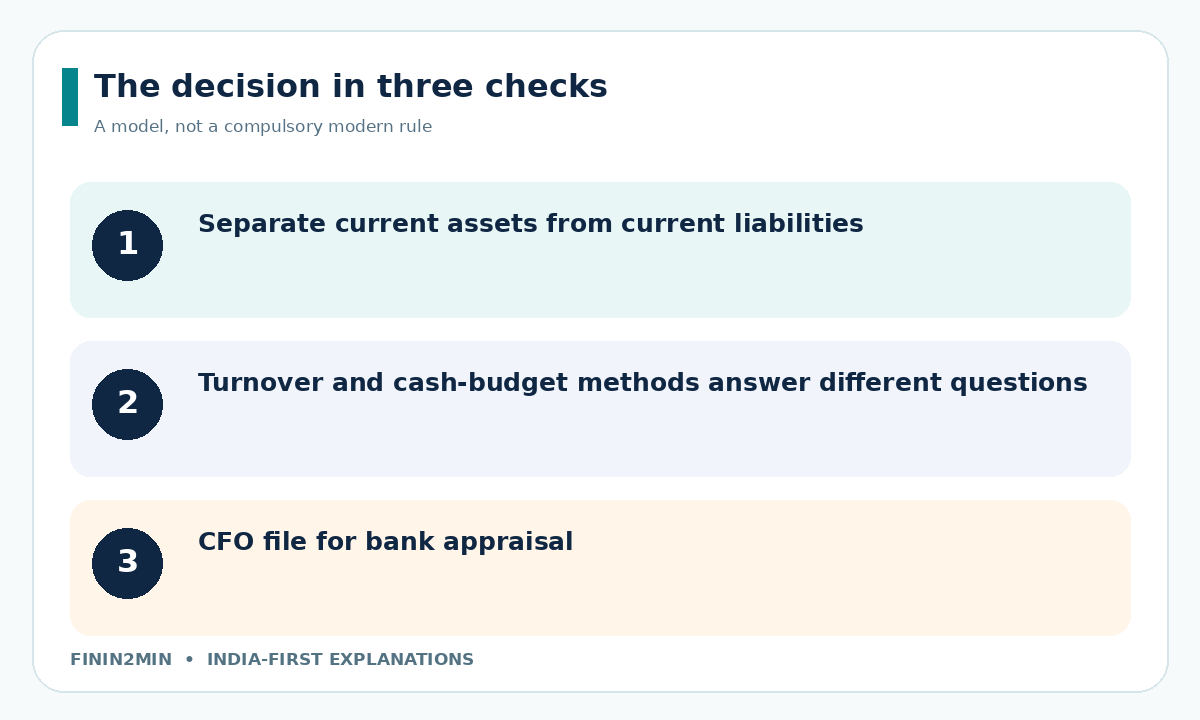
Separate current assets from current liabilities
For funding analysis, current assets may include eligible raw material, work in progress, finished inventory, receivables and operating cash, subject to haircut, age and eligibility conditions. Non-bank current liabilities include supplier credit and operating accruals. A simple working-capital gap (WCG) is current assets less non-bank current liabilities. Bank borrowings must not be mistakenly included in the non-bank liabilities used to determine the gap. The assessment may then recognise stipulated own contribution, minimum margin and the method sanctioned by the lender. Real drawing power depends on eligible securities and exclusions; it is not simply the MPBF limit.
Method I and Method II illustrated
Suppose eligible current assets are ₹500 lakh and non-bank current liabilities ₹180 lakh. The working-capital gap is ₹320 lakh. Under the conventional Method I teaching illustration, borrower margin is 25% of the gap, or ₹80 lakh; indicative MPBF is ₹240 lakh. Under the conventional Method II illustration, minimum borrower margin is 25% of total current assets, or ₹125 lakh; indicative MPBF becomes ₹195 lakh after subtracting non-bank current liabilities. The ₹45-lakh difference arises from the margin base. These are classical model outputs, not RBI-mandated limits today. The banker can use a different appraisal method.
Why sanctioned limit and drawing power differ
A cash-credit sanction may be ₹250 lakh but the monthly drawing power may fall to ₹180 lakh if stock is ineligible, debts exceed sanctioned age, prior charges exist or the bank applies a margin. The stock statement must match the accounting ledger and collateral records. If the borrower reports book stock of ₹300 lakh but ₹70 lakh is obsolete or slow moving, the banker may exclude it when calculating drawing power. Reconcile insurance, receivables assignment, charge creation, GST turnover and ageing. A large sanctioned number does not make unsupported drawings permissible.
CFO file for bank appraisal
Prepare three years’ audited financial statements where available, year-to-date management numbers, projected sales, cost of sales, monthly stock and debtors, creditors, inventory ageing, order book, bank facilities, projected cash flows and a clean explanation of deviations from prior projections. Include related-party items, overdue statutory liabilities and contingent liabilities. Label assumptions explicitly and make the result auditable to trial balance. Where the bank requests a standard CMA format, bridge the forecast to that format rather than treating it as a separate, inconsistent financial model.
Mistakes that reduce bank confidence
Typical errors are double-counting customer advances, treating long-outstanding disputed debtors as eligible, financing fixed assets through a short-term facility without explanation, overforecasting sales without matching production assumptions, or presenting negative net working capital as automatically a lending deficiency. Banks also reject worksheets where the current ratio changes but no underlying cash movement explains it. Start with the business cycle, then the method, and finally confirm the lender’s policy—not the reverse.
Link MPBF to borrowing-base and covenant reviews
To make a working-capital assessment bankable, reconcile three views: annual assessed requirement, operating cash-budget peaks and monthly security-based drawing power. For a business with ₹500 lakh current assets, maintain a bridge showing what is inventory in transit, eligible insured stock, unpaid receivables, advances to suppliers and non-operating deposits. A bank may assign no borrowing value to some of these assets even though accounting recognises them as current. Next reconcile limit utilisation to statements and loan ledger, identifying overdrawn days, interest and penal-charge risk. Finally, test whether additional sales require extra receivables or stock before projecting debt reduction. A model that says turnover will rise while receivables and inventory fall without any collection or process improvement explanation should be challenged by both the CFO and the lender.
Questions readers ask
Is Method II MPBF mandatory for every Indian borrower?
No. RBI withdrew the general MPBF prescription.
Why does Method II usually yield less finance?
Its margin is conventionally calculated on total current assets.
Is the sanctioned cash-credit limit the same as drawing power?
No; drawing power depends on eligible stock/debtors and margins.
Should bank borrowings be subtracted as other current liabilities?
Not in the WCG construct used in the illustration.
Does MPBF replace a monthly cash flow forecast?
No; the cash budget exposes timing and seasonality.
Can banks use modified MPBF today?
Yes, subject to their applicable policy and prudential requirements.
Official sources
- RBI: RBI historical account of MPBF withdrawal — April 1997 withdrawal.
- RBI: RBI working-capital appraisal options — MPBF, cash-budget, turnover alternatives.
Related reading on Finin2min
- Working-Capital Drawing Power Reduced by Bank
- MSME Export Working Capital: Packing Credit Controls
- Cash Credit vs Overdraft: Working-Capital Facility Differences
- Cash Credit vs Overdraft: Working-Capital Facility Differences
- Insights: finance, tax and law explained
- cma data preparation for manufacturing msmes
Disclaimer: Educational information, not individual tax, legal, accounting or investment advice. Check the current law, standards and notifications for the relevant period and take professional advice before acting.