MAT and AMT credit in 2026–27: new 14% MAT and carry-forward
📄 Download the PDF edition (free sign-in)

Finin2min 2-minute summary
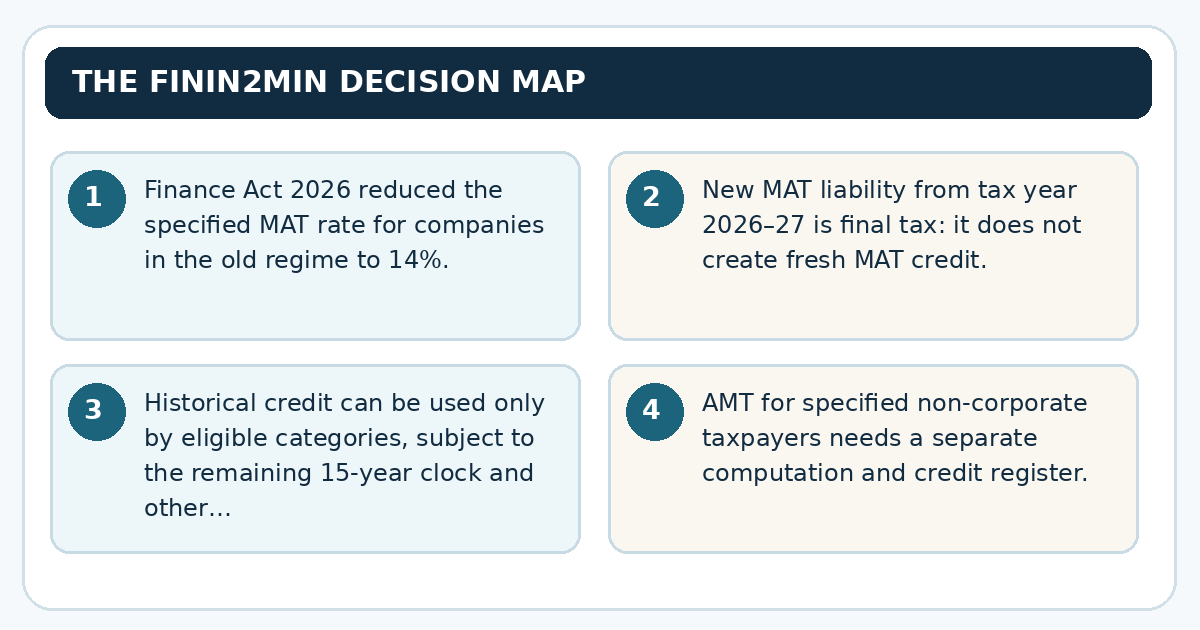
- Finance Act 2026 reduced the specified MAT rate for companies in the old regime to 14%.
- New MAT liability from tax year 2026–27 is final tax: it does not create fresh MAT credit.
- Historical credit can be used only by eligible categories, subject to the remaining 15-year clock and other caps.
- AMT for specified non-corporate taxpayers needs a separate computation and credit register.
Why FY 2025–26 and tax year 2026–27 cannot share one model
For AY 2026–27 under the 1961 Act, company MAT under section 115JB and related MAT credit under section 115JAA need their historical calculations. From tax year 2026–27, the Income-tax Act 2025 section 206 applies with Finance Act 2026 amendments. That reform is fundamental: MAT for companies in the relevant old regime is set at the revised 14% rate, and no new MAT credit accrues on the final-tax liability. A model that creates a new credit equal to 14% MAT less regular tax would overstate future tax assets. Start every calculation by identifying the governing year and company’s tax-regime election.
Where legacy MAT credit can be used
A domestic company with accumulated pre-1 April 2026 MAT credit must test the permitted concessional company-tax regime before set-off. The amended framework permits eligible domestic companies opting for sections 200 or 201 to use historical credit, subject to a 25% limit of current tax payable and the remaining original 15-year expiry. A domestic company remaining in the old regime cannot treat the credit as generally available in that year. Foreign companies continue under the separate statutory difference-based utilisation approach. The register must hold credit by origin year, because a common aggregate balance disguises expiries.
Worked domestic-company example
Assume a domestic company chooses an eligible concessional regime for tax year 2026–27, has ₹18 lakh tax payable under the regime before legacy MAT credit and a valid balance of ₹7 lakh from past years. Twenty-five per cent of ₹18 lakh is ₹4.50 lakh, so illustrative current-year set-off cannot exceed ₹4.50 lakh, assuming no further statutory restriction. The balance ₹2.50 lakh remains subject to the originating credit’s expiry. This example isolates the credit cap and excludes surcharge, cess or specialised adjustments for simplicity; final computation should apply the enacted definition of tax payable and the precise statutory order of credits.
AMT is a different tax calculation
Alternate Minimum Tax addresses specified non-company taxpayers, including qualifying firms and LLPs, and may arise where certain deductions or other qualifying items affect adjusted total income. The standard legacy AMT framework applied 18.5% subject to statutory exceptions; the applicable 2025 Act rules must be checked for the entity and year. Compute adjusted total income, regular tax, AMT and any eligible brought-forward credit separately. Do not apply the new corporate 14% MAT percentage to an LLP. A company-specific credit rule is not automatically available to an individual, firm or LLP, even when both are shown on a combined tax planning worksheet.
Credit expiry and financial reporting
Maintain a credit-vintage schedule showing origin year, original credit, credit used, adjustments arising from assessment/appellate orders, expiry year and amount potentially utilizable under forecast taxable income. For each historic company credit, record whether the company is eligible to use it following a tax-regime transition. Review any deferred tax asset against the applicable accounting standard’s recognition conditions; a tax-law carry-forward balance is not automatically a recoverable balance-sheet asset. The audit committee will want evidence of expected future taxable profits, approved regime choices and potential limitation expiries.
Tax regime selection: not just compare 14% and 22%
The relevant comparison is total income under each regime, available deductions, surcharge/cess, book-profit MAT, future loss utilisation and usable legacy credits. A company with low taxable profit but high book profit may have near-term old-regime MAT even if the headline normal tax rate looks attractive. A concessional election can impose restrictions on deductions and carry-forward losses, which may offset the apparent MAT-credit advantage. Build a multi-year cash-tax model, not one-year arithmetic. Obtain written sign-off on irrevocable or otherwise restricted elections before using the selected case in budgets or disclosures.
Compliance controls and accountant certification
Reconcile book profit to the statutory MAT computation, including additions, reductions and where relevant Ind AS transition adjustments. Preserve Form 66 or the applicable accountant report, return schedules, vintage MAT/AMT registers, assessment orders and last-year carry-forward balances. Confirm current form requirements and dates directly before filing. If a legacy article says that every company paying MAT from April 2026 creates a new credit, it conflicts with the Finance Act 2026 changes. Finance communications should always state which tax year and whether the number is fresh MAT, historical MAT credit or AMT credit.
Corporate budgeting needs two credit waterfalls
Build one waterfall for the tax actually payable in the current year and another for older credit vintages. For an old-regime company subject to 14% MAT, show the amount as final tax without posting fresh MAT credit. For an eligible concessional-regime domestic company, first compute the ordinary tax base correctly, then apply the legacy-credit ceiling and the vintage expiry. Do not net an unused tax-loss benefit against MAT credit as though both were interchangeable. Accountants assessing deferred tax need a forward tax forecast and management’s supporting regime choice. This prevents a deceptively attractive tax asset from remaining on the balance sheet after its legal utilisation window has narrowed.
Practitioner checklist
- Identify the applicable tax year before choosing MAT rules.
- Separate legacy MAT vintages from new final-tax liability.
- Check concessional regime eligibility before credit use.
- Reconcile every credit to return and assessment orders.
- Document deferred-tax forecasts and year-of-expiry risks.
Frequently asked questions
Finance Act 2026 reduced the specified MAT rate to 14% for relevant companies.
No, the amended company MAT framework makes it final tax without fresh credit accrual.
No; the original 15-year clock and the current permitted utilisation conditions continue.
For eligible concessional regimes, up to 25% of qualifying current-year tax liability.
No. AMT is a distinct non-company regime with its own rates and conditions.
No. Maintain a vintage-by-vintage register and separate MAT from AMT.
Official sources and statutory trail
Educational information, not individual tax, legal or accounting advice. Verify the period, instrument, eligibility, filings and latest official guidance before acting.