Cost Sheet Format for Indian Manufacturers: Prime Cost to Profit Reconciliation
📄 Download the PDF edition (free sign-in)

Finin2min's two-minute answer
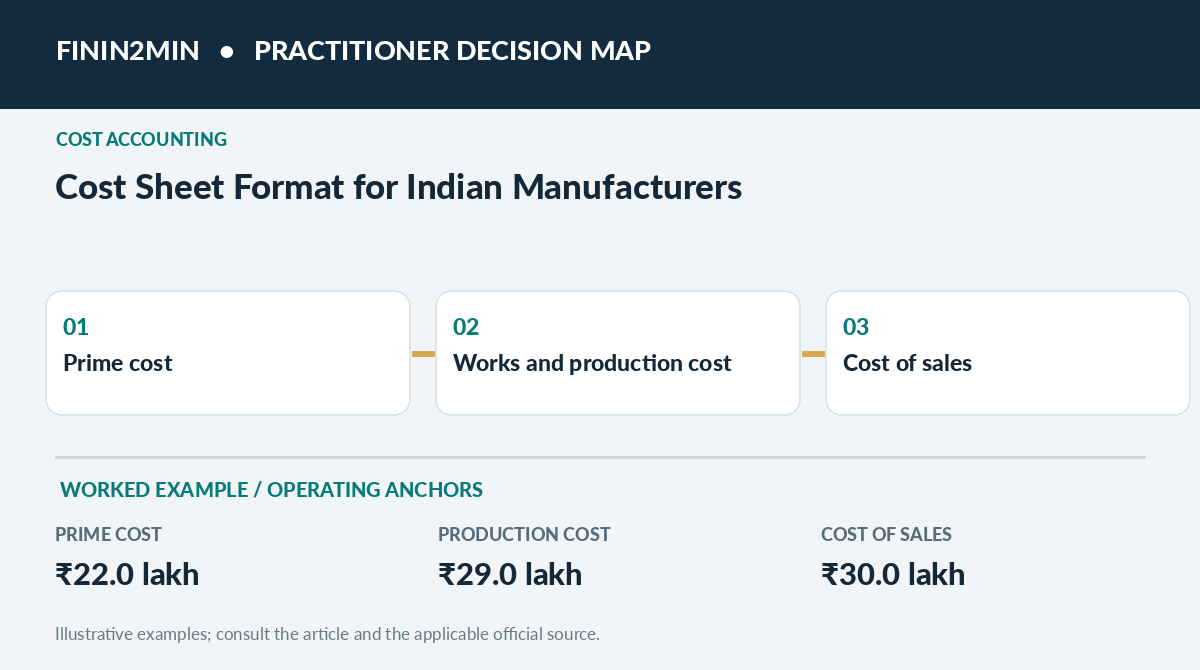
- A cost sheet translates material, labour, expenses, production overhead, inventory movements and selling costs into an understandable cost per unit and margin.
- Do not confuse cost of production, cost of goods sold, cost of sales and invoice selling price. Each contains different items.
- Capacity absorption and normal versus abnormal losses must be assessed; they are not cosmetic allocation choices.
- Cost Accounting Standards published by ICMAI are an important source of terminology, but their legal applicability depends on the relevant rules, company and assignment.
- A useful cost sheet reconciles the cost ledger to financial accounts and separates management costing decisions from statutory inventory valuation.
At-a-glance reference table
| Cost layer | Illustration (₹ lakh) |
|---|---|
| Direct material + labour + expenses (prime cost) | 22.00 |
| Plus factory overhead | 6.00 |
| WIP movement (net) | (0.50) |
| Plus production-related admin | 1.50 |
| Cost of production | 29.00 |
| Finished goods movement (net) | (1.00) |
| Plus selling/distribution | 2.00 |
| Cost of sales | 30.00 |
Understand the layers of cost
Start with direct material consumed: opening raw material plus purchases and attributable costs less returns and closing raw material. Add direct employee cost and direct expenses to obtain prime cost. Add appropriate production or factory overhead to obtain works or factory cost, adjusted for work in progress. Then add applicable administration overhead related to production, where the relevant cost-statement basis supports that inclusion, to arrive at cost of production. Adjust opening and closing finished-goods inventory to reach cost of goods sold. Selling and distribution costs then produce cost of sales, which is compared with net sales to compute margin.
This chain is a management statement. Reconcile its treatment to the specific accounting framework and the ICMAI Cost Accounting Standards rather than declaring the same absorption rules apply universally to financial inventory valuation. Costs that are irrelevant to production may belong below gross profit or outside cost of inventories.
A worked cost sheet for a component factory
Assume opening raw materials ₹2,00,000; net purchases ₹14,00,000; closing raw materials ₹3,00,000. Raw material consumed is ₹13,00,000. Add direct labour ₹7,00,000 and directly traceable expenses ₹2,00,000: prime cost ₹22,00,000. Production overhead assigned under the chosen valid capacity basis is ₹6,00,000, giving ₹28,00,000 before work-in-progress movement. Opening WIP is ₹1,00,000 and closing WIP ₹1,50,000, so works cost of completed production is ₹27,50,000.
Assume production-related administration overhead of ₹1,50,000 is appropriately included under the relevant costing basis. Cost of production becomes ₹29,00,000. Opening finished goods ₹3,00,000 and closing finished goods ₹4,00,000 give cost of goods sold ₹28,00,000. Add selling and distribution expense ₹2,00,000: cost of sales ₹30,00,000. If net sales are ₹36,00,000, the illustrated profit before other income, finance costs, tax and items outside the statement is ₹6,00,000. For 10,000 finished units, cost of production averages ₹290 per unit; that is not necessarily the marginal cost of an extra unit.
Every number in this illustration should have a source: material issue register, payroll allocation, labour routing, machine-hour record, WIP valuation, warehouse closing count and overhead absorption policy. An elegant spreadsheet with unverified closing stock is not a reliable cost sheet.
Absorption and capacity pitfalls
If the plant operates far below normal capacity, applying all fixed production overhead to a small number of units can inflate unit inventory values. Conversely, leaving normal fixed overhead out can understate cost. Evaluate the appropriate normal capacity and idle capacity treatment under applicable standards and financial accounting rules. Separate unavoidable normal process loss from abnormal scrap or rework; investigate the latter instead of concealing it in the same unit rate.
For a multi-product company, use an allocation basis consistent with cause and effect where possible. Machine hours may be more useful for automated components while labour hours might suit manual assembly. A single percentage of sales can be a poor proxy for factory cost, especially if products differ in setups, batch sizes or quality inspections.
Reconcile the sheet to the accounts
Map purchase invoices to inventory movement, GST recoverability, freight inwards and customs duty where relevant. Reconcile labour to production time sheets rather than total payroll cost. Ensure depreciation charged to factory overhead equals the production-related ledger charge after removing selling and corporate assets. Match opening and closing finished goods to the financial stock records with documented valuation differences.
A useful bridge has four columns: general ledger expense, cost accounting classification, non-cost or exceptional item, and amount included in the cost sheet. Investigate variances arising from valuation methods, timing, abnormal wastage, unabsorbed overhead or cost ledger adjustments. Make the reader understand why financial EBITDA can improve while product margin deteriorates due to inventory accumulation.
Pricing versus valuation: two different decisions
A cost sheet is useful for bids and negotiations, but full absorbed cost is not always the right short-run pricing floor. An incremental order with idle capacity may be judged by incremental contribution and strategic constraints; a long-term contract must consider replacement capacity, working capital, support costs and return on capital. The same data can support different decisions without changing the official inventory accounting.
For quotation purposes, separately identify tax, freight recovery terms, price escalation, customer-specific tooling, quality rejection exposure, warranty and credit period. Gross profit is not cash profit if customers pay slowly or the project requires high stock. Use a cash conversion bridge alongside costing data for a major order.
Practical error prevention
Avoid deducting closing stock twice, misclassifying outward freight as factory overhead, using tax-inclusive input costs where GST credit is recoverable, applying total salary expense as direct labour, or calculating cost per unit using dispatches rather than completed output. When yield differs from standard, show the effect explicitly instead of silently changing the production denominator.
Questions manufacturing finance teams ask
Is prime cost equal to production cost? No. Prime cost is direct material, direct labour and direct expenses; production cost includes appropriate further overhead and inventory adjustments.
Does cost of sales include distribution cost? In a typical management cost sheet, selling and distribution costs are added after cost of goods sold, subject to the statement's defined perimeter.
Can fixed overhead simply follow actual output? Not without evaluating the applicable normal-capacity treatment and implications for idle capacity.
Does a cost sheet determine GST valuation? No. Tax valuation follows its own provisions and transaction facts.
Why can cost sheet profit differ from the P&L? Classification, timing, inventory valuation, overhead absorption and exceptional items may differ; a documented reconciliation is necessary.
How often should unit costs be refreshed? Whenever material price, mix, yield, process or capacity shifts materially; monthly is common for management reporting but not a legal universal rule.
Professional information: This article explains accounting and finance concepts using illustrative amounts. Check the applicable standards, entity classification, source amendments, contracts and professional advice for your actual reporting year or transaction.