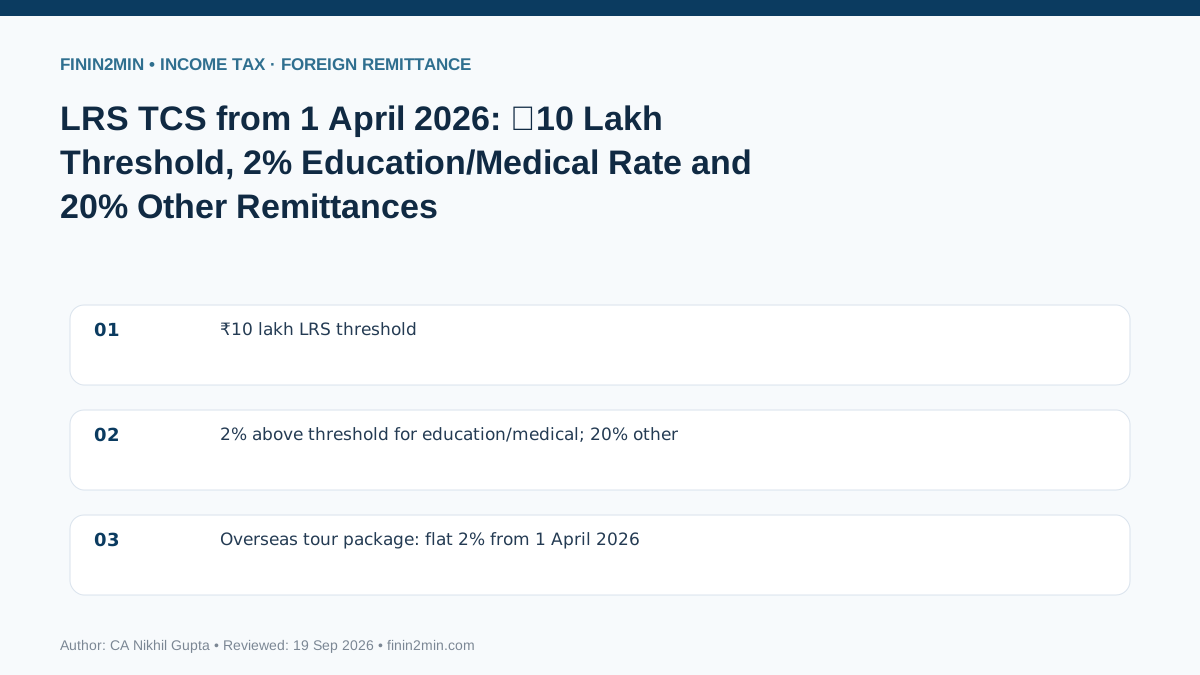
The 2026 law keeps the ₹10 lakh LRS threshold but reduces the education/medical TCS rate to 2%; other LRS purposes remain at 20%. Overseas tour packages move to a flat 2% collection without the earlier amount-based rate split.
The 2026 rate table
Section 394 of the Income-tax Act, 2025 now carries the TCS framework. For Liberalised Remittance Scheme (LRS) remittances, an authorised dealer collects tax when the amount or aggregate remitted in the tax year exceeds ₹10 lakh. From 1 April 2026, the rate on the amount above that threshold is 2% for education or medical treatment and 20% for other LRS purposes.
The Finance Act 2026 also changes overseas tour programme packages. The new section 394 table shows a flat 2% TCS on sale of an overseas tour programme package. The Budget memorandum explains that the old 5%/20% amount-based split was replaced and the threshold removed for this package category.
₹10 lakh is a threshold, not a 2%/20% tax on every rupee remitted
Example — self-funded education. A resident remits ₹18 lakh during the tax year for overseas tuition under LRS and no earlier LRS remittance has been made. Amount above threshold = ₹18 lakh − ₹10 lakh = ₹8 lakh. At 2%, TCS = ₹16,000.
Example — overseas investment. The same ₹18 lakh remitted to buy foreign securities falls in an “other purpose” category. On the same simplified facts, amount above threshold = ₹8 lakh and TCS at 20% = ₹1,60,000.
The difference is cash flow, not a ten-fold difference in final income-tax liability. TCS is generally a tax credit collected in advance and reflected through the tax-credit system; the taxpayer reconciles it while computing advance/self-assessment tax and return liability.
Education loan carve-out
Section 394 contains an important exception: the LRS collection rule does not apply where the remittance is out of a loan obtained from a financial institution, as defined for the statutory education-loan purpose. That can make an education remittance funded by a qualifying education loan very different from an identical tuition remittance funded from savings.
Do not label a family loan or personal loan as “education loan” merely because the money will pay tuition. The bank/authorised dealer will normally need evidence that the statutory loan condition is satisfied.
Overseas tour package: 2% from the first rupee of package consideration
A resident buys a qualifying overseas tour programme package from an Indian tour operator for ₹12,00,000 after 1 April 2026. Under the new flat rate, TCS is 2% × ₹12,00,000 = ₹24,000. The earlier rate bands/₹10 lakh split for tour packages no longer drive this calculation.
Do not automatically treat every foreign hotel or airline payment as an “overseas tour programme package”. The statutory expression covers a package including expenses for travel/hotel/boarding/lodging or similar expenditure. A standalone card purchase or direct hotel booking can instead fall within LRS/card/remittance treatment depending on the transaction channel and RBI rules.
Aggregate tracking across banks matters
The threshold is expressed with reference to an amount or aggregate of amounts. A taxpayer cannot safely assume each bank provides a separate ₹10 lakh bucket. If ₹7 lakh is remitted through Bank A and ₹6 lakh through Bank B for LRS purposes during the same tax year, the aggregate is ₹13 lakh; the threshold analysis is taxpayer-level, even though collection is performed by authorised dealers on the information available to them.
Maintain an LRS ledger containing remittance date, bank, purpose code, gross INR equivalent, TCS collected and Form 26AS/AIS reflection. Families should also distinguish who is the remitter: a parent paying for a child’s study from the parent’s account uses the parent’s LRS/TCS history, not the child’s merely because the child is the student.
Collection timing and refund planning
Section 394 uses the earlier of debit of the amount payable or receipt, depending on the statutory transaction. In practice, the authorised dealer/tour seller collects TCS at the remittance/package-payment event. Large investment remittances can therefore create a material working-capital block months before the income-tax return is filed.
Before sending ₹50 lakh for foreign securities, model the 20% TCS on the portion above ₹10 lakh. On simplified facts: excess = ₹40 lakh; TCS = ₹8 lakh. The remitter may need ₹58 lakh of liquidity to complete a ₹50 lakh investment remittance if the collection is funded separately. That ₹8 lakh is then available as tax credit subject to correct reporting, but it is still cash that leaves the bank account upfront.
Purpose code is not a clerical field
The rate depends on why money is remitted. “Education”, “medical treatment”, “investment”, “maintenance of relatives” and “travel” can have very different TCS consequences. Keep the admission letter/fee demand for education, hospital estimate for medical treatment, broker/investment instructions for securities, and invoices for tour packages. If the bank’s purpose classification is wrong, fix it at transaction time rather than attempting to explain a mismatched TCS record months later.
Reconciliation checklist for the return
- Download annual TCS credits from Form 26AS/AIS.
- Match each entry to the remittance ledger and bank advice.
- Check PAN against the authorised dealer/tour operator record.
- Investigate duplicate collection, wrong amount or wrong person before filing the return.
- Include the credit in the tax computation; TCS is not automatically the final tax on the foreign asset/trip/education expense.
- If the foreign transaction creates taxable foreign income or a foreign asset disclosure, handle that reporting independently of the TCS credit.
Three remitters in one family means three separate tax identities
The LRS operates at the resident-individual remitter level. A family should not assume that one person’s ₹10 lakh TCS threshold can be pooled with another person’s merely because both payments support the same child, trip or investment. The remitting bank tracks the PAN/customer making the remittance and the stated purpose. If parents split an education payment, preserve the fee demand, relationship, source of funds and remittance records so each remitter’s transaction can be explained.
Conversely, opening accounts with multiple authorised dealers does not create multiple thresholds for the same person. The annual threshold is aggregate for the remitter. A practical tracker should therefore record every LRS remittance across banks from 1 April onward, including date, purpose, amount and TCS collected.
Example — same PAN, two banks. A resident remits ₹7 lakh through Bank A for overseas investment and later ₹8 lakh through Bank B for another investment in the same financial year. The second bank relationship does not reset the statutory threshold. The aggregate LRS remittance is ₹15 lakh, so the remitter’s tracker must identify the portion above the ₹10 lakh threshold to which the applicable “other purpose” TCS rate is relevant.
Direct travel booking and an overseas tour programme are not the same TCS fact pattern
The 2026 rationalisation gives an overseas tour programme package a 2% TCS rate without the ₹10 lakh threshold that applies to LRS remittances. A person independently buying an airline ticket, hotel and attraction tickets should not automatically label the entire spend an “overseas tour package”; equally, paying a tour operator for a qualifying package should not be pushed through the ordinary LRS threshold analysis simply because foreign travel is involved.
Ask the collecting entity to identify the statutory category on its receipt/TCS documentation. For corporate travel or a mixed invoice, separate what is being purchased and who is the remitter. The cash-flow difference can be material: 2% on a ₹6 lakh qualifying package is ₹12,000, whereas an ordinary “other purpose” LRS remittance below the ₹10 lakh annual threshold may have a different collection result.
TCS is advance tax credit, but cash-flow still matters
TCS is not, by itself, a second final tax on the underlying foreign asset, tuition fee or medical bill. It is collected and reflected in the taxpayer’s tax-credit records, subject to the law and successful reporting. That distinction matters when a taxpayer compares investments: a 20% collection can lock up cash even if the eventual income-tax liability is much smaller and the excess becomes adjustable/refundable.
Example — investment cash requirement. Suppose the applicable annual threshold has already been exhausted and a resident sends a further ₹12 lakh for an overseas investment falling in the 20% category. The remittance itself is ₹12 lakh; 20% TCS on that taxable remittance portion is ₹2.40 lakh, so the immediate cash outflow can reach ₹14.40 lakh. The ₹2.40 lakh is tracked as TCS credit rather than added to the purchase cost of the overseas security for economic analysis.
Before filing the return, reconcile the collector’s certificate/statement and Form 26AS/AIS against your remittance tracker. Name/PAN errors should be resolved with the collector early; otherwise a large cash collection may fail to appear when the return is prepared.
Education and medical remittances: preserve purpose evidence
The 2% category for education/medical remittances is purpose-sensitive, so the bank file should contain the university fee demand or hospital/medical estimate and the remittance instruction that identifies the beneficiary. Where education is financed through a qualifying loan, retain the sanction letter and the lender-to-remittance trail because the tax treatment can differ from a self-funded remittance. If one transfer combines tuition, living expenses and another purpose, ask the authorised dealer how it will classify the components before remitting rather than discovering the TCS code after collection.
A year-end TCS reconciliation should therefore be more granular than “foreign remittances ₹X”. Break it by education, medical, investment/other LRS and tour-package collection, then match each line to the collector’s reporting. This makes the ITR credit review faster and exposes a misclassified 20% collection while it can still be corrected through the collecting entity.
LRS TCS FAQs for 2026-27
What is the LRS threshold from 1 April 2026?
₹10 lakh in aggregate for the tax year under section 394’s LRS item.
What is the rate for education or medical treatment?
2% on the LRS amount above ₹10 lakh, subject to the statutory exception for qualifying education-loan-funded remittances.
What is the rate for foreign investment?
20% on the LRS amount above ₹10 lakh.
What changed for overseas tour packages?
The 2026 law uses a flat 2% TCS on the package consideration without the prior amount-based rate split.
Is TCS an extra final tax?
Normally it is a tax credit collected in advance. Final tax depends on the taxpayer’s income and return computation.
Can I get a separate ₹10 lakh threshold at each bank?
The statutory language uses aggregate amounts, so taxpayer-level tracking is essential even when multiple authorised dealers are used.
Primary sources
Use the cited instrument or regulator guidance for the proposition described above; check later amendments and transaction-date rules before acting.
Educational information only. Tax, legal, banking and insurance outcomes depend on facts, dates and the instrument/policy in force. Obtain professional advice for material transactions.