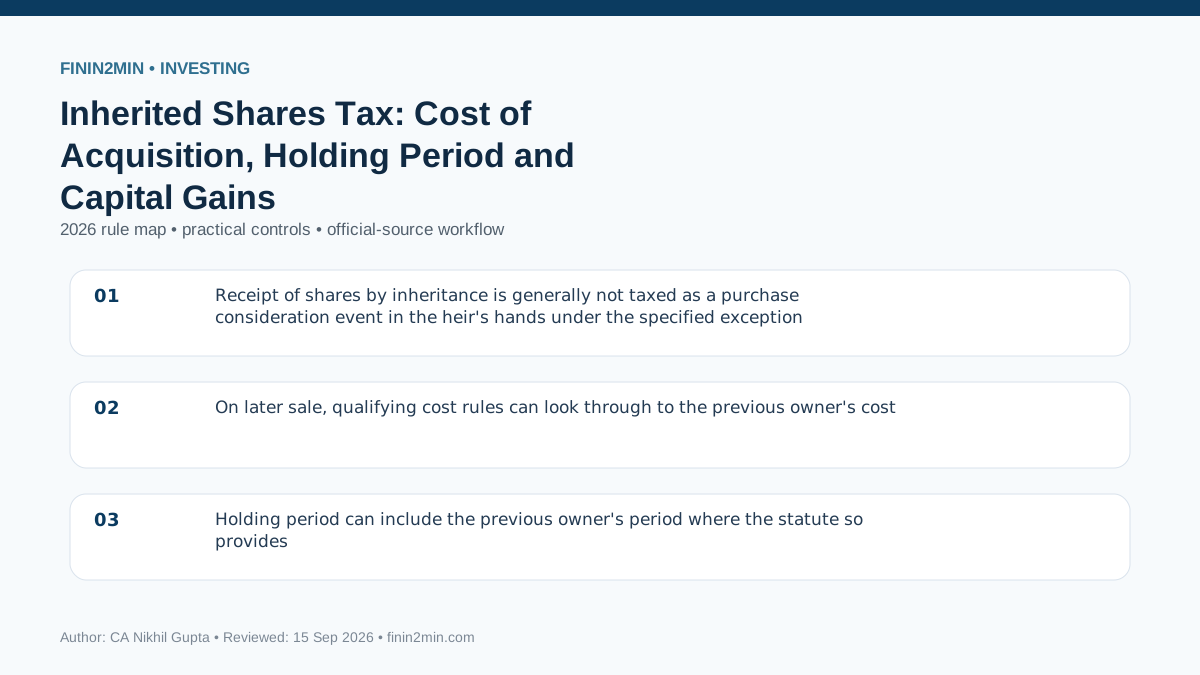
Receiving shares by inheritance does not ordinarily create the same capital-gains event as selling them. The tax issue arises when the heir later transfers the securities.
Current rule and what decides the result
Inheritance is generally not taxed as a sale or a section 56 gift receipt merely because securities pass to an heir. Tax usually arises when the heir later sells. For qualifying inherited assets, the capital-gains cost is generally traced to the previous owner under the carry-over cost rule, and the previous owner’s holding period is considered for short-/long-term classification. Very old assets can require the statutory pre-1 April 2001 fair-market-value option; listed equity also requires the applicable grandfathering/section 112A mechanics where relevant.
Key rules to apply
- Section 49 carries forward the qualifying previous owner’s cost, and the holding-period rule can include the previous owner’s period—so using the probate-date market value as “cost” can overstate or understate the gain.
- Succession/inheritance is covered by specific non-transfer/cost-rollover rules rather than ordinary sale treatment.
- Section 49 generally deems the heir’s cost to be the cost for which the previous owner acquired the shares, subject to statutory exceptions.
- For inherited assets, the previous owner’s holding period is relevant to short-term/long-term classification.
- If listed shares meet section 112A conditions, current 20% STCG/12.5% LTCG rules and ₹1.25 lakh threshold may apply depending on holding and transaction.
- Shares acquired by the previous owner before 1 February 2018 can require section 55 grandfathering/FMV analysis for listed-equity cost.
Inherited listed shares later sold
A father bought listed shares in 2015 for ₹2 lakh. His daughter inherits them in 2025 when market value is ₹6 lakh and sells in 2027 for ₹7.5 lakh. The ₹6 lakh probate/market value is not automatically the daughter’s tax cost. The carry-over cost rule generally starts with the father’s cost, subject to listed-equity grandfathering and other applicable provisions. The father’s holding period also counts, so the later sale is not treated as a two-year holding beginning on inheritance date.
Shares originally acquired before 2001
An heir sells unlisted family-company shares in 2027 that the deceased acquired in 1995 for ₹40,000. For an eligible pre-1 April 2001 capital asset, the tax working should examine the statutory fair-market-value substitution as on 1 April 2001 rather than blindly using ₹40,000. A defensible valuation and evidence of lineage from the previous owner become central because the heir may not possess the original purchase contract.
How to apply it step by step
- Obtain the transmission/succession records and deceased holder’s demat/folio history.
- Reconstruct the previous owner’s purchase dates and costs from broker, company or bank records.
- Apply carry-over cost rules and include previous-owner holding period where the law requires.
- For pre-1 April 2001 assets, test the available FMV substitution and obtain defensible valuation evidence.
- For listed equity, check grandfathering/STT/section 112A conditions at later sale.
- Adjust units and cost for bonus, split, merger or other corporate actions before sale.
- Reconcile sale proceeds with broker/AIS and preserve the inheritance trail.
- Do not use probate/estate value as tax cost unless a specific provision supports it.
Common mistakes and edge cases
- Using market value on date of death as cost by default.
- Starting holding period only from the inheritance date.
- Losing the deceased investor’s historical contract notes and corporate-action records.
- Ignoring the 1 April 2001 FMV rule for very old assets.
- Applying one cost rule to bonus/split lots without tracing corporate actions.
FAQs
Is inheritance itself taxable as a gift?
Inheritance is generally covered by a statutory exception; tax typically arises on later disposal.
What cost does the heir use?
Does the previous owner’s holding period count?
Yes, it is generally included for inherited capital assets when classifying the later sale.
Can I use value on the date of death?
Not automatically. That is a common mistake unless a specific rule makes it relevant.
What about very old shares?
Eligible assets acquired before 1 April 2001 require a separate FMV/cost analysis.
Which records should an heir preserve?
Transmission papers, old statements/contract notes, corporate-action history and later sale records.
Related Finin2min guides
- Gifted Shares: Cost of Acquisition & Capital Gains
- Capital Gains Holding Period: 12-Month vs 24-Month Rules
- Stock Splits and Consolidations: Cost Allocation, Holding Period and Capital-Gains Traps
- Is Inherited Property Taxed? Capital Gains on Sale
- Inherited Property Sale: Cost, Heirs and Capital Gains Proof Pack
- Bonus Shares Sold: Zero Cost, Holding Period and Which ITR?
- Inherited Gold Sold: Whose Cost and Holding Period Should You Use?
- ESOP Sale After Employer Acquisition: Cost Basis, Perquisite and Capital-Gains Reconciliation