IPA-C04 - 13 provisions

Mutual Agency and Third-Party Liability

Indian Partnership Act, 1932

Full local statutory textFinin2min implementation editionCA Nikhil Gupta and Kajri Singh

Download chapter PDFDownload one-page cheat sheet

Finin2min Summary - Chapter in 2 Minutes

Purpose

This unit converts mutual agency and third-party liability into statutory, transaction, evidence and remedy decisions.

Who is covered

Businesses, contracting parties, partners, buyers, sellers, principals, agents and litigants affected by this chapter.

Main obligations

Read the transaction documents and actual conduct against every statutory limb, exception and connected law.

Key timelines

Record event, breach, refusal, notice, acknowledgment and filing dates; apply the correct Limitation Act article.

Forms and evidence

Use the chapter evidence checklist and State/UT forms where registration or public notice applies.

Top risk

Wrong classification, missing authority, weak evidence, ineffective notice, unverified State process or wrong remedy.

Remedy

Preserve rights, mitigate loss, quantify exposure and confirm forum, arbitration, limitation and interim relief.

Finin2min takeaway

Classify - map law - verify authority - prove performance - quantify consequence - select remedy and forum.

Section-by-section provision map

ProvisionTitleStatusDecision theme
s.18Partner to be agent of the firmoperativepartnership authority and liability
s.19Implied authority of partner as agent of the firmoperativepartnership authority and liability
s.20Extension and restriction of partner’s implied authorityoperativepartnership authority and liability
s.21Partner’s authority in an emergencyoperativepartnership authority and liability
s.22Mode of doing act to bind firmoperativepartnership authority and liability
s.23Effect of admissions by a partneroperativepartnership authority and liability
s.24Effect of notice to acting partneroperativepartnership authority and liability
s.25Liability of a partner for acts of the firmoperativepartnership authority and liability
s.26Liability of the firm for wrongful acts of a partneroperativepartnership authority and liability
s.27Liability of firm for misapplication by partnersoperativepartnership authority and liability
s.28Holding outoperativepartnership authority and liability
s.29Rights of transferee of a partner’s interestoperativeprice, payment and financial consequence
s.30Minors admitted to the benefits of partnershipoperativechange in firm constitution

Legal status, amendments and source protocol

Act: Indian Partnership Act, 1932; Act 9 of 1932; commencement 1 October 1932; section 69 from 1 October 1933.

Source protocol: Complete central provision text is reproduced locally. Local public-domain central Act transcription reconciled to India Code structure. Official India Code and Gazette instruments prevail if any discrepancy is identified.

Full statutory text and Finin2min decode

Section 18 - Partner to be agent of the firm
Local statutory-text source control: Local public-domain central Act transcription reconciled to India Code structure. Official India Code source prevails.

Current statutory text

Subject to the provisions of this Act, a partner is the agent of the firm for the purposes of the business of the firm.

Finin2min clause-by-clause decode

ClauseStatutory requirementFinin2min meaningEvidence/control
Main ruleSubject to the provisions of this Act, a partner is the agent of the firm for the purposes of the business of the firm.Test this main limb within the partnership authority and liability framework. Operational focus: subject to the provisions of this act, a partner is the agent of the firm for the purposes.Contract/deed, authority, chronology, notices, performance and payment records tied to this limb.

Finin2min implementation explanation

Section 18 is a partnership authority and liability provision dealing with partner to be agent of the firm. Identify the actor, trigger, cumulative or alternative conditions, provisos, exceptions and legal consequence before reaching a conclusion.

Implementation control: Reconcile the deed, ordinary course, internal limits, third-party knowledge, firm-name execution, admissions and holding out. Internal restrictions may not defeat external liability.

Section-level practical application

Transaction test

Apply this provision to the event-date facts and record every satisfied, disputed or inapplicable limb.

Consequence and remedy

Identify how it changes validity, title, authority, liability, payment, rejection, recovery, registration, evidence or relief.

Section 19 - Implied authority of partner as agent of the firm
Local statutory-text source control: Local public-domain central Act transcription reconciled to India Code structure. Official India Code source prevails.

Current statutory text

(1) Subject to the provisions of section 22, the act of a partner which is done to carry on, in the usual way, business of the kind carried on by the firm binds the firm. The authority of a partner to bind the firm conferred by this section is called his "implied authority". (2) In the absence of any usage or custom of trade to the contrary, the implied authority of a partner does not empower him to- (a) submit a dispute relating to the business of the firm to arbitration; (b) open a banking account on behalf of the firm in his own name; (c) compromise or relinquish any claim or portion of a claim by the firm; (d) withdraw a suit or proceeding filed on behalf of the firm; (e) admit any liability in a suit or proceeding against the firm; (f) acquire immovable property on behalf of the firm; (g) transfer immovable property belonging to the firm; or (h) enter into partnership on behalf of the firm.

Finin2min clause-by-clause decode

ClauseStatutory requirementFinin2min meaningEvidence/control
(1)Subject to the provisions of section 22, the act of a partner which is done to carry on, in the usual way, business of the kind carried on by the firm binds the firm. The authority of a partner to bind the firm conferred by this section is called his "implied authority".Test this (1) within the partnership authority and liability framework. Operational focus: subject to the provisions of section 22, the act of a partner which is done to carry on.Contract/deed, authority, chronology, notices, performance and payment records tied to this limb.
(2)In the absence of any usage or custom of trade to the contrary, the implied authority of a partner does not empower him to-Test this (2) within the partnership authority and liability framework. Operational focus: in the absence of any usage or custom of trade to the contrary, the implied authority of a.Contract/deed, authority, chronology, notices, performance and payment records tied to this limb.
(a)submit a dispute relating to the business of the firm to arbitrationTest this (a) within the partnership authority and liability framework. Operational focus: submit a dispute relating to the business of the firm to arbitration.Contract/deed, authority, chronology, notices, performance and payment records tied to this limb.
(b)open a banking account on behalf of the firm in his own nameTest this (b) within the partnership authority and liability framework. Operational focus: open a banking account on behalf of the firm in his own name.Contract/deed, authority, chronology, notices, performance and payment records tied to this limb.
(c)compromise or relinquish any claim or portion of a claim by the firmTest this (c) within the partnership authority and liability framework. Operational focus: compromise or relinquish any claim or portion of a claim by the firm.Contract/deed, authority, chronology, notices, performance and payment records tied to this limb.
(d)withdraw a suit or proceeding filed on behalf of the firmTest this (d) within the partnership authority and liability framework. Operational focus: withdraw a suit or proceeding filed on behalf of the firm.Contract/deed, authority, chronology, notices, performance and payment records tied to this limb.
(e)admit any liability in a suit or proceeding against the firmTest this (e) within the partnership authority and liability framework. Operational focus: admit any liability in a suit or proceeding against the firm.Contract/deed, authority, chronology, notices, performance and payment records tied to this limb.
(f)acquire immovable property on behalf of the firmTest this (f) within the partnership authority and liability framework. Operational focus: acquire immovable property on behalf of the firm.Contract/deed, authority, chronology, notices, performance and payment records tied to this limb.
(g)transfer immovable property belonging to the firm; orTest this (g) within the partnership authority and liability framework. Operational focus: transfer immovable property belonging to the firm; or.Contract/deed, authority, chronology, notices, performance and payment records tied to this limb.
(h)enter into partnership on behalf of the firm.Test this (h) within the partnership authority and liability framework. Operational focus: enter into partnership on behalf of the firm.Contract/deed, authority, chronology, notices, performance and payment records tied to this limb.

Finin2min implementation explanation

Section 19 is a partnership authority and liability provision dealing with implied authority of partner as agent of the firm. Identify the actor, trigger, cumulative or alternative conditions, provisos, exceptions and legal consequence before reaching a conclusion.

Implementation control: Reconcile the deed, ordinary course, internal limits, third-party knowledge, firm-name execution, admissions and holding out. Internal restrictions may not defeat external liability.

Section-level practical application

Transaction test

Apply this provision to the event-date facts and record every satisfied, disputed or inapplicable limb.

Consequence and remedy

Identify how it changes validity, title, authority, liability, payment, rejection, recovery, registration, evidence or relief.

Section 20 - Extension and restriction of partner’s implied authority
Local statutory-text source control: Local public-domain central Act transcription reconciled to India Code structure. Official India Code source prevails.

Current statutory text

The partners in a firm may, by contract between the partners, extend or restrict the implied authority of any partner. Notwithstanding any such restriction, any act done by a partner on behalf of the firm which falls within his implied authority binds the firm, unless the person with whom he is dealing knows of the restriction or does not know or believe that partner to be a partner.

Finin2min clause-by-clause decode

ClauseStatutory requirementFinin2min meaningEvidence/control
Main ruleThe partners in a firm may, by contract between the partners, extend or restrict the implied authority of any partner. Notwithstanding any such restriction, any act done by a partner on behalf of the firm which falls within his implied authority binds the firm, unless the person with whom he is dealing knows of the restriction or does not know or believe that partner to be a partner.Test this main limb within the partnership authority and liability framework. Operational focus: the partners in a firm may, by contract between the partners, extend or restrict the implied authority of.Contract/deed, authority, chronology, notices, performance and payment records tied to this limb.

Finin2min implementation explanation

Section 20 is a partnership authority and liability provision dealing with extension and restriction of partner’s implied authority. Identify the actor, trigger, cumulative or alternative conditions, provisos, exceptions and legal consequence before reaching a conclusion.

Implementation control: Reconcile the deed, ordinary course, internal limits, third-party knowledge, firm-name execution, admissions and holding out. Internal restrictions may not defeat external liability.

Section-level practical application

Transaction test

Apply this provision to the event-date facts and record every satisfied, disputed or inapplicable limb.

Consequence and remedy

Identify how it changes validity, title, authority, liability, payment, rejection, recovery, registration, evidence or relief.

Section 21 - Partner’s authority in an emergency
Local statutory-text source control: Local public-domain central Act transcription reconciled to India Code structure. Official India Code source prevails.

Current statutory text

A partner has authority, in an emergency, to do all such acts for the purpose of protecting the firm from loss as would be done by a person of ordinary prudence, in his own case, acting under similar circumstances, and such acts bind the firm.

Finin2min clause-by-clause decode

ClauseStatutory requirementFinin2min meaningEvidence/control
Main ruleA partner has authority, in an emergency, to do all such acts for the purpose of protecting the firm from loss as would be done by a person of ordinary prudence, in his own case, acting under similar circumstances, and such acts bind the firm.Test this main limb within the partnership authority and liability framework. Operational focus: a partner has authority, in an emergency, to do all such acts for the purpose of protecting the.Contract/deed, authority, chronology, notices, performance and payment records tied to this limb.

Finin2min implementation explanation

Section 21 is a partnership authority and liability provision dealing with partner’s authority in an emergency. Identify the actor, trigger, cumulative or alternative conditions, provisos, exceptions and legal consequence before reaching a conclusion.

Implementation control: Reconcile the deed, ordinary course, internal limits, third-party knowledge, firm-name execution, admissions and holding out. Internal restrictions may not defeat external liability.

Section-level practical application

Transaction test

Apply this provision to the event-date facts and record every satisfied, disputed or inapplicable limb.

Consequence and remedy

Identify how it changes validity, title, authority, liability, payment, rejection, recovery, registration, evidence or relief.

Section 22 - Mode of doing act to bind firm
Local statutory-text source control: Local public-domain central Act transcription reconciled to India Code structure. Official India Code source prevails.

Current statutory text

In order to bind a firm, an act or instrument done or executed by a partner or other person on behalf of the firm shall be done or executed in the firm name, or in any other manner expressing or implying an intention to bind the firm.

Finin2min clause-by-clause decode

ClauseStatutory requirementFinin2min meaningEvidence/control
Main ruleIn order to bind a firm, an act or instrument done or executed by a partner or other person on behalf of the firm shall be done or executed in the firm name, or in any other manner expressing or implying an intention to bind the firm.Test this main limb within the partnership authority and liability framework. Operational focus: in order to bind a firm, an act or instrument done or executed by a partner or other.Contract/deed, authority, chronology, notices, performance and payment records tied to this limb.

Finin2min implementation explanation

Section 22 is a partnership authority and liability provision dealing with mode of doing act to bind firm. Identify the actor, trigger, cumulative or alternative conditions, provisos, exceptions and legal consequence before reaching a conclusion.

Implementation control: Reconcile the deed, ordinary course, internal limits, third-party knowledge, firm-name execution, admissions and holding out. Internal restrictions may not defeat external liability.

Section-level practical application

Transaction test

Apply this provision to the event-date facts and record every satisfied, disputed or inapplicable limb.

Consequence and remedy

Identify how it changes validity, title, authority, liability, payment, rejection, recovery, registration, evidence or relief.

Section 23 - Effect of admissions by a partner
Local statutory-text source control: Local public-domain central Act transcription reconciled to India Code structure. Official India Code source prevails.

Current statutory text

An admission or representation made by a partner concerning the affairs of the firm is evidence against the firm, if it is made in the ordinary course of business.

Finin2min clause-by-clause decode

ClauseStatutory requirementFinin2min meaningEvidence/control
Main ruleAn admission or representation made by a partner concerning the affairs of the firm is evidence against the firm, if it is made in the ordinary course of business.Test this main limb within the partnership authority and liability framework. Operational focus: an admission or representation made by a partner concerning the affairs of the firm is evidence against the.Contract/deed, authority, chronology, notices, performance and payment records tied to this limb.

Finin2min implementation explanation

Section 23 is a partnership authority and liability provision dealing with effect of admissions by a partner. Identify the actor, trigger, cumulative or alternative conditions, provisos, exceptions and legal consequence before reaching a conclusion.

Implementation control: Reconcile the deed, ordinary course, internal limits, third-party knowledge, firm-name execution, admissions and holding out. Internal restrictions may not defeat external liability.

Section-level practical application

Transaction test

Apply this provision to the event-date facts and record every satisfied, disputed or inapplicable limb.

Consequence and remedy

Identify how it changes validity, title, authority, liability, payment, rejection, recovery, registration, evidence or relief.

Section 24 - Effect of notice to acting partner
Local statutory-text source control: Local public-domain central Act transcription reconciled to India Code structure. Official India Code source prevails.

Current statutory text

Notice to a partner, who habitually acts in the business of the firm, of any matter relating to the affairs of the firm operates as notice to the firm, except in the case of a fraud on the firm committed by or with the consent of that partner.

Finin2min clause-by-clause decode

ClauseStatutory requirementFinin2min meaningEvidence/control
Main ruleNotice to a partner, who habitually acts in the business of the firm, of any matter relating to the affairs of the firm operates as notice to the firm, except in the case of a fraud on the firm committed by or with the consent of that partner.Test this main limb within the partnership authority and liability framework. Operational focus: notice to a partner, who habitually acts in the business of the firm, of any matter relating to.Contract/deed, authority, chronology, notices, performance and payment records tied to this limb.

Finin2min implementation explanation

Section 24 is a partnership authority and liability provision dealing with effect of notice to acting partner. Identify the actor, trigger, cumulative or alternative conditions, provisos, exceptions and legal consequence before reaching a conclusion.

Implementation control: Reconcile the deed, ordinary course, internal limits, third-party knowledge, firm-name execution, admissions and holding out. Internal restrictions may not defeat external liability.

Section-level practical application

Transaction test

Apply this provision to the event-date facts and record every satisfied, disputed or inapplicable limb.

Consequence and remedy

Identify how it changes validity, title, authority, liability, payment, rejection, recovery, registration, evidence or relief.

Section 25 - Liability of a partner for acts of the firm
Local statutory-text source control: Local public-domain central Act transcription reconciled to India Code structure. Official India Code source prevails.

Current statutory text

Every partner is liable, jointly with all the other partners and also severally, for all acts of the firm done while he is a partner.

Finin2min clause-by-clause decode

ClauseStatutory requirementFinin2min meaningEvidence/control
Main ruleEvery partner is liable, jointly with all the other partners and also severally, for all acts of the firm done while he is a partner.Test this main limb within the partnership authority and liability framework. Operational focus: every partner is liable, jointly with all the other partners and also severally, for all acts of the.Contract/deed, authority, chronology, notices, performance and payment records tied to this limb.

Finin2min implementation explanation

Section 25 is a partnership authority and liability provision dealing with liability of a partner for acts of the firm. Identify the actor, trigger, cumulative or alternative conditions, provisos, exceptions and legal consequence before reaching a conclusion.

Implementation control: Reconcile the deed, ordinary course, internal limits, third-party knowledge, firm-name execution, admissions and holding out. Internal restrictions may not defeat external liability.

Section-level practical application

Transaction test

Apply this provision to the event-date facts and record every satisfied, disputed or inapplicable limb.

Consequence and remedy

Identify how it changes validity, title, authority, liability, payment, rejection, recovery, registration, evidence or relief.

Section 26 - Liability of the firm for wrongful acts of a partner
Local statutory-text source control: Local public-domain central Act transcription reconciled to India Code structure. Official India Code source prevails.

Current statutory text

Where, by the wrongful act or omission of a partner acting in the ordinary course of the business of a firm, or with the authority of his partners, loss or injury is caused to any third party, or any penalty is incurred, the firm is liable therefor to the same extent as the partner.

Finin2min clause-by-clause decode

ClauseStatutory requirementFinin2min meaningEvidence/control
Main ruleWhere, by the wrongful act or omission of a partner acting in the ordinary course of the business of a firm, or with the authority of his partners, loss or injury is caused to any third party, or any penalty is incurred, the firm is liable therefor to the same extent as the partner.Test this main limb within the partnership authority and liability framework. Operational focus: where, by the wrongful act or omission of a partner acting in the ordinary course of the business.Contract/deed, authority, chronology, notices, performance and payment records tied to this limb.

Finin2min implementation explanation

Section 26 is a partnership authority and liability provision dealing with liability of the firm for wrongful acts of a partner. Identify the actor, trigger, cumulative or alternative conditions, provisos, exceptions and legal consequence before reaching a conclusion.

Implementation control: Reconcile the deed, ordinary course, internal limits, third-party knowledge, firm-name execution, admissions and holding out. Internal restrictions may not defeat external liability.

Section-level practical application

Transaction test

Apply this provision to the event-date facts and record every satisfied, disputed or inapplicable limb.

Consequence and remedy

Identify how it changes validity, title, authority, liability, payment, rejection, recovery, registration, evidence or relief.

Section 27 - Liability of firm for misapplication by partners
Local statutory-text source control: Local public-domain central Act transcription reconciled to India Code structure. Official India Code source prevails.

Current statutory text

Where- (a) a partner acting within his apparent authority receives money or property from a third party and misapplies it; or (b) a firm in the course of its business receives money or property from a third party, and the money or property is misapplied by any of the partners while it is in the custody of the firm, the firm is liable to make good the loss.

Finin2min clause-by-clause decode

ClauseStatutory requirementFinin2min meaningEvidence/control
Main ruleWhere-Test this main limb within the partnership authority and liability framework. Operational focus: where-.Contract/deed, authority, chronology, notices, performance and payment records tied to this limb.
(a)a partner acting within his apparent authority receives money or property from a third party and misapplies it; orTest this (a) within the partnership authority and liability framework. Operational focus: a partner acting within his apparent authority receives money or property from a third party and misapplies it.Contract/deed, authority, chronology, notices, performance and payment records tied to this limb.
(b)a firm in the course of its business receives money or property from a third party, and the money or property is misapplied by any of the partners while it is in the custody of the firm, the firm is liable to make good the loss.Test this (b) within the partnership authority and liability framework. Operational focus: a firm in the course of its business receives money or property from a third party, and the.Contract/deed, authority, chronology, notices, performance and payment records tied to this limb.

Finin2min implementation explanation

Section 27 is a partnership authority and liability provision dealing with liability of firm for misapplication by partners. Identify the actor, trigger, cumulative or alternative conditions, provisos, exceptions and legal consequence before reaching a conclusion.

Implementation control: Reconcile the deed, ordinary course, internal limits, third-party knowledge, firm-name execution, admissions and holding out. Internal restrictions may not defeat external liability.

Section-level practical application

Transaction test

Apply this provision to the event-date facts and record every satisfied, disputed or inapplicable limb.

Consequence and remedy

Identify how it changes validity, title, authority, liability, payment, rejection, recovery, registration, evidence or relief.

Section 28 - Holding out
Local statutory-text source control: Local public-domain central Act transcription reconciled to India Code structure. Official India Code source prevails.

Current statutory text

(1) Anyone who by words spoken or written or by conduct represents himself, or knowingly permits himself to be represented, to be a partner in a firm, is liable as a partner in that firm to anyone who has on the faith of any such representation given credit to the firm, whether the person representing himself or represented to be a partner does or does not know that the representation has reached the person so giving credit. (2) Where after a partner's death the business is continued in the old firm name, the continued use of that name or of the deceased partner's name as a part thereof shall not of itself make his legal representative or his estate liable for any act of the firm done after his death.

Finin2min clause-by-clause decode

ClauseStatutory requirementFinin2min meaningEvidence/control
(1)Anyone who by words spoken or written or by conduct represents himself, or knowingly permits himself to be represented, to be a partner in a firm, is liable as a partner in that firm to anyone who has on the faith of any such representation given credit to the firm, whether the person representing himself or represented to be a partner does or does not know that the representation has reached the person so giving credit.Test this (1) within the partnership authority and liability framework. Operational focus: anyone who by words spoken or written or by conduct represents himself, or knowingly permits himself to be.Contract/deed, authority, chronology, notices, performance and payment records tied to this limb.
(2)Where after a partner's death the business is continued in the old firm name, the continued use of that name or of the deceased partner's name as a part thereof shall not of itself make his legal representative or his estate liable for any act of the firm done after his death.Test this (2) within the partnership authority and liability framework. Operational focus: where after a partner's death the business is continued in the old firm name, the continued use of.Contract/deed, authority, chronology, notices, performance and payment records tied to this limb.

Finin2min implementation explanation

Section 28 is a partnership authority and liability provision dealing with holding out. Identify the actor, trigger, cumulative or alternative conditions, provisos, exceptions and legal consequence before reaching a conclusion.

Implementation control: Reconcile the deed, ordinary course, internal limits, third-party knowledge, firm-name execution, admissions and holding out. Internal restrictions may not defeat external liability.

Section-level practical application

Transaction test

Apply this provision to the event-date facts and record every satisfied, disputed or inapplicable limb.

Consequence and remedy

Identify how it changes validity, title, authority, liability, payment, rejection, recovery, registration, evidence or relief.

Section 29 - Rights of transferee of a partner’s interest
Local statutory-text source control: Local public-domain central Act transcription reconciled to India Code structure. Official India Code source prevails.

Current statutory text

(1) A transfer by a partner of his interest in the firm, either absolute or by mortgage or by the creation by him of a charge on such interest, does not entitle the transferee, during the continuance of the firm, to interfere in the conduct of the business, to require accounts or to inspect the books of the firm, but entitles the transferee only to receive the share of profits of the transferring partner, and the transferee shall accept the account of profits agreed to by the partners. (2) If the firm is dissolved or if the transferring partner ceases to be a partner, the transferee is entitled, as against the remaining partners, to receive the share of the assets of the firm to which the transferring partner is entitled and, for the purpose of ascertaining that share, to an account as from the date of the dissolution.

Finin2min clause-by-clause decode

ClauseStatutory requirementFinin2min meaningEvidence/control
(1)A transfer by a partner of his interest in the firm, either absolute or by mortgage or by the creation by him of a charge on such interest, does not entitle the transferee, during the continuance of the firm, to interfere in the conduct of the business, to require accounts or to inspect the books of the firm, but entitles the transferee only to receive the share of profits of the transferring partner, and the transferee shall accept the account of profits agreed to by the partners.Test this (1) within the price, payment and financial consequence framework. Operational focus: a transfer by a partner of his interest in the firm, either absolute or by mortgage or by.Contract/deed, authority, chronology, notices, performance and payment records tied to this limb.
(2)If the firm is dissolved or if the transferring partner ceases to be a partner, the transferee is entitled, as against the remaining partners, to receive the share of the assets of the firm to which the transferring partner is entitled and, for the purpose of ascertaining that share, to an account as from the date of the dissolution.Test this (2) within the price, payment and financial consequence framework. Operational focus: if the firm is dissolved or if the transferring partner ceases to be a partner, the transferee is.Contract/deed, authority, chronology, notices, performance and payment records tied to this limb.

Finin2min implementation explanation

Section 29 is a price, payment and financial consequence provision dealing with rights of transferee of a partner’s interest. Identify the actor, trigger, cumulative or alternative conditions, provisos, exceptions and legal consequence before reaching a conclusion.

Implementation control: Reconcile base price, taxes, credits, deductions, interest, due dates and payment proof. Link every adjustment to the contract and statute.

Section-level practical application

Transaction test

Apply this provision to the event-date facts and record every satisfied, disputed or inapplicable limb.

Consequence and remedy

Identify how it changes validity, title, authority, liability, payment, rejection, recovery, registration, evidence or relief.

Section 30 - Minors admitted to the benefits of partnership
Local statutory-text source control: Local public-domain central Act transcription reconciled to India Code structure. Official India Code source prevails.

Current statutory text

(1) A person who is a minor according to the law to which he is subject may not be a partner in a firm, but, with the consent of all the partners for the time being, he may be admitted to the benefits of partnership. (2) Such minor has a right to such share of the property and profits of the firm as may be agreed upon, and he may have access to and inspect and copy any of the accounts of the firm. (3) Such minor's share is liable for the acts of the firm, but the minor is not personally liable for any such act. (4) Such minor may not sue the partners for an account or payment of his share of the property or profits of the firm, save when severing his connection with the firm; and in such case the amount of his share shall be determined by a valuation made as far as possible in accordance with the rules contained in section 48. (5) At any time within six months of his attaining majority, or of his obtaining knowledge that he had been admitted to the benefits of partnership, whichever date is later, such person may give public notice that he has elected to become or not to become a partner in the firm, and such notice shall determine his position as regards the firm: Provided that, if he fails to give such notice, he shall become a partner in the firm on the expiry of the said six months. (6) Where any person has been admitted as a minor to the benefits of partnership, the burden of proving that such person had no knowledge of such admission until a particular date after the expiry of six months from his attaining majority shall lie on the persons asserting that fact. (7) Where such person becomes a partner- (a) his rights and liabilities as a minor continue up to the date on which he becomes a partner, but he also becomes personally liable to third parties for all acts of the firm done since he was admitted to the benefits of partnership; and (b) his share in the property and profits of the firm shall be the share to which he was entitled as a minor. (8) Where such person elects not to become a partner- (a) his rights and liabilities shall continue to be those of a minor under this section up to the date on which he gives public notice; (b) his share shall not be liable for any acts of the firm done after the date of the notice; and (c) he shall be entitled to sue the partners for his share of the property and profits in accordance with sub-section (4). (9) Nothing in sub-sections (7) and (8) shall affect section 28.

Finin2min clause-by-clause decode

ClauseStatutory requirementFinin2min meaningEvidence/control
(1)A person who is a minor according to the law to which he is subject may not be a partner in a firm, but, with the consent of all the partners for the time being, he may be admitted to the benefits of partnership.Test this (1) within the change in firm constitution framework. Operational focus: a person who is a minor according to the law to which he is subject may not be.Contract/deed, authority, chronology, notices, performance and payment records tied to this limb.
(2)Such minor has a right to such share of the property and profits of the firm as may be agreed upon, and he may have access to and inspect and copy any of the accounts of the firm.Test this (2) within the change in firm constitution framework. Operational focus: such minor has a right to such share of the property and profits of the firm as may.Contract/deed, authority, chronology, notices, performance and payment records tied to this limb.
(3)Such minor's share is liable for the acts of the firm, but the minor is not personally liable for any such act.Test this (3) within the change in firm constitution framework. Operational focus: such minor's share is liable for the acts of the firm, but the minor is not personally liable.Contract/deed, authority, chronology, notices, performance and payment records tied to this limb.
(4)Such minor may not sue the partners for an account or payment of his share of the property or profits of the firm, save when severing his connection with the firm; and in such case the amount of his share shall be determined by a valuation made as far as possible in accordance with the rules contained in section 48.Test this (4) within the change in firm constitution framework. Operational focus: such minor may not sue the partners for an account or payment of his share of the property.Contract/deed, authority, chronology, notices, performance and payment records tied to this limb.
(5)At any time within six months of his attaining majority, or of his obtaining knowledge that he had been admitted to the benefits of partnership, whichever date is later, such person may give public notice that he has elected to become or not to become a partner in the firm, and such notice shall determine his position as regards the firm:Test this (5) within the change in firm constitution framework. Operational focus: at any time within six months of his attaining majority, or of his obtaining knowledge that he had.Contract/deed, authority, chronology, notices, performance and payment records tied to this limb.
Provided that, if he fails to give such notice, he shall become a partner in the firm on the expiry of the said six months.Test this provided that within the change in firm constitution framework. Operational focus: , if he fails to give such notice, he shall become a partner in the firm on the.Contract/deed, authority, chronology, notices, performance and payment records tied to this limb.
(6)Where any person has been admitted as a minor to the benefits of partnership, the burden of proving that such person had no knowledge of such admission until a particular date after the expiry of six months from his attaining majority shall lie on the persons asserting that fact.Test this (6) within the change in firm constitution framework. Operational focus: where any person has been admitted as a minor to the benefits of partnership, the burden of proving.Contract/deed, authority, chronology, notices, performance and payment records tied to this limb.
(7)Where such person becomes a partner-Test this (7) within the change in firm constitution framework. Operational focus: where such person becomes a partner-.Contract/deed, authority, chronology, notices, performance and payment records tied to this limb.
(a)his rights and liabilities as a minor continue up to the date on which he becomes a partner, but he also becomes personally liable to third parties for all acts of the firm done since he was admitted to the benefits of partnership; andTest this (a) within the change in firm constitution framework. Operational focus: his rights and liabilities as a minor continue up to the date on which he becomes a partner.Contract/deed, authority, chronology, notices, performance and payment records tied to this limb.
(b)his share in the property and profits of the firm shall be the share to which he was entitled as a minor.Test this (b) within the change in firm constitution framework. Operational focus: his share in the property and profits of the firm shall be the share to which he was.Contract/deed, authority, chronology, notices, performance and payment records tied to this limb.
(8)Where such person elects not to become a partner-Test this (8) within the change in firm constitution framework. Operational focus: where such person elects not to become a partner-.Contract/deed, authority, chronology, notices, performance and payment records tied to this limb.
(a)his rights and liabilities shall continue to be those of a minor under this section up to the date on which he gives public noticeTest this (a) within the change in firm constitution framework. Operational focus: his rights and liabilities shall continue to be those of a minor under this section up to the.Contract/deed, authority, chronology, notices, performance and payment records tied to this limb.
(b)his share shall not be liable for any acts of the firm done after the date of the notice; andTest this (b) within the change in firm constitution framework. Operational focus: his share shall not be liable for any acts of the firm done after the date of the.Contract/deed, authority, chronology, notices, performance and payment records tied to this limb.
(c)he shall be entitled to sue the partners for his share of the property and profits in accordance with sub-sectionTest this (c) within the change in firm constitution framework. Operational focus: he shall be entitled to sue the partners for his share of the property and profits in accordance.Contract/deed, authority, chronology, notices, performance and payment records tied to this limb.
(4).Test this (4) within the change in firm constitution framework. Operational focus: .Contract/deed, authority, chronology, notices, performance and payment records tied to this limb.
(9)Nothing in sub-sectionsTest this (9) within the change in firm constitution framework. Operational focus: nothing in sub-sections.Contract/deed, authority, chronology, notices, performance and payment records tied to this limb.
(7)andTest this (7) within the change in firm constitution framework. Operational focus: and.Contract/deed, authority, chronology, notices, performance and payment records tied to this limb.
(8)shall affect section 28.Test this (8) within the change in firm constitution framework. Operational focus: shall affect section 28.Contract/deed, authority, chronology, notices, performance and payment records tied to this limb.

Finin2min implementation explanation

Section 30 is a change in firm constitution provision dealing with minors admitted to the benefits of partnership. Identify the actor, trigger, cumulative or alternative conditions, provisos, exceptions and legal consequence before reaching a conclusion.

Implementation control: Document consent, effective date, settlement, release, Registrar filing and public notice. Separate pre-change liabilities from post-change authority.

Section-level practical application

Transaction test

Apply this provision to the event-date facts and record every satisfied, disputed or inapplicable limb.

Consequence and remedy

Identify how it changes validity, title, authority, liability, payment, rejection, recovery, registration, evidence or relief.

Practical examples and calculations

Chapter scenario

A partner borrows outside the ordinary course contrary to an undisclosed internal restriction. Test implied authority, third-party knowledge, firm-name execution, holding out and use of funds.

CalculationMethodEvidence
Price / considerationReconcile base amount, GST/tax, credits, retention, deductions and payment terms.Contract, invoice, ledger, tax documents and bank proof.
Loss / compensationSeparate direct loss, consequential loss, avoided cost, mitigation, restitution, interest and stipulated sum.Loss model, market evidence and mitigation log.
Partner settlementReconcile capital, current accounts, loans, drawings, profit share, assets, liabilities and goodwill.Deed, ledgers, bank records and valuation.
LimitationRecord accrual, breach/refusal, notice, acknowledgment, exclusion and filing date.Chronology and limitation memorandum.

Practical transaction application

  1. Identify the transaction, relationship, parties and event date.
  2. Map every provision to the contract/deed and actual conduct.
  3. Record conditions satisfied, disputed, waived, excused or prevented.
  4. Reconcile authority, delivery/performance, acceptance, payment and notices.
  5. Quantify exposure and choose cure, termination, recovery, settlement or litigation strategy.

Authority, consent and execution controls

Authority

  • Correct legal entities and counterparties.
  • Board, partner, power-of-attorney or delegated authority.
  • Ordinary-course and implied-authority limits.
  • Third-party knowledge of restrictions.

Consent

  • Offer, acceptance and agreed version.
  • Capacity, free consent and disclosures.
  • Conditions precedent and approvals.
  • No unauthorised post-execution alteration.

Execution

  • Complete schedules and annexures.
  • Witnessing, attestation and e-sign audit trail.
  • Counterparts, date and place.
  • Original and certified-copy custody.

Stamp duty and registration alerts

Stamp duty is State/UT-specific. Classify the true instrument, place of execution or receipt, consideration and property. Registration is a separate enquiry. Insufficient stamping may require impounding; non-registration may affect property and third-party enforceability.
InstrumentAlert
Commercial agreementDo not default to a generic article if the substance is indemnity, guarantee, security, transfer, lease or another specifically charged instrument.
Partnership deed/reconstitutionCheck capital contribution, immovable property, retirement/dissolution and Registrar filing separately.
Sale of movable goodsCoordinate contract, invoice, GST/e-invoice, transport and sectoral records.
Property-related reliefCheck compulsory registration, title, court fee and decree-registration effects.

Evidence and document-retention checklist

Core file

  • Executed deed and amendments
  • Partner identity and authority records
  • Capital, current account and drawings ledger
  • Profit-sharing and remuneration approvals
  • Firm property and goodwill register
  • Bank mandate and signing matrix
  • Admission, retirement or expulsion documents
  • Registrar filings and public notice evidence

Electronic evidence

  • Native email/message and metadata.
  • Version history and e-sign certificate.
  • System logs and acknowledgements.
  • Legal hold and defensible export.

Retention

  • Executed originals and amendments.
  • Authority and entity records.
  • Tax, payment and accounting records.
  • Claims and litigation records through final disposal.

Forms, registers and operational records

Record/formControl
State registration statementForm and fee are prescribed by the relevant State/UT rules under section 71.
Change intimationState forms commonly apply to firm name, principal place, branches, partner changes and dissolution.
Public notice evidenceRegistrar notice plus Official Gazette and vernacular-newspaper publication where section 72 requires it.

Performance, delivery and payment controls

StageControlProof
Obligation matrixList each reciprocal obligation, owner, due date, dependency and consequence.Signed matrix tied to contract sections.
Delivery/performanceRecord dispatch, carrier, title/risk point, milestones, inspection and acceptance/rejection.Delivery documents, certificates and correspondence.
PaymentReconcile invoice, tax, credit, retention, set-off, due date and bank receipt.Invoice, e-invoice, ledger and bank proof.
Change/cureUse authorised variation and cure procedures; avoid informal waiver.Change order, approval and cure closure.

Breach, loss, mitigation and remedy framework

  1. Identify the exact obligation and legally material breach.
  2. Confirm causation, remoteness, foreseeability and proof of loss.
  3. Record mitigation, avoided cost and substitute performance.
  4. Test damages, price, restitution, lien, stoppage, accounts, dissolution, specific performance, injunction, rescission, rectification, cancellation or declaration.
  5. Check remedy election, double recovery, caps/exclusions and public policy.

Limitation and forum controls

ControlAnalysis
AccrualClassify cause of action and record breach, refusal, knowledge, demand and continuing-obligation dates.
LimitationApply the correct article; test acknowledgment, part-payment, exclusion and disability.
JurisdictionCheck territorial/pecuniary rules, Commercial Courts threshold, exclusive forum and special court.
Interim reliefAssess preservation, injunction, receiver, security and evidence protection.
Appeal/enforcementMap decree/award challenge, execution, interest and cross-border enforcement.

Arbitration and mediation interface

  • Validate agreement, signatories, scope, seat, rules and appointment mechanism.
  • Separate substantive rights from forum selection and identify non-arbitrable issues.
  • Check interim measures, consolidation, joinder and multi-contract issues.
  • Preserve limitation during negotiation or mediation.
  • Record settlement authority, confidentiality, tax, stamp and enforceability.

Company, partnership, GST and tax overlays

OverlayQuestions
Companies ActAuthority, objects, approvals, related-party, loan/guarantee/security and disclosure requirements.
Partnership/LLPDeed/LLP authority, current constitution and public records.
GSTSupply, time/place/value, invoice/e-invoice, ITC, credit note, advance, damages and settlement treatment.
Income tax/TDSWithholding, partner remuneration/interest, capital/revenue, bad debt, settlement and transfer consequences.
IBC/FEMA/consumerMoratorium and avoidance, cross-border payment/governing law, consumer and e-commerce protection.

Binding and foundational judicial principles

AuthorityPrincipleVerification
Cox v. HickmanProfit sharing is relevant but mutual agency is the decisive partnership test.Verify official judgment and later treatment.
Dulichand Laxminarayan v. CITA firm is not a separate legal person in the same sense as a company; statutory context controls treatment.Verify official judgment and later treatment.
Addanki Narayanappa v. Bhaskara KrishnappaA partner has a right to a share in partnership assets and profits, not ownership of a specific item of firm property during subsistence.Verify official judgment and later treatment.
Jagdish Chandra Gupta v. Kajaria TradersSection 69 disabilities are construed with the statutory nature of the claim and firm registration status.Verify official judgment and later treatment.

Central and State/UT variation alerts

Partnership Rules, forms, fees, Registrar portals, stamp duty and public-notice practice are State/UT-specific.

Use the State/UT variation register in the data folder for the live source checklist.

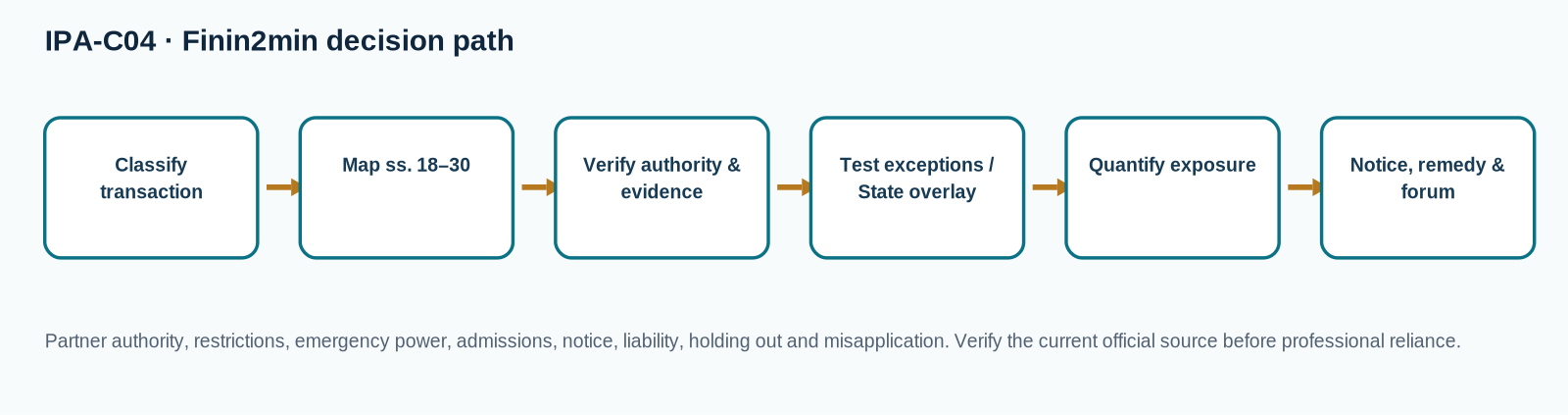
Chapter-specific decision flowchart

Decision flow for Mutual Agency and Third-Party Liability

Finin2min Q&A

What decision does IPA-C04 help a business make?

It determines how mutual agency and third-party liability should be classified, documented, performed and enforced under sections 18-30 of the Indian Partnership Act, 1932.

Which provision should be read first in IPA-C04?

Begin with section 18 (Partner to be agent of the firm) and then read the connected definitions, exceptions and remedy provisions in sequence.

What is the principal implementation risk in IPA-C04?

Applying a commercial label without proving the statutory conditions for mutual agency and third-party liability, or acting without authority, notice, performance and payment evidence.

Which execution checks are specific to IPA-C04?

Confirm the correct entities, signatory authority, consent, complete annexures, stamp and registration treatment, digital audit trail and approvals relevant to mutual agency and third-party liability.

How should evidence be indexed for IPA-C04?

Link every section in the chapter with the contract or deed, authority, chronology, notices, performance, delivery, payment, loss and remedy evidence supporting it.

What calculation should be retained for IPA-C04?

Retain the relevant price, tax, interest, partner-account, loss, mitigation, restitution or relief working with sources and assumptions, not only the final number.

How does limitation affect IPA-C04?

Classify the precise cause of action associated with mutual agency and third-party liability, record accrual, refusal, notice, acknowledgment and exclusion dates, and apply the correct Limitation Act article.

Can arbitration resolve every dispute arising under IPA-C04?

Arbitration may govern the forum, but it does not validate illegality, remove mandatory rules or make a non-arbitrable subject arbitrable. Check scope, seat and interim relief.

Which tax and entity overlays should be checked for IPA-C04?

Check Companies Act authority and related-party controls, partnership constitution, GST supply and invoice consequences, withholding, accounting and insolvency effects.

What is the final professional sign-off for IPA-C04?

Confirm the current statutory source, section conclusions, State variation, authority, calculation, limitation, remedy, forum and complete evidence trail.

Why is section 30 important to IPA-C04?

Section 30 (Minors admitted to the benefits of partnership) completes the chapter control and must be tested independently.

Official sources and verification status

Source and review trail

Use the current official instrument, portal or regulator publication before acting. This panel separates the category authority from page-specific references.

Primary category
Commercial Contracts & Remedies
Official starting point
www.indiacode.nic.in
Editorial review date
2026-07-19
Content status
Finin2min explanation; official source controls where facts, law, rates, forms or procedures can change.

Page source links