ICA-C11 - 57 provisions

Agency, Authority and Principal Liability

Indian Contract Act, 1872

Full local statutory textFinin2min implementation editionCA Nikhil Gupta and Kajri Singh

Download chapter PDFDownload one-page cheat sheet

Finin2min Summary - Chapter in 2 Minutes

Purpose

This unit converts agency, authority and principal liability into statutory, transaction, evidence and remedy decisions.

Who is covered

Businesses, contracting parties, partners, buyers, sellers, principals, agents and litigants affected by this chapter.

Main obligations

Read the transaction documents and actual conduct against every statutory limb, exception and connected law.

Key timelines

Record event, breach, refusal, notice, acknowledgment and filing dates; apply the correct Limitation Act article.

Forms and evidence

Use the chapter evidence checklist and State/UT forms where registration or public notice applies.

Top risk

Wrong classification, missing authority, weak evidence, ineffective notice, unverified State process or wrong remedy.

Remedy

Preserve rights, mitigate loss, quantify exposure and confirm forum, arbitration, limitation and interim relief.

Finin2min takeaway

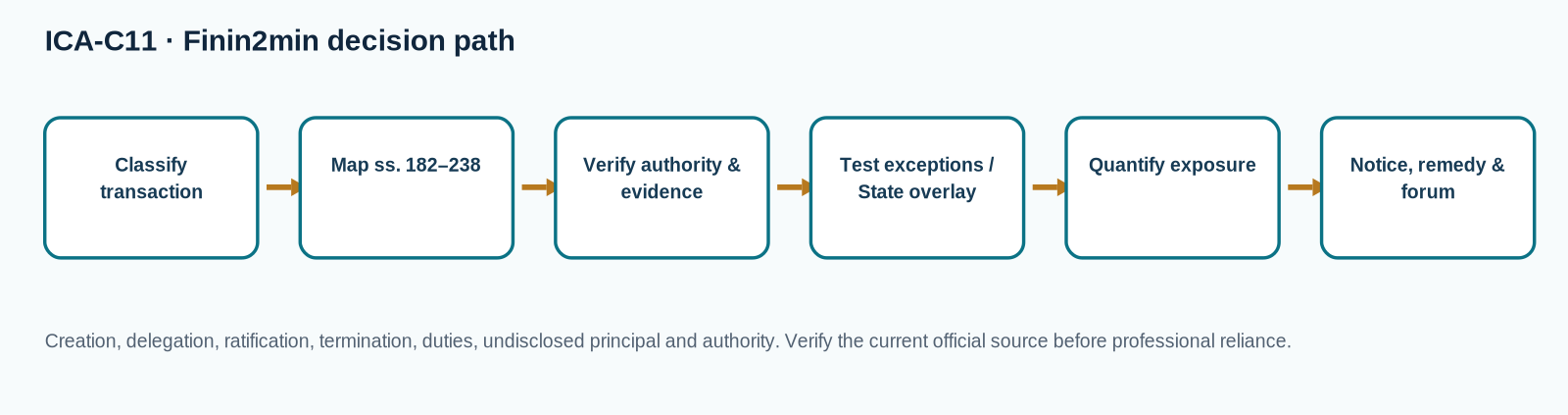
Classify - map law - verify authority - prove performance - quantify consequence - select remedy and forum.

Section-by-section provision map

ProvisionTitleStatusDecision theme
s.182“Agent” and “principal” definedoperativecommercial rights and obligations
s.183Who may employ agentoperativecommercial rights and obligations
s.184Who may be an agentoperativecommercial rights and obligations
s.185Consideration not necessaryoperativecommercial rights and obligations
s.186Agent’s authority may be expressed or impliedoperativepartnership authority and liability
s.187Definitions of express and implied authorityoperativescope and classification
s.188Extent of agent’s authorityoperativepartnership authority and liability
s.189Agent’s authority in an emergencyoperativepartnership authority and liability
s.190When agent cannot delegateoperativecommercial rights and obligations
s.191“Sub-agent” definedoperativecommercial rights and obligations
s.192Representation of principal by sub-agent properly appointed. Sub-agent’s responsibilityoperativecommercial rights and obligations
s.193Agent’s responsibility for sub-agent appointed without authorityoperativepartnership authority and liability
s.194Relation between principal and person duly appointed by agent to act in business of agencyoperativecommercial rights and obligations
s.195Agent’s duty in naming such personoperativecommercial rights and obligations
s.196Right of person as to acts done for him without his authority. Effect of ratificationoperativepartnership authority and liability
s.197Ratification may be expressed or impliedoperativecommercial rights and obligations
s.198Knowledge requisite for valid ratificationoperativecommercial rights and obligations
s.199Effect of ratifying unauthorized act forming part of a transactionoperativecommercial rights and obligations
s.200Ratification of unauthorized act cannot injure third personoperativecommercial rights and obligations
s.201Termination of agencyoperativecommercial rights and obligations
s.202Termination of agency, where agent has an interest in subject-matteroperativeprice, payment and financial consequence
s.203When principal may revoke agent’s authorityoperativepartnership authority and liability
s.204Revocation where authority has been partly exercisedoperativeformation and communication
s.205Compensation for revocation by principal, or renunciation by agentoperativeformation and communication
s.206Notice of revocation or renunciationoperativeformation and communication
s.207Revocation and renunciation may be expressed or impliedoperativeformation and communication
s.208When termination of agent’s authority takes effect as to agent, and as to third personsoperativepartnership authority and liability
s.209Agent’s duty on termination of agency by principal’s death or insanityoperativecommercial rights and obligations
s.210Termination of sub-agent’s authorityoperativepartnership authority and liability
s.211Agent’s duty in conducting principal’s businessoperativecommercial rights and obligations
s.212Skill and diligence required from agentoperativecommercial rights and obligations
s.213Agent’s accountsoperativecommercial rights and obligations
s.214Agent’s duty to communicate with principaloperativecommercial rights and obligations
s.215Right of principal when agent deals, on his own account, in business of agency withoutoperativecommercial rights and obligations
s.216Principal’s right to benefit gained by agent dealing on his own account in business of agencyoperativecommercial rights and obligations
s.217Agent’s right of retainer out of sums received on principal’s accountoperativecommercial rights and obligations
s.218Agent’s duty to pay sums received for principaloperativecommercial rights and obligations
s.219When agent’s remuneration becomes dueoperativecommercial rights and obligations
s.220Agent not entitled to remuneration for business misconductedoperativetitle, property and risk
s.221Agent’s lien on principal’s propertyoperativetitle, property and risk
s.222Agent to be indemnified against consequences of lawful actsoperativecommercial rights and obligations
s.223Agent to be indemnified against consequences of acts done in good faithoperativecommercial rights and obligations
s.224Non-liability of employer of agent to do a criminal actoperativepartnership authority and liability
s.225Compensation to agent for injury caused by principal’s neglectoperativebreach and remedies
s.226Enforcement and consequences of agent’s contractsoperativecommercial rights and obligations
s.227Principal how far bound, when agent exceeds authorityoperativepartnership authority and liability
s.228Principal not bound when excess of agent’s authority is not separableoperativepartnership authority and liability
s.229Consequences of notice given to agentoperativepartnership authority and liability
s.230Agent cannot personally enforce, nor be bound by, contracts on behalf of principal. Presumption of contract to contraryoperativecommercial rights and obligations
s.231Rights of parties to a contract made by agent not disclosedoperativecommercial rights and obligations
s.232Performance of contract with agent supposed to be principaloperativecommercial rights and obligations
s.233Right of person dealing with agent personally liableoperativecommercial rights and obligations
s.234Consequence of inducing agent or principal to act on belief that principal or agent will be held exclusively liableoperativecommercial rights and obligations
s.235Liability of pretended agentoperativepartnership authority and liability
s.236Person falsely contracting as agent not entitled to performanceoperativetitle, property and risk
s.237Liability of principal inducing belief that agent’s unauthorized acts were authorizedoperativepartnership authority and liability
s.238Effect, on agreement, of misrepresentation or fraud by agentoperativevalidity and consent

Legal status, amendments and source protocol

Act: Indian Contract Act, 1872; Act 9 of 1872; commencement 1 September 1872.

Source protocol: Complete central provision text is reproduced locally. Retained official India Code PDF extract. Official India Code and Gazette instruments prevail if any discrepancy is identified.

Full statutory text and Finin2min decode

Section 182 - “Agent” and “principal” defined
Local statutory-text source control: Retained official India Code PDF extract. Official India Code source prevails.

Current statutory text

182.“Agent” and “principal” defined.—An “agent” is a person employed to do any act for another, or to represent another in dealings with third persons. The person for whom such act is done, or who is so represented, is called the “principal”.

Finin2min clause-by-clause decode

ClauseStatutory requirementFinin2min meaningEvidence/control
Main rule182.“Agent” and “principal” defined.—An “agent” is a person employed to do any act for another, or to represent another in dealings with third persons. The person for whom such act is done, or who is so represented, is called the “principal”.Test this main limb within the commercial rights and obligations framework. Operational focus: 182.“agent” and “principal” defined.—an “agent” is a person employed to do any act for another, or to represent.Contract/deed, authority, chronology, notices, performance and payment records tied to this limb.

Finin2min implementation explanation

Section 182 is a commercial rights and obligations provision dealing with “agent” and “principal” defined. Identify the actor, trigger, cumulative or alternative conditions, provisos, exceptions and legal consequence before reaching a conclusion.

Implementation control: Translate the provision into an owner, trigger, approval, evidence, deadline, exception and remedy control, then test connected law and State variation.

Section-level practical application

Transaction test

Apply this provision to the event-date facts and record every satisfied, disputed or inapplicable limb.

Consequence and remedy

Identify how it changes validity, title, authority, liability, payment, rejection, recovery, registration, evidence or relief.

Section 183 - Who may employ agent
Local statutory-text source control: Retained official India Code PDF extract. Official India Code source prevails.

Current statutory text

183. Who may employ agent.—Any person who is of the age of majority according to the law to which he is subject, and who is of sound mind, may employ an agent.

Finin2min clause-by-clause decode

ClauseStatutory requirementFinin2min meaningEvidence/control
Main rule183. Who may employ agent.—Any person who is of the age of majority according to the law to which he is subject, and who is of sound mind, may employ an agent.Test this main limb within the commercial rights and obligations framework. Operational focus: 183. who may employ agent.—any person who is of the age of majority according to the law to.Contract/deed, authority, chronology, notices, performance and payment records tied to this limb.

Finin2min implementation explanation

Section 183 is a commercial rights and obligations provision dealing with who may employ agent. Identify the actor, trigger, cumulative or alternative conditions, provisos, exceptions and legal consequence before reaching a conclusion.

Implementation control: Translate the provision into an owner, trigger, approval, evidence, deadline, exception and remedy control, then test connected law and State variation.

Section-level practical application

Transaction test

Apply this provision to the event-date facts and record every satisfied, disputed or inapplicable limb.

Consequence and remedy

Identify how it changes validity, title, authority, liability, payment, rejection, recovery, registration, evidence or relief.

Section 184 - Who may be an agent
Local statutory-text source control: Retained official India Code PDF extract. Official India Code source prevails.

Current statutory text

184. Who may be an agent.—As between the principal and third persons, any person may become an agent, but no person who is not of the age of majority and of sound mind can become an agent, so as to be responsible to his principal according to the provisions in that behalf herein contained.

Finin2min clause-by-clause decode

ClauseStatutory requirementFinin2min meaningEvidence/control
Main rule184. Who may be an agent.—As between the principal and third persons, any person may become an agent, but no person who is not of the age of majority and of sound mind can become an agent, so as to be responsible to his principal according to the provisions in that behalf herein contained.Test this main limb within the commercial rights and obligations framework. Operational focus: 184. who may be an agent.—as between the principal and third persons, any person may become an agent.Contract/deed, authority, chronology, notices, performance and payment records tied to this limb.

Finin2min implementation explanation

Section 184 is a commercial rights and obligations provision dealing with who may be an agent. Identify the actor, trigger, cumulative or alternative conditions, provisos, exceptions and legal consequence before reaching a conclusion.

Implementation control: Translate the provision into an owner, trigger, approval, evidence, deadline, exception and remedy control, then test connected law and State variation.

Section-level practical application

Transaction test

Apply this provision to the event-date facts and record every satisfied, disputed or inapplicable limb.

Consequence and remedy

Identify how it changes validity, title, authority, liability, payment, rejection, recovery, registration, evidence or relief.

Section 185 - Consideration not necessary
Local statutory-text source control: Retained official India Code PDF extract. Official India Code source prevails.

Current statutory text

185. Consideration not necessary.—No consideration is necessary to create an agency.

Finin2min clause-by-clause decode

ClauseStatutory requirementFinin2min meaningEvidence/control
Main rule185. Consideration not necessary.—No consideration is necessary to create an agency.Test this main limb within the commercial rights and obligations framework. Operational focus: 185. consideration not necessary.—no consideration is necessary to create an agency.Contract/deed, authority, chronology, notices, performance and payment records tied to this limb.

Finin2min implementation explanation

Section 185 is a commercial rights and obligations provision dealing with consideration not necessary. Identify the actor, trigger, cumulative or alternative conditions, provisos, exceptions and legal consequence before reaching a conclusion.

Implementation control: Translate the provision into an owner, trigger, approval, evidence, deadline, exception and remedy control, then test connected law and State variation.

Section-level practical application

Transaction test

Apply this provision to the event-date facts and record every satisfied, disputed or inapplicable limb.

Consequence and remedy

Identify how it changes validity, title, authority, liability, payment, rejection, recovery, registration, evidence or relief.

Section 186 - Agent’s authority may be expressed or implied
Local statutory-text source control: Retained official India Code PDF extract. Official India Code source prevails.

Current statutory text

186. Agent’s authority may be expressed or implied.—The authority of an agent may be expressed or implied1.

Finin2min clause-by-clause decode

ClauseStatutory requirementFinin2min meaningEvidence/control
Main rule186. Agent’s authority may be expressed or implied.—The authority of an agent may be expressed or implied1.Test this main limb within the partnership authority and liability framework. Operational focus: 186. agent’s authority may be expressed or implied.—the authority of an agent may be expressed or implied1.Contract/deed, authority, chronology, notices, performance and payment records tied to this limb.

Finin2min implementation explanation

Section 186 is a partnership authority and liability provision dealing with agent’s authority may be expressed or implied. Identify the actor, trigger, cumulative or alternative conditions, provisos, exceptions and legal consequence before reaching a conclusion.

Implementation control: Reconcile the deed, ordinary course, internal limits, third-party knowledge, firm-name execution, admissions and holding out. Internal restrictions may not defeat external liability.

Section-level practical application

Transaction test

Apply this provision to the event-date facts and record every satisfied, disputed or inapplicable limb.

Consequence and remedy

Identify how it changes validity, title, authority, liability, payment, rejection, recovery, registration, evidence or relief.

Section 187 - Definitions of express and implied authority
Local statutory-text source control: Retained official India Code PDF extract. Official India Code source prevails.

Current statutory text

187. Definitions of express and implied authority.—An authority is said to be express when it is given by words spoken or written. An authority is said to be implied when it is to be inferred from the circumstances of the case; and things spoken or written, or the ordinary course of dealing, may be accounted circumstances of the case. Illustration A owns a shop in Serampore, living himself in Calcutta, and visiting the shop occasionally. The shop is managed by B, and he is in the habit of ordering goods from C in the name of A for the purposes of the shop, and of paying for them out of A’s funds with A’s knowledge. B has an implied authority from A to order goods from C in the name of A for the purposes of the shop.

Finin2min clause-by-clause decode

ClauseStatutory requirementFinin2min meaningEvidence/control
Main rule187. Definitions of express and implied authority.—An authority is said to be express when it is given by words spoken or written. An authority is said to be implied when it is to be inferred from the circumstances of the case; and things spoken or written, or the ordinary course of dealing, may be accounted circumstances of the case. Illustration A owns a shop in Serampore, living himself in Calcutta, and visiting the shop occasionally. The shop is managed by B, and he is in the habit of ordering goods from C in the name of A for the purposes of the shop, and of paying for them out of A’s funds with A’s knowledge. B has an...Test this main limb within the scope and classification framework. Operational focus: 187. definitions of express and implied authority.—an authority is said to be express when it is given by.Contract/deed, authority, chronology, notices, performance and payment records tied to this limb.

Finin2min implementation explanation

Section 187 is a scope and classification provision dealing with definitions of express and implied authority. Identify the actor, trigger, cumulative or alternative conditions, provisos, exceptions and legal consequence before reaching a conclusion.

Implementation control: Freeze the event date and statutory definitions before applying the remaining provisions. Record why each party, asset, instrument and transaction falls inside or outside the defined class.

Section-level practical application

Transaction test

Apply this provision to the event-date facts and record every satisfied, disputed or inapplicable limb.

Consequence and remedy

Identify how it changes validity, title, authority, liability, payment, rejection, recovery, registration, evidence or relief.

Section 188 - Extent of agent’s authority
Local statutory-text source control: Retained official India Code PDF extract. Official India Code source prevails.

Current statutory text

188. Extent of agent’s authority.—An agent, having an authority to do an act, has authority to do every lawful thing which is necessary in order to do such act. An agent having an authority to carry on a business, has authority to do every lawful thing necessary for the purpose, or usually done in the course, of conducting such business. 1. See, however, the Registration Act, 1908 (16 of 1908), s. 33; see also the Code of Civil Procedure, 1908 (5 of 1908), Sch. I, Order III, rule 4. Illustrations (a) A is employed by B, residing in London, to recover at Bombay a debt due to B. A may adopt any legal process necessary for the purpose of recovering the debt, and may give a valid discharge for the same. (b) A constitutes B his agent to carry on his business of a ship-builder. B may purchase timber and other materials, and hire workmen, for the purpose of carrying on the business.

Finin2min clause-by-clause decode

ClauseStatutory requirementFinin2min meaningEvidence/control
Main rule188. Extent of agent’s authority.—An agent, having an authority to do an act, has authority to do every lawful thing which is necessary in order to do such act. An agent having an authority to carry on a business, has authority to do every lawful thing necessary for the purpose, or usually done in the course, of conducting such business. 1. See, however, the Registration Act, 1908 (16 of 1908), s. 33; see also the Code of Civil Procedure, 1908 (5 of 1908), Sch. I, Order III, rule 4. IllustrationsTest this main limb within the partnership authority and liability framework. Operational focus: 188. extent of agent’s authority.—an agent, having an authority to do an act, has authority to do every.Contract/deed, authority, chronology, notices, performance and payment records tied to this limb.
(a)A is employed by B, residing in London, to recover at Bombay a debt due to B. A may adopt any legal process necessary for the purpose of recovering the debt, and may give a valid discharge for the same.Test this (a) within the partnership authority and liability framework. Operational focus: a is employed by b, residing in london, to recover at bombay a debt due to b. a.Contract/deed, authority, chronology, notices, performance and payment records tied to this limb.
(b)A constitutes B his agent to carry on his business of a ship-builder. B may purchase timber and other materials, and hire workmen, for the purpose of carrying on the business.Test this (b) within the partnership authority and liability framework. Operational focus: a constitutes b his agent to carry on his business of a ship-builder. b may purchase timber and.Contract/deed, authority, chronology, notices, performance and payment records tied to this limb.

Finin2min implementation explanation

Section 188 is a partnership authority and liability provision dealing with extent of agent’s authority. Identify the actor, trigger, cumulative or alternative conditions, provisos, exceptions and legal consequence before reaching a conclusion.

Implementation control: Reconcile the deed, ordinary course, internal limits, third-party knowledge, firm-name execution, admissions and holding out. Internal restrictions may not defeat external liability.

Section-level practical application

Transaction test

Apply this provision to the event-date facts and record every satisfied, disputed or inapplicable limb.

Consequence and remedy

Identify how it changes validity, title, authority, liability, payment, rejection, recovery, registration, evidence or relief.

Section 189 - Agent’s authority in an emergency
Local statutory-text source control: Retained official India Code PDF extract. Official India Code source prevails.

Current statutory text

189.Agent’s authority in an emergency.—An agent has authority, in an emergency, to do all such acts for the purpose of protecting his principal from loss as would be done by a person of ordinary prudence, in his own case, under similar circumstances. Illustrations (a) An agent for sale may have goods repaired if it be necessary. (b) A consigns provisions to B at Calcutta, with directions to send them immediately to C, at Cuttack. B may sell the provisions at Calcutta, if they will not bear the journey to Cuttack without spoiling. Sub-Agents

Finin2min clause-by-clause decode

ClauseStatutory requirementFinin2min meaningEvidence/control
Main rule189.Agent’s authority in an emergency.—An agent has authority, in an emergency, to do all such acts for the purpose of protecting his principal from loss as would be done by a person of ordinary prudence, in his own case, under similar circumstances. IllustrationsTest this main limb within the partnership authority and liability framework. Operational focus: 189.agent’s authority in an emergency.—an agent has authority, in an emergency, to do all such acts for the.Contract/deed, authority, chronology, notices, performance and payment records tied to this limb.
(a)An agent for sale may have goods repaired if it be necessary.Test this (a) within the partnership authority and liability framework. Operational focus: an agent for sale may have goods repaired if it be necessary.Contract/deed, authority, chronology, notices, performance and payment records tied to this limb.
(b)A consigns provisions to B at Calcutta, with directions to send them immediately to C, at Cuttack. B may sell the provisions at Calcutta, if they will not bear the journey to Cuttack without spoiling. Sub-AgentsTest this (b) within the partnership authority and liability framework. Operational focus: a consigns provisions to b at calcutta, with directions to send them immediately to c, at cuttack. b.Contract/deed, authority, chronology, notices, performance and payment records tied to this limb.

Finin2min implementation explanation

Section 189 is a partnership authority and liability provision dealing with agent’s authority in an emergency. Identify the actor, trigger, cumulative or alternative conditions, provisos, exceptions and legal consequence before reaching a conclusion.

Implementation control: Reconcile the deed, ordinary course, internal limits, third-party knowledge, firm-name execution, admissions and holding out. Internal restrictions may not defeat external liability.

Section-level practical application

Transaction test

Apply this provision to the event-date facts and record every satisfied, disputed or inapplicable limb.

Consequence and remedy

Identify how it changes validity, title, authority, liability, payment, rejection, recovery, registration, evidence or relief.

Section 190 - When agent cannot delegate
Local statutory-text source control: Retained official India Code PDF extract. Official India Code source prevails.

Current statutory text

190. When agent cannot delegate.—An agent cannot lawfully employ another to perform acts which he has expressly or impliedly undertaken to perform personally, unless by the ordinary custom of trade a sub-agent may, or, from the nature of the agency, a sub-agent must, be employed.

Finin2min clause-by-clause decode

ClauseStatutory requirementFinin2min meaningEvidence/control
Main rule190. When agent cannot delegate.—An agent cannot lawfully employ another to perform acts which he has expressly or impliedly undertaken to perform personally, unless by the ordinary custom of trade a sub-agent may, or, from the nature of the agency, a sub-agent must, be employed.Test this main limb within the commercial rights and obligations framework. Operational focus: 190. when agent cannot delegate.—an agent cannot lawfully employ another to perform acts which he has expressly or.Contract/deed, authority, chronology, notices, performance and payment records tied to this limb.

Finin2min implementation explanation

Section 190 is a commercial rights and obligations provision dealing with when agent cannot delegate. Identify the actor, trigger, cumulative or alternative conditions, provisos, exceptions and legal consequence before reaching a conclusion.

Implementation control: Translate the provision into an owner, trigger, approval, evidence, deadline, exception and remedy control, then test connected law and State variation.

Section-level practical application

Transaction test

Apply this provision to the event-date facts and record every satisfied, disputed or inapplicable limb.

Consequence and remedy

Identify how it changes validity, title, authority, liability, payment, rejection, recovery, registration, evidence or relief.

Section 191 - “Sub-agent” defined
Local statutory-text source control: Retained official India Code PDF extract. Official India Code source prevails.

Current statutory text

191. “Sub-agent” defined.—A “sub-agent” is a person employed by, and acting under the control of, the original agent in the business of the agency.

Finin2min clause-by-clause decode

ClauseStatutory requirementFinin2min meaningEvidence/control
Main rule191. “Sub-agent” defined.—A “sub-agent” is a person employed by, and acting under the control of, the original agent in the business of the agency.Test this main limb within the commercial rights and obligations framework. Operational focus: 191. “sub-agent” defined.—a “sub-agent” is a person employed by, and acting under the control of, the original agent.Contract/deed, authority, chronology, notices, performance and payment records tied to this limb.

Finin2min implementation explanation

Section 191 is a commercial rights and obligations provision dealing with “sub-agent” defined. Identify the actor, trigger, cumulative or alternative conditions, provisos, exceptions and legal consequence before reaching a conclusion.

Implementation control: Translate the provision into an owner, trigger, approval, evidence, deadline, exception and remedy control, then test connected law and State variation.

Section-level practical application

Transaction test

Apply this provision to the event-date facts and record every satisfied, disputed or inapplicable limb.

Consequence and remedy

Identify how it changes validity, title, authority, liability, payment, rejection, recovery, registration, evidence or relief.

Section 192 - Representation of principal by sub-agent properly appointed. Sub-agent’s responsibility
Local statutory-text source control: Retained official India Code PDF extract. Official India Code source prevails.

Current statutory text

192. Representation of principal by sub-agent properly appointed.—Where a sub-agent is properly appointed, the principal is, so far as regards third persons, represented by the sub-agent, and is bound by and responsible for his acts, as if he were an agent originally appointed by the principal. Agent’s responsibility for sub-agent.—The agent is responsible to the principal for the acts of the sub-agent. Sub-agent’s responsibility.—The sub-agent is responsible for his acts to the agent, but not tothe principal, except in cases of fraud or wilful wrong.

Finin2min clause-by-clause decode

ClauseStatutory requirementFinin2min meaningEvidence/control
Main rule192. Representation of principal by sub-agent properly appointed.—Where a sub-agent is properly appointed, the principal is, so far as regards third persons, represented by the sub-agent, and is bound by and responsible for his acts, as if he were an agent originally appointed by the principal. Agent’s responsibility for sub-agent.—The agent is responsible to the principal for the acts of the sub-agent. Sub-agent’s responsibility.—The sub-agent is responsible for his acts to the agent, but not tothe principal, except in cases of fraud or wilful wrong.Test this main limb within the commercial rights and obligations framework. Operational focus: 192. representation of principal by sub-agent properly appointed.—where a sub-agent is properly appointed, the principal is, so far.Contract/deed, authority, chronology, notices, performance and payment records tied to this limb.

Finin2min implementation explanation

Section 192 is a commercial rights and obligations provision dealing with representation of principal by sub-agent properly appointed. sub-agent’s responsibility. Identify the actor, trigger, cumulative or alternative conditions, provisos, exceptions and legal consequence before reaching a conclusion.

Implementation control: Translate the provision into an owner, trigger, approval, evidence, deadline, exception and remedy control, then test connected law and State variation.

Section-level practical application

Transaction test

Apply this provision to the event-date facts and record every satisfied, disputed or inapplicable limb.

Consequence and remedy

Identify how it changes validity, title, authority, liability, payment, rejection, recovery, registration, evidence or relief.

Section 193 - Agent’s responsibility for sub-agent appointed without authority
Local statutory-text source control: Retained official India Code PDF extract. Official India Code source prevails.

Current statutory text

193. Agent’s responsibility for sub-agent appointed without authority.—Where an agent, without having authority to do so, has appointed a person to act as a sub-agent, the agent stands towards such person in the relation of a principal to an agent, and is responsible for his acts both to the principal and to third persons; the principal is not represented, by or responsible for the acts of the person so employed, nor is that person responsible to the principal.

Finin2min clause-by-clause decode

ClauseStatutory requirementFinin2min meaningEvidence/control
Main rule193. Agent’s responsibility for sub-agent appointed without authority.—Where an agent, without having authority to do so, has appointed a person to act as a sub-agent, the agent stands towards such person in the relation of a principal to an agent, and is responsible for his acts both to the principal and to third persons; the principal is not represented, by or responsible for the acts of the person so employed, nor is that person responsible to the principal.Test this main limb within the partnership authority and liability framework. Operational focus: 193. agent’s responsibility for sub-agent appointed without authority.—where an agent, without having authority to do so, has appointed.Contract/deed, authority, chronology, notices, performance and payment records tied to this limb.

Finin2min implementation explanation

Section 193 is a partnership authority and liability provision dealing with agent’s responsibility for sub-agent appointed without authority. Identify the actor, trigger, cumulative or alternative conditions, provisos, exceptions and legal consequence before reaching a conclusion.

Implementation control: Reconcile the deed, ordinary course, internal limits, third-party knowledge, firm-name execution, admissions and holding out. Internal restrictions may not defeat external liability.

Section-level practical application

Transaction test

Apply this provision to the event-date facts and record every satisfied, disputed or inapplicable limb.

Consequence and remedy

Identify how it changes validity, title, authority, liability, payment, rejection, recovery, registration, evidence or relief.

Section 194 - Relation between principal and person duly appointed by agent to act in business of agency
Local statutory-text source control: Retained official India Code PDF extract. Official India Code source prevails.

Current statutory text

194.Relation between principal and person duly appointed by agent to act in business of agency.—Where an agent, holding an express or implied authority to name another person to act for the principal in the business of the agency, has named another person accordingly, such person is not a sub-agent, but an agent of the principal for such part of the business of the agency as is entrusted to him. Illustrations (a)A directs B, his solicitor, to sell his estate by auction, and to employ an auctioneer for the purpose. B names C, an auctioneer, to conduct the sale. C is not a sub-agent, but is A’s agent for the conduct of the sale. (b)A authorizes B, a merchant in Calcutta, to recover the moneys due to A from C & Co. B instructs D, a solicitor, to take legal proceedings against C & Co. for the recovery of the money. D is not a sub-agent, but is solicitor for A.

Finin2min clause-by-clause decode

ClauseStatutory requirementFinin2min meaningEvidence/control
Main rule194.Relation between principal and person duly appointed by agent to act in business of agency.—Where an agent, holding an express or implied authority to name another person to act for the principal in the business of the agency, has named another person accordingly, such person is not a sub-agent, but an agent of the principal for such part of the business of the agency as is entrusted to him. IllustrationsTest this main limb within the commercial rights and obligations framework. Operational focus: 194.relation between principal and person duly appointed by agent to act in business of agency.—where an agent, holding.Contract/deed, authority, chronology, notices, performance and payment records tied to this limb.
(a)A directs B, his solicitor, to sell his estate by auction, and to employ an auctioneer for the purpose. B names C, an auctioneer, to conduct the sale. C is not a sub-agent, but is A’s agent for the conduct of the sale.Test this (a) within the commercial rights and obligations framework. Operational focus: a directs b, his solicitor, to sell his estate by auction, and to employ an auctioneer for the.Contract/deed, authority, chronology, notices, performance and payment records tied to this limb.
(b)A authorizes B, a merchant in Calcutta, to recover the moneys due to A from C & Co. B instructs D, a solicitor, to take legal proceedings against C & Co. for the recovery of the money. D is not a sub-agent, but is solicitor for A.Test this (b) within the commercial rights and obligations framework. Operational focus: a authorizes b, a merchant in calcutta, to recover the moneys due to a from c & co.Contract/deed, authority, chronology, notices, performance and payment records tied to this limb.

Finin2min implementation explanation

Section 194 is a commercial rights and obligations provision dealing with relation between principal and person duly appointed by agent to act in business of agency. Identify the actor, trigger, cumulative or alternative conditions, provisos, exceptions and legal consequence before reaching a conclusion.

Implementation control: Translate the provision into an owner, trigger, approval, evidence, deadline, exception and remedy control, then test connected law and State variation.

Section-level practical application

Transaction test

Apply this provision to the event-date facts and record every satisfied, disputed or inapplicable limb.

Consequence and remedy

Identify how it changes validity, title, authority, liability, payment, rejection, recovery, registration, evidence or relief.

Section 195 - Agent’s duty in naming such person
Local statutory-text source control: Retained official India Code PDF extract. Official India Code source prevails.

Current statutory text

195. Agent’s duty in naming such person.—In selecting such agent for his principal, an agent is bound to exercise the same amount of discretion as a man of ordinary prudence would exercise in his own case; and, if he does this, he is not responsible to the principal for the acts or negligence of the agent so selected. Illustrations (a)A instructs B, a merchant, to buy a ship for him. B employs a ship-surveyor of good reputation to choose a ship for A. The surveyor makes the choice negligently and the ship turns out to be unseaworthy and is lost. B is not, but the surveyor is, responsible to A. (b)A consigns goods to B, a merchant, for sale. B, in due course, employs an auctioneer in good credit to sell the goods of A, and allows the auctioneer to receive the proceeds of the sale. The auctioneer afterwards becomes insolvent without having accounted for the proceeds. B is not responsible to A for the proceeds. Ratification

Finin2min clause-by-clause decode

ClauseStatutory requirementFinin2min meaningEvidence/control
Main rule195. Agent’s duty in naming such person.—In selecting such agent for his principal, an agent is bound to exercise the same amount of discretion as a man of ordinary prudence would exercise in his own case; and, if he does this, he is not responsible to the principal for the acts or negligence of the agent so selected. IllustrationsTest this main limb within the commercial rights and obligations framework. Operational focus: 195. agent’s duty in naming such person.—in selecting such agent for his principal, an agent is bound to.Contract/deed, authority, chronology, notices, performance and payment records tied to this limb.
(a)A instructs B, a merchant, to buy a ship for him. B employs a ship-surveyor of good reputation to choose a ship for A. The surveyor makes the choice negligently and the ship turns out to be unseaworthy and is lost. B is not, but the surveyor is, responsible to A.Test this (a) within the commercial rights and obligations framework. Operational focus: a instructs b, a merchant, to buy a ship for him. b employs a ship-surveyor of good reputation.Contract/deed, authority, chronology, notices, performance and payment records tied to this limb.
(b)A consigns goods to B, a merchant, for sale. B, in due course, employs an auctioneer in good credit to sell the goods of A, and allows the auctioneer to receive the proceeds of the sale. The auctioneer afterwards becomes insolvent without having accounted for the proceeds. B is not responsible to A for the proceeds. RatificationTest this (b) within the commercial rights and obligations framework. Operational focus: a consigns goods to b, a merchant, for sale. b, in due course, employs an auctioneer in good.Contract/deed, authority, chronology, notices, performance and payment records tied to this limb.

Finin2min implementation explanation

Section 195 is a commercial rights and obligations provision dealing with agent’s duty in naming such person. Identify the actor, trigger, cumulative or alternative conditions, provisos, exceptions and legal consequence before reaching a conclusion.

Implementation control: Translate the provision into an owner, trigger, approval, evidence, deadline, exception and remedy control, then test connected law and State variation.

Section-level practical application

Transaction test

Apply this provision to the event-date facts and record every satisfied, disputed or inapplicable limb.

Consequence and remedy

Identify how it changes validity, title, authority, liability, payment, rejection, recovery, registration, evidence or relief.

Section 196 - Right of person as to acts done for him without his authority. Effect of ratification
Local statutory-text source control: Retained official India Code PDF extract. Official India Code source prevails.

Current statutory text

196. Right of person as to acts done for him without his authority. Effect of ratification.— Where acts are done by one person on behalf of another, but without his knowledge or authority, he may elect to ratify or to disown such acts. If he ratify them, the same effects will follow as if they had been performed by his authority.

Finin2min clause-by-clause decode

ClauseStatutory requirementFinin2min meaningEvidence/control
Main rule196. Right of person as to acts done for him without his authority. Effect of ratification.— Where acts are done by one person on behalf of another, but without his knowledge or authority, he may elect to ratify or to disown such acts. If he ratify them, the same effects will follow as if they had been performed by his authority.Test this main limb within the partnership authority and liability framework. Operational focus: 196. right of person as to acts done for him without his authority. effect of ratification.— where acts.Contract/deed, authority, chronology, notices, performance and payment records tied to this limb.

Finin2min implementation explanation

Section 196 is a partnership authority and liability provision dealing with right of person as to acts done for him without his authority. effect of ratification. Identify the actor, trigger, cumulative or alternative conditions, provisos, exceptions and legal consequence before reaching a conclusion.

Implementation control: Reconcile the deed, ordinary course, internal limits, third-party knowledge, firm-name execution, admissions and holding out. Internal restrictions may not defeat external liability.

Section-level practical application

Transaction test

Apply this provision to the event-date facts and record every satisfied, disputed or inapplicable limb.

Consequence and remedy

Identify how it changes validity, title, authority, liability, payment, rejection, recovery, registration, evidence or relief.

Section 197 - Ratification may be expressed or implied
Local statutory-text source control: Retained official India Code PDF extract. Official India Code source prevails.

Current statutory text

197.Ratification may be expressed or implied.—Ratification may be expressed or may be implied in the conduct of the person on whose behalf the acts are done. Illustrations (a)A, without authority, buys goods for B. Afterwards B sells them to C on his own account; B’s conduct implies a ratification of the purchase made for him by A. (b)A, without B’s authority, lends B’s money to C. Afterwards B accepts interest on the money from C. B’s conduct implies a ratification of the loan.

Finin2min clause-by-clause decode

ClauseStatutory requirementFinin2min meaningEvidence/control
Main rule197.Ratification may be expressed or implied.—Ratification may be expressed or may be implied in the conduct of the person on whose behalf the acts are done. IllustrationsTest this main limb within the commercial rights and obligations framework. Operational focus: 197.ratification may be expressed or implied.—ratification may be expressed or may be implied in the conduct of the.Contract/deed, authority, chronology, notices, performance and payment records tied to this limb.
(a)A, without authority, buys goods for B. Afterwards B sells them to C on his own account; B’s conduct implies a ratification of the purchase made for him by A.Test this (a) within the commercial rights and obligations framework. Operational focus: a, without authority, buys goods for b. afterwards b sells them to c on his own account; b’s.Contract/deed, authority, chronology, notices, performance and payment records tied to this limb.
(b)A, without B’s authority, lends B’s money to C. Afterwards B accepts interest on the money from C. B’s conduct implies a ratification of the loan.Test this (b) within the commercial rights and obligations framework. Operational focus: a, without b’s authority, lends b’s money to c. afterwards b accepts interest on the money from c.Contract/deed, authority, chronology, notices, performance and payment records tied to this limb.

Finin2min implementation explanation

Section 197 is a commercial rights and obligations provision dealing with ratification may be expressed or implied. Identify the actor, trigger, cumulative or alternative conditions, provisos, exceptions and legal consequence before reaching a conclusion.

Implementation control: Translate the provision into an owner, trigger, approval, evidence, deadline, exception and remedy control, then test connected law and State variation.

Section-level practical application

Transaction test

Apply this provision to the event-date facts and record every satisfied, disputed or inapplicable limb.

Consequence and remedy

Identify how it changes validity, title, authority, liability, payment, rejection, recovery, registration, evidence or relief.

Section 198 - Knowledge requisite for valid ratification
Local statutory-text source control: Retained official India Code PDF extract. Official India Code source prevails.

Current statutory text

198.Knowledge requisite for valid ratification.—No valid ratification can be made by a person whose knowledge of the facts of the case is materially defective.

Finin2min clause-by-clause decode

ClauseStatutory requirementFinin2min meaningEvidence/control
Main rule198.Knowledge requisite for valid ratification.—No valid ratification can be made by a person whose knowledge of the facts of the case is materially defective.Test this main limb within the commercial rights and obligations framework. Operational focus: 198.knowledge requisite for valid ratification.—no valid ratification can be made by a person whose knowledge of the facts.Contract/deed, authority, chronology, notices, performance and payment records tied to this limb.

Finin2min implementation explanation

Section 198 is a commercial rights and obligations provision dealing with knowledge requisite for valid ratification. Identify the actor, trigger, cumulative or alternative conditions, provisos, exceptions and legal consequence before reaching a conclusion.

Implementation control: Translate the provision into an owner, trigger, approval, evidence, deadline, exception and remedy control, then test connected law and State variation.

Section-level practical application

Transaction test

Apply this provision to the event-date facts and record every satisfied, disputed or inapplicable limb.

Consequence and remedy

Identify how it changes validity, title, authority, liability, payment, rejection, recovery, registration, evidence or relief.

Section 199 - Effect of ratifying unauthorized act forming part of a transaction
Local statutory-text source control: Retained official India Code PDF extract. Official India Code source prevails.

Current statutory text

199.Effect of ratifying unauthorized act forming part of a transaction.—A person ratifying any unauthorized act done on his behalf ratifies the whole of the transaction of which such act formed a part.

Finin2min clause-by-clause decode

ClauseStatutory requirementFinin2min meaningEvidence/control
Main rule199.Effect of ratifying unauthorized act forming part of a transaction.—A person ratifying any unauthorized act done on his behalf ratifies the whole of the transaction of which such act formed a part.Test this main limb within the commercial rights and obligations framework. Operational focus: 199.effect of ratifying unauthorized act forming part of a transaction.—a person ratifying any unauthorized act done on his.Contract/deed, authority, chronology, notices, performance and payment records tied to this limb.

Finin2min implementation explanation

Section 199 is a commercial rights and obligations provision dealing with effect of ratifying unauthorized act forming part of a transaction. Identify the actor, trigger, cumulative or alternative conditions, provisos, exceptions and legal consequence before reaching a conclusion.

Implementation control: Translate the provision into an owner, trigger, approval, evidence, deadline, exception and remedy control, then test connected law and State variation.

Section-level practical application

Transaction test

Apply this provision to the event-date facts and record every satisfied, disputed or inapplicable limb.

Consequence and remedy

Identify how it changes validity, title, authority, liability, payment, rejection, recovery, registration, evidence or relief.

Section 200 - Ratification of unauthorized act cannot injure third person
Local statutory-text source control: Retained official India Code PDF extract. Official India Code source prevails.

Current statutory text

200.Ratification of unauthorized act cannot injure third person.—An act done by one person on behalf of another, without such other person’s authority, which, if done with authority, would have the effect of subjecting a third person to damages, or of terminating any right or interest of a third person, cannot, by ratification, be made to have such effect. Illustrations (a)A, not being authorized thereto by B, demands, on behalf of B, the delivery of a chattel, the property of B, from C, who is in possession of it. This demand cannot be ratified by B, so as to make C liable for damages for his refusal to deliver. (b)A holds a lease from B, terminable on three months’ notice. C, an unauthorized person, gives notice of termination to A. The notice cannot be ratified by B, so as to be binding on A. Revocation of Authority

Finin2min clause-by-clause decode

ClauseStatutory requirementFinin2min meaningEvidence/control
Main rule200.Ratification of unauthorized act cannot injure third person.—An act done by one person on behalf of another, without such other person’s authority, which, if done with authority, would have the effect of subjecting a third person to damages, or of terminating any right or interest of a third person, cannot, by ratification, be made to have such effect. IllustrationsTest this main limb within the commercial rights and obligations framework. Operational focus: 200.ratification of unauthorized act cannot injure third person.—an act done by one person on behalf of another, without.Contract/deed, authority, chronology, notices, performance and payment records tied to this limb.
(a)A, not being authorized thereto by B, demands, on behalf of B, the delivery of a chattel, the property of B, from C, who is in possession of it. This demand cannot be ratified by B, so as to make C liable for damages for his refusal to deliver.Test this (a) within the commercial rights and obligations framework. Operational focus: a, not being authorized thereto by b, demands, on behalf of b, the delivery of a chattel, the.Contract/deed, authority, chronology, notices, performance and payment records tied to this limb.
(b)A holds a lease from B, terminable on three months’ notice. C, an unauthorized person, gives notice of termination to A. The notice cannot be ratified by B, so as to be binding on A. Revocation of AuthorityTest this (b) within the commercial rights and obligations framework. Operational focus: a holds a lease from b, terminable on three months’ notice. c, an unauthorized person, gives notice of.Contract/deed, authority, chronology, notices, performance and payment records tied to this limb.

Finin2min implementation explanation

Section 200 is a commercial rights and obligations provision dealing with ratification of unauthorized act cannot injure third person. Identify the actor, trigger, cumulative or alternative conditions, provisos, exceptions and legal consequence before reaching a conclusion.

Implementation control: Translate the provision into an owner, trigger, approval, evidence, deadline, exception and remedy control, then test connected law and State variation.

Section-level practical application

Transaction test

Apply this provision to the event-date facts and record every satisfied, disputed or inapplicable limb.

Consequence and remedy

Identify how it changes validity, title, authority, liability, payment, rejection, recovery, registration, evidence or relief.

Section 201 - Termination of agency
Local statutory-text source control: Retained official India Code PDF extract. Official India Code source prevails.

Current statutory text

201. Termination of agency.—An agency is terminated by the principal revoking his authority; or by the agent renouncing the business of the agency; or by the business of the agency being completed; or by either the principal or agent dying or becoming of unsound mind; or by the principal being adjudicated an insolvent under the provisions of any Act for the time being in force for the relief of insolvent debtors.

Finin2min clause-by-clause decode

ClauseStatutory requirementFinin2min meaningEvidence/control
Main rule201. Termination of agency.—An agency is terminated by the principal revoking his authority; or by the agent renouncing the business of the agency; or by the business of the agency being completed; or by either the principal or agent dying or becoming of unsound mind; or by the principal being adjudicated an insolvent under the provisions of any Act for the time being in force for the relief of insolvent debtors.Test this main limb within the commercial rights and obligations framework. Operational focus: 201. termination of agency.—an agency is terminated by the principal revoking his authority; or by the agent renouncing.Contract/deed, authority, chronology, notices, performance and payment records tied to this limb.

Finin2min implementation explanation

Section 201 is a commercial rights and obligations provision dealing with termination of agency. Identify the actor, trigger, cumulative or alternative conditions, provisos, exceptions and legal consequence before reaching a conclusion.

Implementation control: Translate the provision into an owner, trigger, approval, evidence, deadline, exception and remedy control, then test connected law and State variation.

Section-level practical application

Transaction test

Apply this provision to the event-date facts and record every satisfied, disputed or inapplicable limb.

Consequence and remedy

Identify how it changes validity, title, authority, liability, payment, rejection, recovery, registration, evidence or relief.

Section 202 - Termination of agency, where agent has an interest in subject-matter
Local statutory-text source control: Retained official India Code PDF extract. Official India Code source prevails.

Current statutory text

202.Termination of agency, where agent has an interest in subject-matter.—Where the agent has himself an interest in the property which forms the subject-matter of the agency, the agency cannot, in the absence of an express contract, be terminated to the prejudice of such interest. Illustrations (a) A gives authority to B to sell A’s land, and to pay himself, out of the proceeds, the debts due to him from A. A cannot revoke this authority, nor can it be terminated by his insanity or death. (b) A consigns 1,000 bales of cotton to B, who has made advances to him on such cotton, and desires B to sell the cotton, and to repay himself out of the price, the amount of his own advances. A cannot revoke this authority, nor is it terminated by his insanity or death.

Finin2min clause-by-clause decode

ClauseStatutory requirementFinin2min meaningEvidence/control
Main rule202.Termination of agency, where agent has an interest in subject-matter.—Where the agent has himself an interest in the property which forms the subject-matter of the agency, the agency cannot, in the absence of an express contract, be terminated to the prejudice of such interest. IllustrationsTest this main limb within the price, payment and financial consequence framework. Operational focus: 202.termination of agency, where agent has an interest in subject-matter.—where the agent has himself an interest in the.Contract/deed, authority, chronology, notices, performance and payment records tied to this limb.
(a)A gives authority to B to sell A’s land, and to pay himself, out of the proceeds, the debts due to him from A. A cannot revoke this authority, nor can it be terminated by his insanity or death.Test this (a) within the price, payment and financial consequence framework. Operational focus: a gives authority to b to sell a’s land, and to pay himself, out of the proceeds, the.Contract/deed, authority, chronology, notices, performance and payment records tied to this limb.
(b)A consigns 1,000 bales of cotton to B, who has made advances to him on such cotton, and desires B to sell the cotton, and to repay himself out of the price, the amount of his own advances. A cannot revoke this authority, nor is it terminated by his insanity or death.Test this (b) within the price, payment and financial consequence framework. Operational focus: a consigns 1,000 bales of cotton to b, who has made advances to him on such cotton, and.Contract/deed, authority, chronology, notices, performance and payment records tied to this limb.

Finin2min implementation explanation

Section 202 is a price, payment and financial consequence provision dealing with termination of agency, where agent has an interest in subject-matter. Identify the actor, trigger, cumulative or alternative conditions, provisos, exceptions and legal consequence before reaching a conclusion.

Implementation control: Reconcile base price, taxes, credits, deductions, interest, due dates and payment proof. Link every adjustment to the contract and statute.

Section-level practical application

Transaction test

Apply this provision to the event-date facts and record every satisfied, disputed or inapplicable limb.

Consequence and remedy

Identify how it changes validity, title, authority, liability, payment, rejection, recovery, registration, evidence or relief.

Section 203 - When principal may revoke agent’s authority
Local statutory-text source control: Retained official India Code PDF extract. Official India Code source prevails.

Current statutory text

203.When principal may revoke agent’s authority.—The principal may, save as is otherwise provided by the last preceding section, revoke the authority given to his agent at any time before the authority has been exercised so as to bind the principal.

Finin2min clause-by-clause decode

ClauseStatutory requirementFinin2min meaningEvidence/control
Main rule203.When principal may revoke agent’s authority.—The principal may, save as is otherwise provided by the last preceding section, revoke the authority given to his agent at any time before the authority has been exercised so as to bind the principal.Test this main limb within the partnership authority and liability framework. Operational focus: 203.when principal may revoke agent’s authority.—the principal may, save as is otherwise provided by the last preceding section.Contract/deed, authority, chronology, notices, performance and payment records tied to this limb.

Finin2min implementation explanation

Section 203 is a partnership authority and liability provision dealing with when principal may revoke agent’s authority. Identify the actor, trigger, cumulative or alternative conditions, provisos, exceptions and legal consequence before reaching a conclusion.

Implementation control: Reconcile the deed, ordinary course, internal limits, third-party knowledge, firm-name execution, admissions and holding out. Internal restrictions may not defeat external liability.

Section-level practical application

Transaction test

Apply this provision to the event-date facts and record every satisfied, disputed or inapplicable limb.

Consequence and remedy

Identify how it changes validity, title, authority, liability, payment, rejection, recovery, registration, evidence or relief.

Section 204 - Revocation where authority has been partly exercised
Local statutory-text source control: Retained official India Code PDF extract. Official India Code source prevails.

Current statutory text

204.Revocation where authority has been partly exercised.—The principal cannot revoke the authority given to his agent after the authority has been partly exercised, so far as regards such acts and obligations as arise from acts already done in the agency. Illustrations (a)A authorizes B to buy 1,000 bales of cotton on account of A, and to pay for it out of A’s moneys remaining in B’s hands. B buys 1,000 bales of cotton in his own name, so as to make himself personally liable for the price. A cannot revoke B’s authority so far as regards payment for the cotton. (b) A authorizes B to buy 1,000 bales of cotton on account of A, and to pay for it out of A’s moneys remaining in B’s hands. B buys 1,000 bales of cotton in A’s name, and so as not to render himself personally liable for the price. A can revoke B’s authority to pay for the cotton.

Finin2min clause-by-clause decode

ClauseStatutory requirementFinin2min meaningEvidence/control
Main rule204.Revocation where authority has been partly exercised.—The principal cannot revoke the authority given to his agent after the authority has been partly exercised, so far as regards such acts and obligations as arise from acts already done in the agency. IllustrationsTest this main limb within the formation and communication framework. Operational focus: 204.revocation where authority has been partly exercised.—the principal cannot revoke the authority given to his agent after the.Contract/deed, authority, chronology, notices, performance and payment records tied to this limb.
(a)A authorizes B to buy 1,000 bales of cotton on account of A, and to pay for it out of A’s moneys remaining in B’s hands. B buys 1,000 bales of cotton in his own name, so as to make himself personally liable for the price. A cannot revoke B’s authority so far as regards payment for the cotton.Test this (a) within the formation and communication framework. Operational focus: a authorizes b to buy 1,000 bales of cotton on account of a, and to pay for it.Contract/deed, authority, chronology, notices, performance and payment records tied to this limb.
(b)A authorizes B to buy 1,000 bales of cotton on account of A, and to pay for it out of A’s moneys remaining in B’s hands. B buys 1,000 bales of cotton in A’s name, and so as not to render himself personally liable for the price. A can revoke B’s authority to pay for the cotton.Test this (b) within the formation and communication framework. Operational focus: a authorizes b to buy 1,000 bales of cotton on account of a, and to pay for it.Contract/deed, authority, chronology, notices, performance and payment records tied to this limb.

Finin2min implementation explanation

Section 204 is a formation and communication provision dealing with revocation where authority has been partly exercised. Identify the actor, trigger, cumulative or alternative conditions, provisos, exceptions and legal consequence before reaching a conclusion.

Implementation control: Build a dated offer-acceptance matrix, identify authorised senders and recipients, preserve dispatch and receipt evidence, and isolate counter-offers, conditions and revocations.

Section-level practical application

Transaction test

Apply this provision to the event-date facts and record every satisfied, disputed or inapplicable limb.

Consequence and remedy

Identify how it changes validity, title, authority, liability, payment, rejection, recovery, registration, evidence or relief.

Section 205 - Compensation for revocation by principal, or renunciation by agent
Local statutory-text source control: Retained official India Code PDF extract. Official India Code source prevails.

Current statutory text

205.Compensation for revocation by principal, or renunciation by agent.—Where there is an express or implied contract that the agency should be continued for any period of time, the principal must make compensation to the agent, or the agent to the principal, as the case may be, for any previous revocation or renunciation of the agency without sufficient cause.

Finin2min clause-by-clause decode

ClauseStatutory requirementFinin2min meaningEvidence/control
Main rule205.Compensation for revocation by principal, or renunciation by agent.—Where there is an express or implied contract that the agency should be continued for any period of time, the principal must make compensation to the agent, or the agent to the principal, as the case may be, for any previous revocation or renunciation of the agency without sufficient cause.Test this main limb within the formation and communication framework. Operational focus: 205.compensation for revocation by principal, or renunciation by agent.—where there is an express or implied contract that the.Contract/deed, authority, chronology, notices, performance and payment records tied to this limb.

Finin2min implementation explanation

Section 205 is a formation and communication provision dealing with compensation for revocation by principal, or renunciation by agent. Identify the actor, trigger, cumulative or alternative conditions, provisos, exceptions and legal consequence before reaching a conclusion.

Implementation control: Build a dated offer-acceptance matrix, identify authorised senders and recipients, preserve dispatch and receipt evidence, and isolate counter-offers, conditions and revocations.

Section-level practical application

Transaction test

Apply this provision to the event-date facts and record every satisfied, disputed or inapplicable limb.

Consequence and remedy

Identify how it changes validity, title, authority, liability, payment, rejection, recovery, registration, evidence or relief.

Section 206 - Notice of revocation or renunciation
Local statutory-text source control: Retained official India Code PDF extract. Official India Code source prevails.

Current statutory text

206. Notice of revocation or renunciation.—Reasonable notice must be given of such revocation or renunciation, otherwise the damage thereby resulting to the principal or the agent, as the case may be, must be made good to the one by the other.

Finin2min clause-by-clause decode

ClauseStatutory requirementFinin2min meaningEvidence/control
Main rule206. Notice of revocation or renunciation.—Reasonable notice must be given of such revocation or renunciation, otherwise the damage thereby resulting to the principal or the agent, as the case may be, must be made good to the one by the other.Test this main limb within the formation and communication framework. Operational focus: 206. notice of revocation or renunciation.—reasonable notice must be given of such revocation or renunciation, otherwise the damage.Contract/deed, authority, chronology, notices, performance and payment records tied to this limb.

Finin2min implementation explanation

Section 206 is a formation and communication provision dealing with notice of revocation or renunciation. Identify the actor, trigger, cumulative or alternative conditions, provisos, exceptions and legal consequence before reaching a conclusion.

Implementation control: Build a dated offer-acceptance matrix, identify authorised senders and recipients, preserve dispatch and receipt evidence, and isolate counter-offers, conditions and revocations.

Section-level practical application

Transaction test

Apply this provision to the event-date facts and record every satisfied, disputed or inapplicable limb.

Consequence and remedy

Identify how it changes validity, title, authority, liability, payment, rejection, recovery, registration, evidence or relief.

Section 207 - Revocation and renunciation may be expressed or implied
Local statutory-text source control: Retained official India Code PDF extract. Official India Code source prevails.

Current statutory text

207.Revocation and renunciation may be expressed or implied.—Revocation and renunciation may be expressed or may be implied in the conduct of the principal or agent respectively. Illustration A empowers B to let A’s house. Afterwards A lets it himself. This is an implied revocation of B’s authority.

Finin2min clause-by-clause decode

ClauseStatutory requirementFinin2min meaningEvidence/control
Main rule207.Revocation and renunciation may be expressed or implied.—Revocation and renunciation may be expressed or may be implied in the conduct of the principal or agent respectively. Illustration A empowers B to let A’s house. Afterwards A lets it himself. This is an implied revocation of B’s authority.Test this main limb within the formation and communication framework. Operational focus: 207.revocation and renunciation may be expressed or implied.—revocation and renunciation may be expressed or may be implied in.Contract/deed, authority, chronology, notices, performance and payment records tied to this limb.

Finin2min implementation explanation

Section 207 is a formation and communication provision dealing with revocation and renunciation may be expressed or implied. Identify the actor, trigger, cumulative or alternative conditions, provisos, exceptions and legal consequence before reaching a conclusion.

Implementation control: Build a dated offer-acceptance matrix, identify authorised senders and recipients, preserve dispatch and receipt evidence, and isolate counter-offers, conditions and revocations.

Section-level practical application

Transaction test

Apply this provision to the event-date facts and record every satisfied, disputed or inapplicable limb.

Consequence and remedy

Identify how it changes validity, title, authority, liability, payment, rejection, recovery, registration, evidence or relief.

Section 208 - When termination of agent’s authority takes effect as to agent, and as to third persons
Local statutory-text source control: Retained official India Code PDF extract. Official India Code source prevails.

Current statutory text

208.When termination of agent’s authority takes effect as to agent, and as to third persons.— The termination of the authority of an agent does not, so far as regards the agent, take effect before it becomes known to him, or, so far as regards third persons, before it becomes known to them. Illustrations (a) A directs B to sell goods for him, and agrees to give B five per cent. commission on the price fetched by the goods. A afterwards, by letter, revoke B’s authority. B, after the letter is sent, but before he receives it, sells the goods for 100 rupees. The sale is binding on A, and B is entitled to five rupees as his commission. (b) A, at Madras, by letter, directs B to sell for him some cotton lying in a warehouse in Bombay, and afterwards, by letter, revokes his authority to sell, and directs B to send the cotton to Madras. B, after receiving the second letter, enters into a contract with C, who knows of the first letter, but not of the second, for the sale to him of the cotton. C pays B the money, with which B absconds. C’s payment is good as against A. (c) A directs B, his agent, to pay certain money to C. A dies, and D takes out probate to his will. B, after A’s death, but before hearing of it, pays the money to C. The payment is good as against D, the executor.

Finin2min clause-by-clause decode

ClauseStatutory requirementFinin2min meaningEvidence/control
Main rule208.When termination of agent’s authority takes effect as to agent, and as to third persons.— The termination of the authority of an agent does not, so far as regards the agent, take effect before it becomes known to him, or, so far as regards third persons, before it becomes known to them. IllustrationsTest this main limb within the partnership authority and liability framework. Operational focus: 208.when termination of agent’s authority takes effect as to agent, and as to third persons.— the termination of.Contract/deed, authority, chronology, notices, performance and payment records tied to this limb.
(a)A directs B to sell goods for him, and agrees to give B five per cent. commission on the price fetched by the goods. A afterwards, by letter, revoke B’s authority. B, after the letter is sent, but before he receives it, sells the goods for 100 rupees. The sale is binding on A, and B is entitled to five rupees as his commission.Test this (a) within the partnership authority and liability framework. Operational focus: a directs b to sell goods for him, and agrees to give b five per cent. commission on.Contract/deed, authority, chronology, notices, performance and payment records tied to this limb.
(b)A, at Madras, by letter, directs B to sell for him some cotton lying in a warehouse in Bombay, and afterwards, by letter, revokes his authority to sell, and directs B to send the cotton to Madras. B, after receiving the second letter, enters into a contract with C, who knows of the first letter, but not of the second, for the sale to him of the cotton. C pays B the money, with which B absconds. C’s payment is good as against A.Test this (b) within the partnership authority and liability framework. Operational focus: a, at madras, by letter, directs b to sell for him some cotton lying in a warehouse in.Contract/deed, authority, chronology, notices, performance and payment records tied to this limb.
(c)A directs B, his agent, to pay certain money to C. A dies, and D takes out probate to his will. B, after A’s death, but before hearing of it, pays the money to C. The payment is good as against D, the executor.Test this (c) within the partnership authority and liability framework. Operational focus: a directs b, his agent, to pay certain money to c. a dies, and d takes out probate.Contract/deed, authority, chronology, notices, performance and payment records tied to this limb.

Finin2min implementation explanation

Section 208 is a partnership authority and liability provision dealing with when termination of agent’s authority takes effect as to agent, and as to third persons. Identify the actor, trigger, cumulative or alternative conditions, provisos, exceptions and legal consequence before reaching a conclusion.

Implementation control: Reconcile the deed, ordinary course, internal limits, third-party knowledge, firm-name execution, admissions and holding out. Internal restrictions may not defeat external liability.

Section-level practical application

Transaction test

Apply this provision to the event-date facts and record every satisfied, disputed or inapplicable limb.

Consequence and remedy

Identify how it changes validity, title, authority, liability, payment, rejection, recovery, registration, evidence or relief.

Section 209 - Agent’s duty on termination of agency by principal’s death or insanity
Local statutory-text source control: Retained official India Code PDF extract. Official India Code source prevails.

Current statutory text

209.Agent’s duty on termination of agency by principal’s death or insanity.—When an agency is terminated by the principal dying or becoming of unsound mind, the agent is bound to take, on behalf of the representatives of his late principal, all reasonable steps for the protection and preservation of the interests entrusted to him.

Finin2min clause-by-clause decode

ClauseStatutory requirementFinin2min meaningEvidence/control
Main rule209.Agent’s duty on termination of agency by principal’s death or insanity.—When an agency is terminated by the principal dying or becoming of unsound mind, the agent is bound to take, on behalf of the representatives of his late principal, all reasonable steps for the protection and preservation of the interests entrusted to him.Test this main limb within the commercial rights and obligations framework. Operational focus: 209.agent’s duty on termination of agency by principal’s death or insanity.—when an agency is terminated by the principal.Contract/deed, authority, chronology, notices, performance and payment records tied to this limb.

Finin2min implementation explanation

Section 209 is a commercial rights and obligations provision dealing with agent’s duty on termination of agency by principal’s death or insanity. Identify the actor, trigger, cumulative or alternative conditions, provisos, exceptions and legal consequence before reaching a conclusion.

Implementation control: Translate the provision into an owner, trigger, approval, evidence, deadline, exception and remedy control, then test connected law and State variation.

Section-level practical application

Transaction test

Apply this provision to the event-date facts and record every satisfied, disputed or inapplicable limb.

Consequence and remedy

Identify how it changes validity, title, authority, liability, payment, rejection, recovery, registration, evidence or relief.

Section 210 - Termination of sub-agent’s authority
Local statutory-text source control: Retained official India Code PDF extract. Official India Code source prevails.

Current statutory text

210. Termination of sub-agent’s authority.—The termination of the authority of an agent causes the termination (subject to the rules herein contained regarding the termination of an agent’s authority) of the authority of all sub-agents appointed by him. Agent’s duty to principal

Finin2min clause-by-clause decode

ClauseStatutory requirementFinin2min meaningEvidence/control
Main rule210. Termination of sub-agent’s authority.—The termination of the authority of an agent causes the termination (subject to the rules herein contained regarding the termination of an agent’s authority) of the authority of all sub-agents appointed by him. Agent’s duty to principalTest this main limb within the partnership authority and liability framework. Operational focus: 210. termination of sub-agent’s authority.—the termination of the authority of an agent causes the termination (subject to the.Contract/deed, authority, chronology, notices, performance and payment records tied to this limb.

Finin2min implementation explanation

Section 210 is a partnership authority and liability provision dealing with termination of sub-agent’s authority. Identify the actor, trigger, cumulative or alternative conditions, provisos, exceptions and legal consequence before reaching a conclusion.

Implementation control: Reconcile the deed, ordinary course, internal limits, third-party knowledge, firm-name execution, admissions and holding out. Internal restrictions may not defeat external liability.

Section-level practical application

Transaction test

Apply this provision to the event-date facts and record every satisfied, disputed or inapplicable limb.

Consequence and remedy

Identify how it changes validity, title, authority, liability, payment, rejection, recovery, registration, evidence or relief.

Section 211 - Agent’s duty in conducting principal’s business
Local statutory-text source control: Retained official India Code PDF extract. Official India Code source prevails.

Current statutory text

211.Agent’s duty in conducting principal’s business.—An agent is bound to conduct the business of his principal according to the directions given by the principal, or, in the absence of any such directions, according to the custom which prevails in doing business of the same kind at the place where the agent conducts such business. When the agent acts otherwise, if any loss be sustained, he must make it good to his principal, and if any profit accrues, he must account for it. Illustrations (a) A, an agent engaged in carrying on for B a business, in which it is the custom to invest from time to time, at interest, the moneys which may be in hand, omits to make such investment. A must make good to B the interest usually obtained by such investments. (b) B, a broker, in whose business it is not the custom to sell on credit, sells goods of A on credit to C, whose credit at the time was very high. C, before payment, becomes insolvent. B must make good the loss to A.

Finin2min clause-by-clause decode

ClauseStatutory requirementFinin2min meaningEvidence/control
Main rule211.Agent’s duty in conducting principal’s business.—An agent is bound to conduct the business of his principal according to the directions given by the principal, or, in the absence of any such directions, according to the custom which prevails in doing business of the same kind at the place where the agent conducts such business. When the agent acts otherwise, if any loss be sustained, he must make it good to his principal, and if any profit accrues, he must account for it. IllustrationsTest this main limb within the commercial rights and obligations framework. Operational focus: 211.agent’s duty in conducting principal’s business.—an agent is bound to conduct the business of his principal according to.Contract/deed, authority, chronology, notices, performance and payment records tied to this limb.
(a)A, an agent engaged in carrying on for B a business, in which it is the custom to invest from time to time, at interest, the moneys which may be in hand, omits to make such investment. A must make good to B the interest usually obtained by such investments.Test this (a) within the commercial rights and obligations framework. Operational focus: a, an agent engaged in carrying on for b a business, in which it is the custom to.Contract/deed, authority, chronology, notices, performance and payment records tied to this limb.
(b)B, a broker, in whose business it is not the custom to sell on credit, sells goods of A on credit to C, whose credit at the time was very high. C, before payment, becomes insolvent. B must make good the loss to A.Test this (b) within the commercial rights and obligations framework. Operational focus: b, a broker, in whose business it is not the custom to sell on credit, sells goods of.Contract/deed, authority, chronology, notices, performance and payment records tied to this limb.

Finin2min implementation explanation

Section 211 is a commercial rights and obligations provision dealing with agent’s duty in conducting principal’s business. Identify the actor, trigger, cumulative or alternative conditions, provisos, exceptions and legal consequence before reaching a conclusion.

Implementation control: Translate the provision into an owner, trigger, approval, evidence, deadline, exception and remedy control, then test connected law and State variation.

Section-level practical application

Transaction test

Apply this provision to the event-date facts and record every satisfied, disputed or inapplicable limb.

Consequence and remedy

Identify how it changes validity, title, authority, liability, payment, rejection, recovery, registration, evidence or relief.

Section 212 - Skill and diligence required from agent
Local statutory-text source control: Retained official India Code PDF extract. Official India Code source prevails.

Current statutory text

212. Skill and diligence required from agent.—An agent is bound to conduct the business of the agency with as much skill as is generally possessed by persons engaged in similar business, unless the principal has notice of his want of skill. The agent is always bound to act with reasonable diligence, and to use such skill as he possesses; and to make compensation to his principal in respect of the direct consequences of his own neglect, want of skill, or misconduct, but not in respect of loss or damage which are indirectly or remotely caused by such neglect, want of skill, or misconduct. Illustrations (a)A, a merchant in Calcutta, has an agent, B, in London, to whom a sum of money is paid on A’s account, with orders to remit. B retains the money for a considerable time. A, in consequence of not receiving the money, becomes insolvent. B is liable for the money and interest from the day on which it ought to have been paid, according to the usual rate, and for any further direct loss-as, e.g., by variation of rate of exchange-but not further. (b)A, an agent for the sale of goods, having authority to sell on credit, sells to B on credit, without making the proper and usual enquiries as to the solvency of B. B, at the time of such sale, is insolvent. A must make compensation to his principal in respect of any loss thereby sustained. (c)A, an insurance-broker employed by B to effect an insurance on a ship, omits to see that the usual clauses are inserted in the policy. The ship is after wards lost. In consequence of the omission of the clauses nothing can be recovered from the underwriters. A is bound to make good the loss to B. (d)A, a merchant in England, directs B, his agent at Bombay, who accepts the agency, to send him 100 bales of cotton by a certain ship. B, having it in his power to send the cotton, omits to do so. The ship arrives safely in England. Soon after her arrival the price of cotton rises. B is bound to make good to A the profit which he might have made by the 100 bales of cotton at the time the ship arrived, but not any profit he might have made by the subsequent rise.

Finin2min clause-by-clause decode

ClauseStatutory requirementFinin2min meaningEvidence/control
Main rule212. Skill and diligence required from agent.—An agent is bound to conduct the business of the agency with as much skill as is generally possessed by persons engaged in similar business, unless the principal has notice of his want of skill. The agent is always bound to act with reasonable diligence, and to use such skill as he possesses; and to make compensation to his principal in respect of the direct consequences of his own neglect, want of skill, or misconduct, but not in respect of loss or damage which are indirectly or remotely caused by such neglect, want of skill, or misconduct. IllustrationsTest this main limb within the commercial rights and obligations framework. Operational focus: 212. skill and diligence required from agent.—an agent is bound to conduct the business of the agency with.Contract/deed, authority, chronology, notices, performance and payment records tied to this limb.
(a)A, a merchant in Calcutta, has an agent, B, in London, to whom a sum of money is paid on A’s account, with orders to remit. B retains the money for a considerable time. A, in consequence of not receiving the money, becomes insolvent. B is liable for the money and interest from the day on which it ought to have been paid, according to the usual rate, and for any further direct loss-as, e.g., by variation of rate of exchange-but not further.Test this (a) within the commercial rights and obligations framework. Operational focus: a, a merchant in calcutta, has an agent, b, in london, to whom a sum of money is.Contract/deed, authority, chronology, notices, performance and payment records tied to this limb.
(b)A, an agent for the sale of goods, having authority to sell on credit, sells to B on credit, without making the proper and usual enquiries as to the solvency of B. B, at the time of such sale, is insolvent. A must make compensation to his principal in respect of any loss thereby sustained.Test this (b) within the commercial rights and obligations framework. Operational focus: a, an agent for the sale of goods, having authority to sell on credit, sells to b on.Contract/deed, authority, chronology, notices, performance and payment records tied to this limb.
(c)A, an insurance-broker employed by B to effect an insurance on a ship, omits to see that the usual clauses are inserted in the policy. The ship is after wards lost. In consequence of the omission of the clauses nothing can be recovered from the underwriters. A is bound to make good the loss to B.Test this (c) within the commercial rights and obligations framework. Operational focus: a, an insurance-broker employed by b to effect an insurance on a ship, omits to see that the.Contract/deed, authority, chronology, notices, performance and payment records tied to this limb.
(d)A, a merchant in England, directs B, his agent at Bombay, who accepts the agency, to send him 100 bales of cotton by a certain ship. B, having it in his power to send the cotton, omits to do so. The ship arrives safely in England. Soon after her arrival the price of cotton rises. B is bound to make good to A the profit which he might have made by the 100 bales of cotton at the time the ship arrived, but not any profit he might have made by the subsequent rise.Test this (d) within the commercial rights and obligations framework. Operational focus: a, a merchant in england, directs b, his agent at bombay, who accepts the agency, to send him.Contract/deed, authority, chronology, notices, performance and payment records tied to this limb.

Finin2min implementation explanation

Section 212 is a commercial rights and obligations provision dealing with skill and diligence required from agent. Identify the actor, trigger, cumulative or alternative conditions, provisos, exceptions and legal consequence before reaching a conclusion.

Implementation control: Translate the provision into an owner, trigger, approval, evidence, deadline, exception and remedy control, then test connected law and State variation.

Section-level practical application

Transaction test

Apply this provision to the event-date facts and record every satisfied, disputed or inapplicable limb.

Consequence and remedy

Identify how it changes validity, title, authority, liability, payment, rejection, recovery, registration, evidence or relief.

Section 213 - Agent’s accounts
Local statutory-text source control: Retained official India Code PDF extract. Official India Code source prevails.

Current statutory text

213.Agent’s accounts.—An agent is bound to render proper accounts to his principal on demand.

Finin2min clause-by-clause decode

ClauseStatutory requirementFinin2min meaningEvidence/control
Main rule213.Agent’s accounts.—An agent is bound to render proper accounts to his principal on demand.Test this main limb within the commercial rights and obligations framework. Operational focus: 213.agent’s accounts.—an agent is bound to render proper accounts to his principal on demand.Contract/deed, authority, chronology, notices, performance and payment records tied to this limb.

Finin2min implementation explanation

Section 213 is a commercial rights and obligations provision dealing with agent’s accounts. Identify the actor, trigger, cumulative or alternative conditions, provisos, exceptions and legal consequence before reaching a conclusion.

Implementation control: Translate the provision into an owner, trigger, approval, evidence, deadline, exception and remedy control, then test connected law and State variation.

Section-level practical application

Transaction test

Apply this provision to the event-date facts and record every satisfied, disputed or inapplicable limb.

Consequence and remedy

Identify how it changes validity, title, authority, liability, payment, rejection, recovery, registration, evidence or relief.

Section 214 - Agent’s duty to communicate with principal
Local statutory-text source control: Retained official India Code PDF extract. Official India Code source prevails.

Current statutory text

214.Agent’s duty to communicate with principal.—It is the duty of an agent, in cases of difficulty, to use all reasonable diligence in communicating with his principal, and in seeking to obtain his instructions.

Finin2min clause-by-clause decode

ClauseStatutory requirementFinin2min meaningEvidence/control
Main rule214.Agent’s duty to communicate with principal.—It is the duty of an agent, in cases of difficulty, to use all reasonable diligence in communicating with his principal, and in seeking to obtain his instructions.Test this main limb within the commercial rights and obligations framework. Operational focus: 214.agent’s duty to communicate with principal.—it is the duty of an agent, in cases of difficulty, to use.Contract/deed, authority, chronology, notices, performance and payment records tied to this limb.

Finin2min implementation explanation

Section 214 is a commercial rights and obligations provision dealing with agent’s duty to communicate with principal. Identify the actor, trigger, cumulative or alternative conditions, provisos, exceptions and legal consequence before reaching a conclusion.

Implementation control: Translate the provision into an owner, trigger, approval, evidence, deadline, exception and remedy control, then test connected law and State variation.

Section-level practical application

Transaction test

Apply this provision to the event-date facts and record every satisfied, disputed or inapplicable limb.

Consequence and remedy

Identify how it changes validity, title, authority, liability, payment, rejection, recovery, registration, evidence or relief.

Section 215 - Right of principal when agent deals, on his own account, in business of agency without
Local statutory-text source control: Retained official India Code PDF extract. Official India Code source prevails.

Current statutory text

215.Right of principal when agent deals, on his own account, in business of agency without principal’s consent.—If an agent deals on his own account in the business of the agency, without first obtaining the consent of his principal and acquainting him with all material circumstances which have come to his own knowledge on the subject, the principal may repudiate the transaction, if the case shows, either that any material fact has been dishonestly concealed from him by the agent, or that the dealings of the agent have been disadvantageous to him. Illustrations (a)A directs B to sell A’s estate. B buys the estate for himself in the name of C. A, on discovering that B has bought the estate for himself, may repudiate the sale, if he can show that B has dishonestly concealed any material fact, or that the sale has been disadvantageous to him. (b)A directs B to sell A’s estate B, on looking over the estate before selling it, finds a mine on the estate which is unknown to A. B informs A that he wishes to buy the estate for himself, but conceals the discovery of the mine. A allows B to buy, in ignorance of the existence of the mine. A, on discovering that B knew of the mine at the time he bought the estate, may either repudiate or adopt the sale at his option.

Finin2min clause-by-clause decode

ClauseStatutory requirementFinin2min meaningEvidence/control
Main rule215.Right of principal when agent deals, on his own account, in business of agency without principal’s consent.—If an agent deals on his own account in the business of the agency, without first obtaining the consent of his principal and acquainting him with all material circumstances which have come to his own knowledge on the subject, the principal may repudiate the transaction, if the case shows, either that any material fact has been dishonestly concealed from him by the agent, or that the dealings of the agent have been disadvantageous to him. IllustrationsTest this main limb within the commercial rights and obligations framework. Operational focus: 215.right of principal when agent deals, on his own account, in business of agency without principal’s consent.—if an.Contract/deed, authority, chronology, notices, performance and payment records tied to this limb.
(a)A directs B to sell A’s estate. B buys the estate for himself in the name of C. A, on discovering that B has bought the estate for himself, may repudiate the sale, if he can show that B has dishonestly concealed any material fact, or that the sale has been disadvantageous to him.Test this (a) within the commercial rights and obligations framework. Operational focus: a directs b to sell a’s estate. b buys the estate for himself in the name of c.Contract/deed, authority, chronology, notices, performance and payment records tied to this limb.
(b)A directs B to sell A’s estate B, on looking over the estate before selling it, finds a mine on the estate which is unknown to A. B informs A that he wishes to buy the estate for himself, but conceals the discovery of the mine. A allows B to buy, in ignorance of the existence of the mine. A, on discovering that B knew of the mine at the time he bought the estate, may either repudiate or adopt the sale at his option.Test this (b) within the commercial rights and obligations framework. Operational focus: a directs b to sell a’s estate b, on looking over the estate before selling it, finds a.Contract/deed, authority, chronology, notices, performance and payment records tied to this limb.

Finin2min implementation explanation

Section 215 is a commercial rights and obligations provision dealing with right of principal when agent deals, on his own account, in business of agency without. Identify the actor, trigger, cumulative or alternative conditions, provisos, exceptions and legal consequence before reaching a conclusion.

Implementation control: Translate the provision into an owner, trigger, approval, evidence, deadline, exception and remedy control, then test connected law and State variation.

Section-level practical application

Transaction test

Apply this provision to the event-date facts and record every satisfied, disputed or inapplicable limb.

Consequence and remedy

Identify how it changes validity, title, authority, liability, payment, rejection, recovery, registration, evidence or relief.

Section 216 - Principal’s right to benefit gained by agent dealing on his own account in business of agency
Local statutory-text source control: Retained official India Code PDF extract. Official India Code source prevails.

Current statutory text

216. Principal’s right to benefit gained by agent dealing on his own account in business of agency.—If an agent, without the knowledge of his principal, deals in the business of the agency on his own account instead of on account of his principal, the principal is entitled to claim from the agent any benefit which may have resulted to him from the transaction. Illustration A directs B, his agent, to buy a certain house for him. B tells A it cannot be bought, and buys the house for himself. A may, on discovering that B has bought the house, compel him to sell it to A at the price he gave for it.

Finin2min clause-by-clause decode

ClauseStatutory requirementFinin2min meaningEvidence/control
Main rule216. Principal’s right to benefit gained by agent dealing on his own account in business of agency.—If an agent, without the knowledge of his principal, deals in the business of the agency on his own account instead of on account of his principal, the principal is entitled to claim from the agent any benefit which may have resulted to him from the transaction. Illustration A directs B, his agent, to buy a certain house for him. B tells A it cannot be bought, and buys the house for himself. A may, on discovering that B has bought the house, compel him to sell it to A at the price he gave for it.Test this main limb within the commercial rights and obligations framework. Operational focus: 216. principal’s right to benefit gained by agent dealing on his own account in business of agency.—if an.Contract/deed, authority, chronology, notices, performance and payment records tied to this limb.

Finin2min implementation explanation

Section 216 is a commercial rights and obligations provision dealing with principal’s right to benefit gained by agent dealing on his own account in business of agency. Identify the actor, trigger, cumulative or alternative conditions, provisos, exceptions and legal consequence before reaching a conclusion.

Implementation control: Translate the provision into an owner, trigger, approval, evidence, deadline, exception and remedy control, then test connected law and State variation.

Section-level practical application

Transaction test

Apply this provision to the event-date facts and record every satisfied, disputed or inapplicable limb.

Consequence and remedy

Identify how it changes validity, title, authority, liability, payment, rejection, recovery, registration, evidence or relief.

Section 217 - Agent’s right of retainer out of sums received on principal’s account
Local statutory-text source control: Retained official India Code PDF extract. Official India Code source prevails.

Current statutory text

217.Agent’s right of retainer out of sums received on principal’s account.—An agent may retain, out of any sums received on account of the principal in the business of the agency, all moneys due to himself in respect of advances made or expenses properly incurred by him in conducting such business, and also such remuneration as may be payable to him for acting as agent.

Finin2min clause-by-clause decode

ClauseStatutory requirementFinin2min meaningEvidence/control
Main rule217.Agent’s right of retainer out of sums received on principal’s account.—An agent may retain, out of any sums received on account of the principal in the business of the agency, all moneys due to himself in respect of advances made or expenses properly incurred by him in conducting such business, and also such remuneration as may be payable to him for acting as agent.Test this main limb within the commercial rights and obligations framework. Operational focus: 217.agent’s right of retainer out of sums received on principal’s account.—an agent may retain, out of any sums.Contract/deed, authority, chronology, notices, performance and payment records tied to this limb.

Finin2min implementation explanation

Section 217 is a commercial rights and obligations provision dealing with agent’s right of retainer out of sums received on principal’s account. Identify the actor, trigger, cumulative or alternative conditions, provisos, exceptions and legal consequence before reaching a conclusion.

Implementation control: Translate the provision into an owner, trigger, approval, evidence, deadline, exception and remedy control, then test connected law and State variation.

Section-level practical application

Transaction test

Apply this provision to the event-date facts and record every satisfied, disputed or inapplicable limb.

Consequence and remedy

Identify how it changes validity, title, authority, liability, payment, rejection, recovery, registration, evidence or relief.

Section 218 - Agent’s duty to pay sums received for principal
Local statutory-text source control: Retained official India Code PDF extract. Official India Code source prevails.

Current statutory text

218. Agent’s duty to pay sums received for principal.—Subject to such deductions, the agent is bound to pay to his principal all sums received on his account.

Finin2min clause-by-clause decode

ClauseStatutory requirementFinin2min meaningEvidence/control
Main rule218. Agent’s duty to pay sums received for principal.—Subject to such deductions, the agent is bound to pay to his principal all sums received on his account.Test this main limb within the commercial rights and obligations framework. Operational focus: 218. agent’s duty to pay sums received for principal.—subject to such deductions, the agent is bound to pay.Contract/deed, authority, chronology, notices, performance and payment records tied to this limb.

Finin2min implementation explanation

Section 218 is a commercial rights and obligations provision dealing with agent’s duty to pay sums received for principal. Identify the actor, trigger, cumulative or alternative conditions, provisos, exceptions and legal consequence before reaching a conclusion.

Implementation control: Translate the provision into an owner, trigger, approval, evidence, deadline, exception and remedy control, then test connected law and State variation.

Section-level practical application

Transaction test

Apply this provision to the event-date facts and record every satisfied, disputed or inapplicable limb.

Consequence and remedy

Identify how it changes validity, title, authority, liability, payment, rejection, recovery, registration, evidence or relief.

Section 219 - When agent’s remuneration becomes due
Local statutory-text source control: Retained official India Code PDF extract. Official India Code source prevails.

Current statutory text

219.When agent’s remuneration becomes due.—In the absence of any special contract, payment for the performance of any act is not due to the agent until the completion of such act; but an agent may detain moneys received by him on account of goods sold, although the whole of the goods consigned to him for sale may not have been sold, or although the sale may not be actually complete.

Finin2min clause-by-clause decode

ClauseStatutory requirementFinin2min meaningEvidence/control
Main rule219.When agent’s remuneration becomes due.—In the absence of any special contract, payment for the performance of any act is not due to the agent until the completion of such act; but an agent may detain moneys received by him on account of goods sold, although the whole of the goods consigned to him for sale may not have been sold, or although the sale may not be actually complete.Test this main limb within the commercial rights and obligations framework. Operational focus: 219.when agent’s remuneration becomes due.—in the absence of any special contract, payment for the performance of any act.Contract/deed, authority, chronology, notices, performance and payment records tied to this limb.

Finin2min implementation explanation

Section 219 is a commercial rights and obligations provision dealing with when agent’s remuneration becomes due. Identify the actor, trigger, cumulative or alternative conditions, provisos, exceptions and legal consequence before reaching a conclusion.

Implementation control: Translate the provision into an owner, trigger, approval, evidence, deadline, exception and remedy control, then test connected law and State variation.

Section-level practical application

Transaction test

Apply this provision to the event-date facts and record every satisfied, disputed or inapplicable limb.

Consequence and remedy

Identify how it changes validity, title, authority, liability, payment, rejection, recovery, registration, evidence or relief.

Section 220 - Agent not entitled to remuneration for business misconducted
Local statutory-text source control: Retained official India Code PDF extract. Official India Code source prevails.

Current statutory text

220.Agent not entitled to remuneration for business misconducted.—An agent who is guilty of misconduct in the business of the agency, is not entitled to any remuneration in respect of that part of the business which he has misconducted. Illustrations (a) A employs B to recover, 1,00,000 rupees from C, and to lay it out on good security. B recovers the 1,00,000 rupees; and lays out 90,000 rupees on good security, but lays out 10,000 rupees on security which he ought to have known to be bad, whereby A loses 2,000 rupees. B is entitled to remuneration for recovering the 1,00,000 rupees and for investing the 90,000 rupees. He is not entitled to any remuneration for investing the 10,000 rupees, and he must make good the 2,000 rupees to B. (b)A employs B to recover 1,000 rupees from C. Through B’s misconduct the money is not recovered. B is entitled to no remuneration for his services, and must make good the loss.

Finin2min clause-by-clause decode

ClauseStatutory requirementFinin2min meaningEvidence/control
Main rule220.Agent not entitled to remuneration for business misconducted.—An agent who is guilty of misconduct in the business of the agency, is not entitled to any remuneration in respect of that part of the business which he has misconducted. IllustrationsTest this main limb within the title, property and risk framework. Operational focus: 220.agent not entitled to remuneration for business misconducted.—an agent who is guilty of misconduct in the business of.Contract/deed, authority, chronology, notices, performance and payment records tied to this limb.
(a)A employs B to recover, 1,00,000 rupees from C, and to lay it out on good security. B recovers the 1,00,000 rupees; and lays out 90,000 rupees on good security, but lays out 10,000 rupees on security which he ought to have known to be bad, whereby A loses 2,000 rupees. B is entitled to remuneration for recovering the 1,00,000 rupees and for investing the 90,000 rupees. He is not entitled to any remuneration for investing the 10,000 rupees, and he must make good the 2,000 rupees to B.Test this (a) within the title, property and risk framework. Operational focus: a employs b to recover, 1,00,000 rupees from c, and to lay it out on good security. b.Contract/deed, authority, chronology, notices, performance and payment records tied to this limb.
(b)A employs B to recover 1,000 rupees from C. Through B’s misconduct the money is not recovered. B is entitled to no remuneration for his services, and must make good the loss.Test this (b) within the title, property and risk framework. Operational focus: a employs b to recover 1,000 rupees from c. through b’s misconduct the money is not recovered. b.Contract/deed, authority, chronology, notices, performance and payment records tied to this limb.

Finin2min implementation explanation

Section 220 is a title, property and risk provision dealing with agent not entitled to remuneration for business misconducted. Identify the actor, trigger, cumulative or alternative conditions, provisos, exceptions and legal consequence before reaching a conclusion.

Implementation control: Prepare a title-risk timeline covering identification, appropriation, notice, delivery, documents of title, reservation of disposal and good-faith third-party rights.

Section-level practical application

Transaction test

Apply this provision to the event-date facts and record every satisfied, disputed or inapplicable limb.

Consequence and remedy

Identify how it changes validity, title, authority, liability, payment, rejection, recovery, registration, evidence or relief.

Section 221 - Agent’s lien on principal’s property
Local statutory-text source control: Retained official India Code PDF extract. Official India Code source prevails.

Current statutory text

221. Agent’s lien on principal’s property.—In the absence of any contract to the contrary, an agent is entitled to retain goods, papers and other property, whether movable or immovable of the principal received by him, until the amount due to himself for commission, disbursements and services in respect of the same has been paid or accounted for to him. Principal’s duty to agent

Finin2min clause-by-clause decode

ClauseStatutory requirementFinin2min meaningEvidence/control
Main rule221. Agent’s lien on principal’s property.—In the absence of any contract to the contrary, an agent is entitled to retain goods, papers and other property, whether movable or immovable of the principal received by him, until the amount due to himself for commission, disbursements and services in respect of the same has been paid or accounted for to him. Principal’s duty to agentTest this main limb within the title, property and risk framework. Operational focus: 221. agent’s lien on principal’s property.—in the absence of any contract to the contrary, an agent is entitled.Contract/deed, authority, chronology, notices, performance and payment records tied to this limb.

Finin2min implementation explanation

Section 221 is a title, property and risk provision dealing with agent’s lien on principal’s property. Identify the actor, trigger, cumulative or alternative conditions, provisos, exceptions and legal consequence before reaching a conclusion.

Implementation control: Prepare a title-risk timeline covering identification, appropriation, notice, delivery, documents of title, reservation of disposal and good-faith third-party rights.

Section-level practical application

Transaction test

Apply this provision to the event-date facts and record every satisfied, disputed or inapplicable limb.

Consequence and remedy

Identify how it changes validity, title, authority, liability, payment, rejection, recovery, registration, evidence or relief.

Section 222 - Agent to be indemnified against consequences of lawful acts
Local statutory-text source control: Retained official India Code PDF extract. Official India Code source prevails.

Current statutory text

222.Agent to be indemnified against consequences of lawful acts.—The employer of an agent is bound to indemnify him against the consequences of all lawful acts done by such agent in exercise of the authority conferred upon him. Illustrations (a)B, at Singapur, under instructions from A of Calcutta, contracts with C to deliver certain goods to him. A does not send the goods to B, and C sues B for breach of contract. B informs A of the suit, and A authorizes him to defend the suit. B defends the suit, and is compelled to pay damages and costs, and incurs expenses. A is liable to B for such damages, costs and expenses. (b)B, a broker at Calcutta, by the orders of A, a merchant there, contracts with C for the purchase of 10 casks of oil for A. Afterwards A refuses to receive the oil, and C sues B. B informs A, who repudiates the contract altogether. B defends, but unsuccessfully, and has to pay damages and costs and incurs expenses. A is liable to B for such damages, costs and expenses.

Finin2min clause-by-clause decode

ClauseStatutory requirementFinin2min meaningEvidence/control
Main rule222.Agent to be indemnified against consequences of lawful acts.—The employer of an agent is bound to indemnify him against the consequences of all lawful acts done by such agent in exercise of the authority conferred upon him. IllustrationsTest this main limb within the commercial rights and obligations framework. Operational focus: 222.agent to be indemnified against consequences of lawful acts.—the employer of an agent is bound to indemnify him.Contract/deed, authority, chronology, notices, performance and payment records tied to this limb.
(a)B, at Singapur, under instructions from A of Calcutta, contracts with C to deliver certain goods to him. A does not send the goods to B, and C sues B for breach of contract. B informs A of the suit, and A authorizes him to defend the suit. B defends the suit, and is compelled to pay damages and costs, and incurs expenses. A is liable to B for such damages, costs and expenses.Test this (a) within the commercial rights and obligations framework. Operational focus: b, at singapur, under instructions from a of calcutta, contracts with c to deliver certain goods to him.Contract/deed, authority, chronology, notices, performance and payment records tied to this limb.
(b)B, a broker at Calcutta, by the orders of A, a merchant there, contracts with C for the purchase of 10 casks of oil for A. Afterwards A refuses to receive the oil, and C sues B. B informs A, who repudiates the contract altogether. B defends, but unsuccessfully, and has to pay damages and costs and incurs expenses. A is liable to B for such damages, costs and expenses.Test this (b) within the commercial rights and obligations framework. Operational focus: b, a broker at calcutta, by the orders of a, a merchant there, contracts with c for the.Contract/deed, authority, chronology, notices, performance and payment records tied to this limb.

Finin2min implementation explanation

Section 222 is a commercial rights and obligations provision dealing with agent to be indemnified against consequences of lawful acts. Identify the actor, trigger, cumulative or alternative conditions, provisos, exceptions and legal consequence before reaching a conclusion.

Implementation control: Translate the provision into an owner, trigger, approval, evidence, deadline, exception and remedy control, then test connected law and State variation.

Section-level practical application

Transaction test

Apply this provision to the event-date facts and record every satisfied, disputed or inapplicable limb.

Consequence and remedy

Identify how it changes validity, title, authority, liability, payment, rejection, recovery, registration, evidence or relief.

Section 223 - Agent to be indemnified against consequences of acts done in good faith
Local statutory-text source control: Retained official India Code PDF extract. Official India Code source prevails.

Current statutory text

223.Agent to be indemnified against consequences of acts done in good faith.—Where one person employs another to do an act, and the agent does the act in good faith, the employer is liable to indemnify the agent against the consequences of that act, though it cause an injury to the rights of third persons. Illustrations (a)A, a decree-holder and entitled to execution of B’s goods, requires the officer of the Court to seize certain goods, representing them to be the goods of B. The officer seizes the goods, and is sued by C, the true owner of the goods. A is liable to indemnify the officer for the sum which he is compelled to pay to C, in consequence of obeying A’s directions. (b)B, at the request of A, sells goods in the possession of A, but which A had no right to dispose of, B does not know this, and hands over the proceeds of the sale to A. Afterwards C, the true owner of the goods, sues B and recovers the value of the goods and costs. A is liable to indemnify B for what he has been compelled to pay to C, and for B’s own expenses.

Finin2min clause-by-clause decode

ClauseStatutory requirementFinin2min meaningEvidence/control
Main rule223.Agent to be indemnified against consequences of acts done in good faith.—Where one person employs another to do an act, and the agent does the act in good faith, the employer is liable to indemnify the agent against the consequences of that act, though it cause an injury to the rights of third persons. IllustrationsTest this main limb within the commercial rights and obligations framework. Operational focus: 223.agent to be indemnified against consequences of acts done in good faith.—where one person employs another to do.Contract/deed, authority, chronology, notices, performance and payment records tied to this limb.
(a)A, a decree-holder and entitled to execution of B’s goods, requires the officer of the Court to seize certain goods, representing them to be the goods of B. The officer seizes the goods, and is sued by C, the true owner of the goods. A is liable to indemnify the officer for the sum which he is compelled to pay to C, in consequence of obeying A’s directions.Test this (a) within the commercial rights and obligations framework. Operational focus: a, a decree-holder and entitled to execution of b’s goods, requires the officer of the court to seize.Contract/deed, authority, chronology, notices, performance and payment records tied to this limb.
(b)B, at the request of A, sells goods in the possession of A, but which A had no right to dispose of, B does not know this, and hands over the proceeds of the sale to A. Afterwards C, the true owner of the goods, sues B and recovers the value of the goods and costs. A is liable to indemnify B for what he has been compelled to pay to C, and for B’s own expenses.Test this (b) within the commercial rights and obligations framework. Operational focus: b, at the request of a, sells goods in the possession of a, but which a had no.Contract/deed, authority, chronology, notices, performance and payment records tied to this limb.

Finin2min implementation explanation

Section 223 is a commercial rights and obligations provision dealing with agent to be indemnified against consequences of acts done in good faith. Identify the actor, trigger, cumulative or alternative conditions, provisos, exceptions and legal consequence before reaching a conclusion.

Implementation control: Translate the provision into an owner, trigger, approval, evidence, deadline, exception and remedy control, then test connected law and State variation.

Section-level practical application

Transaction test

Apply this provision to the event-date facts and record every satisfied, disputed or inapplicable limb.

Consequence and remedy

Identify how it changes validity, title, authority, liability, payment, rejection, recovery, registration, evidence or relief.

Section 224 - Non-liability of employer of agent to do a criminal act
Local statutory-text source control: Retained official India Code PDF extract. Official India Code source prevails.

Current statutory text

224.Non-liability of employer of agent to do a criminal act.—Where one person employs another to do an act which is criminal, the employer is not liable to the agent, either upon an express or an implied promise, to indemnify him against the consequences of that Act1. Illustrations (a) A employs B to beat C, and agrees to indemnify him against all consequences of the act. B thereupon beats C, and has to pay damages to C for so doing. A is not liable to indemnify B for those damages. (b)B, the proprietor of a newspaper, publishes, at A’s request, a libel upon C in the paper, and A agrees to indemnify B against the consequences of the publication, and all costs and damages of any action in respect thereof. B is sued by C and has to pay damages, and also incurs expenses. A is not liable to B upon the indemnity.

Finin2min clause-by-clause decode

ClauseStatutory requirementFinin2min meaningEvidence/control
Main rule224.Non-liability of employer of agent to do a criminal act.—Where one person employs another to do an act which is criminal, the employer is not liable to the agent, either upon an express or an implied promise, to indemnify him against the consequences of that Act1. IllustrationsTest this main limb within the partnership authority and liability framework. Operational focus: 224.non-liability of employer of agent to do a criminal act.—where one person employs another to do an act.Contract/deed, authority, chronology, notices, performance and payment records tied to this limb.
(a)A employs B to beat C, and agrees to indemnify him against all consequences of the act. B thereupon beats C, and has to pay damages to C for so doing. A is not liable to indemnify B for those damages.Test this (a) within the partnership authority and liability framework. Operational focus: a employs b to beat c, and agrees to indemnify him against all consequences of the act. b.Contract/deed, authority, chronology, notices, performance and payment records tied to this limb.
(b)B, the proprietor of a newspaper, publishes, at A’s request, a libel upon C in the paper, and A agrees to indemnify B against the consequences of the publication, and all costs and damages of any action in respect thereof. B is sued by C and has to pay damages, and also incurs expenses. A is not liable to B upon the indemnity.Test this (b) within the partnership authority and liability framework. Operational focus: b, the proprietor of a newspaper, publishes, at a’s request, a libel upon c in the paper, and.Contract/deed, authority, chronology, notices, performance and payment records tied to this limb.

Finin2min implementation explanation

Section 224 is a partnership authority and liability provision dealing with non-liability of employer of agent to do a criminal act. Identify the actor, trigger, cumulative or alternative conditions, provisos, exceptions and legal consequence before reaching a conclusion.

Implementation control: Reconcile the deed, ordinary course, internal limits, third-party knowledge, firm-name execution, admissions and holding out. Internal restrictions may not defeat external liability.

Section-level practical application

Transaction test

Apply this provision to the event-date facts and record every satisfied, disputed or inapplicable limb.

Consequence and remedy

Identify how it changes validity, title, authority, liability, payment, rejection, recovery, registration, evidence or relief.

Section 225 - Compensation to agent for injury caused by principal’s neglect
Local statutory-text source control: Retained official India Code PDF extract. Official India Code source prevails.

Current statutory text

225.Compensation to agent for injury caused by principal’s neglect.—The principal must make compensation to his agent in respect of injury2caused to such agent by the principal’s neglect or want of skill. Illustration A employs B as a bricklayer in building a house, and puts up the scaffolding himself. The scaffolding is unskilfully put up, and B is in consequence hurt. A must make compensation to B. Effect of agency on contracts with third persons

Finin2min clause-by-clause decode

ClauseStatutory requirementFinin2min meaningEvidence/control
Main rule225.Compensation to agent for injury caused by principal’s neglect.—The principal must make compensation to his agent in respect of injury2caused to such agent by the principal’s neglect or want of skill. Illustration A employs B as a bricklayer in building a house, and puts up the scaffolding himself. The scaffolding is unskilfully put up, and B is in consequence hurt. A must make compensation to B. Effect of agency on contracts with third personsTest this main limb within the breach and remedies framework. Operational focus: 225.compensation to agent for injury caused by principal’s neglect.—the principal must make compensation to his agent in respect.Contract/deed, authority, chronology, notices, performance and payment records tied to this limb.

Finin2min implementation explanation

Section 225 is a breach and remedies provision dealing with compensation to agent for injury caused by principal’s neglect. Identify the actor, trigger, cumulative or alternative conditions, provisos, exceptions and legal consequence before reaching a conclusion.

Implementation control: Identify breach, causation, remoteness, mitigation, stipulated sums, restitution, interest and remedy election. Preserve a reproducible claim and defence working.

Section-level practical application

Transaction test

Apply this provision to the event-date facts and record every satisfied, disputed or inapplicable limb.

Consequence and remedy

Identify how it changes validity, title, authority, liability, payment, rejection, recovery, registration, evidence or relief.

Section 226 - Enforcement and consequences of agent’s contracts
Local statutory-text source control: Retained official India Code PDF extract. Official India Code source prevails.

Current statutory text

226. Enforcement and consequences of agent’s contracts.—Contracts entered into through an agent, and obligations arising from acts done by an agent, may be enforced in the same manner, and will have the same legal consequences, as if the contracts had been entered into and the acts done by the principal in person. Illustrations (a)A buys goods from B, knowing that he is an agent for their sale, but not knowing who is the principal. B’s principal is the person entitled to claim from A the price of the goods, and A cannot, in a suit by the principal, set-off against that claim a debt due to himself from B. 1. See s. 24, supra. 2. Cf. the Indian Fatal Accidents Act, 1855 (13 of 1855). (b)A, being B’s agent, with authority to receive money on his behalf, receives from C a sum of money due to B. C is discharged of his obligation to pay the sum in question to B.

Finin2min clause-by-clause decode

ClauseStatutory requirementFinin2min meaningEvidence/control
Main rule226. Enforcement and consequences of agent’s contracts.—Contracts entered into through an agent, and obligations arising from acts done by an agent, may be enforced in the same manner, and will have the same legal consequences, as if the contracts had been entered into and the acts done by the principal in person. IllustrationsTest this main limb within the commercial rights and obligations framework. Operational focus: 226. enforcement and consequences of agent’s contracts.—contracts entered into through an agent, and obligations arising from acts done.Contract/deed, authority, chronology, notices, performance and payment records tied to this limb.
(a)A buys goods from B, knowing that he is an agent for their sale, but not knowing who is the principal. B’s principal is the person entitled to claim from A the price of the goods, and A cannot, in a suit by the principal, set-off against that claim a debt due to himself from B. 1. See s. 24, supra. 2. Cf. the Indian Fatal Accidents Act, 1855 (13 of 1855).Test this (a) within the commercial rights and obligations framework. Operational focus: a buys goods from b, knowing that he is an agent for their sale, but not knowing who.Contract/deed, authority, chronology, notices, performance and payment records tied to this limb.
(b)A, being B’s agent, with authority to receive money on his behalf, receives from C a sum of money due to B. C is discharged of his obligation to pay the sum in question to B.Test this (b) within the commercial rights and obligations framework. Operational focus: a, being b’s agent, with authority to receive money on his behalf, receives from c a sum of.Contract/deed, authority, chronology, notices, performance and payment records tied to this limb.

Finin2min implementation explanation

Section 226 is a commercial rights and obligations provision dealing with enforcement and consequences of agent’s contracts. Identify the actor, trigger, cumulative or alternative conditions, provisos, exceptions and legal consequence before reaching a conclusion.

Implementation control: Translate the provision into an owner, trigger, approval, evidence, deadline, exception and remedy control, then test connected law and State variation.

Section-level practical application

Transaction test

Apply this provision to the event-date facts and record every satisfied, disputed or inapplicable limb.

Consequence and remedy

Identify how it changes validity, title, authority, liability, payment, rejection, recovery, registration, evidence or relief.

Section 227 - Principal how far bound, when agent exceeds authority
Local statutory-text source control: Retained official India Code PDF extract. Official India Code source prevails.

Current statutory text

227. Principal how far bound, when agent exceeds authority.—When an agent does more than he is authorized to do, and when the part of what he does, which is within his authority, can be separated from the part which is beyond his authority, so much only of what he does as is within his authority is binding as between him and his principal. Illustration A, being owner of a ship and cargo, authorizes B to procure an insurance for 4,000 rupees on the ship. B procures a policy for 4,000 rupees on the ship, and another for the like sum on the cargo. A is bound to pay the premium for the policy on the ship, but not the premium for the policy on the cargo.

Finin2min clause-by-clause decode

ClauseStatutory requirementFinin2min meaningEvidence/control
Main rule227. Principal how far bound, when agent exceeds authority.—When an agent does more than he is authorized to do, and when the part of what he does, which is within his authority, can be separated from the part which is beyond his authority, so much only of what he does as is within his authority is binding as between him and his principal. Illustration A, being owner of a ship and cargo, authorizes B to procure an insurance for 4,000 rupees on the ship. B procures a policy for 4,000 rupees on the ship, and another for the like sum on the cargo. A is bound to pay the premium for the policy on the ship, but not the premium for the...Test this main limb within the partnership authority and liability framework. Operational focus: 227. principal how far bound, when agent exceeds authority.—when an agent does more than he is authorized to.Contract/deed, authority, chronology, notices, performance and payment records tied to this limb.

Finin2min implementation explanation

Section 227 is a partnership authority and liability provision dealing with principal how far bound, when agent exceeds authority. Identify the actor, trigger, cumulative or alternative conditions, provisos, exceptions and legal consequence before reaching a conclusion.

Implementation control: Reconcile the deed, ordinary course, internal limits, third-party knowledge, firm-name execution, admissions and holding out. Internal restrictions may not defeat external liability.

Section-level practical application

Transaction test

Apply this provision to the event-date facts and record every satisfied, disputed or inapplicable limb.

Consequence and remedy

Identify how it changes validity, title, authority, liability, payment, rejection, recovery, registration, evidence or relief.

Section 228 - Principal not bound when excess of agent’s authority is not separable
Local statutory-text source control: Retained official India Code PDF extract. Official India Code source prevails.

Current statutory text

228.Principal not bound when excess of agent’s authority is not separable.—Where an agent does more than he is authorized to do, and what he does beyond the scope of his authority cannot be separated from what is within it, the principal is not bound to recognize the transaction. Illustration A authorizes B to buy 500 sheep for him. B buys 500 sheep and 200 lambs for one sum of 6,000 rupees. A may repudiate the whole transaction.

Finin2min clause-by-clause decode

ClauseStatutory requirementFinin2min meaningEvidence/control
Main rule228.Principal not bound when excess of agent’s authority is not separable.—Where an agent does more than he is authorized to do, and what he does beyond the scope of his authority cannot be separated from what is within it, the principal is not bound to recognize the transaction. Illustration A authorizes B to buy 500 sheep for him. B buys 500 sheep and 200 lambs for one sum of 6,000 rupees. A may repudiate the whole transaction.Test this main limb within the partnership authority and liability framework. Operational focus: 228.principal not bound when excess of agent’s authority is not separable.—where an agent does more than he is.Contract/deed, authority, chronology, notices, performance and payment records tied to this limb.

Finin2min implementation explanation

Section 228 is a partnership authority and liability provision dealing with principal not bound when excess of agent’s authority is not separable. Identify the actor, trigger, cumulative or alternative conditions, provisos, exceptions and legal consequence before reaching a conclusion.

Implementation control: Reconcile the deed, ordinary course, internal limits, third-party knowledge, firm-name execution, admissions and holding out. Internal restrictions may not defeat external liability.

Section-level practical application

Transaction test

Apply this provision to the event-date facts and record every satisfied, disputed or inapplicable limb.

Consequence and remedy

Identify how it changes validity, title, authority, liability, payment, rejection, recovery, registration, evidence or relief.

Section 229 - Consequences of notice given to agent
Local statutory-text source control: Retained official India Code PDF extract. Official India Code source prevails.

Current statutory text

229.Consequences of notice given to agent.—Any notice given to or information obtained by the agent, provided it be given or obtained in the course of the business transacted by him for the principal, shall, as between the principal and third parties, have the same legal consequences as if it had been given to or obtained by the principal. Illustrations (a)A is employed by B to buy from C certain goods, of which C is the apparent owner, and buys them accordingly. In the course of the treaty for the sale, A learns that the goods really belonged to D, but B is ignorant of that fact. B is not entitled to set-off a debt owing to him from C against the price of the goods. (b)A is employed by B to buy from C goods of which C is the apparent owner. A was, before he was so employed, a servant of C, and then learnt that the goods really belonged to D, but B is ignorant of that fact. In spite of the knowledge of his agent, B may set-off against the price of the goods a debt owing to him from C.

Finin2min clause-by-clause decode

ClauseStatutory requirementFinin2min meaningEvidence/control
Main rule229.Consequences of notice given to agent.—Any notice given to or information obtained by the agent, provided it be given or obtained in the course of the business transacted by him for the principal, shall, as between the principal and third parties, have the same legal consequences as if it had been given to or obtained by the principal. IllustrationsTest this main limb within the partnership authority and liability framework. Operational focus: 229.consequences of notice given to agent.—any notice given to or information obtained by the agent, provided it be.Contract/deed, authority, chronology, notices, performance and payment records tied to this limb.
(a)A is employed by B to buy from C certain goods, of which C is the apparent owner, and buys them accordingly. In the course of the treaty for the sale, A learns that the goods really belonged to D, but B is ignorant of that fact. B is not entitled to set-off a debt owing to him from C against the price of the goods.Test this (a) within the partnership authority and liability framework. Operational focus: a is employed by b to buy from c certain goods, of which c is the apparent owner.Contract/deed, authority, chronology, notices, performance and payment records tied to this limb.
(b)A is employed by B to buy from C goods of which C is the apparent owner. A was, before he was so employed, a servant of C, and then learnt that the goods really belonged to D, but B is ignorant of that fact. In spite of the knowledge of his agent, B may set-off against the price of the goods a debt owing to him from C.Test this (b) within the partnership authority and liability framework. Operational focus: a is employed by b to buy from c goods of which c is the apparent owner. a.Contract/deed, authority, chronology, notices, performance and payment records tied to this limb.

Finin2min implementation explanation

Section 229 is a partnership authority and liability provision dealing with consequences of notice given to agent. Identify the actor, trigger, cumulative or alternative conditions, provisos, exceptions and legal consequence before reaching a conclusion.

Implementation control: Reconcile the deed, ordinary course, internal limits, third-party knowledge, firm-name execution, admissions and holding out. Internal restrictions may not defeat external liability.

Section-level practical application

Transaction test

Apply this provision to the event-date facts and record every satisfied, disputed or inapplicable limb.

Consequence and remedy

Identify how it changes validity, title, authority, liability, payment, rejection, recovery, registration, evidence or relief.

Section 230 - Agent cannot personally enforce, nor be bound by, contracts on behalf of principal. Presumption of contract to contrary
Local statutory-text source control: Retained official India Code PDF extract. Official India Code source prevails.

Current statutory text

230.Agent cannot personally enforce, nor be bound by, contracts on behalf of principal.—In the absence of any contract to that effect, an agent cannot personally enforce contracts entered into by him on behalf of his principal, nor is he personally bound by them. Presumption of contract to contrary—Such a contract shall be presumed to exist in the following cases:— (1) where the contract is made by an agent for the sale or purchase of goods for a merchant resident abroad; (2) where the agent does not disclose the name of his principal; (3) where the principal, though disclosed, cannot be sued.

Finin2min clause-by-clause decode

ClauseStatutory requirementFinin2min meaningEvidence/control
Main rule230.Agent cannot personally enforce, nor be bound by, contracts on behalf of principal.—In the absence of any contract to that effect, an agent cannot personally enforce contracts entered into by him on behalf of his principal, nor is he personally bound by them. Presumption of contract to contrary—Such a contract shall be presumed to exist in the following cases:—Test this main limb within the commercial rights and obligations framework. Operational focus: 230.agent cannot personally enforce, nor be bound by, contracts on behalf of principal.—in the absence of any contract.Contract/deed, authority, chronology, notices, performance and payment records tied to this limb.
(1)where the contract is made by an agent for the sale or purchase of goods for a merchant resident abroadTest this (1) within the commercial rights and obligations framework. Operational focus: where the contract is made by an agent for the sale or purchase of goods for a merchant.Contract/deed, authority, chronology, notices, performance and payment records tied to this limb.
(2)where the agent does not disclose the name of his principalTest this (2) within the commercial rights and obligations framework. Operational focus: where the agent does not disclose the name of his principal.Contract/deed, authority, chronology, notices, performance and payment records tied to this limb.
(3)where the principal, though disclosed, cannot be sued.Test this (3) within the commercial rights and obligations framework. Operational focus: where the principal, though disclosed, cannot be sued.Contract/deed, authority, chronology, notices, performance and payment records tied to this limb.

Finin2min implementation explanation

Section 230 is a commercial rights and obligations provision dealing with agent cannot personally enforce, nor be bound by, contracts on behalf of principal. presumption of contract to contrary. Identify the actor, trigger, cumulative or alternative conditions, provisos, exceptions and legal consequence before reaching a conclusion.

Implementation control: Translate the provision into an owner, trigger, approval, evidence, deadline, exception and remedy control, then test connected law and State variation.

Section-level practical application

Transaction test

Apply this provision to the event-date facts and record every satisfied, disputed or inapplicable limb.

Consequence and remedy

Identify how it changes validity, title, authority, liability, payment, rejection, recovery, registration, evidence or relief.

Section 231 - Rights of parties to a contract made by agent not disclosed
Local statutory-text source control: Retained official India Code PDF extract. Official India Code source prevails.

Current statutory text

231.Rights of parties to a contract made by agent not disclosed.—If an agent makes a contract with a person who neither knows, nor has reason to suspect, that he is an agent, his principal may require the performance of the contract; but the other contracting party has, as against the principal, the same rights as he would have had as against the agent if the agent had been principal. If the principal discloses himself before the contract is completed, the other contracting party may refuse to fulfil the contract, if he can show that, if he had known who was the principal in the contract, or if he had known that the agent was not a principal, he would not have entered into the contract.

Finin2min clause-by-clause decode

ClauseStatutory requirementFinin2min meaningEvidence/control
Main rule231.Rights of parties to a contract made by agent not disclosed.—If an agent makes a contract with a person who neither knows, nor has reason to suspect, that he is an agent, his principal may require the performance of the contract; but the other contracting party has, as against the principal, the same rights as he would have had as against the agent if the agent had been principal. If the principal discloses himself before the contract is completed, the other contracting party may refuse to fulfil the contract, if he can show that, if he had known who was the principal in the contract, or if he had known that the agent was...Test this main limb within the commercial rights and obligations framework. Operational focus: 231.rights of parties to a contract made by agent not disclosed.—if an agent makes a contract with a.Contract/deed, authority, chronology, notices, performance and payment records tied to this limb.

Finin2min implementation explanation

Section 231 is a commercial rights and obligations provision dealing with rights of parties to a contract made by agent not disclosed. Identify the actor, trigger, cumulative or alternative conditions, provisos, exceptions and legal consequence before reaching a conclusion.

Implementation control: Translate the provision into an owner, trigger, approval, evidence, deadline, exception and remedy control, then test connected law and State variation.

Section-level practical application

Transaction test

Apply this provision to the event-date facts and record every satisfied, disputed or inapplicable limb.

Consequence and remedy

Identify how it changes validity, title, authority, liability, payment, rejection, recovery, registration, evidence or relief.

Section 232 - Performance of contract with agent supposed to be principal
Local statutory-text source control: Retained official India Code PDF extract. Official India Code source prevails.

Current statutory text

232. Performance of contract with agent supposed to be principal.—Where one man makes a contract with another, neither knowing nor having reasonable ground to suspect that the other is an agent, the principal, if he requires the performance of the contract, can only obtain such performance subject to the rights and obligations subsisting between the agent and the other party to the contract. Illustration A, who owes 500 rupees to B, sells 1,000 rupees worth of rice to B. A is acting as agent for C in the transaction, but B has no knowledge nor reasonable ground of suspicion that such is the case. C cannot compel B to take the rice without allowing him to set-off A’s debt.

Finin2min clause-by-clause decode

ClauseStatutory requirementFinin2min meaningEvidence/control
Main rule232. Performance of contract with agent supposed to be principal.—Where one man makes a contract with another, neither knowing nor having reasonable ground to suspect that the other is an agent, the principal, if he requires the performance of the contract, can only obtain such performance subject to the rights and obligations subsisting between the agent and the other party to the contract. Illustration A, who owes 500 rupees to B, sells 1,000 rupees worth of rice to B. A is acting as agent for C in the transaction, but B has no knowledge nor reasonable ground of suspicion that such is the case. C cannot compel B to take the...Test this main limb within the commercial rights and obligations framework. Operational focus: 232. performance of contract with agent supposed to be principal.—where one man makes a contract with another, neither.Contract/deed, authority, chronology, notices, performance and payment records tied to this limb.

Finin2min implementation explanation

Section 232 is a commercial rights and obligations provision dealing with performance of contract with agent supposed to be principal. Identify the actor, trigger, cumulative or alternative conditions, provisos, exceptions and legal consequence before reaching a conclusion.

Implementation control: Translate the provision into an owner, trigger, approval, evidence, deadline, exception and remedy control, then test connected law and State variation.

Section-level practical application

Transaction test

Apply this provision to the event-date facts and record every satisfied, disputed or inapplicable limb.

Consequence and remedy

Identify how it changes validity, title, authority, liability, payment, rejection, recovery, registration, evidence or relief.

Section 233 - Right of person dealing with agent personally liable
Local statutory-text source control: Retained official India Code PDF extract. Official India Code source prevails.

Current statutory text

233.Right of person dealing with agent personally liable.—In cases where the agent is personally liable, a person dealing with him may hold either him or his principal, or both of them, liable. Illustration A enters into a contract with B to sell him 100 bales of cotton, and afterwards discovers that B was acting as agent for C. A may sue either B or C, or both, for the price of the cotton.

Finin2min clause-by-clause decode

ClauseStatutory requirementFinin2min meaningEvidence/control
Main rule233.Right of person dealing with agent personally liable.—In cases where the agent is personally liable, a person dealing with him may hold either him or his principal, or both of them, liable. Illustration A enters into a contract with B to sell him 100 bales of cotton, and afterwards discovers that B was acting as agent for C. A may sue either B or C, or both, for the price of the cotton.Test this main limb within the commercial rights and obligations framework. Operational focus: 233.right of person dealing with agent personally liable.—in cases where the agent is personally liable, a person dealing.Contract/deed, authority, chronology, notices, performance and payment records tied to this limb.

Finin2min implementation explanation

Section 233 is a commercial rights and obligations provision dealing with right of person dealing with agent personally liable. Identify the actor, trigger, cumulative or alternative conditions, provisos, exceptions and legal consequence before reaching a conclusion.

Implementation control: Translate the provision into an owner, trigger, approval, evidence, deadline, exception and remedy control, then test connected law and State variation.

Section-level practical application

Transaction test

Apply this provision to the event-date facts and record every satisfied, disputed or inapplicable limb.

Consequence and remedy

Identify how it changes validity, title, authority, liability, payment, rejection, recovery, registration, evidence or relief.

Section 234 - Consequence of inducing agent or principal to act on belief that principal or agent will be held exclusively liable
Local statutory-text source control: Retained official India Code PDF extract. Official India Code source prevails.

Current statutory text

234. Consequence of inducing agent or principal to act on belief that principal or agent will be held exclusively liable.—When a person who has made a contract with an agent induces the agent to act upon the belief that the principal only will be held liable, or induces the principal to act upon the belief that the agent only will be held liable, he cannot afterwards hold liable the agent or principal respectively.

Finin2min clause-by-clause decode

ClauseStatutory requirementFinin2min meaningEvidence/control
Main rule234. Consequence of inducing agent or principal to act on belief that principal or agent will be held exclusively liable.—When a person who has made a contract with an agent induces the agent to act upon the belief that the principal only will be held liable, or induces the principal to act upon the belief that the agent only will be held liable, he cannot afterwards hold liable the agent or principal respectively.Test this main limb within the commercial rights and obligations framework. Operational focus: 234. consequence of inducing agent or principal to act on belief that principal or agent will be held.Contract/deed, authority, chronology, notices, performance and payment records tied to this limb.

Finin2min implementation explanation

Section 234 is a commercial rights and obligations provision dealing with consequence of inducing agent or principal to act on belief that principal or agent will be held exclusively liable. Identify the actor, trigger, cumulative or alternative conditions, provisos, exceptions and legal consequence before reaching a conclusion.

Implementation control: Translate the provision into an owner, trigger, approval, evidence, deadline, exception and remedy control, then test connected law and State variation.

Section-level practical application

Transaction test

Apply this provision to the event-date facts and record every satisfied, disputed or inapplicable limb.

Consequence and remedy

Identify how it changes validity, title, authority, liability, payment, rejection, recovery, registration, evidence or relief.

Section 235 - Liability of pretended agent
Local statutory-text source control: Retained official India Code PDF extract. Official India Code source prevails.

Current statutory text

235. Liability of pretended agent.—A person untruly representing himself to be the authorized agent of another, and thereby inducing a third person to deal with him as such agent, is liable, if his alleged employer does not ratify his acts, to make compensation to the other in respect of any loss or damage which he has incurred by so dealing.

Finin2min clause-by-clause decode

ClauseStatutory requirementFinin2min meaningEvidence/control
Main rule235. Liability of pretended agent.—A person untruly representing himself to be the authorized agent of another, and thereby inducing a third person to deal with him as such agent, is liable, if his alleged employer does not ratify his acts, to make compensation to the other in respect of any loss or damage which he has incurred by so dealing.Test this main limb within the partnership authority and liability framework. Operational focus: 235. liability of pretended agent.—a person untruly representing himself to be the authorized agent of another, and thereby.Contract/deed, authority, chronology, notices, performance and payment records tied to this limb.

Finin2min implementation explanation

Section 235 is a partnership authority and liability provision dealing with liability of pretended agent. Identify the actor, trigger, cumulative or alternative conditions, provisos, exceptions and legal consequence before reaching a conclusion.

Implementation control: Reconcile the deed, ordinary course, internal limits, third-party knowledge, firm-name execution, admissions and holding out. Internal restrictions may not defeat external liability.

Section-level practical application

Transaction test

Apply this provision to the event-date facts and record every satisfied, disputed or inapplicable limb.

Consequence and remedy

Identify how it changes validity, title, authority, liability, payment, rejection, recovery, registration, evidence or relief.

Section 236 - Person falsely contracting as agent not entitled to performance
Local statutory-text source control: Retained official India Code PDF extract. Official India Code source prevails.

Current statutory text

236.Person falsely contracting as agent not entitled to performance.—A person with whom a contract has been entered into in the character of agent, is not entitled to require the performance of it, if he was in reality acting, not as agent, but on his own account.

Finin2min clause-by-clause decode

ClauseStatutory requirementFinin2min meaningEvidence/control
Main rule236.Person falsely contracting as agent not entitled to performance.—A person with whom a contract has been entered into in the character of agent, is not entitled to require the performance of it, if he was in reality acting, not as agent, but on his own account.Test this main limb within the title, property and risk framework. Operational focus: 236.person falsely contracting as agent not entitled to performance.—a person with whom a contract has been entered into.Contract/deed, authority, chronology, notices, performance and payment records tied to this limb.

Finin2min implementation explanation

Section 236 is a title, property and risk provision dealing with person falsely contracting as agent not entitled to performance. Identify the actor, trigger, cumulative or alternative conditions, provisos, exceptions and legal consequence before reaching a conclusion.

Implementation control: Prepare a title-risk timeline covering identification, appropriation, notice, delivery, documents of title, reservation of disposal and good-faith third-party rights.

Section-level practical application

Transaction test

Apply this provision to the event-date facts and record every satisfied, disputed or inapplicable limb.

Consequence and remedy

Identify how it changes validity, title, authority, liability, payment, rejection, recovery, registration, evidence or relief.

Section 237 - Liability of principal inducing belief that agent’s unauthorized acts were authorized
Local statutory-text source control: Retained official India Code PDF extract. Official India Code source prevails.

Current statutory text

237.Liability of principal inducing belief that agent’s unauthorized acts were authorized.— When an agent has, without authority, done acts or incurred obligations to third persons on behalf of his principal, the principal is bound by such acts or obligations, if he has by his words or conduct induced such third persons to believe that such acts and obligations were within the scope of the agent’s authority. Illustrations (a) A consigns goods to B for sale, and gives him instructions not to sell under a fixed price. C, being ignorant of B’s instructions, enters into a contract with B to buy the goods at a price lower than the reserved price. A is bound by the contract. (b) A entrusts B with negotiable instruments endorsed in blank. B sells them to C in violation of private orders from A. The sale is good.

Finin2min clause-by-clause decode

ClauseStatutory requirementFinin2min meaningEvidence/control
Main rule237.Liability of principal inducing belief that agent’s unauthorized acts were authorized.— When an agent has, without authority, done acts or incurred obligations to third persons on behalf of his principal, the principal is bound by such acts or obligations, if he has by his words or conduct induced such third persons to believe that such acts and obligations were within the scope of the agent’s authority. IllustrationsTest this main limb within the partnership authority and liability framework. Operational focus: 237.liability of principal inducing belief that agent’s unauthorized acts were authorized.— when an agent has, without authority, done.Contract/deed, authority, chronology, notices, performance and payment records tied to this limb.
(a)A consigns goods to B for sale, and gives him instructions not to sell under a fixed price. C, being ignorant of B’s instructions, enters into a contract with B to buy the goods at a price lower than the reserved price. A is bound by the contract.Test this (a) within the partnership authority and liability framework. Operational focus: a consigns goods to b for sale, and gives him instructions not to sell under a fixed price.Contract/deed, authority, chronology, notices, performance and payment records tied to this limb.
(b)A entrusts B with negotiable instruments endorsed in blank. B sells them to C in violation of private orders from A. The sale is good.Test this (b) within the partnership authority and liability framework. Operational focus: a entrusts b with negotiable instruments endorsed in blank. b sells them to c in violation of private.Contract/deed, authority, chronology, notices, performance and payment records tied to this limb.

Finin2min implementation explanation

Section 237 is a partnership authority and liability provision dealing with liability of principal inducing belief that agent’s unauthorized acts were authorized. Identify the actor, trigger, cumulative or alternative conditions, provisos, exceptions and legal consequence before reaching a conclusion.

Implementation control: Reconcile the deed, ordinary course, internal limits, third-party knowledge, firm-name execution, admissions and holding out. Internal restrictions may not defeat external liability.

Section-level practical application

Transaction test

Apply this provision to the event-date facts and record every satisfied, disputed or inapplicable limb.

Consequence and remedy

Identify how it changes validity, title, authority, liability, payment, rejection, recovery, registration, evidence or relief.

Section 238 - Effect, on agreement, of misrepresentation or fraud by agent
Local statutory-text source control: Retained official India Code PDF extract. Official India Code source prevails.

Current statutory text

238. Effect, on agreement, of misrepresentation of fraud, by agent.—Misrepresentation made, or frauds committed, by agents acting in the course of their business for their principals, have the same effect on agreements made by such agents as if such misrepresentations or frauds had been made or committed by the principals; but misrepresentations made, or frauds committed, by agents, in matters which do not fall within their authority, do not affect their principals. Illustrations (a) A, being B’s agent for the sale of goods, induces C to buy them by a misrepresentation, which he was not authorized by B to make. The contract is voidable, as between B and C, at the option of C. (b) A, the captain of B’s ship, signs bills of lading without having received on board the goods mentioned therein. The bills of lading are void as between B and the pretended cosignor. CHAPTER XI.—[OF PARTNERSHIP.]Rep. by the Indian Partnership Act, 1932 (9 of 1932), s. 73 and the Second Schedule.

Finin2min clause-by-clause decode

ClauseStatutory requirementFinin2min meaningEvidence/control
Main rule238. Effect, on agreement, of misrepresentation of fraud, by agent.—Misrepresentation made, or frauds committed, by agents acting in the course of their business for their principals, have the same effect on agreements made by such agents as if such misrepresentations or frauds had been made or committed by the principals; but misrepresentations made, or frauds committed, by agents, in matters which do not fall within their authority, do not affect their principals. IllustrationsTest this main limb within the validity and consent framework. Operational focus: 238. effect, on agreement, of misrepresentation of fraud, by agent.—misrepresentation made, or frauds committed, by agents acting in.Contract/deed, authority, chronology, notices, performance and payment records tied to this limb.
(a)A, being B’s agent for the sale of goods, induces C to buy them by a misrepresentation, which he was not authorized by B to make. The contract is voidable, as between B and C, at the option of C.Test this (a) within the validity and consent framework. Operational focus: a, being b’s agent for the sale of goods, induces c to buy them by a misrepresentation, which.Contract/deed, authority, chronology, notices, performance and payment records tied to this limb.
(b)A, the captain of B’s ship, signs bills of lading without having received on board the goods mentioned therein. The bills of lading are void as between B and the pretended cosignor. CHAPTER XI.—[OF PARTNERSHIP.]Rep. by the Indian Partnership Act, 1932 (9 of 1932), s. 73 and the Second Schedule.Test this (b) within the validity and consent framework. Operational focus: a, the captain of b’s ship, signs bills of lading without having received on board the goods mentioned.Contract/deed, authority, chronology, notices, performance and payment records tied to this limb.

Finin2min implementation explanation

Section 238 is a validity and consent provision dealing with effect, on agreement, of misrepresentation or fraud by agent. Identify the actor, trigger, cumulative or alternative conditions, provisos, exceptions and legal consequence before reaching a conclusion.

Implementation control: Preserve negotiations, disclosures and approvals. Test capacity, free consent, lawful object, severability, restitution and ratification as separate questions.

Section-level practical application

Transaction test

Apply this provision to the event-date facts and record every satisfied, disputed or inapplicable limb.

Consequence and remedy

Identify how it changes validity, title, authority, liability, payment, rejection, recovery, registration, evidence or relief.

Practical examples and calculations

Chapter scenario

A live transaction raises issues concerning agency, authority and principal liability. Freeze the event date, map each statutory condition, preserve authority and performance evidence, quantify exposure and choose remedy only after limitation and forum review.

CalculationMethodEvidence
Price / considerationReconcile base amount, GST/tax, credits, retention, deductions and payment terms.Contract, invoice, ledger, tax documents and bank proof.
Loss / compensationSeparate direct loss, consequential loss, avoided cost, mitigation, restitution, interest and stipulated sum.Loss model, market evidence and mitigation log.
Partner settlementReconcile capital, current accounts, loans, drawings, profit share, assets, liabilities and goodwill.Deed, ledgers, bank records and valuation.
LimitationRecord accrual, breach/refusal, notice, acknowledgment, exclusion and filing date.Chronology and limitation memorandum.

Practical transaction application

  1. Identify the transaction, relationship, parties and event date.
  2. Map every provision to the contract/deed and actual conduct.
  3. Record conditions satisfied, disputed, waived, excused or prevented.
  4. Reconcile authority, delivery/performance, acceptance, payment and notices.
  5. Quantify exposure and choose cure, termination, recovery, settlement or litigation strategy.

Authority, consent and execution controls

Authority

  • Correct legal entities and counterparties.
  • Board, partner, power-of-attorney or delegated authority.
  • Ordinary-course and implied-authority limits.
  • Third-party knowledge of restrictions.

Consent

  • Offer, acceptance and agreed version.
  • Capacity, free consent and disclosures.
  • Conditions precedent and approvals.
  • No unauthorised post-execution alteration.

Execution

  • Complete schedules and annexures.
  • Witnessing, attestation and e-sign audit trail.
  • Counterparts, date and place.
  • Original and certified-copy custody.

Stamp duty and registration alerts

Stamp duty is State/UT-specific. Classify the true instrument, place of execution or receipt, consideration and property. Registration is a separate enquiry. Insufficient stamping may require impounding; non-registration may affect property and third-party enforceability.
InstrumentAlert
Commercial agreementDo not default to a generic article if the substance is indemnity, guarantee, security, transfer, lease or another specifically charged instrument.
Partnership deed/reconstitutionCheck capital contribution, immovable property, retirement/dissolution and Registrar filing separately.
Sale of movable goodsCoordinate contract, invoice, GST/e-invoice, transport and sectoral records.
Property-related reliefCheck compulsory registration, title, court fee and decree-registration effects.

Evidence and document-retention checklist

Core file

  • Executed agreement and every amendment
  • Authority and approval trail
  • Negotiation and version history
  • Notices and receipt proof
  • Performance and acceptance evidence
  • Invoices, ledger and bank proof
  • Loss and mitigation working
  • Limitation and forum note

Electronic evidence

  • Native email/message and metadata.
  • Version history and e-sign certificate.
  • System logs and acknowledgements.
  • Legal hold and defensible export.

Retention

  • Executed originals and amendments.
  • Authority and entity records.
  • Tax, payment and accounting records.
  • Claims and litigation records through final disposal.

Forms, registers and operational records

Record/formControl
No universal statutory formThe Act generally works through agreements, notices and evidence rather than prescribed Central forms.
Contract registerMaintain owner, counterparty, value, term, renewal, governing law and dispute route.
Breach/claim filePreserve notice, causation, loss, mitigation and remedy decision.

Performance, delivery and payment controls

StageControlProof
Obligation matrixList each reciprocal obligation, owner, due date, dependency and consequence.Signed matrix tied to contract sections.
Delivery/performanceRecord dispatch, carrier, title/risk point, milestones, inspection and acceptance/rejection.Delivery documents, certificates and correspondence.
PaymentReconcile invoice, tax, credit, retention, set-off, due date and bank receipt.Invoice, e-invoice, ledger and bank proof.
Change/cureUse authorised variation and cure procedures; avoid informal waiver.Change order, approval and cure closure.

Breach, loss, mitigation and remedy framework

  1. Identify the exact obligation and legally material breach.
  2. Confirm causation, remoteness, foreseeability and proof of loss.
  3. Record mitigation, avoided cost and substitute performance.
  4. Test damages, price, restitution, lien, stoppage, accounts, dissolution, specific performance, injunction, rescission, rectification, cancellation or declaration.
  5. Check remedy election, double recovery, caps/exclusions and public policy.

Limitation and forum controls

ControlAnalysis
AccrualClassify cause of action and record breach, refusal, knowledge, demand and continuing-obligation dates.
LimitationApply the correct article; test acknowledgment, part-payment, exclusion and disability.
JurisdictionCheck territorial/pecuniary rules, Commercial Courts threshold, exclusive forum and special court.
Interim reliefAssess preservation, injunction, receiver, security and evidence protection.
Appeal/enforcementMap decree/award challenge, execution, interest and cross-border enforcement.

Arbitration and mediation interface

  • Validate agreement, signatories, scope, seat, rules and appointment mechanism.
  • Separate substantive rights from forum selection and identify non-arbitrable issues.
  • Check interim measures, consolidation, joinder and multi-contract issues.
  • Preserve limitation during negotiation or mediation.
  • Record settlement authority, confidentiality, tax, stamp and enforceability.

Company, partnership, GST and tax overlays

OverlayQuestions
Companies ActAuthority, objects, approvals, related-party, loan/guarantee/security and disclosure requirements.
Partnership/LLPDeed/LLP authority, current constitution and public records.
GSTSupply, time/place/value, invoice/e-invoice, ITC, credit note, advance, damages and settlement treatment.
Income tax/TDSWithholding, partner remuneration/interest, capital/revenue, bad debt, settlement and transfer consequences.
IBC/FEMA/consumerMoratorium and avoidance, cross-border payment/governing law, consumer and e-commerce protection.

Binding and foundational judicial principles

AuthorityPrincipleVerification
Mohori Bibee v. Dharmodas GhoseCapacity: a minor cannot be made contractually liable through an agreement treated as enforceable against the minor.Verify official judgment and later treatment.
Bhagwandas Goverdhandas Kedia v. Girdharilal ParshottamdasCommunication rules determine where and when acceptance creates a concluded contract.Verify official judgment and later treatment.
Central Inland Water Transport Corp. v. Brojo Nath GangulyUnconscionable terms and unequal bargaining power may engage public-policy and undue-influence analysis.Verify official judgment and later treatment.
Satyabrata Ghose v. Mugneeram Bangur & Co.Section 56 covers practical impossibility and frustration, not merely literal physical impossibility.Verify official judgment and later treatment.
Fateh Chand v. Balkishan DasA stipulated sum does not automatically become recoverable; reasonable compensation remains the statutory measure.Verify official judgment and later treatment.
Kailash Nath Associates v. DDASection 74 compensation requires legal injury and cannot operate as an automatic windfall.Verify official judgment and later treatment.

Central and State/UT variation alerts

Stamp duty, registration, court fee, civil procedure and State amendments must be checked for the instrument and forum.

Use the State/UT variation register in the data folder for the live source checklist.

Chapter-specific decision flowchart

Decision flow for Agency, Authority and Principal Liability

Finin2min Q&A

What decision does ICA-C11 help a business make?

It determines how agency, authority and principal liability should be classified, documented, performed and enforced under sections 182-238 of the Indian Contract Act, 1872.

Which provision should be read first in ICA-C11?

Begin with section 182 (“Agent” and “principal” defined) and then read the connected definitions, exceptions and remedy provisions in sequence.

What is the principal implementation risk in ICA-C11?

Applying a commercial label without proving the statutory conditions for agency, authority and principal liability, or acting without authority, notice, performance and payment evidence.

Which execution checks are specific to ICA-C11?

Confirm the correct entities, signatory authority, consent, complete annexures, stamp and registration treatment, digital audit trail and approvals relevant to agency, authority and principal liability.

How should evidence be indexed for ICA-C11?

Link every section in the chapter with the contract or deed, authority, chronology, notices, performance, delivery, payment, loss and remedy evidence supporting it.

What calculation should be retained for ICA-C11?

Retain the relevant price, tax, interest, partner-account, loss, mitigation, restitution or relief working with sources and assumptions, not only the final number.

How does limitation affect ICA-C11?

Classify the precise cause of action associated with agency, authority and principal liability, record accrual, refusal, notice, acknowledgment and exclusion dates, and apply the correct Limitation Act article.

Can arbitration resolve every dispute arising under ICA-C11?

Arbitration may govern the forum, but it does not validate illegality, remove mandatory rules or make a non-arbitrable subject arbitrable. Check scope, seat and interim relief.

Which tax and entity overlays should be checked for ICA-C11?

Check Companies Act authority and related-party controls, partnership constitution, GST supply and invoice consequences, withholding, accounting and insolvency effects.

What is the final professional sign-off for ICA-C11?

Confirm the current statutory source, section conclusions, State variation, authority, calculation, limitation, remedy, forum and complete evidence trail.

Why is section 238 important to ICA-C11?

Section 238 (Effect, on agreement, of misrepresentation or fraud by agent) completes the chapter control and must be tested independently.

Official sources and verification status

Source and review trail

Use the current official instrument, portal or regulator publication before acting. This panel separates the category authority from page-specific references.

Primary category
Commercial Contracts & Remedies
Official starting point
www.indiacode.nic.in
Editorial review date
2026-07-19
Content status
Finin2min explanation; official source controls where facts, law, rates, forms or procedures can change.

Page source links