PF, Pension and Gratuity Dues in Liquidation is not a topic where one headline rate or one commercial label is enough. The correct treatment depends on the operative law, the exact legal form of the transaction, the parties, timing, documentation and the way the amount is ultimately reported or accounted for.
Finin2min takeaway
- Start with the legal classification and the current rule—not a rate copied from an older example.
- Model tax/regulatory/accounting and cash-flow effects together where they interact.
- Reconcile the final position to source records, filing schedules and supporting evidence.
- Re-run the analysis when a controlling fact such as party status, date, valuation, contract term or regulatory category changes.
1. Current rule and the points that actually control the answer
Some employee benefit funds are outside the liquidation estate
The IBC excludes sums due to workmen or employees from provident, pension and gratuity funds from the liquidation estate. Separate from that exclusion, Section 53 gives specified priority to workmen dues and employee dues. Mixing these concepts can materially misstate recoveries.
For PF, Pension and Gratuity Dues in Liquidation, this point can change the tax, regulatory, accounting or cash-flow result even when the commercial transaction looks unchanged. It should therefore be tested before the computation or filing is finalised.
- the valuation base
- the valuation date / period
- the supporting calculation and source records
PF, pension and gratuity funds are conceptually separate from the waterfall
Amounts due to workmen or employees from provident, pension and gratuity funds are excluded from the liquidation estate. They should not be treated as ordinary unsecured claims simply because Section 53 contains employee priorities.
For PF, Pension and Gratuity Dues in Liquidation, this point can change the tax, regulatory, accounting or cash-flow result even when the commercial transaction looks unchanged. It should therefore be tested before the computation or filing is finalised.
- the valuation base
- the valuation date / period
- the supporting calculation and source records
Workmen and employees do not rank identically
Section 53 gives workmen dues for the prescribed 24-month period a higher waterfall position alongside the relevant secured-creditor class, while employee dues for the prescribed 12-month period rank in a lower specified tier.
For PF, Pension and Gratuity Dues in Liquidation, this point can change the tax, regulatory, accounting or cash-flow result even when the commercial transaction looks unchanged. It should therefore be tested before the computation or filing is finalised.
- the governing provision
- the factual condition that activates it
- the document that proves the position
Security decisions affect the pool
A secured creditor can choose the statutory route to relinquish security into the estate or realise security outside, subject to the Code. That choice changes the distributable pool and recovery analysis for other stakeholders.
For PF, Pension and Gratuity Dues in Liquidation, this point can change the tax, regulatory, accounting or cash-flow result even when the commercial transaction looks unchanged. It should therefore be tested before the computation or filing is finalised.
- the governing provision
- the factual condition that activates it
- the document that proves the position
Claims should be split by legal character
Payroll arrears, leave encashment, bonus, PF, gratuity and reimbursement claims should not be bundled under one “employee dues” line. The liquidator needs the basis and period of each component.
For PF, Pension and Gratuity Dues in Liquidation, this point can change the tax, regulatory, accounting or cash-flow result even when the commercial transaction looks unchanged. It should therefore be tested before the computation or filing is finalised.
- the governing provision
- the factual condition that activates it
- the document that proves the position
Current-law control
The insolvency framework changed materially in 2026. The Insolvency and Bankruptcy Code (Amendment) Act, 2026 received Presidential assent on 6 April 2026, and IBBI issued multiple process-regulation amendments and revised formats in May–June 2026. Any timeline, claim, voting or liquidation analysis should therefore be checked against the provision actually in force for the relevant process date.
- Provident fund, pension fund and gratuity fund dues require a separate estate-exclusion analysis before the Section 53 waterfall is applied.
- Do not merge “employee dues” into one bucket: estate-excluded funds, workmen dues and employee claims can occupy different legal positions.
2. Detailed analysis: what a professional review should cover
The practical risk here lies in chronology and statutory process. Default, notices, creditor status, eligibility, voting, claims, valuation, plan/liquidation treatment and the regulation version in force on the relevant date must be documented before a conclusion is signed off.
Process law is outcome law
IBC outcomes can turn on service, limitation, eligibility, voting, disclosure and timing. A commercially strong claim can still fail if the statutory process is not followed.
Evidence chronology
Build a dated evidence index before filing or voting: contract, default, notice, reply, claim, admission, minutes, plan and order. The chronology helps identify limitation and pre-existing-dispute issues early.
Stakeholder economics
Always translate the legal route into stakeholder cash outcomes—secured/unsecured status, priority, liquidation value, dissent rights, employee dues and implementation risk.
Article-specific decision matrix
| Decision point | Current-position question | Evidence to retain |
|---|---|---|
| Some employee benefit funds are outside the liquidation estate | The IBC excludes sums due to workmen or employees from provident, pension and gratuity funds from the liquidation estate. Separate from that exclusion, Section 53 gives specified priority to workmen dues and employee dues. Mixing these concepts can materially … | employee-wise dues register |
| PF, pension and gratuity funds are conceptually separate from the waterfall | Amounts due to workmen or employees from provident, pension and gratuity funds are excluded from the liquidation estate. They should not be treated as ordinary unsecured claims simply because Section 53 contains employee priorities. | EPF/ESI/trust records |
| Workmen and employees do not rank identically | Section 53 gives workmen dues for the prescribed 24-month period a higher waterfall position alongside the relevant secured-creditor class, while employee dues for the prescribed 12-month period rank in a lower specified tier. | gratuity actuarial/provision records |
| Security decisions affect the pool | A secured creditor can choose the statutory route to relinquish security into the estate or realise security outside, subject to the Code. That choice changes the distributable pool and recovery analysis for other stakeholders. | liquidation estate inventory |
| Claims should be split by legal character | Payroll arrears, leave encashment, bonus, PF, gratuity and reimbursement claims should not be bundled under one “employee dues” line. The liquidator needs the basis and period of each component. | loan / supply contracts and default evidence |
Practical nuance
Provident fund, pension fund and gratuity fund dues require a separate estate-exclusion analysis before the Section 53 waterfall is applied.
Documentation nuance
For PF, Pension and Gratuity Dues in Liquidation, the date of commencement and stakeholder classification control much of the analysis. The same creditor can have very different rights depending on whether the issue is admission, claim verification, CoC voting, plan distribution, avoidance or liquidation.
3. Step-by-step execution workflow
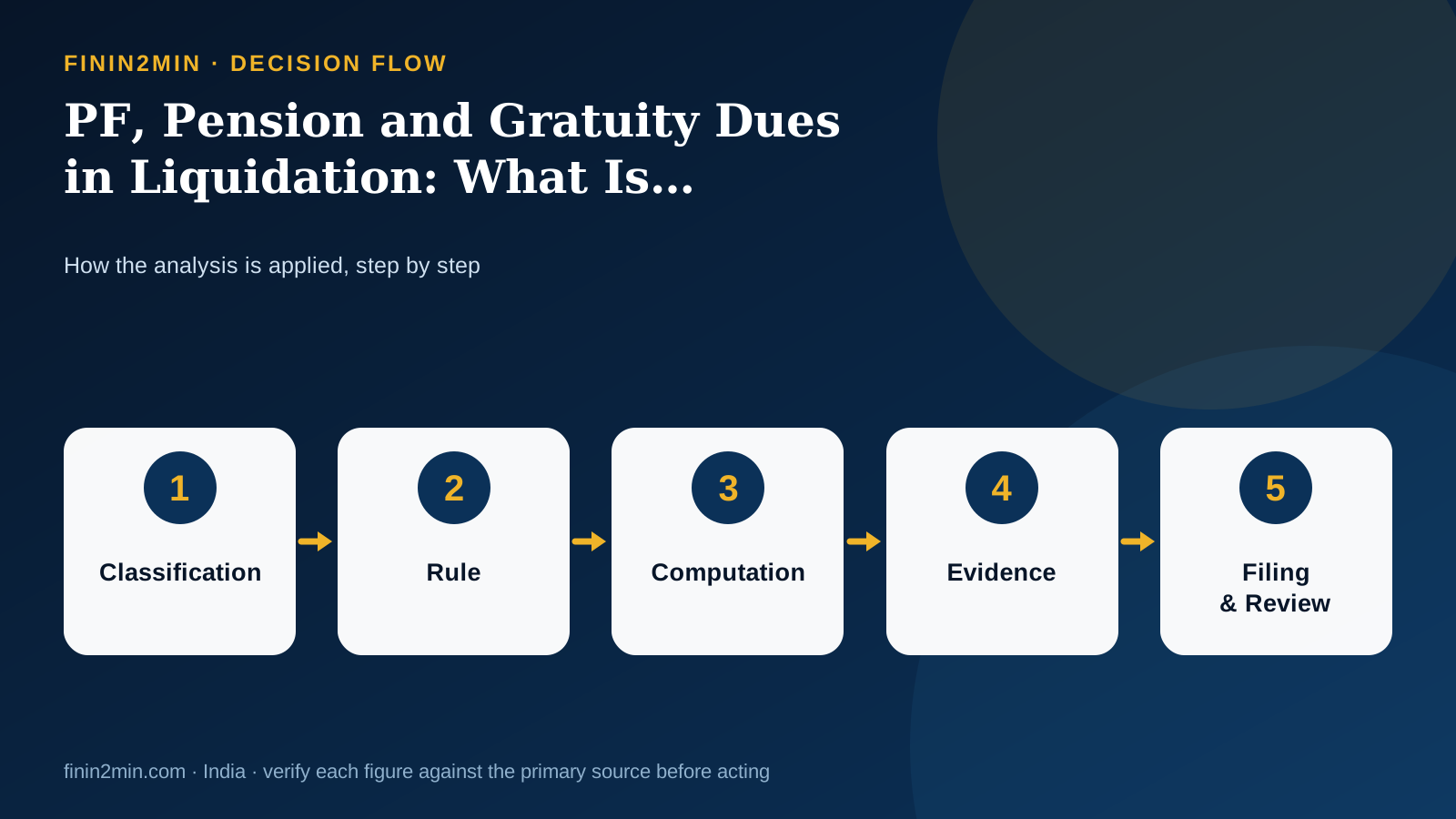
The six steps should be documented in sequence. If the final filing or accounting entry cannot be traced back through the workflow to the source document and legal provision, the position is not yet audit-ready.
4. Worked example and scenario analysis
Illustrative scenario — not a universal tax or legal result Assume a creditor has a ₹20 lakh exposure connected with PF, Pension and Gratuity Dues in Liquidation. The commercial team wants immediate recovery, but the legal outcome depends on the IBC stage. Build a timeline of default, acknowledgements, demand/recall notices and pending disputes; identify security and creditor class; then compare admission, settlement, CoC outcome and liquidation recovery. A ₹20 lakh book balance does not itself establish the amount or priority ultimately admitted in the insolvency process.
Recalculate the conclusion for at least three variations: (1) a change in party/residential or regulatory status, (2) a change in transaction date or holding/tenure, and (3) a change in value, consideration or cash-flow structure. This reveals whether the result is robust or depends on a single fragile assumption.
For PF, Pension and Gratuity Dues in Liquidation: What Is Outside the Liquidation Estate and Where Employees Rank, a reviewer should be able to explain the result in four reconciled layers: the governing legal or accounting rule, the numerical working, the document that proves each input, and the exact filing / financial-statement / transaction output. Where the commercial outcome changes under a different date, party status, valuation basis or classification, the working paper should show that sensitivity explicitly rather than burying it in assumptions.
5. Evidence file, controls and common failure points
Evidence to retain
- employee-wise dues register
- EPF/ESI/trust records
- gratuity actuarial/provision records
- liquidation estate inventory
- loan / supply contracts and default evidence
- demand notices, replies and pre-existing dispute record
Red flags to review
- placing excluded employee funds inside liquidation estate
- confusing workmen dues priority with PF/gratuity exclusion
- omitting trust assets
Cut-off dates — Claim rights and process obligations can turn on insolvency commencement, liquidation commencement or a regulation amendment date. Claim vs admitted claim — Model distributions on the amount/status recognised in the process, while separately tracking disputed amounts and challenge rights. Security status — Do not assume every secured creditor has identical enforcement or distribution economics; document the actual security and election/plan treatment. Related-party status — Related-party conclusions can affect committee participation, eligibility and scrutiny. Preserve the ownership/control analysis. Order-driven exceptions — Tribunal directions can change a standard process step. The live case order must sit above a generic checklist.
Which proceeding under the Code/Companies Act is actually underway? What is the relevant commencement, default, filing or admission date? Which current IBBI regulation and form governs the step? Who has standing to decide, vote, object or appeal? What claim value/security/priority is admitted rather than merely asserted? Which timeline is statutory and which can be excluded/extended under the law? Does the proposed settlement/plan preserve mandatory payments and approvals? Is the complete chronology supported by orders, filings and committee records?
Reviewer sign-off questions
- Is the legal provision current for the transaction / tax year being analysed?
- Does the classification in the working paper match the contract, ledger and filing?
- Are values, dates, rates and assumptions independently traceable to evidence?
- Has the team documented any judgement, exception, litigation risk or alternative interpretation?
- Would another reviewer be able to reproduce the result without asking for undocumented assumptions?
Implementation checklist: from analysis to an audit-ready file
For PF, Pension and Gratuity Dues in Liquidation: What Is Outside the Liquidation Estate and Where Employees Rank, the review should finish with a file that another professional can reproduce without relying on oral explanations. The following controls convert the technical conclusion into an execution-ready record.
Control 1: employee-wise dues register
Retain employee-wise dues register as a primary input, not merely as background support. The working paper should identify the relevant date, amount, party and legal character visible in that record, then cross-reference it to the computation and final filing / accounting output. Where the document does not directly prove an assumption, record the additional evidence or judgement used to bridge the gap.
Control 2: EPF/ESI/trust records
Retain EPF/ESI/trust records as a primary input, not merely as background support. The working paper should identify the relevant date, amount, party and legal character visible in that record, then cross-reference it to the computation and final filing / accounting output. Where the document does not directly prove an assumption, record the additional evidence or judgement used to bridge the gap.
Control 3: gratuity actuarial/provision records
Retain gratuity actuarial/provision records as a primary input, not merely as background support. The working paper should identify the relevant date, amount, party and legal character visible in that record, then cross-reference it to the computation and final filing / accounting output. Where the document does not directly prove an assumption, record the additional evidence or judgement used to bridge the gap.
Control 4: liquidation estate inventory
Retain liquidation estate inventory as a primary input, not merely as background support. The working paper should identify the relevant date, amount, party and legal character visible in that record, then cross-reference it to the computation and final filing / accounting output. Where the document does not directly prove an assumption, record the additional evidence or judgement used to bridge the gap.
Pre-sign-off challenge test
Before sign-off, challenge the conclusion specifically for: placing excluded employee funds inside liquidation estate; confusing workmen dues priority with PF/gratuity exclusion; omitting trust assets. If any of these conditions is present, re-open classification and computation rather than treating the issue as a disclosure-only point.
6. Frequently asked questions
What does “Some employee benefit funds are outside the liquidation estate” mean for PF, Pension and Gratuity Dues in Liquidation?
The IBC excludes sums due to workmen or employees from provident, pension and gratuity funds from the liquidation estate. Separate from that exclusion, Section 53 gives specified priority to workmen dues and employee dues. Mixing these concepts can materially misstate recoveries.
What does “PF, pension and gratuity funds are conceptually separate from the waterfall” mean for PF, Pension and Gratuity Dues in Liquidation?
Amounts due to workmen or employees from provident, pension and gratuity funds are excluded from the liquidation estate. They should not be treated as ordinary unsecured claims simply because Section 53 contains employee priorities.
What does “Workmen and employees do not rank identically” mean for PF, Pension and Gratuity Dues in Liquidation?
Section 53 gives workmen dues for the prescribed 24-month period a higher waterfall position alongside the relevant secured-creditor class, while employee dues for the prescribed 12-month period rank in a lower specified tier.
What should be documented before taking a position on PF, Pension and Gratuity Dues in Liquidation?
At minimum, preserve employee-wise dues register, EPF/ESI/trust records, gratuity actuarial/provision records, liquidation estate inventory. The calculation should be traceable from source records to the legal provision and the final return, filing, accounting entry or board decision.
What is the most common review risk?
The highest-risk errors include placing excluded employee funds inside liquidation estate, confusing workmen dues priority with PF/gratuity exclusion, omitting trust assets. A reviewer should test these items separately rather than relying on a single summary memo.
When should professional advice be obtained?
Seek transaction-specific advice where facts cross multiple regimes, involve material value, foreign parties, litigation, valuation judgement, restructuring, significant estimates or a position that is not clearly covered by the latest statutory text / regulator guidance.
7. Related Finin2min topics
- Pre-Packaged Insolvency Resolution Process (PIRP): Timelines, Eligibility and Threshold Framework for MSMEs
- Section 29A IBC Disqualification: Related Parties, Defaulters and the Corporate-Veil Analysis
- Rights of Dissenting Financial Creditors: Minimum Payment and Priority in CoC-Approved Resolution Plans
- Schemes of Arrangement under Sections 230–232: Merger Protocols, NCLT Process and Startup Use Cases
- Avoidance Transactions in IBC: Preferential, Undervalued, Extortionate and Fraudulent Transactions Compared
Primary sources and validation basis
Use the linked official material as the starting point. Check the latest amendment / circular / notification applicable to the specific date and facts before filing or executing a transaction.
- IBBI — Current consolidated insolvency regulations
- IBBI — Circulars and process formats
- IBBI — Insolvency and Bankruptcy Code / amendments