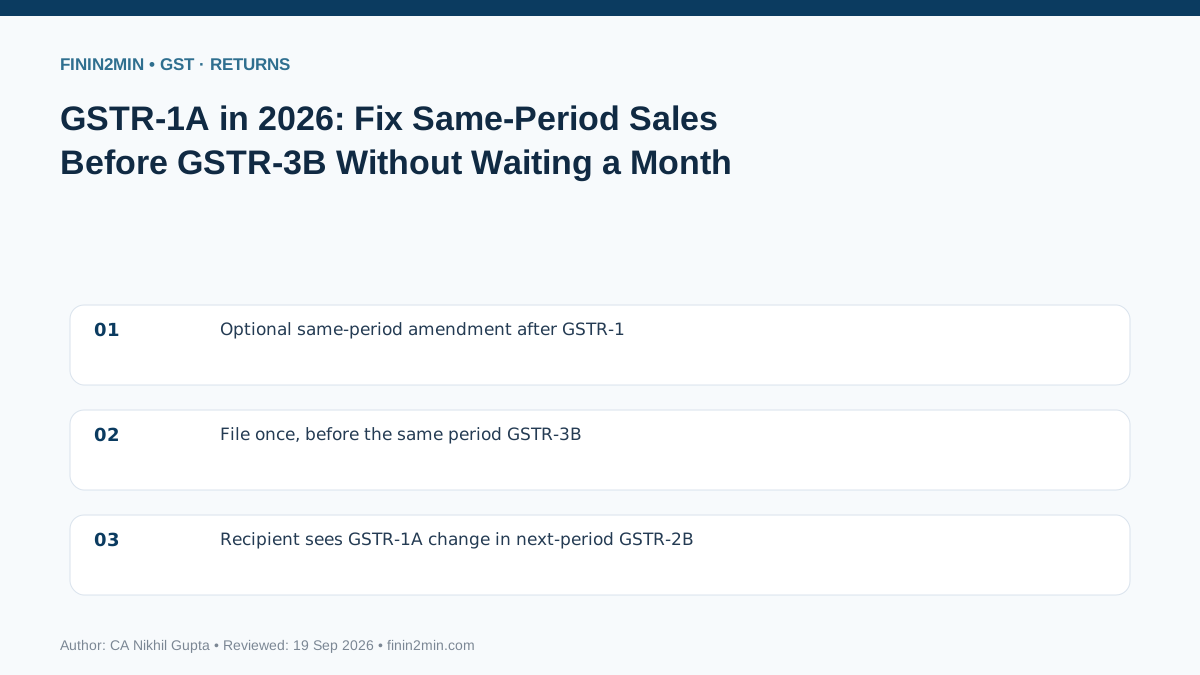
GSTR-1A is an optional same-period repair window after GSTR-1 and before GSTR-3B. It can correct or add outward-supply records once for the period, but the recipient’s ITC from those additions/amendments moves to the next GSTR-2B.
What GSTR-1A actually fixes
GSTR-1A is not a second monthly return and it is not a general revision facility for old periods. The GST Portal describes it as an optional amendment return for the same tax period: a supplier can amend records already furnished in GSTR-1 or add a supply that was missed, after GSTR-1 is filed and before GSTR-3B for that period is filed.
The window opens on the later of the GSTR-1 due date or the actual GSTR-1 filing date. For a monthly filer the portal FAQ uses the normal 11th-of-next-month GSTR-1 due date; for a quarterly filer it refers to the 13th following the quarter. There is no standalone GSTR-1A due date, because the hard stop is the filing of GSTR-3B for the same period.
Same-period liability, next-period ITC: the asymmetry to remember
The supplier-side correction and recipient-side ITC do not land in the same place. Changes made through GSTR-1A feed the supplier’s GSTR-3B for that same tax period. However, the GST Portal states that supplies added or amended through GSTR-1A are made available to the recipient in the next tax period’s GSTR-2B. This timing difference matters for vendor/customer communication.
Example 1 — missed B2B invoice. A monthly filer submitted August GSTR-1 but omitted an August B2B invoice with taxable value ₹1,00,000 and GST ₹18,000. Before filing August GSTR-3B, the supplier adds it in August GSTR-1A. The supplier’s August output-tax computation increases by ₹18,000 and the corrected figure is carried into the same-period GSTR-3B workflow. The customer should not expect the ₹18,000 ITC in August GSTR-2B merely because the invoice belongs to August; the portal FAQ says a record added through August GSTR-1A reaches the recipient’s next-period GSTR-2B.
That sequencing prevents a common reconciliation mistake: the supplier sees the liability immediately and assumes the buyer sees matching ITC immediately. Finance teams should send the GSTR-1A filing acknowledgement and tell the recipient which GSTR-2B period will contain the record.
What can be added or amended?
The portal guidance allows a record from the current GSTR-1 period to be corrected and a record missed from that period to be added. The facility is particularly useful for wrong taxable value, tax amount, POS-related fields, invoice details or a completely omitted outward supply, subject to the field-level validations on the portal.
Use the following decision order:
- Is the record for the same tax period? If it belongs to an older period, use the amendment mechanism available in a later GSTR-1 instead of treating GSTR-1A as a back-period return.
- Has GSTR-3B already been filed? If yes, GSTR-1A for that period is no longer available.
- Has GSTR-1A already been filed once? If yes, there is no second same-period GSTR-1A filing.
- Will the change alter liability? Reconcile the system-computed GSTR-3B figures and your saved GSTR-3B values before filing.
- Will the counterparty’s ITC timing change? Tell the recipient that GSTR-1A records feed the next GSTR-2B.
Worked correction: wrong value, not a missed invoice
A supplier reported Invoice A-417 in GSTR-1 at taxable value ₹5,00,000 with 18% GST of ₹90,000. The actual invoice is ₹5,80,000 plus ₹1,04,400 GST. Before GSTR-3B, the error is discovered.
Difference in taxable value: ₹80,000. Difference in tax: ₹14,400. The supplier amends the record in GSTR-1A and reviews GSTR-3B so that the additional ₹14,400 output liability is not left out. The recipient’s corresponding amended credit information will move through the next-period GSTR-2B cycle.
If the erroneous GSTR-1 figure was higher than the actual invoice, do not reduce tax mechanically without checking whether the amendment is permitted for that field, whether a credit note is actually the legally correct document, and whether the recipient has acted on the original record. GSTR-1A is a reporting tool; it does not replace the substantive GST rules for tax invoices, debit notes and credit notes.
Monthly and quarterly timeline map
| Filer | GSTR-1A opens | Latest point to use it | How often |
|---|---|---|---|
| Monthly | Later of actual GSTR-1 filing or normal GSTR-1 due date (portal FAQ refers to 11th) | Before filing GSTR-3B for that month | Once for that tax period |
| Quarterly | Later of actual quarterly GSTR-1 filing or normal due date (portal FAQ refers to 13th after quarter) | Before quarterly GSTR-3B for the period | Once for that quarter |
The usual monthly GSTR-3B due date shown on the Portal is the 20th of the following month; quarterly due dates may be the 22nd or 24th depending on the notified State/UT category. Extensions can be notified, so a live filing calendar should still be checked when a deadline is close.
A finance-team procedure that catches errors before GSTR-1A is consumed
- Freeze the outward-supply ledger immediately after GSTR-1 filing.
- Compare GSTR-1 invoice count/value with the final sales register and e-invoice/e-way-bill population where relevant.
- Create one exception sheet showing invoice number, GSTIN, original value, correct value, tax delta and reason.
- Separate “reporting correction” from cases that legally require a debit/credit note.
- Get commercial confirmation for large amendments so the GST record matches the customer’s books.
- Enter all valid changes, generate the draft summary and recheck because the form can be filed only once.
- After filing, review GSTR-3B system values. The portal warns that saved GSTR-3B data can affect auto-population behaviour, so compare rather than assume.
- Send affected customers the corrected invoice/reference and expected next GSTR-2B period.
Three mistakes that create avoidable notices
1. Filing GSTR-3B first. Once GSTR-3B for the period is filed, the same-period GSTR-1A route closes. The correction may then need to travel through a later GSTR-1 and reconciliation trail.
2. Treating GSTR-1A as a buyer-ITC acceleration tool. It repairs the supplier’s current-period outward-supply data, but the Portal expressly says the recipient gets those additions/amendments in the next GSTR-2B.
3. Filing the one available GSTR-1A too early. A hurried correction of one invoice can lock out a second batch of errors found later the same day. Do one consolidated review.
Debit note, credit note or GSTR-1A amendment: choose the legal event first
A finance team should not use GSTR-1A merely because a number in GSTR-1 is inconvenient. First identify what actually happened. If the original invoice itself was reported with the wrong taxable value, GSTIN, place-of-supply detail or tax amount for the same period, an amendment may be the right route. If the commercial event after invoicing genuinely gives rise to a debit note or credit note, the statutory document should be created and reported as such rather than rewriting history through an invoice amendment.
This distinction matters because the accounting trail, e-invoice trail where applicable, customer ledger and GST return should tell the same story. A return correction that conflicts with the underlying document can solve one mismatch and create another. Before filing GSTR-1A, compare the invoice register, credit/debit-note register, e-invoice data, e-way-bill data where relevant and the draft GSTR-3B liability summary.
Example — price reduction after invoice. A supplier issued an August invoice for ₹5,00,000 plus 18% GST and reported it correctly in August GSTR-1. On 18 September, after a quality dispute, the parties agree to a genuine ₹50,000 taxable-value reduction and the supplier issues a credit note. That is not the same fact pattern as an August invoice typed as ₹5,50,000 by mistake. The first is a later commercial adjustment evidenced by a credit note; the second is an error in the invoice/reporting data. The return route should follow the actual document trail.
Why GSTR-1A changes the supplier's control calendar
The most useful way to operate GSTR-1A is to create a short review window between GSTR-1 and GSTR-3B. For monthly filers, that means locking the sales register, filing GSTR-1, then running one final exception report before GSTR-3B. The exception report should focus on high-value invoices, invoices with changed customer GSTINs, B2C/B2B classification errors, exports/SEZ records, credit/debit notes and items appearing in the books but not the filed GSTR-1.
If no exception exists, do not file GSTR-1A merely to create an acknowledgement. If an exception exists, batch the same-period corrections because the portal permits only one GSTR-1A filing for the period. After filing, re-download or re-check the system-populated GSTR-3B values instead of relying on a working prepared before the amendment.
| Control point | Evidence to retain | Why it matters |
|---|---|---|
| Before GSTR-1 | Sales register vs portal draft | Prevents ordinary data errors from entering the return. |
| After GSTR-1 | Exception list signed off by tax/accounts | Creates a deliberate one-time GSTR-1A decision. |
| After GSTR-1A | Filed acknowledgement + amended record list | Explains the change during later reconciliation. |
| Before GSTR-3B | Liability reconciliation to filed GSTR-1/GSTR-1A | Confirms the same-period tax effect is captured. |
| Customer communication | Invoice-wise note showing expected GSTR-2B period | Reduces avoidable vendor-ITC escalations. |
Recipient communication: avoid promising ITC in the wrong month
Because additions and amendments through GSTR-1A reach the recipient's next-period GSTR-2B, a supplier should not tell a customer “the invoice is fixed, claim it now” without checking the statement period. A better note identifies the invoice number, original error, GSTR-1A filing date and the GSTR-2B period in which the corrected record is expected. The recipient can then keep the invoice in its reconciliation queue instead of either claiming prematurely or blocking the vendor indefinitely.
For large customers, this small operational discipline is commercially important: vendor payment holds are often driven by GSTR-2B matching. A well-evidenced GSTR-1A correction gives the customer’s AP/tax team a clear reason for the one-period lag.
GSTR-1A FAQs
Is GSTR-1A compulsory every month?
No. The GST Portal calls it optional. Use it only when a same-period GSTR-1 record needs addition or amendment before GSTR-3B.
Can GSTR-1A be filed twice?
No. Portal guidance says it can be filed only once for a particular tax period.
Can I file it after GSTR-3B?
No. GSTR-1A is available only up to the filing of GSTR-3B for the same period.
Does a GSTR-1A invoice appear in the buyer’s same-month GSTR-2B?
No. The portal says additions/amendments through GSTR-1A appear in the recipient’s next tax-period GSTR-2B.
Will GSTR-1A change my GSTR-3B liability?
Its changes are used in the supplier’s GSTR-3B computation. Always compare system-computed values with any GSTR-3B data you saved earlier.
Can I correct an old-period invoice through current GSTR-1A?
GSTR-1A is designed for records of the same tax period. Older-period amendments use the normal subsequent-return amendment route subject to GST time limits and validations.
October 2026 update: gstr 1a 2026 amend outward supplies before gstr 3b
Finin2min 2-minute summary
GSTR-1A is the same-tax-period correction bridge between a filed GSTR-1 and an unfiled GSTR-3B. It allows the supplier to amend details already furnished in GSTR-1 or add outward-supply details omitted from that GSTR-1.
The facility is optional and, according to GST Portal guidance, can be filed only once for a tax period. It becomes available after the later of the GSTR-1 due date or the actual GSTR-1 filing date and remains open only until the taxpayer files GSTR-3B for that period.
Additional or amended liability in GSTR-1A flows into the same period GSTR-3B. This is why the books-to-GSTR-1 review should be completed before pressing the GSTR-3B filing button.
What can be corrected
Use GSTR-1A for genuine same-period corrections or omissions in outward-supply reporting. Typical examples include a missed B2B invoice, an incorrect taxable value, wrong tax amount, an omitted credit/debit note or another GSTR-1 record that the portal permits to be amended.
The correction should be supported by the source invoice/credit note, customer master, place-of-supply analysis, e-invoice record where applicable and the relevant accounting entry.
What GSTR-1A does not do
It is not a general revision return after GSTR-3B. Once GSTR-3B for the same period is filed, the GSTR-1A window closes. Subsequent-period amendment mechanisms remain separate and the statutory rectification cut-off continues to apply independently.
It also does not automatically put the recipient’s ITC into the same month GSTR-2B. GST Portal guidance states that supplies added or amended through GSTR-1A are made available to the recipient in the next tax-period GSTR-2B.
Monthly and quarterly filers
For monthly filers, GSTR-1A opens from the later of the GSTR-1 due date or actual filing date and remains available until GSTR-3B is filed. For quarterly filers, the same logic operates around the quarterly GSTR-1 timeline and quarterly GSTR-3B.
Teams using QRMP should distinguish GSTR-1A from IFF. IFF is an optional invoice-furnishing facility for eligible first-two-month B2B details; GSTR-1A is a correction/addition mechanism after GSTR-1.
Control workflow
1. Freeze the sales register for the period. 2. Reconcile books to e-invoice/IRP data where applicable. 3. Reconcile books to filed GSTR-1. 4. List every omitted or incorrect record. 5. Classify whether GSTR-1A can correct it. 6. Maker-checker review. 7. File GSTR-1A once. 8. Confirm the changed liability in GSTR-3B. 9. Preserve the filing acknowledgment and reconciliation schedule.
Common errors
Filing GSTR-3B before completing the reconciliation; expecting GSTR-1A to remain available after GSTR-3B; confusing GSTR-1A with a later-period amendment; assuming recipient ITC appears in the same GSTR-2B; and fixing the tax amount without correcting the underlying invoice master/e-invoice data.
Finin2min takeaway
GSTR-1A is most valuable when it is embedded into the monthly close. Treat “GSTR-1 filed” as the start of the final outward-supply reconciliation, not the end. Complete the review, use GSTR-1A where required, then file GSTR-3B.
Primary sources
Use the cited instrument or regulator guidance for the proposition described above; check later amendments and transaction-date rules before acting.
Educational information only. Tax, legal, banking and insurance outcomes depend on facts, dates and the instrument/policy in force. Obtain professional advice for material transactions.