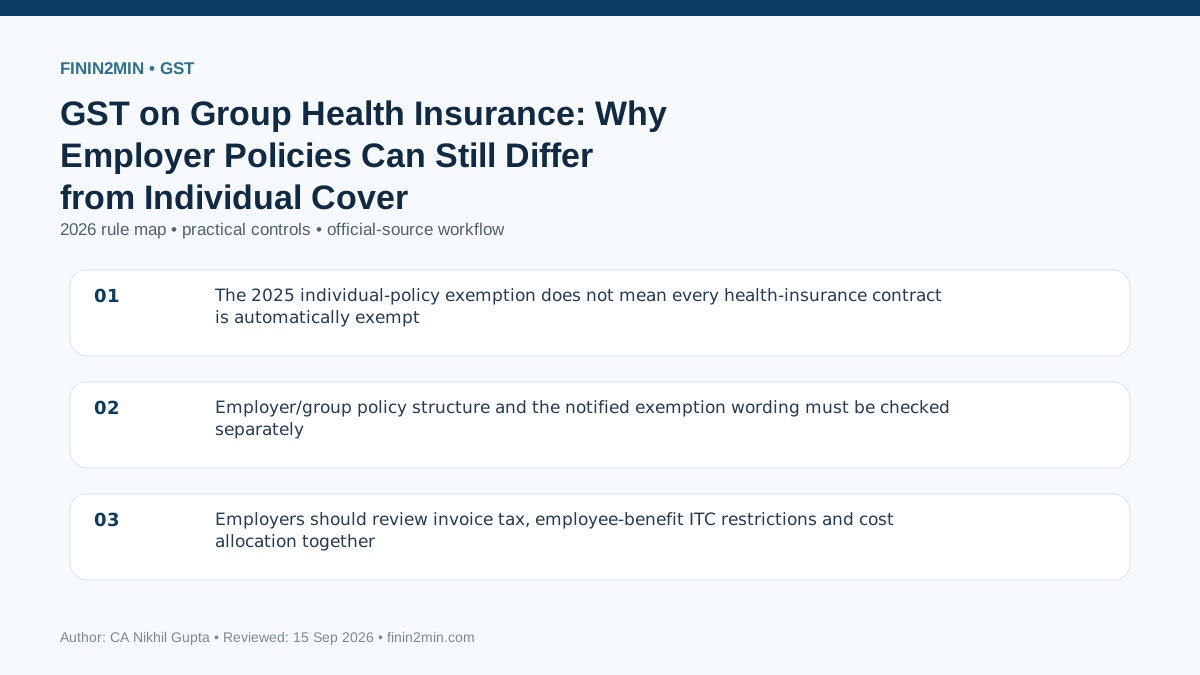
The September 2025 GST Council decision that attracted headlines on health-insurance relief was framed around individual health insurance, including family floater and senior-citizen policies, together with related reinsurance. An employer’s group mediclaim is a different contract category and should not be assumed to inherit the individual-policy exemption.
Current rule and what decides the result
The GST relief effective 22 September 2025 exempts individual health-insurance policies, including family floater and senior-citizen individual cover, together with specified related reinsurance. Employer-sponsored group health/mediclaim is not the same product category and continues to attract GST at the applicable rate—commonly 18% under the current framework. For the employer, a second question is input-tax credit: section 17(5) restrictions on health insurance must be tested together with the exception where provision is obligatory under law. Premium recovery from employees does not by itself convert a group contract into an exempt individual policy.
Key rules to apply
- Employers must also separately test input-tax-credit restrictions under section 17(5), including the statutory-obligation exception where relevant.
- The 56th GST Council materials identify exemption for individual health insurance policies, including family floater and senior-citizen policies, plus associated reinsurance.
- Employer-employee group health is not automatically an “individual health insurance policy” merely because each employee receives a health card.
- Apply the notification/rate entry actually governing the group policy at invoice date; do not use a consumer headline as the tax code.
- GST on life/health insurance can be blocked for the recipient under section 17(5), subject to statutory exceptions.
- Where the employer is required under law to provide the relevant benefit, the section 17(5) proviso/exception must be tested on the exact legal obligation and policy scope.
Employer group cover after 22 September 2025
A company renews a group mediclaim policy for 500 employees for ₹40 lakh premium after 22 September 2025. The insurer treats the employer group policy as taxable at 18%, producing ₹7.2 lakh GST. The company cannot demand the individual-policy exemption merely because each employee and family member has a health card; the contract is group cover. It must separately determine whether any input-tax-credit exception applies to the employer’s facts.
Individual family floater bought by employee
An employee independently buys a qualifying family-floater health policy in her own name for ₹30,000 premium after the exemption date. That individual contract is in the exempt category under the post-September 2025 relief. It should not be used as a rate precedent for the employer’s separate group master policy; the two supplies have different classifications.
How to apply it step by step
- Identify who is the policyholder and whether the insurer contract is individual/family floater or group.
- Check invoice date/supply period against the 22 September 2025 exemption effective date.
- For group cover, verify the applicable GST rate from the insurer invoice/rate notification.
- For employers, test section 17(5) input-credit restriction separately from output-rate classification.
- Document any law that makes the employee health benefit mandatory if relying on the statutory-obligation ITC exception.
- Analyse employee premium recovery/optional parent cover separately for supply/valuation consequences.
- Reconcile insurer GST invoice, payroll recoveries and ITC ledger.
- Retain policy schedule/master policy because classification depends on the actual contract, not marketing language.
Common mistakes and edge cases
- Applying the individual-policy exemption to an employer group master policy.
- Assuming GST charged by insurer is automatically available as ITC to employer.
- Using an employee’s family-floater invoice as proof for group-policy classification.
- Ignoring optional/dependent premium recoveries from employees.
- Citing a Council headline without checking the effective notification/date.
FAQs
Are individual health policies exempt from GST now?
Qualifying individual health insurance, including family floater/senior-citizen individual policies, became exempt from 22 September 2025.
Is employer group mediclaim also exempt?
No automatic exemption applies; group health remains a separate taxable category under the current framework.
What rate commonly applies to group health?
The current group-health supply generally continues at 18%, subject to the governing notification/invoice facts.
Can the employer claim ITC?
Section 17(5) restrictions and exceptions must be tested; output GST on the insurer invoice does not itself guarantee credit.
Does employee recovery make the policy individual?
No. The master policy classification does not change simply because employees contribute to premium.
What should be checked first?
Read the master policy and insurer tax invoice, then apply rate and ITC rules separately.
Related Finin2min guides
- Group Health Insurance from Employer: Why Employees Still Need Personal Cover | Finin2min Insurance Playbook
- Employer Health Cover Gaps
- Employer Health Cover Gaps
- Health Insurance Moratorium After 60 Months
- Group Insurance Employer Policy Coverage: Benefits, Costs & Risks
- Super Top-Up Health Insurance: Cheap Cover or Confusing Product?
- Super Top-Up Insurance: Deductibles Explained
- OPD Cover in Health Insurance: Useful Add-On or Expensive Feature? | Finin2min Insurance Playbook