Online Gaming GST at 28% is not a topic where one headline rate or one commercial label is enough. The correct treatment depends on the operative law, the exact legal form of the transaction, the parties, timing, documentation and the way the amount is ultimately reported or accounted for.
Finin2min takeaway
- Start with the legal classification and the current rule—not a rate copied from an older example.
- Model tax/regulatory/accounting and cash-flow effects together where they interact.
- Reconcile the final position to source records, filing schedules and supporting evidence.
- Re-run the analysis when a controlling fact such as party status, date, valuation, contract term or regulatory category changes.
1. Current rule and the points that actually control the answer
Online-money-gaming valuation is not GGR based
Rule 31B values online gaming, including online money gaming, by reference to the amount paid/payable or deposited with the supplier by or on behalf of the player, including VDA consideration. This makes a “28% of GGR” shorthand misleading for the current statutory valuation framework.
For Online Gaming GST at 28%, this point can change the tax, regulatory, accounting or cash-flow result even when the commercial transaction looks unchanged. It should therefore be tested before the computation or filing is finalised.
- the valuation base
- the valuation date / period
- the supporting calculation and source records
The statutory value is not gross gaming revenue
Rule 31B values online gaming by the amount paid/payable or deposited with the supplier by or on behalf of the player, including VDA consideration. The law therefore does not simply apply 28% to platform GGR.
For Online Gaming GST at 28%, this point can change the tax, regulatory, accounting or cash-flow result even when the commercial transaction looks unchanged. It should therefore be tested before the computation or filing is finalised.
- the valuation base
- the valuation date / period
- the supporting calculation and source records
Refunds do not necessarily reduce the valuation base
Rule 31B expressly restricts deduction of amounts returned/refunded for the reasons covered by the rule. Product-led “wallet” design therefore has to be reconciled to the tax valuation rule.
For Online Gaming GST at 28%, this point can change the tax, regulatory, accounting or cash-flow result even when the commercial transaction looks unchanged. It should therefore be tested before the computation or filing is finalised.
- the valuation base
- the valuation date / period
- the supporting calculation and source records
Offshore suppliers have an India compliance problem too
The 2023 amendments created registration and tax mechanisms for overseas suppliers of online money gaming to persons in India. Location of servers or corporate incorporation abroad does not by itself remove Indian GST exposure.
For Online Gaming GST at 28%, this point can change the tax, regulatory, accounting or cash-flow result even when the commercial transaction looks unchanged. It should therefore be tested before the computation or filing is finalised.
- the valuation base
- the valuation date / period
- the supporting calculation and source records
Income-tax/VDA and GST are separate layers
A gaming platform accepting crypto may face GST valuation using VDA consideration while the player or payer can separately face VDA income-tax/TDS rules. The same token movement can therefore create different compliance records under two laws.
For Online Gaming GST at 28%, this point can change the tax, regulatory, accounting or cash-flow result even when the commercial transaction looks unchanged. It should therefore be tested before the computation or filing is finalised.
- the valuation base
- the valuation date / period
- the supporting calculation and source records
Current-law control
GST conclusions must be built in layers: first identify whether there is a supply, then determine place/time/value of supply, rate or exemption, input-tax-credit consequences and the reporting trail. A GST Council recommendation is not by itself the operative law until the relevant Act, rule, notification or circular gives it effect.
- The 28% GST framework for online money gaming is linked to the statutory actionable-claim and valuation architecture, with Rule 31B focusing on amounts paid/deposited with the supplier rather than a conventional GGR approach.
- Do not multiply GST by every re-bet of winnings: the valuation rule and its treatment of amounts entered from prior winnings must be read before modelling tax.
2. Detailed analysis: what a professional review should cover
The practical risk here lies in mapping the actual contract and supply chain before applying a GST rate. Supplier/recipient GSTIN, place and time of supply, valuation rule, input-tax-credit position, invoices and return reporting must tell the same story.
Supply before rate
The first question is whether there is a taxable supply and who makes it to whom. Rate and valuation analysis comes only after classification, place/time of supply, exemption/zero-rating and distinct-person rules are mapped.
Output tax and ITC together
A position that appears neutral at entity level can create cash-flow, interest or blocked-credit exposure at a registration level. Model output tax and recipient ITC together, including timing mismatches.
Litigation file
For positions likely to be reviewed, create a legal memo with facts, contract extracts, circulars/notifications relied on, calculation and return mapping. This often matters more than a later generic explanation.
Article-specific decision matrix
| Decision point | Current-position question | Evidence to retain |
|---|---|---|
| Online-money-gaming valuation is not GGR based | Rule 31B values online gaming, including online money gaming, by reference to the amount paid/payable or deposited with the supplier by or on behalf of the player, including VDA consideration. This makes a “28% of GGR” shorthand misleading for the current stat… | wallet and deposit ledger |
| The statutory value is not gross gaming revenue | Rule 31B values online gaming by the amount paid/payable or deposited with the supplier by or on behalf of the player, including VDA consideration. The law therefore does not simply apply 28% to platform GGR. | Rule 31B valuation working |
| Refunds do not necessarily reduce the valuation base | Rule 31B expressly restricts deduction of amounts returned/refunded for the reasons covered by the rule. Product-led “wallet” design therefore has to be reconciled to the tax valuation rule. | promotional credit terms |
| Offshore suppliers have an India compliance problem too | The 2023 amendments created registration and tax mechanisms for overseas suppliers of online money gaming to persons in India. Location of servers or corporate incorporation abroad does not by itself remove Indian GST exposure. | tax invoice / platform settlement records |
| Income-tax/VDA and GST are separate layers | A gaming platform accepting crypto may face GST valuation using VDA consideration while the player or payer can separately face VDA income-tax/TDS rules. The same token movement can therefore create different compliance records under two laws. | contracts / SLAs / guarantees / commercial terms |
Practical nuance
The 28% GST framework for online money gaming is linked to the statutory actionable-claim and valuation architecture, with Rule 31B focusing on amounts paid/deposited with the supplier rather than a conventional GGR approach.
Documentation nuance
Do not multiply GST by every re-bet of winnings: the valuation rule and its treatment of amounts entered from prior winnings must be read before modelling tax.
3. Step-by-step execution workflow
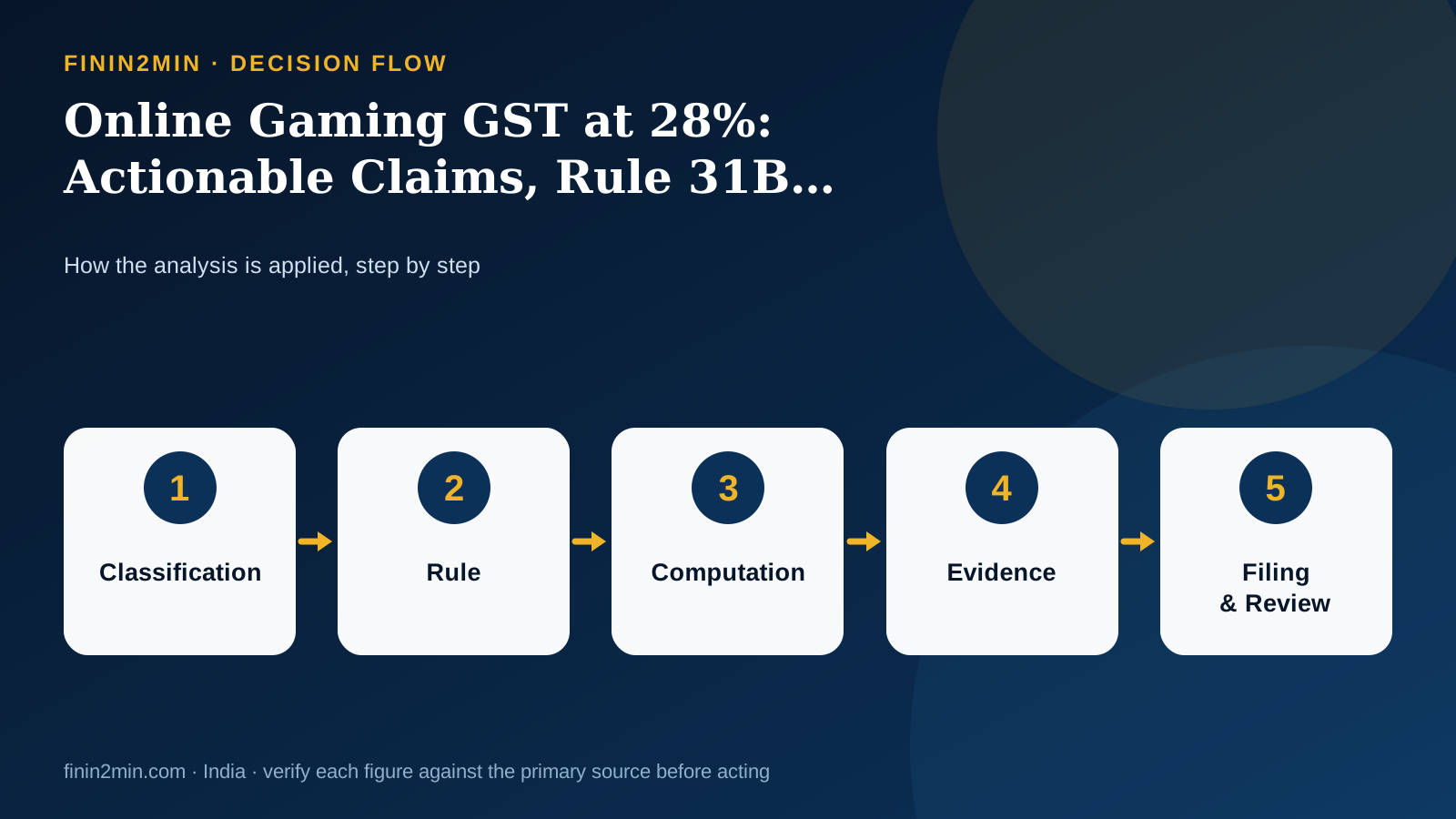
The six steps should be documented in sequence. If the final filing or accounting entry cannot be traced back through the workflow to the source document and legal provision, the position is not yet audit-ready.
4. Worked example and scenario analysis
Illustrative scenario — not a universal tax or legal result Assume Company A and Company B are registrations/entities involved in a Online Gaming GST at 28% arrangement with a commercial value of ₹25 lakh. Before raising an invoice, the tax team should document (1) what is supplied, (2) who supplies it to whom, (3) place/time of supply, (4) the valuation rule, (5) the tax rate/RCM position and (6) whether the recipient can take credit. The accounting recharge of ₹25 lakh is therefore the starting evidence, not automatically the GST value.
Recalculate the conclusion for at least three variations: (1) a change in party/residential or regulatory status, (2) a change in transaction date or holding/tenure, and (3) a change in value, consideration or cash-flow structure. This reveals whether the result is robust or depends on a single fragile assumption.
For Online Gaming GST at 28%: Actionable Claims, Rule 31B and Why GGR Is Not the Valuation Base, a reviewer should be able to explain the result in four reconciled layers: the governing legal or accounting rule, the numerical working, the document that proves each input, and the exact filing / financial-statement / transaction output. Where the commercial outcome changes under a different date, party status, valuation basis or classification, the working paper should show that sensitivity explicitly rather than burying it in assumptions.
5. Evidence file, controls and common failure points
Evidence to retain
- wallet and deposit ledger
- Rule 31B valuation working
- promotional credit terms
- tax invoice / platform settlement records
- contracts / SLAs / guarantees / commercial terms
- tax invoices, debit/credit notes and e-invoice trail
Red flags to review
- using GGR as GST value where statute prescribes amount paid/deposited
- ignoring re-deposit / returned money mechanics
- mixing income-tax TDS with GST valuation
Registration mismatch — The same PAN can have multiple GSTINs. Confirm which registration supplied and received the service before applying valuation or ITC. Commercial credit vs GST credit note — A financial adjustment does not automatically reduce taxable value; test the statutory credit-note conditions separately. Full ITC assumptions — A related-party valuation shortcut may depend on full ITC. Confirm actual eligibility, not merely that the recipient is registered. Circular scope — Use a circular to interpret the facts it addresses; do not stretch it to a different supply merely because the commercial label is similar. Portal/book differences — Investigate GSTR-1, GSTR-3B, e-invoice, e-way-bill and ledger differences before the annual close instead of carrying unreconciled balances.
What is the underlying supply and is there valid consideration or a deeming provision? Which GSTIN is the supplier and which GSTIN actually receives the benefit? What is the place and time of supply? Is there a special valuation rule before applying the rate? Does the recipient have full, partial or blocked ITC? Do invoice, e-invoice/e-way bill and return fields use the same classification? Is a circular being used within the facts it actually addresses? What reconciliation proves that the tax paid/credit claimed matches books and portal data?
Reviewer sign-off questions
- Is the legal provision current for the transaction / tax year being analysed?
- Does the classification in the working paper match the contract, ledger and filing?
- Are values, dates, rates and assumptions independently traceable to evidence?
- Has the team documented any judgement, exception, litigation risk or alternative interpretation?
- Would another reviewer be able to reproduce the result without asking for undocumented assumptions?
Implementation checklist: from analysis to an audit-ready file
For Online Gaming GST at 28%: Actionable Claims, Rule 31B and Why GGR Is Not the Valuation Base, the review should finish with a file that another professional can reproduce without relying on oral explanations. The following controls convert the technical conclusion into an execution-ready record.
Control 1: wallet and deposit ledger
Retain wallet and deposit ledger as a primary input, not merely as background support. The working paper should identify the relevant date, amount, party and legal character visible in that record, then cross-reference it to the computation and final filing / accounting output. Where the document does not directly prove an assumption, record the additional evidence or judgement used to bridge the gap.
Control 2: Rule 31B valuation working
Retain Rule 31B valuation working as a primary input, not merely as background support. The working paper should identify the relevant date, amount, party and legal character visible in that record, then cross-reference it to the computation and final filing / accounting output. Where the document does not directly prove an assumption, record the additional evidence or judgement used to bridge the gap.
Control 3: promotional credit terms
Retain promotional credit terms as a primary input, not merely as background support. The working paper should identify the relevant date, amount, party and legal character visible in that record, then cross-reference it to the computation and final filing / accounting output. Where the document does not directly prove an assumption, record the additional evidence or judgement used to bridge the gap.
Control 4: tax invoice / platform settlement records
Retain tax invoice / platform settlement records as a primary input, not merely as background support. The working paper should identify the relevant date, amount, party and legal character visible in that record, then cross-reference it to the computation and final filing / accounting output. Where the document does not directly prove an assumption, record the additional evidence or judgement used to bridge the gap.
Pre-sign-off challenge test
Before sign-off, challenge the conclusion specifically for: using GGR as GST value where statute prescribes amount paid/deposited; ignoring re-deposit / returned money mechanics; mixing income-tax TDS with GST valuation. If any of these conditions is present, re-open classification and computation rather than treating the issue as a disclosure-only point.
6. Frequently asked questions
What does “Online-money-gaming valuation is not GGR based” mean for Online Gaming GST at 28%?
Rule 31B values online gaming, including online money gaming, by reference to the amount paid/payable or deposited with the supplier by or on behalf of the player, including VDA consideration. This makes a “28% of GGR” shorthand misleading for the current statutory valuation framework.
What does “The statutory value is not gross gaming revenue” mean for Online Gaming GST at 28%?
Rule 31B values online gaming by the amount paid/payable or deposited with the supplier by or on behalf of the player, including VDA consideration. The law therefore does not simply apply 28% to platform GGR.
What does “Refunds do not necessarily reduce the valuation base” mean for Online Gaming GST at 28%?
Rule 31B expressly restricts deduction of amounts returned/refunded for the reasons covered by the rule. Product-led “wallet” design therefore has to be reconciled to the tax valuation rule.
What should be documented before taking a position on Online Gaming GST at 28%?
At minimum, preserve wallet and deposit ledger, Rule 31B valuation working, promotional credit terms, tax invoice / platform settlement records. The calculation should be traceable from source records to the legal provision and the final return, filing, accounting entry or board decision.
What is the most common review risk?
The highest-risk errors include using GGR as GST value where statute prescribes amount paid/deposited, ignoring re-deposit / returned money mechanics, mixing income-tax TDS with GST valuation. A reviewer should test these items separately rather than relying on a single summary memo.
When should professional advice be obtained?
Seek transaction-specific advice where facts cross multiple regimes, involve material value, foreign parties, litigation, valuation judgement, restructuring, significant estimates or a position that is not clearly covered by the latest statutory text / regulator guidance.
7. Related Finin2min topics
- Corporate Guarantees Between Related Parties: GST Valuation under Rule 28(2) and the 1% per Annum Benchmark
- Cross-Charge vs. ISD: Mandatory Compliance for Common Input Services in Multi-State Organisations
- EV Battery Swapping vs. Charging Stations: Classification, Rate and Input Tax Credit Issues
- GST on Co-Lending Arrangements: Tax Implications for NBFC and Bank Partnerships
- Liquidated Damages and Notice Pay Recovery: When Does a Contractual Payment Attract GST?
Primary sources and validation basis
Use the linked official material as the starting point. Check the latest amendment / circular / notification applicable to the specific date and facts before filing or executing a transaction.
- CBIC — 51st GST Council press release
- CBIC — GST Acts, Rules and Circulars
- GST Council — circulars and decisions