GST documentation
GST Delivery Challan Format: Job Work, Returns and Goods Movement
By Finin2min Editorial Desk · Reviewed by CA Nikhil Gupta · Last reviewed 9 October 2026
📄 Download the PDF edition (free sign-in)
Finin2min 2-minute summary
- Rule 55 permits a serially numbered delivery challan for specified transport situations, including job work and movement otherwise than by way of supply.
- A challan is not a universal replacement for a tax invoice or an e-way bill.
- Quantity, value, description, sender, recipient, movement purpose and triplicate-copy controls should reconcile to dispatch and return records.
When the invoice can lawfully be replaced at dispatch
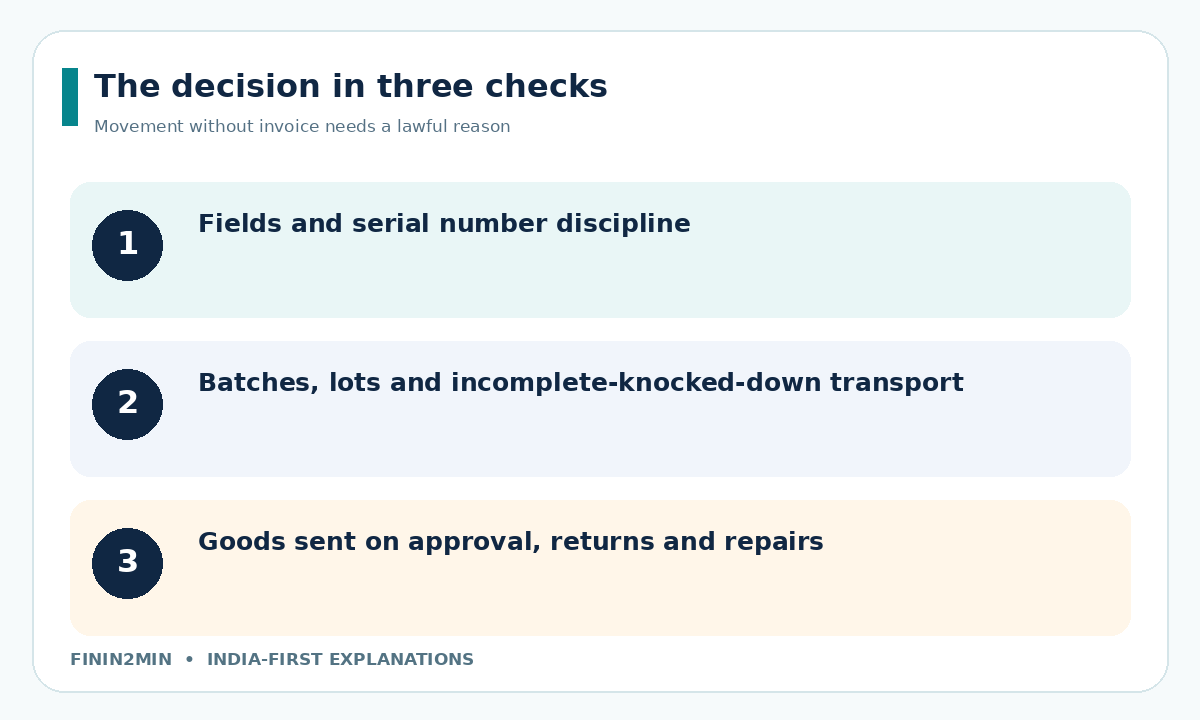
Rule 55 addresses transportation of goods without an invoice in specified circumstances, including job work, certain liquid-gas movements where quantity is not known, and movements for reasons other than supply. A dispatch of goods that constitutes a taxable sale does not automatically qualify because the supplier prefers fewer documents. The first test is the underlying legal purpose, not what the warehouse has historically printed. A branch transfer between distinct GST persons can constitute a supply and requires its own legal consideration, even where there is no commercial consideration. Record the movement reason and the responsible tax manager’s assessment before issuing the challan.
Fields and serial number discipline
A proper delivery challan should carry date and unique number within the permitted length, consignor and consignee identities and GSTIN/UIN where registered, HSN, goods description, quantity including provisional quantity when appropriate, taxable value, relevant tax rate and amount where the rules call for it, place of supply for interstate movement and appropriate signature or authorisation. These fields allow transport officers to distinguish materials from finished goods and allow both businesses to reconcile later. Use a dedicated number series and maintain a dispatch log; do not reuse numbers after a delivery is cancelled. A warehouse label with only carton count is insufficient.
Job-work movement with an illustrative material trail
Suppose a manufacturer sends 800 aluminium castings valued at ₹12 lakh for machining by a registered job worker and expects 780 processed units plus documented scrap and rejection. The challan records 800 units, actual weight, value, item description, supplier and job-worker GSTIN and the job-work purpose. The inventory ledger should follow work-in-progress transferred, expected yield, scrap, date sent and date received or further shipped. Depending on section 143 and current rules, return or onward supply of inputs or capital goods has specific conditions and timelines. The job-worker’s processing fee is a separate supply to be invoiced under the applicable tax treatment.
Batches, lots and incomplete-knocked-down transport
For machinery shipped in lots or semi/complete knocked-down condition, rule 55 contains a special document chain. Depending on the operative requirements, the complete invoice relates to the first consignment and subsequent consignments carry challans referring to that invoice together with the required certified copy. The purpose is to maintain continuity across trucks, not to create multiple taxable sales for one ordered machine. Identify serial numbers, gross/net quantities, original invoice reference and each vehicle number. The dispatch team should link each transport document back to the common sales order, customer acceptance and final delivery; otherwise the receiver may not reconcile parts with the invoice.
E-way bill and transport documents
A delivery challan is a goods movement document, while the e-way bill is a separate transport-compliance requirement under rule 138 and associated state conditions. Where e-way-bill applicability is met, generating a challan does not excuse non-generation of the transport document. Value, consignee, vehicle and item descriptions should match the e-way-bill particulars, including permissible updates or cancellations. Keep QR/identification details and transport references where used, but do not invent an IRN for a simple delivery challan. Check whether the route passes interstate borders, whether a notification grants an exception and whether transporter information has changed after loading.
Goods sent on approval, returns and repairs
Not every return or warranty replacement has the same GST treatment. A customer return after a sale may require a credit note or other statutory document, depending on the actual transaction, while temporary movement for testing or repair can fit a permitted non-supply challan scenario. A goods-on-approval arrangement also has specific invoicing and time-of-supply considerations. Document title, reason for movement, anticipated return, customer and original supply references. The accounts team should review the final outcome: returned unchanged, repaired, scrapped, sold from another location or converted into a taxable supply. A challan is an evidentiary link, not a substitute for deciding taxability.
Triplicate controls and stock reconciliation
The prescribed traditional method uses an original for the consignee, duplicate for transporter and triplicate for consignor, subject to permitted electronic records and current rules. Control must survive digital workflows: timestamp the dispatch, obtain delivery receipt, reconcile vehicle load against warehouse gate record and close open challans only when return or disposal is documented. Ageing reports should show challans open beyond expected job-work or return periods. For inventory counts, distinguish goods owned by the principal but physically with the job worker from goods sold to the job worker. Reconcile scrap and shortages before claiming or reversing input credits.
Mistakes and compliance review
Frequent failures are using a challan for an ordinary sale, forgetting the document value, issuing one generic job-work challan for multiple unrelated dispatches, failing to match e-way-bill descriptions, and not tracking the eventual return. Another common issue is quoting rules from a discussion agenda rather than the operative CGST Rules. For each movement, attach the current rule 55 extract, the contract or work order, approved goods codes, transporter details and receipt acknowledgement. This guide prepares the reader to design forms; a working electronic challan generator is separate functionality.
Questions readers ask
Is a delivery challan the same as a sales invoice?
No; it is authorised for specified movements under the GST rules.
Can it be used for job work?
Yes, subject to the detailed job-work and documentation requirements.
Does it eliminate an e-way bill?
No; evaluate rule 138 independently.
Should the challan mention value?
Yes, prescribed particulars include relevant goods value.
Is a consignee acknowledgement useful?
Yes; it helps reconcile dispatch, receipt and eventual return.
Can an ordinary taxable sale use only a challan?
Not merely for convenience; issue the legally required tax document.
Official sources
- GST Council: CGST rules official compendium — Rule 55 and Rule 138.
- GST Council: Government GST FAQ transport examples — Challan valuation and e-way bill.
- GST Council: Job-work challan operational discussion — Rule 55 document controls.
Related reading on Finin2min
- REITs in India: How They Work, Returns, Taxation & How to Buy
- Job-Work Goods Not Returned Within Time
- Sale of Goods Act, 1930 SOG-C04 | Performance, Delivery, Acceptance and Rejection
- Last-Mile Delivery Economics: Density, Failed Deliveries and Returns
- GST and Indirect Tax Hub
- warranty replacements under gst itc delivery challans dealer reimbursements and audit checklist
Disclaimer: Educational information, not individual tax, legal, accounting or investment advice. Check the current law, standards and notifications for the relevant period and take professional advice before acting.