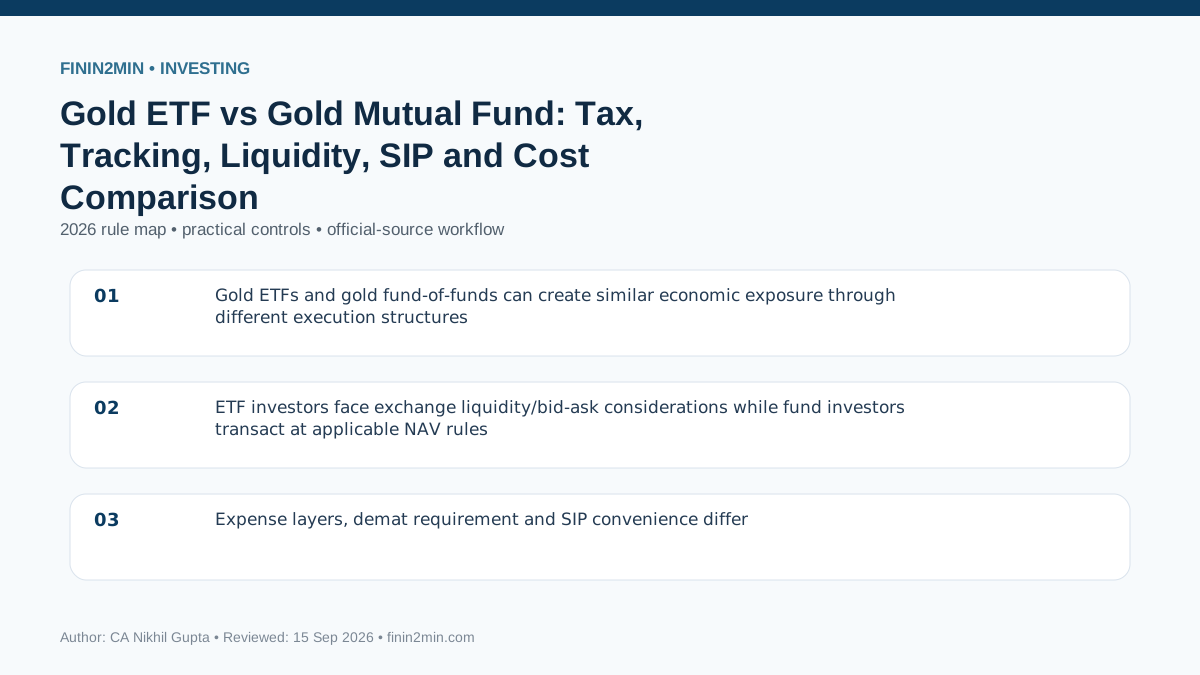
Gold ETFs and gold fund-of-funds can hold broadly similar gold exposure but the operating mechanics differ. An ETF trades on the exchange and introduces bid-ask spread and demat/broker execution; a gold fund-of-funds transacts at NAV through the mutual fund and can be easier for small SIPs, but it bears its own scheme expenses on top of the underlying ETF exposure.
Current rule and what decides the result
From the post-2024 capital-gains simplification, listed 'other units' can become long-term after more than 12 months, while unlisted units generally use a 24-month threshold. The amended specified-mutual-fund definition effective for the relevant 2026 regime focuses on debt and money-market exposure, so a gold ETF or gold fund should not automatically be treated under the old 'always deemed short-term' assumption. Product structure still matters: an exchange-traded Gold ETF and an unlisted gold fund-of-funds have different execution, expense and holding-period mechanics.
Key rules to apply
- Tax must be tested under the current capital-gains and specified-mutual-fund rules, not old “all debt funds are the same” shortcuts.
- Gold ETF units are exchange-traded; FoF units are purchased/redeemed with the AMC at applicable NAV cut-off mechanics.
- ETF returns seek to track domestic gold before expenses; tracking error/difference and cash holdings can create divergence.
- An FoF can bear its own total expense ratio while investing in an underlying ETF that also has expenses; compare the combined economic drag.
- ETF execution depends on market liquidity, spread and market-maker activity; an FoF avoids exchange spread but follows mutual-fund transaction timing.
- For 2026, do not assume section 50AA covers every gold-oriented fund.
Execution cost versus convenience
An investor puts ₹5 lakh into gold exposure. A Gold ETF may have an annual expense ratio of, say, 0.50% in the chosen scheme, but the investor also faces brokerage and a bid-ask spread when buying and selling. A gold fund-of-funds might charge its own 0.30% while investing in an ETF that itself costs 0.50%, creating an illustrative 0.80% layered expense before tracking effects. Those figures are examples, not market quotes; the point is to compare the actual current TER and spread of the selected products rather than assuming a FoF is 'free' because the transaction occurs at NAV.
Different holding-period outcomes
Assume listed Gold ETF units and unlisted gold FoF units are each sold after 18 months, and neither falls into a specified-mutual-fund deeming rule. The listed ETF is beyond the 12-month threshold and can be long-term; the unlisted FoF has not crossed 24 months and remains short-term. The economic gold exposure is similar, but the legal form of the unit changes the holding-period result. At 26 months the unlisted FoF can cross the general long-term threshold, subject to its exact tax classification.
How to apply it step by step
- Identify whether the chosen product is a listed Gold ETF or an unlisted mutual-fund FoF and verify its portfolio mandate.
- Read the latest scheme factsheet for TER, tracking error/difference, cash holdings and underlying ETF costs.
- For an ETF, check exchange liquidity, typical spread and broker/demat charges at the investment size you expect to trade.
- For a FoF, add the FoF's own expense ratio to the economic drag already present in the underlying ETF exposure.
- Before redemption, determine whether the units are listed or unlisted and whether the scheme meets the current specified-mutual-fund definition.
- Apply the correct 12-month or 24-month holding threshold where the general rule applies.
- Reconcile broker/AMC capital-gain statements to your actual acquisition lots and dates.
- Choose between products on total execution, convenience and tax facts—not on a single headline TER.
Common mistakes and edge cases
- Treating every gold-oriented mutual fund as a section 50AA specified mutual fund in 2026.
- Comparing ETF TER with FoF TER without adding the underlying ETF's expenses.
- Ignoring bid-ask spread and market liquidity for a small ETF.
- Assuming SIP convenience has no cost trade-off.
- Using one holding-period rule for both listed ETF units and unlisted FoF units.
FAQs
Is a Gold ETF taxed like an equity fund?
No. It is exchange-traded, but it is not an equity-oriented fund merely because it is listed. The listed-unit holding-period rule can still make it long-term after more than 12 months under the current framework, with the applicable non-equity capital-gain rate.
Is a gold FoF automatically a specified mutual fund?
Not automatically under the amended 2026 definition. The scheme's debt/money-market composition and the statutory definition must be checked; gold exposure by itself is not enough to assume deemed short-term treatment.
Why can a FoF cost more?
The FoF bears its own operating expenses while investing in an underlying ETF that also bears expenses. The investor should compare the combined economic drag, not only the FoF's displayed TER.
Why can an ETF price differ from NAV?
ETF units trade on an exchange. Bid-ask spreads, market depth and creation/redemption activity can make the execution price differ from indicative NAV, especially for a thinly traded fund or large order.
Which format is easier for monthly SIPs?
A FoF is operationally simpler for conventional mutual-fund SIPs because purchases occur through the AMC. ETF SIPs require exchange execution or a broker feature and may involve small-lot spread/brokerage effects.
What records matter at sale?
Keep contract notes or AMC statements, acquisition dates, unit quantities, scheme classification, TER/factsheets and the capital-gain statement. Tax treatment depends on the actual unit and holding period, not just the word 'gold' in the scheme name.
Related Finin2min guides
- Index Fund vs ETF in India: Tracking Difference, Liquidity and Execution Cost
- Which ITR for Gold ETF and Gold Mutual Fund Gains in 2026?
- US ETF vs Indian Feeder Fund
- Silver ETF vs Physical Silver: Cost, Liquidity and Tax
- Mutual Fund XIRR Calculation SIP: Formula, Example & Planning
- SIP Mutual Fund Tax: The FIFO Rule Explained
- Mutual Fund SIP Panic Checklist: What to Do When Market Falls 20%
- Debt Mutual Fund Risk Checklist: Duration, Credit and Liquidity Before Investing