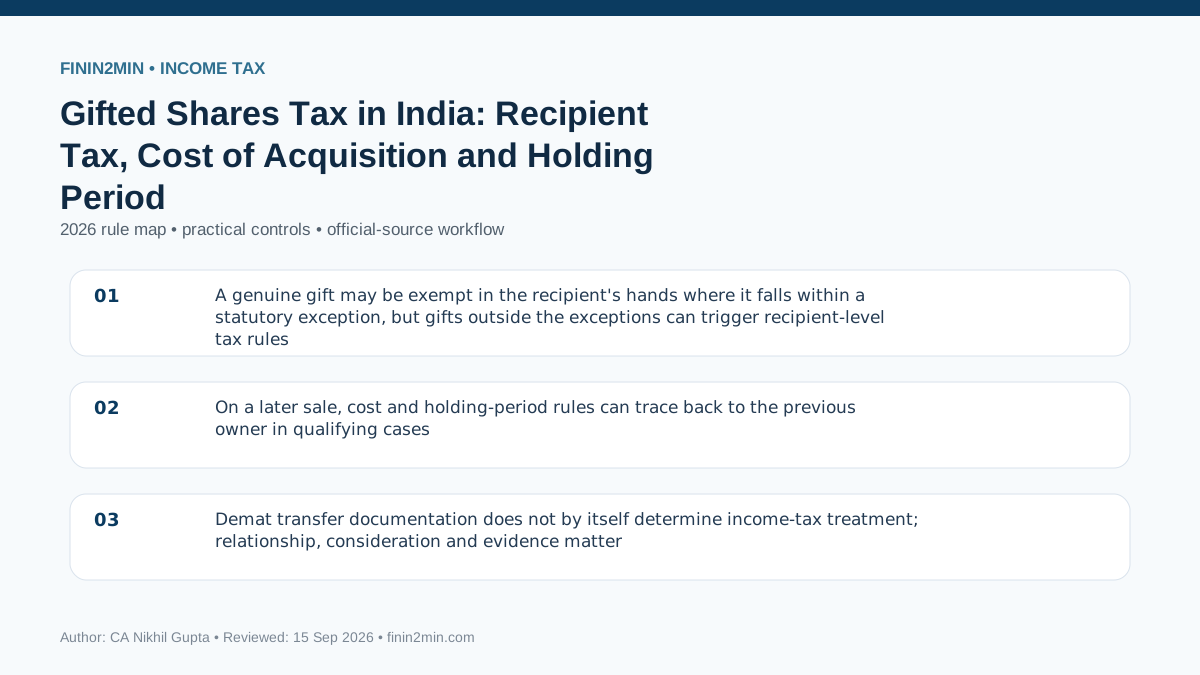
A share gift has two tax checkpoints: receipt by the donee and eventual sale. Section 56(2)(x) can tax shares received without or for inadequate consideration when the statutory value threshold is crossed, unless an exception such as a gift from a defined relative applies.
Current rule and what decides the result
A gift of shares requires two separate tax tests. First, at receipt, section 56-type anti-abuse rules can tax specified property received without or for inadequate consideration when the statutory ₹50,000 threshold is crossed, unless an exception such as receipt from a defined relative applies. Second, when the donee later sells an exemptly received gift, carry-over cost rules generally use the previous owner's cost and include the previous owner's holding period. The market value on the gift date is therefore not automatically the donee's later capital-gains cost.
Key rules to apply
- If the receipt is exempt and section 49 applies, the previous owner’s cost—and relevant holding history—usually follows the shares into the donee’s later capital-gains computation.
- A gift from a person falling within the statutory definition of relative is generally outside the section 56(2)(x) receipt tax, subject to the facts.
- ₹50,000 threshold: For specified property received without consideration from a non-relative, crossing the aggregate ₹50,000 FMV threshold can make the statutory amount taxable; do not assume only the excess is taxed.
- Where property is acquired below prescribed FMV and the difference crosses the statutory threshold, the difference can be taxable under section 56(2)(x), subject to exceptions.
- Section 49 generally carries the previous owner’s cost to the donee for qualifying gift transfers.
- The previous owner’s holding period is relevant when classifying the donee’s later sale as short- or long-term.
Gift from parent
A mother gifts listed shares worth ₹6 lakh to her adult daughter. A parent is within the statutory relative definition, so the receipt is generally within the relative exception rather than taxed merely because value exceeds ₹50,000. The mother originally bought the shares for ₹1.80 lakh. If the daughter later sells them for ₹7 lakh, the gift-date ₹6 lakh value is not automatically her tax cost; the carry-over cost/holding-period rules and listed-equity grandfathering, if relevant, must be applied.
Gift from non-relative
A friend gifts unlisted shares with prescribed fair value of ₹2.20 lakh for no consideration. If no statutory exception applies, the aggregate ₹50,000 threshold test can make the prescribed amount taxable in the recipient’s hands under the anti-abuse provision; it is not necessarily only ₹1.70 lakh (the excess over ₹50,000). Later cost rules must then be determined using the provision that taxed the receipt and the actual facts.
How to apply it step by step
- Identify donor relationship and whether a statutory gift exception applies.
- For a non-exempt receipt, determine prescribed FMV under the applicable valuation rules.
- Aggregate relevant property receipts for the ₹50,000 threshold test.
- Keep gift deed, demat transfer instruction and donor/recipient PAN details.
- Obtain the donor’s original purchase cost/date and corporate-action history.
- On later sale, apply carry-over or receipt-tax cost rules as the law requires.
- Include previous-owner holding period where applicable.
- For listed shares, separately test STT/section 111A/112A and grandfathering conditions.
Common mistakes and edge cases
- Assuming all gifts are tax-free.
- Taxing only the amount over ₹50,000 where the statute taxes the prescribed amount once the threshold is crossed.
- Using gift-date market value as cost for a relative gift without authority.
- Losing the donor’s original cost records.
- Treating a demat off-market gift as a normal sale.
FAQs
Are shares gifted by parents taxable on receipt?
A parent is generally within the defined-relative exception, subject to the statutory conditions.
What if a non-relative gifts shares worth more than ₹50,000?
The section 56-type anti-abuse provision can tax the prescribed value where the threshold is crossed and no exception applies.
What cost is used when a relative gift is later sold?
Carry-over cost from the previous owner generally applies to qualifying gifts.
Does the donor’s holding period count?
Yes, previous-owner holding period generally counts for qualifying carry-over-cost gifts.
Do I need a gift deed?
A clear written gift record plus demat and cost evidence is strongly advisable.
Does off-market demat transfer mean it is taxable as a sale?
No. The legal character—gift versus sale—depends on the transaction and consideration, not merely the depository mode.
Related Finin2min guides
- Bonus Shares Sold: Zero Cost, Holding Period and Which ITR?
- Gifted Shares: Cost of Acquisition & Capital Gains
- Inherited Gold Sold: Whose Cost and Holding Period Should You Use?
- Stock Splits and Consolidations: Cost Allocation, Holding Period and Capital-Gains Traps
- Property Cost of Acquisition
- Capital Gains Holding Period: 12-Month vs 24-Month Rules
- Arbitrage Fund vs Liquid Fund After Tax
- Silver ETF Sold: Which ITR and Holding-Period Rule Applies?