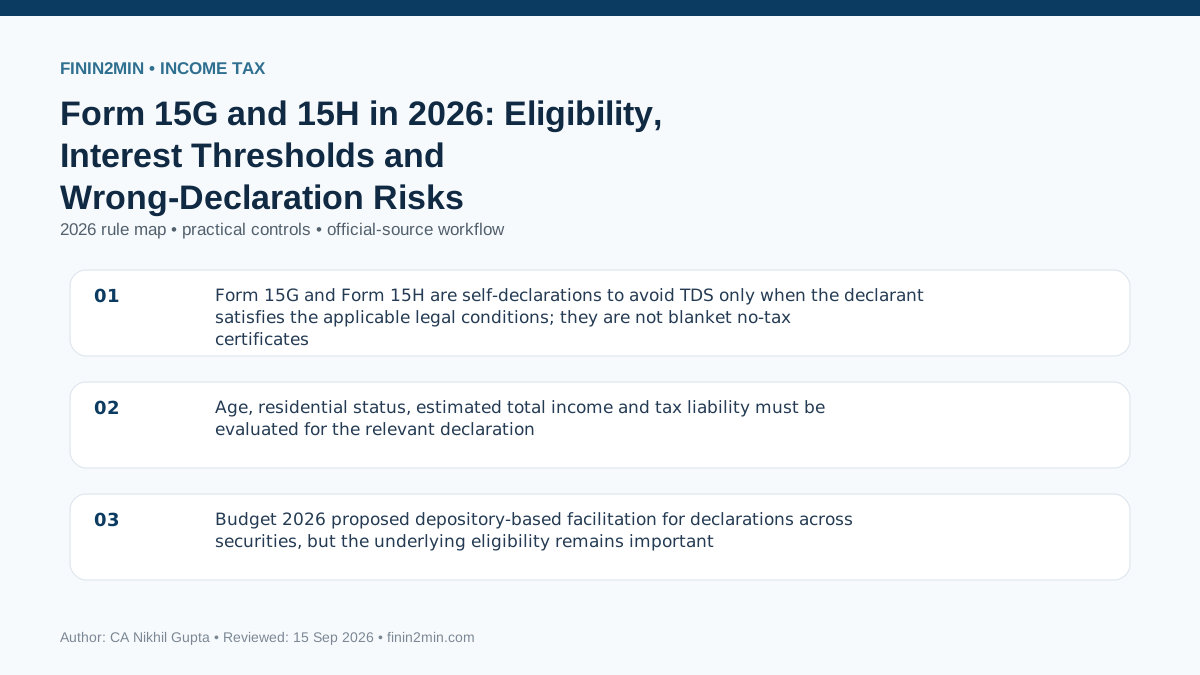
Form 15G/15H is a declaration to the payer not to deduct specified TDS; it is not an exemption from income tax. Form 15G has stricter eligibility for a resident non-senior declarant, while Form 15H is for resident individuals aged 60 or more with estimated total tax nil.
Current rule and what decides the result
For tax year 2026–27, the familiar Forms 15G and 15H become a legacy search label rather than the filing format. Under section 393(6) of the Income-tax Act, 2025 and the Income-tax Rules, 2026, the recipient declaration for nil deduction is Form 121 for a tax year beginning on or after 1 April 2026. Eligibility remains conceptually similar: the declarant must be within the prescribed resident/person conditions and the estimated tax on total income must be nil. A declaration does not convert taxable interest into exempt income; it only affects withholding when valid.
Key rules to apply
- The payer’s section 194A TDS threshold and the declaration’s eligibility conditions are separate tests.
- From 1 April 2025, the section 194A threshold for bank/co-operative bank/post-office interest is ₹50,000 for a non-senior and ₹1,00,000 for a senior citizen, subject to the provision.
- A resident individual aged 60 or more can furnish Form 15H when estimated tax on total income is nil; the special 15G income-limit condition does not apply in the same way.
- Eligible resident persons below the senior-citizen route must satisfy nil estimated tax and the statutory condition on the relevant income versus the basic exemption framework.
- Threshold/declaration analysis is across the payer/branch reporting framework and the person’s total estimated income; splitting deposits does not create tax exemption.
- Valid PAN and declaration particulars are critical; payer systems can apply higher withholding when PAN requirements are not met.
Resident senior citizen with nil tax
A 66-year-old resident estimates pension and bank interest of ₹8.2 lakh for tax year 2026–27, with deductions/rebate position resulting in nil estimated tax under the applicable regime. Instead of handing the bank the old Form 15H, the current-rule declaration is Form 121. The bank should still report the interest; the taxpayer must include it in the return if a return is required.
Wrong declaration when tax is payable
A 42-year-old resident expects ₹4 lakh of interest plus ₹14 lakh of consultancy income and will have positive tax payable. Filing a nil-deduction declaration merely to stop bank TDS is not valid because estimated tax on total income is not nil. The absence of TDS would not reduce the final tax; it can instead create advance-tax/self-assessment liability and expose the declarant to consequences for a false statement.
How to apply it step by step
- Estimate full-year total income, not only interest from one bank.
- Choose the tax regime and compute estimated tax including rebate/deductions that actually apply.
- Confirm resident/age/entity eligibility for the declaration route.
- For tax year 2026–27 onward, use Form 121 rather than the old 15G/15H format.
- Give the declaration to each payer using the current process and keep acknowledgement/reference details.
- Track interest across banks, bonds and post-office accounts throughout the year.
- Recompute if income changes materially; pay advance tax where required.
- Include taxable interest in the return even if no tax was deducted at source.
Common mistakes and edge cases
- Submitting old Form 15G/15H for a tax year beginning on/after 1 April 2026 without checking Form 121 requirements.
- Looking only at bank interest and ignoring salary/business/capital-gain income.
- Believing no TDS means no tax.
- Using a declaration when estimated tax is positive.
- Forgetting to reassess eligibility after a large mid-year income event.
FAQs
What replaces Form 15G/15H for tax year 2026–27?
Income Tax Department guidance says the declaration is Form 121 under the Income-tax Rules, 2026.
What is the new statutory provision?
The corresponding Income-tax Act, 2025 provision is section 393(6).
Did eligibility completely change?
The Department states the eligibility concept continues: eligible resident persons may declare where estimated total-income tax is nil.
Does Form 121 make interest tax-free?
No. It addresses withholding; taxable interest remains part of total income.
Can I submit it if tax is payable after all income is counted?
No. The nil estimated-tax condition is central.
Should I keep copies?
Yes. Keep payer acknowledgements and the income/tax working supporting the declaration.
Related Finin2min guides
- Form 15G & 15H: How to Avoid TDS on Interest Income (Complete Guide)
- Form 121 Replaces Form 15G/15H: Who Can Give the No-TDS Declaration in Tax Year 2026-27?
- Form 15H Becomes Form 121 for Tax Year 2026-27
- Wrong ITR Form Filed: Revision and Correction
- Personal Loan Interest Rates & Eligibility in India: What Determines Your Rate
- Penalty For Wrong Form Filing Defective: AY 2026-27 Rules &
- Beneficial Interest in Shares Under Section 89: Declaration Checklist