Form 147 in 2026: Quarterly Foreign-Remittance Statement for Authorised Dealers
2-minute answer: Form 147 is the 2026 quarterly statement for authorised dealers reporting specified remittances to non-residents/foreign companies. It is filed through the ITDREIN reporting-entity workflow and is due within 15 days from quarter-end.
This guide is designed around the search intent remittance declaration quarterly reporting, but it does not assume the wording of that keyword is legally correct. The article first fixes the current terminology and governing period, then converts the rule into an execution workflow with evidence, examples, decision points and common-error controls.
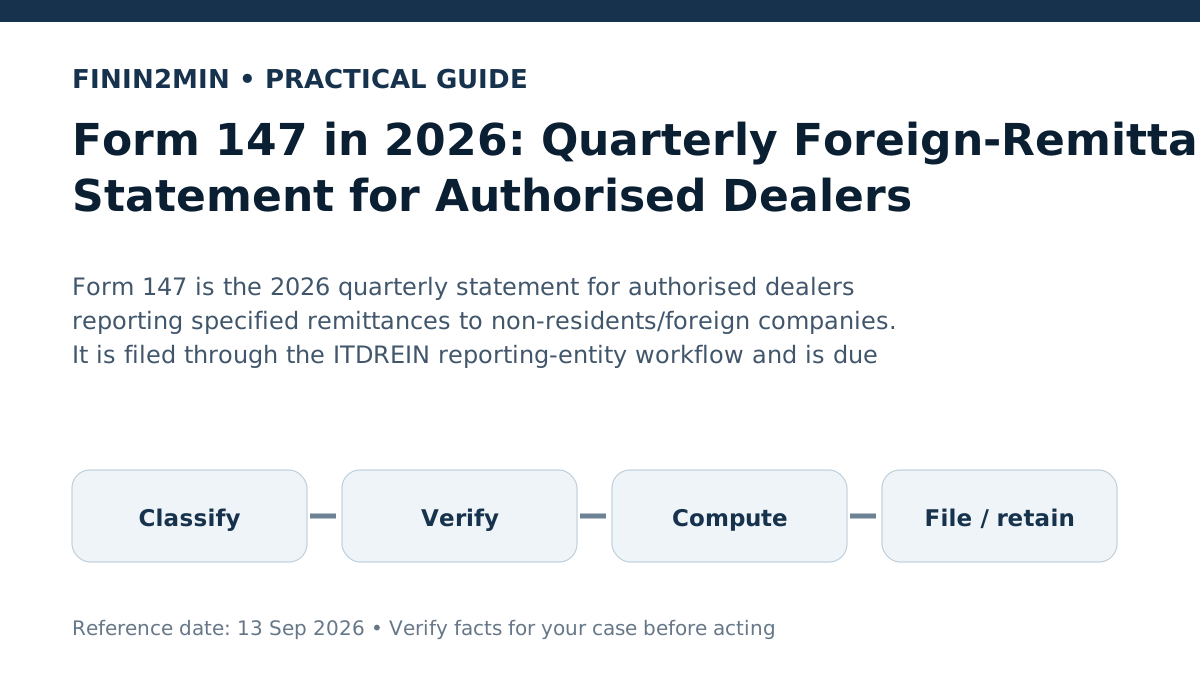
What matters first
1. Form 147 is an authorised-dealer reporting obligation, not the remitter's Form 145
For Form 147 in 2026: Quarterly Foreign-Remittance Statement for Authorised Dealers, this point changes the answer because form 147 is an authorised-dealer reporting obligation, not the remitter's form 145. In practice, start with the underlying transaction or event rather than the search phrase “remittance declaration quarterly reporting”. Identify the person, period, amount, document trail and the exact legal or regulatory rule that creates the obligation. This prevents a common error: jumping from a familiar form number or headline rate directly to a filing position. A robust working paper records both the conclusion and the facts on which it depends, so a later portal notice, audit query or reviewer can reconstruct the reasoning without relying on memory.
Control 1: Form 147 is an authorised-dealer reporting obligation, not the remitter's Form 145. Before closing the file, create a one-page issue sheet. Record any assumption that could change the result, particularly the governing year, residence/status, amount threshold, form version and whether an earlier proceeding already exists.
2. Generate/use ITDREIN for the reporting-entity workflow
The operational consequence is equally important. Generate/use ITDREIN for the reporting-entity workflow. A taxpayer or compliance team should translate that rule into a control: who owns the task, which document proves the fact, what date triggers action, and which amount must reconcile to books, bank records or portal data. Where international tax rules interact with another framework, the interaction should be documented explicitly instead of assuming that one approval or one disclosure satisfies every law. The most defensible file therefore links the legal test to the evidence and to the number ultimately reported.
Control 2: Generate/use ITDREIN for the reporting-entity workflow. Before closing the file, attach the primary evidence. Record any assumption that could change the result, particularly the governing year, residence/status, amount threshold, form version and whether an earlier proceeding already exists.
3. Capture remitter, remittee, amount/date, account particulars, RBI purpose code and Form 145 acknowledgement or applicable non-filing code
A good review asks two questions about this issue. First, what would make the conclusion different—for example a change in residence, transaction character, date, threshold, counterparty status or prior-year history? Second, what independent evidence supports the chosen treatment? Because capture remitter, remittee, amount/date, account particulars, rbi purpose code and form 145 acknowledgement or applicable non-filing code, both questions should be answered before filing or payment. If the answer relies on an exception, treaty, exemption or transition provision, retain the conditions and supporting documents alongside the computation. That discipline is more valuable than copying a generic checklist after the deadline.
Control 3: Capture remitter, remittee, amount/date, account particulars, RBI purpose code and Form 145 acknowledgement or applicable non-filing code. Before closing the file, reconcile the amount to source records. Record any assumption that could change the result, particularly the governing year, residence/status, amount threshold, form version and whether an earlier proceeding already exists.
4. The due date is 15 days from the end of each quarter
This is also an SEO/search-intent trap: users often search a short phrase such as “remittance declaration quarterly reporting”, while the law asks a more precise question. The article therefore treats the due date is 15 days from the end of each quarter as a decision point, not a slogan. Readers should avoid treating examples as universal rates or deadlines. Instead, map their own facts to the governing period, confirm whether a later notification or portal utility changed the procedure, and record the source used. That approach keeps the answer useful even where the factual pattern is slightly different from the worked example below.
Control 4: The due date is 15 days from the end of each quarter. Before closing the file, record the statutory/portal date. Record any assumption that could change the result, particularly the governing year, residence/status, amount threshold, form version and whether an earlier proceeding already exists.
5. Build maker-checker reconciliation between core banking/remittance data and the filed statement
For Form 147 in 2026: Quarterly Foreign-Remittance Statement for Authorised Dealers, this point changes the answer because build maker-checker reconciliation between core banking/remittance data and the filed statement. In practice, start with the underlying transaction or event rather than the search phrase “remittance declaration quarterly reporting”. Identify the person, period, amount, document trail and the exact legal or regulatory rule that creates the obligation. This prevents a common error: jumping from a familiar form number or headline rate directly to a filing position. A robust working paper records both the conclusion and the facts on which it depends, so a later portal notice, audit query or reviewer can reconstruct the reasoning without relying on memory.
Control 5: Build maker-checker reconciliation between core banking/remittance data and the filed statement. Before closing the file, obtain a second-person review. Record any assumption that could change the result, particularly the governing year, residence/status, amount threshold, form version and whether an earlier proceeding already exists.
6. Retain exception evidence for remittances where Form 145 is not required
The operational consequence is equally important. Retain exception evidence for remittances where Form 145 is not required. A taxpayer or compliance team should translate that rule into a control: who owns the task, which document proves the fact, what date triggers action, and which amount must reconcile to books, bank records or portal data. Where international tax rules interact with another framework, the interaction should be documented explicitly instead of assuming that one approval or one disclosure satisfies every law. The most defensible file therefore links the legal test to the evidence and to the number ultimately reported.
Control 6: Retain exception evidence for remittances where Form 145 is not required. Before closing the file, retain the acknowledgement and computation. Record any assumption that could change the result, particularly the governing year, residence/status, amount threshold, form version and whether an earlier proceeding already exists.
Decision table: do not skip these gates
| Question | If yes | If no / unclear |
|---|---|---|
| Does your case satisfy this point: Form 147 is an authorised-dealer reporting obligation, not the remitter's Form 145? | Document the supporting fact and continue to the next test. Proceed only after evidence. | Do not force the example. Reclassify the issue, check the governing provision/form and obtain case-specific advice if the tax or legal exposure is material. |
| Does your case satisfy this point: Generate/use ITDREIN for the reporting-entity workflow? | Document the supporting fact and continue to the next test. Reconcile before filing. | Do not force the example. Reclassify the issue, check the governing provision/form and obtain case-specific advice if the tax or legal exposure is material. |
| Does your case satisfy this point: Capture remitter, remittee, amount/date, account particulars, RBI purpose code and Form 145 acknowledgement or applicable non-filing code? | Document the supporting fact and continue to the next test. Escalate if facts differ. | Do not force the example. Reclassify the issue, check the governing provision/form and obtain case-specific advice if the tax or legal exposure is material. |
| Does your case satisfy this point: The due date is 15 days from the end of each quarter? | Document the supporting fact and continue to the next test. Retain proof. | Do not force the example. Reclassify the issue, check the governing provision/form and obtain case-specific advice if the tax or legal exposure is material. |
| Does your case satisfy this point: Build maker-checker reconciliation between core banking/remittance data and the filed statement? | Document the supporting fact and continue to the next test. Proceed only after evidence. | Do not force the example. Reclassify the issue, check the governing provision/form and obtain case-specific advice if the tax or legal exposure is material. |
| Does your case satisfy this point: Retain exception evidence for remittances where Form 145 is not required? | Document the supporting fact and continue to the next test. Reconcile before filing. | Do not force the example. Reclassify the issue, check the governing provision/form and obtain case-specific advice if the tax or legal exposure is material. |
Step-by-step execution workflow
- Step 1 — Define the exact event. Use form 147 is an authorised-dealer reporting obligation, not the remitter's form 145 as the principal check at this stage. Write the answer in transaction-level terms: who, what, when, how much, which account/form/order, and what evidence supports it. Where the position depends on an exception or transition rule, note both the base rule and the condition relied on. Do not let a portal label substitute for the legal analysis; conversely, do not finish a legal memo without confirming the portal/payment mechanics actually needed to execute it.
- Step 2 — Fix the governing period. Use generate/use itdrein for the reporting-entity workflow as the principal check at this stage. Write the answer in transaction-level terms: who, what, when, how much, which account/form/order, and what evidence supports it. Where the position depends on an exception or transition rule, note both the base rule and the condition relied on. Do not let a portal label substitute for the legal analysis; conversely, do not finish a legal memo without confirming the portal/payment mechanics actually needed to execute it.
- Step 3 — Classify the receipt/transaction. Use capture remitter, remittee, amount/date, account particulars, rbi purpose code and form 145 acknowledgement or applicable non-filing code as the principal check at this stage. Write the answer in transaction-level terms: who, what, when, how much, which account/form/order, and what evidence supports it. Where the position depends on an exception or transition rule, note both the base rule and the condition relied on. Do not let a portal label substitute for the legal analysis; conversely, do not finish a legal memo without confirming the portal/payment mechanics actually needed to execute it.
- Step 4 — Collect primary evidence. Use the due date is 15 days from the end of each quarter as the principal check at this stage. Write the answer in transaction-level terms: who, what, when, how much, which account/form/order, and what evidence supports it. Where the position depends on an exception or transition rule, note both the base rule and the condition relied on. Do not let a portal label substitute for the legal analysis; conversely, do not finish a legal memo without confirming the portal/payment mechanics actually needed to execute it.
- Step 5 — Run the legal tests. Use build maker-checker reconciliation between core banking/remittance data and the filed statement as the principal check at this stage. Write the answer in transaction-level terms: who, what, when, how much, which account/form/order, and what evidence supports it. Where the position depends on an exception or transition rule, note both the base rule and the condition relied on. Do not let a portal label substitute for the legal analysis; conversely, do not finish a legal memo without confirming the portal/payment mechanics actually needed to execute it.
- Step 6 — Compute and reconcile. Use retain exception evidence for remittances where form 145 is not required as the principal check at this stage. Write the answer in transaction-level terms: who, what, when, how much, which account/form/order, and what evidence supports it. Where the position depends on an exception or transition rule, note both the base rule and the condition relied on. Do not let a portal label substitute for the legal analysis; conversely, do not finish a legal memo without confirming the portal/payment mechanics actually needed to execute it.
- Step 7 — File/pay/respond. Use form 147 is an authorised-dealer reporting obligation, not the remitter's form 145 as the principal check at this stage. Write the answer in transaction-level terms: who, what, when, how much, which account/form/order, and what evidence supports it. Where the position depends on an exception or transition rule, note both the base rule and the condition relied on. Do not let a portal label substitute for the legal analysis; conversely, do not finish a legal memo without confirming the portal/payment mechanics actually needed to execute it.
- Step 8 — Archive and monitor. Use generate/use itdrein for the reporting-entity workflow as the principal check at this stage. Write the answer in transaction-level terms: who, what, when, how much, which account/form/order, and what evidence supports it. Where the position depends on an exception or transition rule, note both the base rule and the condition relied on. Do not let a portal label substitute for the legal analysis; conversely, do not finish a legal memo without confirming the portal/payment mechanics actually needed to execute it.
Worked example
Applied scenario: assume a taxpayer, finance team or entity is dealing with “Form 147 in 2026: Quarterly Foreign-Remittance Statement for Authorised Dealers” in September 2026. The preparer first tests whether form 147 is an authorised-dealer reporting obligation, not the remitter's form 145. The file then records whether generate/use itdrein for the reporting-entity workflow, before deciding the filing, payment, disclosure or commercial action.
The reviewer independently tests the third control—Capture remitter, remittee, amount/date, account particulars, RBI purpose code and Form 145 acknowledgement or applicable non-filing code—against the cited primary sources and underlying documents. Any mismatch is put into an exception log with an owner and resolution date. This makes the example specific to Form 147 in 2026: Quarterly Foreign-Remittance Statement for Authorised Dealers rather than a generic compliance checklist.
Detailed reviewer notes
Classification: Form 147 is an authorised-dealer reporting obligation, not the remitter's Form 145
A good review asks two questions about this issue. First, what would make the conclusion different—for example a change in residence, transaction character, date, threshold, counterparty status or prior-year history? Second, what independent evidence supports the chosen treatment? Because form 147 is an authorised-dealer reporting obligation, not the remitter's form 145, both questions should be answered before filing or payment. If the answer relies on an exception, treaty, exemption or transition provision, retain the conditions and supporting documents alongside the computation. That discipline is more valuable than copying a generic checklist after the deadline.
For Form 147 in 2026: Quarterly Foreign-Remittance Statement for Authorised Dealers, this point changes the answer because form 147 is an authorised-dealer reporting obligation, not the remitter's form 145. In practice, start with the underlying transaction or event rather than the search phrase “remittance declaration quarterly reporting”. Identify the person, period, amount, document trail and the exact legal or regulatory rule that creates the obligation. This prevents a common error: jumping from a familiar form number or headline rate directly to a filing position. A robust working paper records both the conclusion and the facts on which it depends, so a later portal notice, audit query or reviewer can reconstruct the reasoning without relying on memory.
Timing: Generate/use ITDREIN for the reporting-entity workflow
This is also an SEO/search-intent trap: users often search a short phrase such as “remittance declaration quarterly reporting”, while the law asks a more precise question. The article therefore treats generate/use itdrein for the reporting-entity workflow as a decision point, not a slogan. Readers should avoid treating examples as universal rates or deadlines. Instead, map their own facts to the governing period, confirm whether a later notification or portal utility changed the procedure, and record the source used. That approach keeps the answer useful even where the factual pattern is slightly different from the worked example below.
The operational consequence is equally important. Generate/use ITDREIN for the reporting-entity workflow. A taxpayer or compliance team should translate that rule into a control: who owns the task, which document proves the fact, what date triggers action, and which amount must reconcile to books, bank records or portal data. Where international tax rules interact with another framework, the interaction should be documented explicitly instead of assuming that one approval or one disclosure satisfies every law. The most defensible file therefore links the legal test to the evidence and to the number ultimately reported.
Evidence: Capture remitter, remittee, amount/date, account particulars, RBI purpose code and Form 145 acknowledgement or applicable non-filing code
For Form 147 in 2026: Quarterly Foreign-Remittance Statement for Authorised Dealers, this point changes the answer because capture remitter, remittee, amount/date, account particulars, rbi purpose code and form 145 acknowledgement or applicable non-filing code. In practice, start with the underlying transaction or event rather than the search phrase “remittance declaration quarterly reporting”. Identify the person, period, amount, document trail and the exact legal or regulatory rule that creates the obligation. This prevents a common error: jumping from a familiar form number or headline rate directly to a filing position. A robust working paper records both the conclusion and the facts on which it depends, so a later portal notice, audit query or reviewer can reconstruct the reasoning without relying on memory.
A good review asks two questions about this issue. First, what would make the conclusion different—for example a change in residence, transaction character, date, threshold, counterparty status or prior-year history? Second, what independent evidence supports the chosen treatment? Because capture remitter, remittee, amount/date, account particulars, rbi purpose code and form 145 acknowledgement or applicable non-filing code, both questions should be answered before filing or payment. If the answer relies on an exception, treaty, exemption or transition provision, retain the conditions and supporting documents alongside the computation. That discipline is more valuable than copying a generic checklist after the deadline.
Computation: The due date is 15 days from the end of each quarter
The operational consequence is equally important. The due date is 15 days from the end of each quarter. A taxpayer or compliance team should translate that rule into a control: who owns the task, which document proves the fact, what date triggers action, and which amount must reconcile to books, bank records or portal data. Where international tax rules interact with another framework, the interaction should be documented explicitly instead of assuming that one approval or one disclosure satisfies every law. The most defensible file therefore links the legal test to the evidence and to the number ultimately reported.
This is also an SEO/search-intent trap: users often search a short phrase such as “remittance declaration quarterly reporting”, while the law asks a more precise question. The article therefore treats the due date is 15 days from the end of each quarter as a decision point, not a slogan. Readers should avoid treating examples as universal rates or deadlines. Instead, map their own facts to the governing period, confirm whether a later notification or portal utility changed the procedure, and record the source used. That approach keeps the answer useful even where the factual pattern is slightly different from the worked example below.
Execution: Build maker-checker reconciliation between core banking/remittance data and the filed statement
A good review asks two questions about this issue. First, what would make the conclusion different—for example a change in residence, transaction character, date, threshold, counterparty status or prior-year history? Second, what independent evidence supports the chosen treatment? Because build maker-checker reconciliation between core banking/remittance data and the filed statement, both questions should be answered before filing or payment. If the answer relies on an exception, treaty, exemption or transition provision, retain the conditions and supporting documents alongside the computation. That discipline is more valuable than copying a generic checklist after the deadline.
For Form 147 in 2026: Quarterly Foreign-Remittance Statement for Authorised Dealers, this point changes the answer because build maker-checker reconciliation between core banking/remittance data and the filed statement. In practice, start with the underlying transaction or event rather than the search phrase “remittance declaration quarterly reporting”. Identify the person, period, amount, document trail and the exact legal or regulatory rule that creates the obligation. This prevents a common error: jumping from a familiar form number or headline rate directly to a filing position. A robust working paper records both the conclusion and the facts on which it depends, so a later portal notice, audit query or reviewer can reconstruct the reasoning without relying on memory.
Review: Retain exception evidence for remittances where Form 145 is not required
This is also an SEO/search-intent trap: users often search a short phrase such as “remittance declaration quarterly reporting”, while the law asks a more precise question. The article therefore treats retain exception evidence for remittances where form 145 is not required as a decision point, not a slogan. Readers should avoid treating examples as universal rates or deadlines. Instead, map their own facts to the governing period, confirm whether a later notification or portal utility changed the procedure, and record the source used. That approach keeps the answer useful even where the factual pattern is slightly different from the worked example below.
The operational consequence is equally important. Retain exception evidence for remittances where Form 145 is not required. A taxpayer or compliance team should translate that rule into a control: who owns the task, which document proves the fact, what date triggers action, and which amount must reconcile to books, bank records or portal data. Where international tax rules interact with another framework, the interaction should be documented explicitly instead of assuming that one approval or one disclosure satisfies every law. The most defensible file therefore links the legal test to the evidence and to the number ultimately reported.
Documents and evidence checklist
- — preserve the source record and write the conclusion next to it.
- — preserve the source record and write the conclusion next to it.
- — preserve the source record and write the conclusion next to it.
- — preserve the source record and write the conclusion next to it.
- — preserve the source record and write the conclusion next to it.
- — preserve the source record and write the conclusion next to it.
Common mistakes to avoid
Frequently asked questions
What should I check first for Form 147 in 2026: Quarterly Foreign-Remittance Statement for Authorised Dealers?
Start with Form 147 is an authorised-dealer reporting obligation, not the remitter's Form 145. Then lock the relevant period and facts before selecting a form, rate, accounting treatment or action.
What is the current 2026 position?
The 2026 position for Form 147 in 2026: Quarterly Foreign-Remittance Statement for Authorised Dealers depends on the applicable period, governing law and current official guidance.
Which facts can change the result?
The key change-points include whether form 147 is an authorised-dealer reporting obligation, not the remitter's form 145, whether generate/use itdrein for the reporting-entity workflow, and whether capture remitter, remittee, amount/date, account particulars, rbi purpose code and form 145 acknowledgement or applicable non-filing code. Document any fact that could reverse the conclusion.
Which records should be retained?
Keep Form 147 is an authorised-dealer reporting obligation, not the remitter's Form 145. — preserve the source record and write the conclusion next to it; Generate/use ITDREIN for the reporting-entity workflow. — preserve the source record and write the conclusion next to it; and Capture remitter, remittee, amount/date, account particulars, RBI purpose code and Form 145 acknowledgement or applicable non-filing code. — preserve the source record and write the conclusion next to it. Also retain the final filing, approval or acknowledgement where applicable.
What common error should be avoided?
For Form 147 in 2026: Quarterly Foreign-Remittance Statement for Authorised Dealers, a frequent error is treating the raw search phrase as if it were a statutory term. Another is mixing assessment year, financial year and the post-2026 tax-year framework. Verify the governing period and official form/provision before acting.
How should the conclusion be reviewed?
For Form 147 in 2026: Quarterly Foreign-Remittance Statement for Authorised Dealers, the reviewer should trace the conclusion back to the current primary source, the underlying evidence and the computation or reconciliation. Open assumptions and mismatches should be recorded explicitly.
When is professional advice appropriate?
Obtain transaction-specific professional advice where Form 147 in 2026: Quarterly Foreign-Remittance Statement for Authorised Dealers involves material amounts, cross-border facts, disputed interpretation, regulatory exposure, litigation risk or facts that do not fit the standard case described here.
Primary and authoritative sources
Official source used for the legal/regulatory position in this article. Checked 13 September 2026.
Official source used for the legal/regulatory position in this article. Checked 13 September 2026.
Official source used for the legal/regulatory position in this article. Checked 13 September 2026.
Official source used for the legal/regulatory position in this article. Checked 13 September 2026.