Foreign Liabilities and Assets Return is not a topic where one headline rate or one commercial label is enough. The correct treatment depends on the operative law, the exact legal form of the transaction, the parties, timing, documentation and the way the amount is ultimately reported or accounted for.
Finin2min takeaway
- Start with the legal classification and the current rule—not a rate copied from an older example.
- Model tax/regulatory/accounting and cash-flow effects together where they interact.
- Reconcile the final position to source records, filing schedules and supporting evidence.
- Re-run the analysis when a controlling fact such as party status, date, valuation, contract term or regulatory category changes.
1. Current rule and the points that actually control the answer
FLA is an annual foreign-investment reporting obligation
RBI’s foreign-investment reporting framework requires the annual FLA return from covered Indian entities, generally by 15 July based on the prescribed reporting scope. Corrections should be made through the permitted process rather than silently changing audited or filed numbers.
For Foreign Liabilities and Assets Return, this point can change the tax, regulatory, accounting or cash-flow result even when the commercial transaction looks unchanged. It should therefore be tested before the computation or filing is finalised.
- the event date
- the prescribed form / filing route
- proof of submission and any correction mechanism
July 15 is the operational anchor
The annual FLA return is generally due by 15 July for covered Indian entities with foreign direct investment liabilities and/or overseas direct investment assets in the relevant balance-sheet framework.
For Foreign Liabilities and Assets Return, this point can change the tax, regulatory, accounting or cash-flow result even when the commercial transaction looks unchanged. It should therefore be tested before the computation or filing is finalised.
- the governing provision
- the factual condition that activates it
- the document that proves the position
Audited accounts may not yet exist
The return mechanism allows filing on provisional/unaudited numbers where permitted, followed by revision once audited numbers are available. The finance team should plan the revision rather than miss the original timeline.
For Foreign Liabilities and Assets Return, this point can change the tax, regulatory, accounting or cash-flow result even when the commercial transaction looks unchanged. It should therefore be tested before the computation or filing is finalised.
- the event date
- the prescribed form / filing route
- proof of submission and any correction mechanism
FLA is a balance-sheet reconciliation
Equity capital, reserves, debt and investment positions must tie to the company’s books and the underlying FDI/ODI records. It is not simply a list of foreign shareholders.
For Foreign Liabilities and Assets Return, this point can change the tax, regulatory, accounting or cash-flow result even when the commercial transaction looks unchanged. It should therefore be tested before the computation or filing is finalised.
- the governing provision
- the factual condition that activates it
- the document that proves the position
Late filing and wrong filing are different problems
If the filing is late, use the prescribed late-submission/regularisation route. If a filed return is wrong, use the correction/revision process and preserve the reason for the change.
For Foreign Liabilities and Assets Return, this point can change the tax, regulatory, accounting or cash-flow result even when the commercial transaction looks unchanged. It should therefore be tested before the computation or filing is finalised.
- the event date
- the prescribed form / filing route
- proof of submission and any correction mechanism
Current-law control
Cross-border compliance is transaction-specific. FEMA, the relevant Rules/Regulations and RBI directions must be read together, while tax, treaty, company-law, SEBI and customs consequences remain separate layers. The authorised dealer bank is an important execution gate, but bank processing does not replace legal classification or reporting responsibility.
- The FLA return is an annual RBI reporting requirement for entities within its scope and is distinct from transaction-level FEMA reporting.
- Maintain opening/closing foreign investment, reserves, direct-investment position and other balance-sheet classifications in a reconciliation that ties to audited or provisional financial statements.
2. Detailed analysis: what a professional review should cover
The practical risk here lies in FEMA classification and execution: resident status, instrument, ownership/control, permitted route, pricing, funding source, designated AD-bank process, reporting form and repatriation trail must align with the transaction documents.
Route matters
Two economically similar remittances can have different FEMA treatment depending on ownership, control, instrument, purpose and whether the transaction is ODI, OPI, FDI, ECB or current account.
AD-bank execution
In practice, documentation must be bankable. Align legal analysis with the AD bank checklist, valuation, KYC, purpose code and reporting forms before funds move.
Cross-law reconciliation
FEMA compliance does not replace tax, Companies Act, transfer-pricing, customs or accounting compliance. The final file should reconcile all regimes to the same facts and dates.
Article-specific decision matrix
| Decision point | Current-position question | Evidence to retain |
|---|---|---|
| FLA is an annual foreign-investment reporting obligation | RBI’s foreign-investment reporting framework requires the annual FLA return from covered Indian entities, generally by 15 July based on the prescribed reporting scope. Corrections should be made through the permitted process rather than silently changing audit… | audited/provisional balance sheet |
| July 15 is the operational anchor | The annual FLA return is generally due by 15 July for covered Indian entities with foreign direct investment liabilities and/or overseas direct investment assets in the relevant balance-sheet framework. | foreign investment and overseas investment schedules |
| Audited accounts may not yet exist | The return mechanism allows filing on provisional/unaudited numbers where permitted, followed by revision once audited numbers are available. The finance team should plan the revision rather than miss the original timeline. | previous-year FLA acknowledgement |
| FLA is a balance-sheet reconciliation | Equity capital, reserves, debt and investment positions must tie to the company’s books and the underlying FDI/ODI records. It is not simply a list of foreign shareholders. | revised-return support if figures change |
| Late filing and wrong filing are different problems | If the filing is late, use the prescribed late-submission/regularisation route. If a filed return is wrong, use the correction/revision process and preserve the reason for the change. | board approvals and transaction agreements |
Practical nuance
For Foreign Liabilities and Assets (FLA) Return, separate the legal permission from the payment mechanics. A transaction can be commercially agreed and bankable but still require a different FEMA route, pricing test, approval or reporting form.
Documentation nuance
The issue described as applicability, july 15 timeline and error correction should be modelled from both sides of the border: Indian remitter/investor/borrower, overseas counterparty, currency of account, settlement currency, valuation and eventual repatriation or exit.
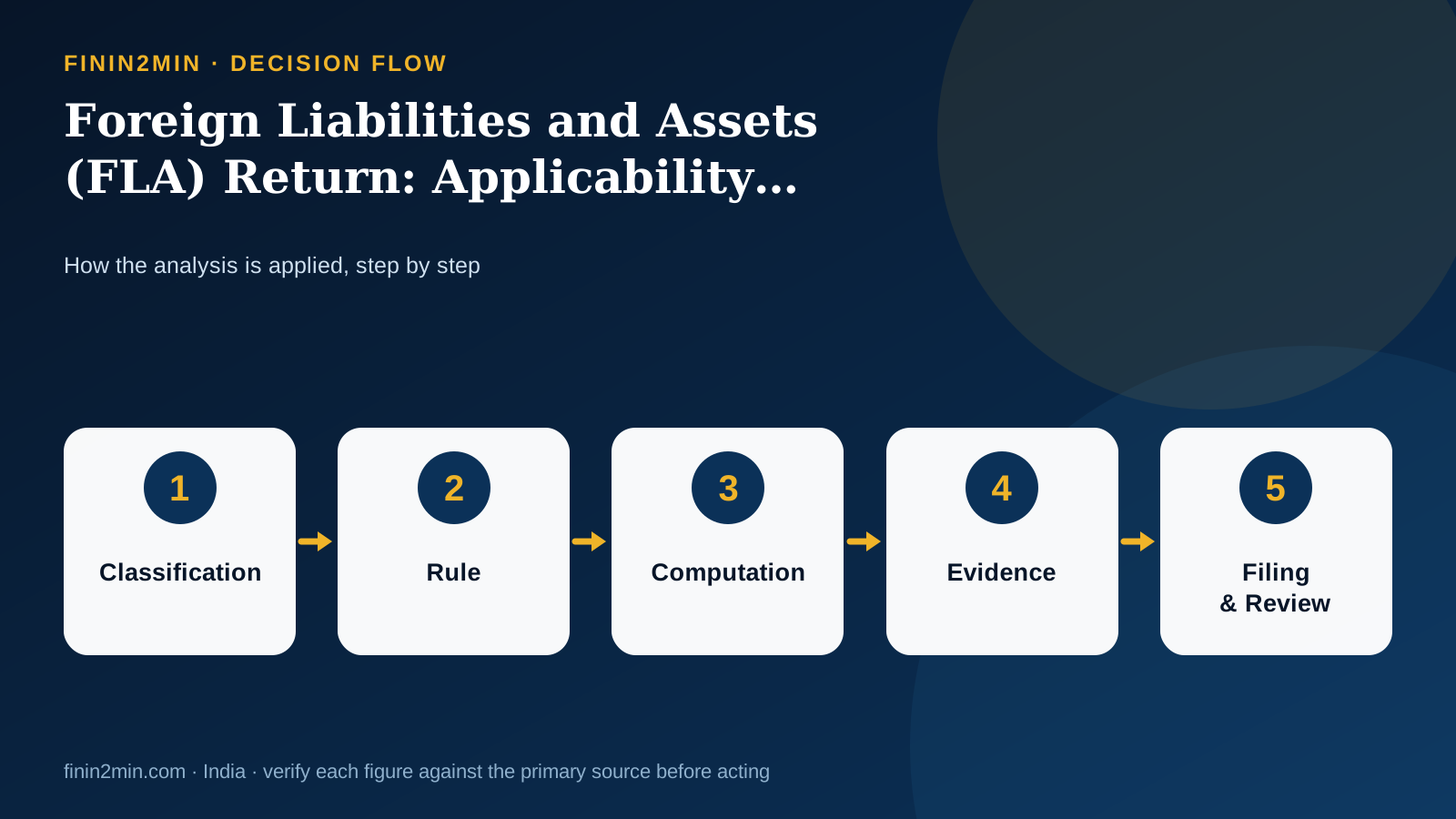
3. Step-by-step execution workflow
The six steps should be documented in sequence. If the final filing or accounting entry cannot be traced back through the workflow to the source document and legal provision, the position is not yet audit-ready.
4. Worked example and scenario analysis
Illustrative scenario — not a universal tax or legal result Assume an Indian company proposes a ₹30 lakh equivalent cross-border transaction involving Foreign Liabilities and Assets (FLA) Return. The CFO should freeze the commercial term sheet long enough to classify the transaction under FEMA: residency, instrument, route, pricing, permitted account and reporting form. Only after that should funds move. If the classification changes after remittance, the cost is not just a late form—it can affect valuation, downstream reporting, repatriation and compounding exposure.
Recalculate the conclusion for at least three variations: (1) a change in party/residential or regulatory status, (2) a change in transaction date or holding/tenure, and (3) a change in value, consideration or cash-flow structure. This reveals whether the result is robust or depends on a single fragile assumption.
For Foreign Liabilities and Assets (FLA) Return: Applicability, July 15 Timeline and Error Correction, a reviewer should be able to explain the result in four reconciled layers: the governing legal or accounting rule, the numerical working, the document that proves each input, and the exact filing / financial-statement / transaction output. Where the commercial outcome changes under a different date, party status, valuation basis or classification, the working paper should show that sensitivity explicitly rather than burying it in assumptions.
5. Evidence file, controls and common failure points
Evidence to retain
- audited/provisional balance sheet
- foreign investment and overseas investment schedules
- previous-year FLA acknowledgement
- revised-return support if figures change
- board approvals and transaction agreements
- valuation / pricing certificate where applicable
Red flags to review
- assuming nil transaction means no filing despite outstanding foreign liabilities/assets
- using book values inconsistently
- missing July 15 and revision process
Purpose code is not the legal route — A bank purpose code helps reporting but does not by itself establish that an ODI/OPI/ECB/current-account transaction is legally permissible. Valuation date — Pricing and valuation rules can depend on issue/transfer date and the transaction direction. Keep the signed valuation certificate with the remittance file. Delayed reporting — A late form can require a late submission fee or, in some cases, a broader regularisation/compounding analysis. Do not treat every delay alike. Repatriation / exit — Plan the eventual dividend, sale, repayment or liquidation route when the investment is made; exit documentation is easier when the original file is complete. Parallel tax obligations — FEMA permission does not determine withholding, PE, transfer pricing, GST/customs or foreign tax credit. Maintain separate workstreams and reconcile them.
Is this a current-account or capital-account transaction and what FEMA route applies? Who is resident/non-resident for FEMA purposes? Is the sector, instrument and counterparty eligible under the route? Is a pricing, valuation, maturity, end-use or leverage condition triggered? What prior approval/NOC is required, if any? Which form/reporting event and due date applies? Does the remittance trail reconcile with board approvals, agreement and valuation? What separate income-tax, transfer-pricing, GST/customs or company-law workstream exists?
Reviewer sign-off questions
- Is the legal provision current for the transaction / tax year being analysed?
- Does the classification in the working paper match the contract, ledger and filing?
- Are values, dates, rates and assumptions independently traceable to evidence?
- Has the team documented any judgement, exception, litigation risk or alternative interpretation?
- Would another reviewer be able to reproduce the result without asking for undocumented assumptions?
Implementation checklist: from analysis to an audit-ready file
For Foreign Liabilities and Assets (FLA) Return: Applicability, July 15 Timeline and Error Correction, the review should finish with a file that another professional can reproduce without relying on oral explanations. The following controls convert the technical conclusion into an execution-ready record.
Control 1: audited/provisional balance sheet
Retain audited/provisional balance sheet as a primary input, not merely as background support. The working paper should identify the relevant date, amount, party and legal character visible in that record, then cross-reference it to the computation and final filing / accounting output. Where the document does not directly prove an assumption, record the additional evidence or judgement used to bridge the gap.
Control 2: foreign investment and overseas investment schedules
Retain foreign investment and overseas investment schedules as a primary input, not merely as background support. The working paper should identify the relevant date, amount, party and legal character visible in that record, then cross-reference it to the computation and final filing / accounting output. Where the document does not directly prove an assumption, record the additional evidence or judgement used to bridge the gap.
Control 3: previous-year FLA acknowledgement
Retain previous-year FLA acknowledgement as a primary input, not merely as background support. The working paper should identify the relevant date, amount, party and legal character visible in that record, then cross-reference it to the computation and final filing / accounting output. Where the document does not directly prove an assumption, record the additional evidence or judgement used to bridge the gap.
Control 4: revised-return support if figures change
Retain revised-return support if figures change as a primary input, not merely as background support. The working paper should identify the relevant date, amount, party and legal character visible in that record, then cross-reference it to the computation and final filing / accounting output. Where the document does not directly prove an assumption, record the additional evidence or judgement used to bridge the gap.
Pre-sign-off challenge test
Before sign-off, challenge the conclusion specifically for: assuming nil transaction means no filing despite outstanding foreign liabilities/assets; using book values inconsistently; missing July 15 and revision process. If any of these conditions is present, re-open classification and computation rather than treating the issue as a disclosure-only point.
6. Frequently asked questions
What does “FLA is an annual foreign-investment reporting obligation” mean for Foreign Liabilities and Assets Return?
RBI’s foreign-investment reporting framework requires the annual FLA return from covered Indian entities, generally by 15 July based on the prescribed reporting scope. Corrections should be made through the permitted process rather than silently changing audited or filed numbers.
What does “July 15 is the operational anchor” mean for Foreign Liabilities and Assets Return?
The annual FLA return is generally due by 15 July for covered Indian entities with foreign direct investment liabilities and/or overseas direct investment assets in the relevant balance-sheet framework.
What does “Audited accounts may not yet exist” mean for Foreign Liabilities and Assets Return?
The return mechanism allows filing on provisional/unaudited numbers where permitted, followed by revision once audited numbers are available. The finance team should plan the revision rather than miss the original timeline.
What should be documented before taking a position on Foreign Liabilities and Assets Return?
At minimum, preserve audited/provisional balance sheet, foreign investment and overseas investment schedules, previous-year FLA acknowledgement, revised-return support if figures change. The calculation should be traceable from source records to the legal provision and the final return, filing, accounting entry or board decision.
What is the most common review risk?
The highest-risk errors include assuming nil transaction means no filing despite outstanding foreign liabilities/assets, using book values inconsistently, missing July 15 and revision process. A reviewer should test these items separately rather than relying on a single summary memo.
When should professional advice be obtained?
Seek transaction-specific advice where facts cross multiple regimes, involve material value, foreign parties, litigation, valuation judgement, restructuring, significant estimates or a position that is not clearly covered by the latest statutory text / regulator guidance.
7. Related Finin2min topics
- Overseas Direct Investment (ODI): Strategic vs. Portfolio Investments for Indian Tech Firms
- External Commercial Borrowings (ECB): Hedging, End-Use and All-in-Cost Compliance
- FEMA Non-Debt Instrument Rules: Compliance for Downstream Foreign Investments
- Compounding of FEMA Contraventions: Step-by-Step RBI Application and Documentation Guide
- Convertible Notes for Foreign Investors: Startup Pricing, Minimum Tranche and Reporting Rules
Primary sources and validation basis
Use the linked official material as the starting point. Check the latest amendment / circular / notification applicable to the specific date and facts before filing or executing a transaction.