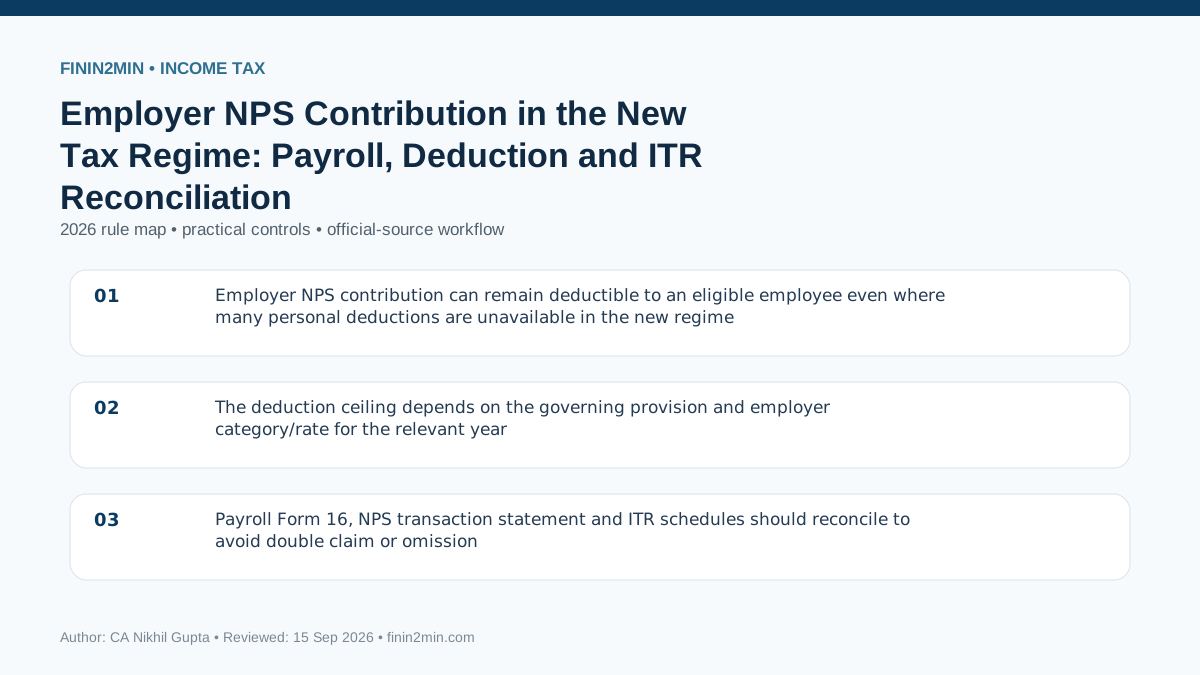
Employer contribution to NPS is one of the important deductions that survives the new tax regime. After the Finance (No. 2) Act 2024 change, section 80CCD(2) allows the “other employer” limit to be read as 14% of salary when income is taxed under the new regime.
Current rule and what decides the result
Employer NPS contribution remains an important deduction in the new tax regime. For new-regime computation, the employer-contribution ceiling is 14% of the relevant salary base for all employer categories; under the old regime, Central/State Government uses 14% while other employers ordinarily use 10%. The salary base for this purpose is not gross CTC. Employer contributions to recognised PF, NPS and approved superannuation must also be checked against the separate ₹7.5 lakh aggregate employer-contribution perquisite rule, including the prescribed annual accretion on any excess.
Key rules to apply
- Under the old regime, the familiar distinction remains: Central/State Government 14%, other employers 10%.
- For section 115BAC new-regime computation, employer NPS contribution under section 80CCD(2) can qualify up to 14% of salary for all employer categories.
- Under old-regime computation, Central/State Government employer contribution can use 14%, while other employers ordinarily use 10% of salary.
- The statutory “salary” base for this deduction is not necessarily gross CTC; use the section’s definition, including the prescribed basic/dearness-allowance treatment and exclusions.
- Employer contributions to recognised PF, NPS and approved superannuation are also tested against the separate aggregate ₹7.5 lakh perquisite rule; excess and related accretion can become taxable perquisite.
- Employee’s own NPS contribution follows separate section 80CCD(1)/(1B) rules and new-regime restrictions; do not combine it with employer 80CCD(2).
New-regime employer contribution
Priya’s basic salary plus qualifying DA for the year is ₹12 lakh. Her private-sector employer contributes ₹1.50 lakh to NPS. Under the new regime, 14% of ₹12 lakh is ₹1.68 lakh, so the entire ₹1.50 lakh is within the employer-NPS deduction ceiling, assuming the statutory salary base is correctly computed. This is an employer contribution; it should not be mixed with Priya’s own NPS deposit when reconciling the return.
Aggregate ₹7.5 lakh perquisite cap
A senior executive receives employer contributions of ₹5 lakh to recognised PF, ₹2.4 lakh to NPS and ₹1 lakh to an approved superannuation fund. Aggregate employer funding is ₹8.4 lakh. The separate perquisite rule therefore requires the excess over ₹7.5 lakh—₹90,000—to be examined as taxable perquisite, along with prescribed accretion, even if the NPS component by itself is within the section-specific percentage ceiling.
How to apply it step by step
- Reconcile employer NPS contribution from payslips, Form 16 and PRAN transaction statement.
- Compute the statutory salary base rather than using total CTC.
- Apply the correct percentage for the chosen tax regime and employer category.
- Separate employer contribution from employee 80CCD(1)/(1B)-type contributions.
- Aggregate employer PF, NPS and approved-superannuation contributions for the ₹7.5 lakh perquisite test.
- Check whether the employer has already included excess contribution/accretion in taxable perquisites.
- Match the eligible employer contribution with the deduction schedule in the ITR.
- Preserve payroll policy, Form 16 and NPS statement if the return value differs from AIS/payroll feeds.
Common mistakes and edge cases
- Using gross CTC as the percentage base.
- Claiming an employee’s own NPS deposit as employer contribution.
- Applying the old private-employer 10% ceiling to a new-regime year.
- Ignoring the separate ₹7.5 lakh aggregate employer-contribution perquisite rule.
- Double-claiming a payroll amount that was already excluded or deducted correctly.
FAQs
Does employer NPS deduction survive the new tax regime?
Yes, subject to the statutory employer-contribution ceiling and salary definition.
What percentage applies in the new regime?
The ceiling is 14% of the relevant salary base for employer NPS contribution.
Is the base my gross salary?
No. Use the salary definition prescribed for the NPS provision rather than gross CTC.
Does the ₹7.5 lakh rule replace the NPS percentage limit?
No. They are separate tests and both may need to be applied.
Can I also claim my own NPS contribution in the new regime?
Employee contributions follow separate provisions and new-regime restrictions; do not combine them with employer contribution.
What should I reconcile before filing?
Form 16, payslips, PRAN/NPS statement and the ITR deduction schedule should tell the same story.
Related Finin2min guides
- Old Regime vs New Regime for Employees With Employer NPS
- NPS Deduction: 80CCD(1B) and Employer Contribution
- NPS Deduction: 80CCD(1B), Employer Contribution and Evidence
- NPS Subscriber Changes Employer
- Tax on Employer's Excess Contribution to PF, NPS & Superannuation: The Rs 7.5 Lakh Rule
- New vs Old Regime for HRA + NPS Employees
- Employer Payroll Declaration Forms Under New Act: Complete Guide for 2026
- Corporate NPS Payroll-to-CRA Reconciliation Guide