Finin2min analysis / Ind AS 109
Effective Interest Rate Method: Loan Amortised Cost and Fee Adjustment
📄 Download the PDF edition (free sign-in)

Finin2min 2-minute summary
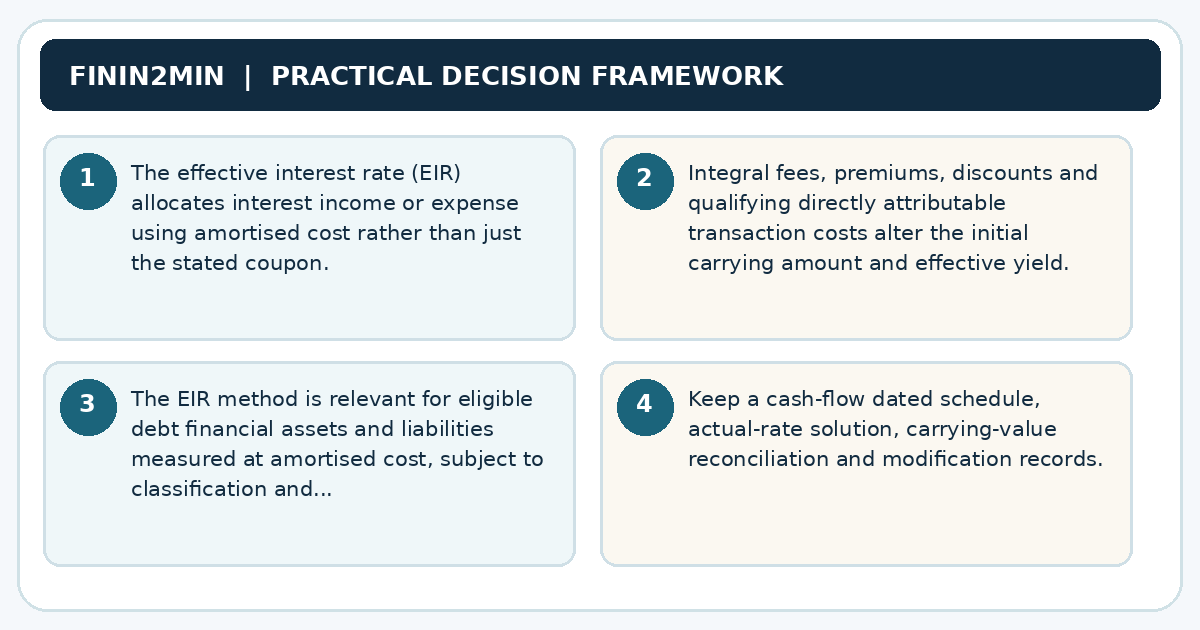
- The effective interest rate (EIR) allocates interest income or expense using amortised cost rather than just the stated coupon.
- Integral fees, premiums, discounts and qualifying directly attributable transaction costs alter the initial carrying amount and effective yield.
- The EIR method is relevant for eligible debt financial assets and liabilities measured at amortised cost, subject to classification and impairment rules.
- Keep a cash-flow dated schedule, actual-rate solution, carrying-value reconciliation and modification records.
Why contractual interest can understate the true cost
A lender may advance the face value of a loan but charge an upfront processing fee, origination cost, discount or premium. The cash actually received can differ from contractual principal. Under Ind AS 109, an eligible financial liability initially measured at amortised cost is accounted for using the effective interest method, which allocates finance cost to periods based on the opening carrying amount and an effective rate. The coupon represents contractual cash interest; EIR incorporates qualifying integral fees and cash-flow timing. Not every fee belongs in EIR: analyse whether it is an integral part of the financial instrument or consideration for a distinct service. Loan balance in the bank statement, amortised cost in financial statements and repayment principal are three related but distinct amounts.
Classification and initial measurement first
Before constructing a schedule, assess whether the instrument meets amortised-cost measurement requirements under Ind AS 109. For qualifying liabilities, transaction costs directly attributable to issue generally reduce the initial carrying amount when not at fair value through profit or loss. For qualifying assets, directly attributable transaction costs typically increase initial carrying amount, subject to the instrument’s category and recognition provisions. Assess commitment fees, legal fees, arrangement fees and regulatory charges individually; general administration and holding costs do not automatically qualify. A financial asset held for trading or mandatorily at fair value through profit or loss is not modelled as an ordinary amortised-cost asset. The accounting model must follow the contractual rights and business model.
Worked example: face value ₹10 lakh and ₹20,000 fee
Suppose a company borrows ₹10 lakh at an 8% annual coupon, payable each year, with principal repayable at the end of year three. A qualifying upfront transaction fee of ₹20,000 is deducted from proceeds, so initial carrying value is ₹9.80 lakh. Contractual cash outflows are ₹80,000 in year one, ₹80,000 in year two and ₹10.80 lakh in year three. Solve the rate at which those cash flows discount to ₹9.80 lakh: the EIR is a little above the 8% coupon (approximately 8.79% annually). In year one, apply EIR to ₹9.80 lakh as finance cost, deduct cash coupon ₹80,000 and carry the resulting higher liability forward. By contractual maturity the carrying amount accretes to ₹10 lakh just before principal settlement, subject to rounding.
Amortised cost roll-forward and journal treatment
On day one recognise the borrowing at the amount required under the standard after qualifying transaction costs. In each accounting period debit finance cost at the effective interest accrual and credit liability for the difference between EIR expense and actual coupon paid, while separately recording cash paid. When cash principal is repaid, reduce liability accordingly. For a zero-coupon instrument, the liability can accrete even when no contractual interest cash flows occur. A payment calendar based on actual dates may require a daily, monthly or irregular-period rate and a corresponding convention; never blindly divide annual EIR by twelve if compounding and exact dates are material. A schedule should reconcile opening to closing carrying amount exactly.
Modification, prepayment and credit-impaired assets
Changes in contractual cash flows can require recalculation, modification gain/loss recognition or derecognition under the applicable standard. Assess whether the terms are substantially different for liabilities, applying the relevant quantitative and qualitative guidance, and record any new fees correctly. For financial assets, effective interest interacts with the impairment model; the credit-adjusted EIR treatment for purchased or originated credit-impaired assets is distinct from the ordinary model. Early prepayment can change the remaining unamortised fee pattern and create immediate accounting effects. Do not recalculate the original effective interest rate after every market yield movement unless the specific standard provisions require it. Preserve original and revised schedules with a clear modification event log.
Related reporting and tax implications
The accounting finance charge derived from EIR may differ from contractual bank interest and from tax-deductible interest under applicable income-tax provisions. Keep a book-to-tax reconciliation rather than assuming the accounting accretion is automatically deductible in the same tax period. Financing cash flows show actual coupon and principal cash payments; non-cash interest accretion is not a separate bank movement. For covenant testing, read loan agreements carefully: a covenant may use interest actually paid, accrued finance charges or an adjusted definition. Income-statement effective interest expense and cash-flow disclosures should reconcile to the same debt inventory. Distinguish interest rate from yield to maturity of a tradable bond when early optionality alters expected life.
Design a reviewer-proof amortisation schedule
Store sanctioned amount, initial recognition date, fair value, integral fees and costs, contractual rate, expected cash-flow dates, repayment type, floating-rate clauses, payment timing, day-count convention and currency. The EIR solver should verify a stable root for the present-value equation and clearly flag cases in which multiple or no economically relevant roots exist. For each row show opening carrying value, effective interest accrual, cash coupon, principal repayment, modification adjustment and closing amount. Check that final balance agrees with contract settlement and that all interest amounts tie to journal entries. A later interactive calculator should expose these controls and warnings rather than a single attractive yield percentage.
Practitioner checklist
- Identify instrument classification and cash flow contractual terms.
- Separate integral costs/fees from stand-alone services.
- Solve EIR from dated cash flows and opening carrying amount.
- Reconcile each period finance expense and repayments.
- Document modifications, book-tax difference and disclosures.
Frequently asked questions
Not always; it depends on the nature and direction of fees, premiums and discounts.
Qualifying fees integral to the EIR and directly attributable transaction costs may affect initial carrying value.
A straight-line approximation is not automatically compliant where the effective interest method is required.
Use the actual cash-flow schedule and consistent compounding/day-count convention.
Both may describe yields, but accounting measurement and regulatory APR definitions may differ.
Yes. Assess modification or derecognition, revised cash flows and unamortised fees under Ind AS 109.
Primary sources and reporting references
Educational information, not individual accounting, tax, legal or investment advice. Confirm the applicable accounting framework, reporting period and currently effective instruments before acting.