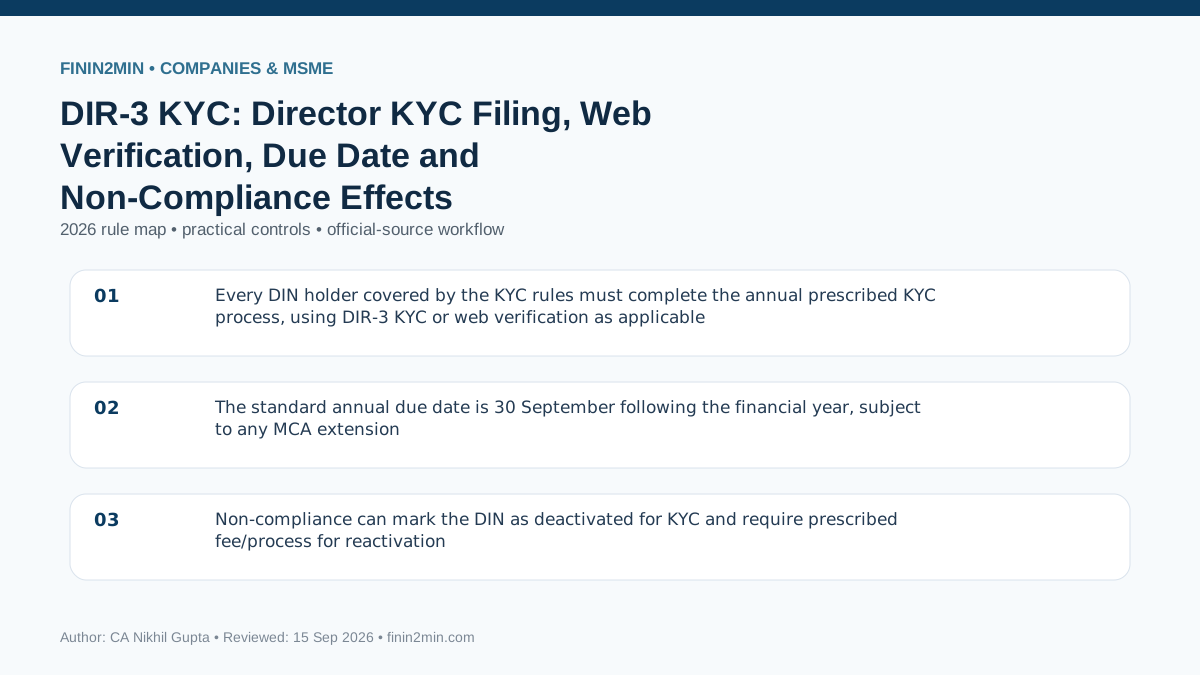
DIR-3 KYC is a director-level compliance linked to the DIN, not the company’s annual return. Since 31 March 2026 it falls due once in every third consecutive financial year, and a change in mobile number, email ID or residential address must be updated within 30 days.
Current rule and what decides the result
Rule 12A of the Companies (Appointment and Qualification of Directors) Rules, 2014, as substituted by G.S.R. 943(E) dated 31 December 2025 and in force from 31 March 2026, requires every individual who holds a DIN as on 31 March of a financial year to file Form DIR-3 KYC Web once in every third consecutive financial year, on or before 30 June. MCA has stated that directors who had completed KYC under the earlier annual system are next due by 30 June 2028; a DIN allotted during FY 2025-26 first falls due by 30 June 2029. Failure can cause the DIN to be marked 'Deactivated due to non-filing of DIR-3 KYC', and the same form is used to re-activate it, for a fee of ₹5,000.
Key rules to apply
- Form DIR-3 KYC Web replaced both the DIR-3 KYC e-form and the earlier DIR-3 KYC-WEB; there is no separate annual web-verification route.
- The three-year cycle is counted from the financial year in which the DIN was allotted. For a director who filed KYC in FY 2025-26 (DIN allotted on or before 31 March 2025), MCA has said no filing is due for FY 2026-27 and FY 2027-28 if the KYC particulars do not change.
- Any change in mobile number, email ID or residential address must be updated within 30 days through the same form, with a fee of ₹500 for every such filing; the update does not change the three-year date.
- Verification by the director and certification by a professional, both by digital signature, are required only when the form is filed for one of those updates.
- The obligation attaches to the DIN, so it applies even to a DIN holder who has resigned from every directorship or is disqualified as a director.
- The director’s own mobile number and email are used for OTP authentication and must be unique as required by MCA validation.
No change in particulars
A director filed DIR-3 KYC for FY 2025-26 and still uses the same mobile number, email address and residential address. Under MCA's illustration no KYC filing is due for FY 2026-27 or FY 2027-28, so the company's register should show 30 June 2028 as the next due date. The director completes Form DIR-3 KYC Web with OTP authentication in the April–June 2028 window, and the company retains the successful acknowledgement so that a later DIN-status issue can be traced.
Changed details during the cycle
A DIN is allotted on 1 January 2026 (FY 2025-26) and the director changes mobile number in FY 2027-28. The update goes through Form DIR-3 KYC Web within 30 days of the change, with a fee of ₹500, and needs digital-signature verification by the director and certification by a professional. The three-year cycle is still counted from FY 2025-26, so the next KYC for compliance is due in April–June 2029 — the update does not move it (MCA illustration).
Missed due date
A director misses the due date and the DIN is marked deactivated for non-filing. If the director needs to sign an MCA filing months later, KYC must first be completed through Form DIR-3 KYC Web and the ₹5,000 fee paid. The late KYC does not erase any separate delay on a company form that could not be signed while the DIN was inactive.
How to apply it step by step
- Prepare a DIN-wise register of all directors with the allotment financial year, the last KYC date and the next three-year due date, and verify current DIN status on MCA.
- Ask each director to confirm mobile, email and residential address, and to tell the company within days of any change, because an update has to be filed within 30 days.
- Check that the director's DSC, PAN/name details and registered contact information are usable before a filing or update.
- Complete OTP verification on the director's own registered channels rather than using a common office number.
- Download and archive the successful filing acknowledgement for each DIN.
- After filing, recheck DIN status where the director had previously been deactivated.
- Link the KYC register to board and ROC calendars so an inactive DIN does not block AOC-4, MGT-7 or other time-sensitive filings.
Common mistakes and edge cases
- Still diarising 30 September every year after the 2026 reform.
- Assuming nothing is ever required between the three-year dates and ignoring a changed mobile number, email or address.
- Assuming KYC is needed only when a director changes company.
- Waiting until the due date to discover a dead mobile number, expired DSC or PAN mismatch.
- Treating payment of the fee as the only consequence when an inactive DIN may also delay company filings.
- Keeping no acknowledgement after filing.
FAQs
What is the DIR-3 KYC due date now?
Form DIR-3 KYC Web is due once in every third consecutive financial year, on or before 30 June. MCA has stated that directors who had completed KYC under the earlier annual system are next due by 30 June 2028; a DIN allotted during FY 2025-26 first falls due by 30 June 2029.
Is there still a separate web-verification route?
The amended Rule 12A replaced the DIR-3 KYC e-form and DIR-3 KYC-WEB with a single Form DIR-3 KYC Web. Verification by the director and certification by a professional, both by digital signature, are needed only when the form is filed to update a mobile number, email ID or residential address.
What happens if KYC is not filed?
The DIN can be marked 'Deactivated due to non-filing of DIR-3 KYC', which can prevent the director from being used normally in MCA filings until the compliance is completed.
What does a late, reactivation or change filing cost?
A filing after the timeline, or to re-activate a DIN, costs ₹5,000; a filing within the timeline is free; and every filing made for a change costs ₹500 (item VII of the Annexure to the Companies (Registration Offices and Fees) Rules, 2014, as substituted by G.S.R. 300(E) dated 21 April 2026). That is separate from any additional fee or consequence on a company form delayed because the DIN could not be used.
How soon must a change of mobile number, email or address be updated?
Within 30 days of the change, through Form DIR-3 KYC Web, with a fee of ₹500 for every filing. The update does not change the three-year KYC date.
Can the company use its compliance team's phone for all directors?
The KYC process is designed around the director's registered contact details and OTP authentication. Reusing office contact details can create verification and governance problems and should not be treated as a shortcut.
What evidence should a company secretary keep?
Maintain the DIN list, director confirmations, filed form acknowledgement, payment receipt where applicable and a post-filing DIN-status check. This creates a clean director-KYC control file.
Related Finin2min guides
- Director KYC (DIR-3 KYC): The Three-Year Filing Every DIN Holder Must Not Miss
- Director KYC and DIR-3 KYC Due-Date Checker
- DIR-3 KYC 2026: Annual Filing Replaced by Three-Year Cycle — Who Is Due and When?
- KYC AML Compliance Verification: Mechanics, Risks, India
- ITR-4 AY 2026-27 Due Date 31 August 2026
- ITR-3 Due Date AY 2026-27: Audit and Non-Audit Cases
- Independent Director Databank Compliance Guide
Primary sources
- Ministry of Corporate Affairs — MCA replaces annual KYC with abridged KYC once in three years (PIB, 1 January 2026)
- Ministry of Corporate Affairs — Important MCA Update for Directors (Form DIR-3 KYC Web, G.S.R. 943(E) dated 31 December 2025)
- Ministry of Corporate Affairs — Companies (Registration Offices and Fees) Amendment Rules, 2026, G.S.R. 300(E) dated 21 April 2026 (item VII of the Annexure)
- Ministry of Corporate Affairs — Companies Act/rules e-books
- India Code — Companies Act, 2013
- MCA portal — director/DIN services