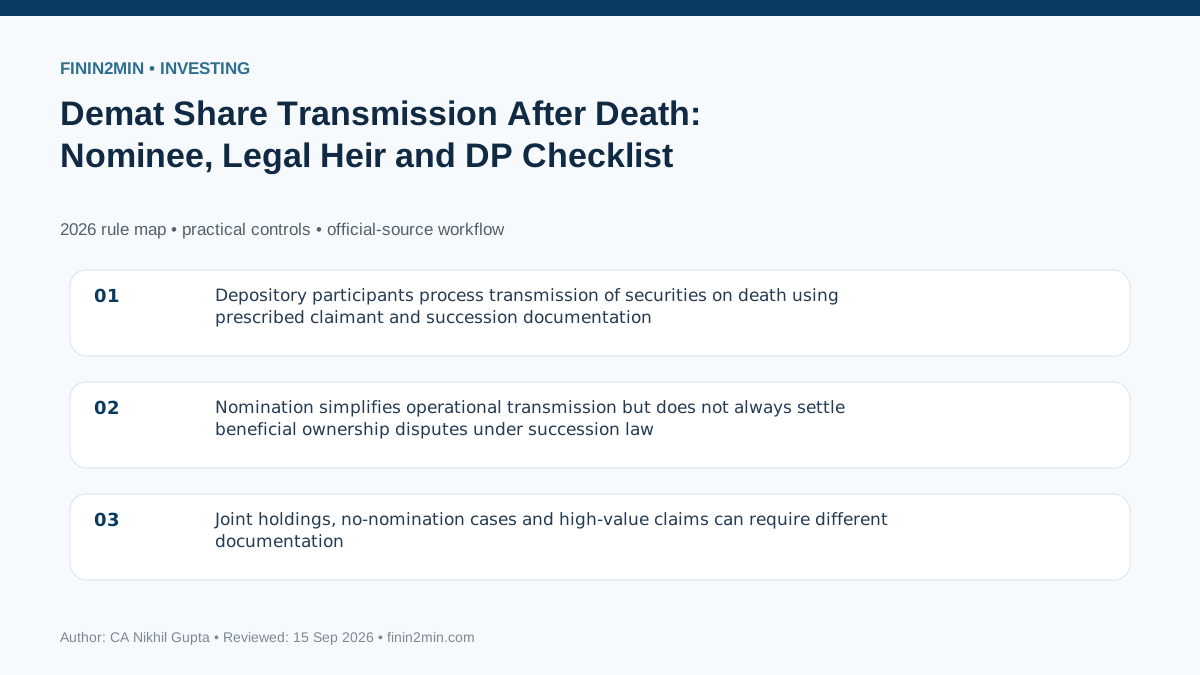
Transmission is the movement of securities after death by operation of succession/nomination, not an ordinary market sale. SEBI’s September 2025 circular specifically recognises the nominee as trustee for the original holder’s securities and introduced the “TLH” reason code so nominee-to-legal-heir transfers are not inappropriately reported as capital-gains transfers.
Current rule and what decides the result
Transmission is the succession process for securities after death; it is not an ordinary market transfer. SEBI’s current framework distinguishes surviving joint holders, nominees and legal heirs, and the documentation depends on the holding pattern, nomination and value/facts. For physical securities, securities issued pursuant to transmission are now moved into demat mode under the current RTA framework. A nominee facilitates transmission but does not automatically settle every beneficial-ownership dispute under succession law, so the family should separate the DP/RTA operating process from the final succession entitlement where contested.
Key rules to apply
- SEBI states that the nominee acts as trustee of the original holder’s securities and transfers them to the legal heir in line with succession.
- Section 47 succession/inheritance principles and SEBI’s process distinguish transmission from a taxable market transfer merely because ownership changes.
- For nominee-to-legal-heir movement, reporting entities use reason code “TLH — Transmission to Legal Heirs” under SEBI’s 2025 mechanism to avoid inappropriate capital-gains reporting.
- DP/RTA requirements commonly include transmission request, death certificate, claimant KYC/PAN and nomination/succession evidence; the exact set depends on whether a nominee exists and value/circumstances.
- Where a surviving joint holder exists, the operational path differs from sole-holder death with a nominee/legal heir.
- When heirs later sell, inherited-asset cost and holding-period rules must be applied; the non-taxable transmission itself does not mean later sale is exempt.
Nominee in a sole demat account
A sole holder dies with listed shares worth ₹18 lakh and a valid nominee recorded in the demat account. The nominee submits the prescribed transmission request, death certificate, PAN/KYC and DP documentation. Once transmitted, the securities move through the depository process without a sale, so the transmission itself is not a market disposal. If family members dispute beneficial ownership, that succession issue is separate from the DP’s operational transmission step.
No nominee and multiple heirs
A sole holder dies without nomination, leaving securities worth ₹35 lakh and three legal heirs. The DP/RTA may require succession/legal-heir documentation, affidavits/indemnities or probate/succession certificate depending on the applicable threshold and facts. The heirs should first agree who will receive the securities or establish authority; trying to use an off-market transfer from the deceased account is the wrong process.
How to apply it step by step
- Obtain a certified death certificate and identify every demat/physical holding.
- Check whether the account was sole or joint and whether a nominee is registered.
- Ask the DP/RTA for the current transmission checklist and applicable value threshold.
- Complete claimant KYC/PAN and the prescribed transmission request/affidavit/indemnity documents.
- Where no nomination exists, obtain the required legal-heir/succession/probate evidence for the facts.
- Open/confirm the claimant’s demat account because transmitted securities ultimately need the proper account/demat route.
- After credit, preserve the deceased holder’s acquisition records for future capital-gains cost and holding-period calculations.
- Update dividend/bank/nomination details only after the securities are lawfully transmitted.
Common mistakes and edge cases
- Using an ordinary transfer instruction instead of transmission.
- Assuming nomination conclusively determines beneficial ownership in every succession dispute.
- Losing the deceased holder’s purchase/cost records after transmission.
- Submitting different claimant names across PAN, death certificate and demat records without resolving mismatches.
- Assuming physical certificates can simply be reissued in physical form after transmission.
FAQs
Is transmission the same as transfer?
No. Transmission arises by operation of law after death; a transfer is a voluntary transaction.
Does a nominee automatically become the final beneficial owner?
Nomination facilitates securities transmission, while ultimate succession rights can depend on applicable succession law and facts.
What if there is no nominee?
The DP/RTA applies the legal-heir/succession documentation route, with requirements depending on value and circumstances.
Can transmitted physical shares remain physical?
Current SEBI/RTA rules require securities pursuant to transmission to be issued in demat mode.
Is transmission itself a taxable sale?
Transmission on death is not a market sale; tax generally becomes relevant when the recipient later disposes of the securities.
Which record is most important for later tax?
Keep the deceased holder’s original cost and acquisition/holding history because it can carry into the heir’s capital-gains computation.
Related Finin2min guides
- Transmission of Securities 2026: SEBI’s Simplified Documents, Nominee/Legal-Heir Workflow and RTA Control
- EPF Nominee vs Legal Heir After Member Death
- Nominee vs Legal Heir: The Family-Finance Confusion Explained
- Nominee vs Legal Heir: Asset-by-Asset Guide
- Nominee vs Legal Heir: Why Your Family Can Still Struggle After Nomination
- Family Gratuity After Employee Death: Nominee vs Legal Heir
- Nominee vs Legal Heir: Asset-by-Asset Guide
- Will vs Nominee vs Legal Heir: Family Wealth Transfer Checklist