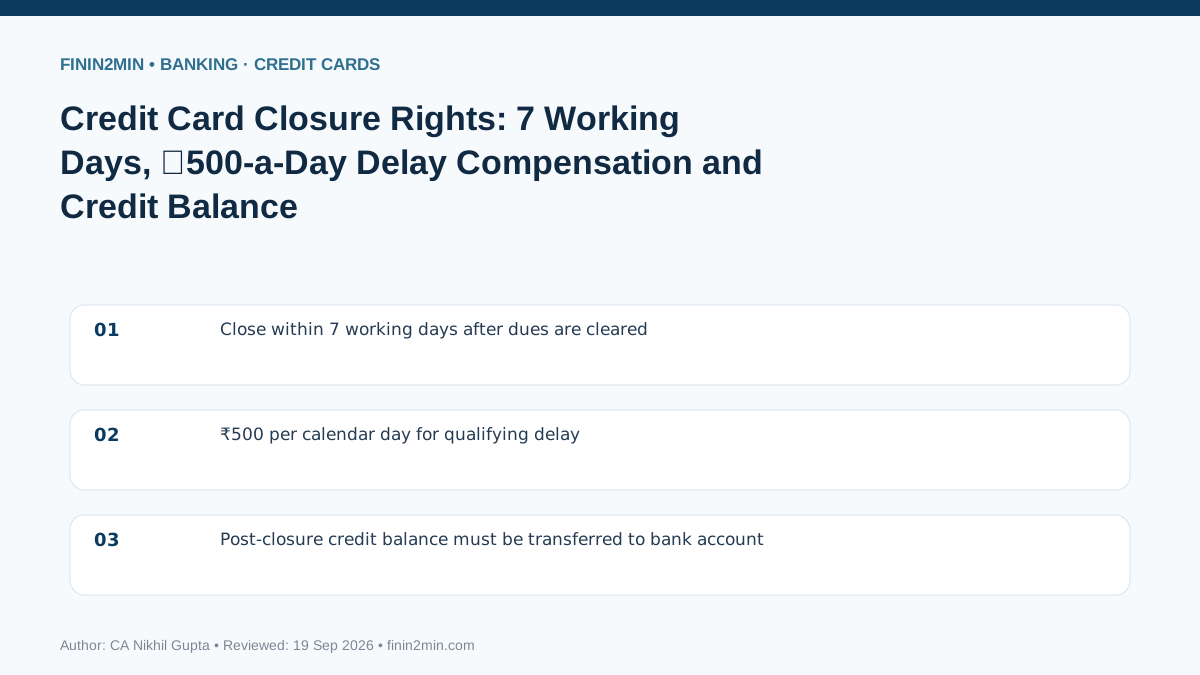
A closure request is not an informal service request. RBI’s card directions set a seven-working-day completion standard once dues are cleared, prescribe ₹500 per calendar day for qualifying delay and require post-closure credit balances to be returned to the cardholder’s bank account.
The RBI closure standard
RBI’s card directions require a card issuer to honour a credit-card closure request within seven working days, subject to the cardholder paying all dues. Once closed, the issuer must notify the cardholder through a channel such as email or SMS. The issuer must also provide multiple ways to ask for closure — for example helpline, dedicated email, IVR, website link, internet banking or mobile app — and cannot insist on a postal request that would itself delay receipt.
The same direction attaches a monetary consequence. If the issuer does not complete closure within seven working days, it must pay ₹500 per calendar day of delay until closure, provided there is no outstanding in the account. This is compensation owed to the cardholder; it is not a late fee charged to the bank account.
How to count the seven working days when dues exist
A closure request can be made while a balance is still outstanding, but the clock is not treated as though the issuer must close an unpaid account. RBI’s FAQ clarifies that the issuer should tell the cardholder the outstanding amount on receiving the closure request and advise payment. The seven-working-day computation then excludes the days the cardholder takes to clear those dues.
Example — five days of compensable delay. Assume all dues are already zero when the issuer receives a valid closure request. The seventh working day expires, but the account remains open for another five calendar days before the issuer actually closes it. The RBI compensation is 5 × ₹500 = ₹2,500. If two of those five days are a weekend, they still count for compensation because the rate is per calendar day after the seven-working-day closure deadline.
Keep the request acknowledgement and closure confirmation because those two timestamps determine the dispute. If the issuer says dues existed, ask for the transaction-level outstanding statement showing what was payable and when it was cleared.
What happens to a positive credit balance?
Some card accounts show a negative amount after refunds, charge reversals or an overpayment — meaning the issuer actually owes money to the cardholder. RBI requires any credit balance remaining after closure to be transferred to the cardholder’s bank account. If the issuer does not already have the necessary account details, it should obtain them.
This matters when users “prepay” a card before closing it. A ₹3,000 excess payment is not supposed to disappear with the card. Ask for the transfer reference and reconcile it with the final card statement.
Closure is different from blocking, expiry and inactivity
| Status | What it means | Action |
|---|---|---|
| Blocked card | Card use is stopped, often after loss/fraud; the credit-card account can still exist. | If you want to end the relationship, submit a separate closure request. |
| Expired plastic | The physical card validity ends; a renewed card/account may continue. | Decline renewal or request closure if you do not want the account. |
| Inactive for >1 year | RBI permits issuer-initiated closure after intimation and 30 days without response, subject to dues being cleared. | Respond if you intend to retain it; otherwise reconcile dues/rewards/credits. |
| Closed account | Issuer has completed closure and notified you. | Preserve confirmation and monitor the next credit bureau update. |
A clean closure workflow
- Redeem or consciously forgo reward points/cashback after checking the programme rules; closure can end access.
- Stop fresh recurring mandates and migrate subscriptions.
- Download recent statements and verify EMI/chargeback/refund positions.
- Pay all billed and unbilled dues. If the app shows “zero” but an issuer cites dues, demand the breakup.
- Submit closure through an RBI-permitted channel and save the request/ticket number.
- Record the request date and the date dues became zero.
- Expect closure within seven working days after the dues condition is satisfied.
- Get the closure confirmation and check any credit balance refund.
- After reasonable reporting time, verify the account status with credit information companies if the card remains shown as open.
What if the issuer offers a retention deal?
A retention call can waive an annual fee or offer points, but it does not erase your closure request unless you agree to keep the account. If your decision is to close, state that clearly and ask the issuer to confirm whether the original request remains active. Do not allow a “temporary block” to be passed off as account closure.
Likewise, cutting the plastic card or deleting it from the app has no legal effect on the underlying account. The evidence you need is the issuer’s closure confirmation.
Escalation: issuer first, RBI Ombudsman after 30 days
RBI’s credit-card FAQ says the customer must first approach the card issuer. If there is no response within 30 days, the complaint is rejected wholly or partly, or the customer is dissatisfied with the response, the customer can approach the RBI Ombudsman under the Integrated Ombudsman Scheme. Online complaints can be lodged through RBI’s Complaint Management System.
A useful complaint file has: closure request/ticket, zero-dues proof, statements, issuer emails/chats, date-count working, closure confirmation (if later received), and your calculation of ₹500 per calendar day. Keep the grievance factual; the fixed closure-delay compensation can be shown separately from any other claimed loss.
Example where compensation does not start immediately
A cardholder requests closure on 1 September with ₹12,600 still outstanding. The issuer immediately communicates the balance. The cardholder pays only on 8 September. The RBI FAQ says the days taken by the cardholder to clear the dues are excluded when computing the seven-working-day closure period. Therefore the compensation calculation cannot simply start seven working days after 1 September; it must reflect when the dues condition was satisfied.
If the issuer then takes 11 working days after the relevant zero-dues point, compensation is based on the calendar-day delay beyond the permitted seven working days.
Closure arithmetic: when ₹500 per calendar day starts
The RBI rule is easy to quote and easy to misapply. The seven-working-day clock is tied to a valid closure request and settlement of outstanding dues. If the cardholder owes ₹18,400 on the request date and clears it four days later, those four days should not be presented as issuer delay. Once the dues condition is satisfied, however, an issuer-caused failure beyond the permitted period can trigger ₹500 for each calendar day of delay, provided there is no outstanding amount.
Example — compensation after dues are cleared. Assume all card dues are fully paid, the issuer receives a closure request through an accepted channel, and the seven-working-day period expires on 10 October. If closure is completed only on 18 October for reasons attributable to the issuer, the delay after the permissible period is eight calendar days. At ₹500 per day, the compensation works to ₹4,000. Weekends inside those eight delayed days are still calendar days; the seven-day service standard itself is expressed in working days.
Keep the request acknowledgement, zero-dues proof and the final closure confirmation. If the issuer disputes the compensation period, these three timestamps are the core evidence.
Recurring mandates, EMIs and disputed transactions need separate treatment
Closing a card account is not the same as cancelling every commercial arrangement linked to the card number. Before closure, identify standing instructions, subscriptions, tokenised merchant mandates, pending refunds, unbilled EMIs, fuel/hotel pre-authorisations and chargeback disputes. A merchant mandate may need cancellation with the merchant as well as the issuer. A pending refund can create a positive credit balance after the account is otherwise ready to close.
Where an EMI is outstanding, ask the issuer for the exact foreclosure/closure amount rather than paying only the latest statement balance. Likewise, if a transaction is under dispute, obtain written treatment of the disputed amount so that the cardholder knows whether it is considered outstanding for closure purposes. The RBI closure rule should not be used as a reason to abandon an unresolved chargeback record.
| Before closure | Action |
|---|---|
| Autopay subscriptions | Move essential services to another payment method and cancel old mandates. |
| Reward points | Check redemption/expiry terms before the account is closed. |
| EMI conversion | Ask for foreclosure amount and any disclosed charges/taxes. |
| Pending refund | Track whether it will arrive before or after closure and where the credit will be transferred. |
| Disputed transaction | Preserve complaint/chargeback reference and written outstanding-dues treatment. |
Credit report hygiene after closure
A closure confirmation is the first checkpoint, not the last. Preserve it and later review the relevant credit report to confirm the account is no longer being shown as active with an unintended outstanding balance. If reporting is wrong, raise the discrepancy with the issuer/CIC through the applicable grievance route and attach the zero-dues and closure proof. This is particularly important when the card has been inactive for months, because “blocked”, “expired”, “suspended” and “closed” describe different account states.
Do not destroy old statements immediately. A modest archive containing the last six to twelve statements, closure request, zero-dues evidence, refund/credit-balance proof and closure confirmation is enough to resolve most later disputes without reconstructing the history from scratch.
What a good closure confirmation should say
Ask for a communication that identifies the card account, confirms closure (not merely card blocking), and shows that no amount remains payable as of the closure processing. If a refund arrives later, preserve the transfer trail for that positive balance. The account holder should also keep the complaint/service-request number because it anchors the seven-working-day calculation if the issuer later says the request was received on a different date.
For a joint household that uses supplementary/add-on cards, confirm the primary account status rather than assuming destruction of each physical card has closed the underlying facility. The closure request should cover the credit-card account itself and any add-on cards linked to it.
Credit-card closure FAQs
Can the bank force me to send a closure letter by post?
RBI requires multiple closure channels and says an issuer must not insist on post or another mode that can delay receipt.
Is ₹500 calculated per working day?
No. The closure deadline is seven working days, but the compensation after qualifying delay is ₹500 per calendar day.
Does compensation apply if I still owe money?
The fixed delay compensation is conditional on there being no outstanding. RBI’s FAQ excludes the time taken by the cardholder to clear dues when counting the closure period.
What happens to an overpaid balance?
After closure, a remaining credit balance must be transferred to the cardholder’s bank account.
Does blocking a card close the account?
No. Blocking stops usage; closure terminates the account. Ask for explicit closure confirmation.
When can I approach the RBI Ombudsman?
After first complaining to the issuer, you can approach the Ombudsman if there is no response within 30 days, the complaint is rejected wholly/partly, or you are dissatisfied with the resolution. For complaints filed from 1 July 2026 the Reserve Bank – Integrated Ombudsman Scheme, 2026 applies (earlier complaints stay under the 2021 scheme); check RBI’s current FAQ for the exact timelines.
Primary sources
Use the cited instrument or regulator guidance for the proposition described above; check later amendments and transaction-date rules before acting.
Educational information only. Tax, legal, banking and insurance outcomes depend on facts, dates and the instrument/policy in force. Obtain professional advice for material transactions.