
Commodity options combine commodity price exposure with asymmetric option payoffs. Tax files need to prove recognised-exchange eligibility, premium and settlement treatment, derivative turnover and whether the transaction is trading, hedging or associated with physical commodity exposure.
Finin2min takeaway
- Classify before computing.
- Use the law/regulation in force for the actual transaction or process date.
- Separate legal, tax, accounting and cash-flow conclusions.
- Reconcile every material conclusion to evidence and the filed output.
1. Overview — what exactly are we analysing?
Commodity options combine commodity price exposure with asymmetric option payoffs. Tax files need to prove recognised-exchange eligibility, premium and settlement treatment, derivative turnover and whether the transaction is trading, hedging or associated with physical commodity exposure.
This version focuses on controls, audit defence, governance, scenario testing and failure points. For Commodity Options: Hedge Documentation, Broker Reconciliation and Tax-Risk Controls, the objective is not to produce a one-line rate or checklist answer. The objective is to make the position reproducible: another reviewer should be able to identify the legal event, apply the current rule, rebuild the calculation and trace the result into the relevant return, form, register, financial statement or board paper.
What makes this topic difficult?
For Commodity Options: Hedge Documentation, Broker Reconciliation and Tax-Risk Controls, the difficult part is linking instrument classification to income character and then proving the result through option contract notes. A commercially similar transaction can produce a different outcome when the profile-specific facts change. The first failure mode to guard against is spot movement used instead of contract settlement, so this guide starts with classification and evidence rather than a headline percentage.
2. Current framework — 4 September 2026
Current-position note for Commodity Options: Hedge Documentation, Broker Reconciliation and Tax-Risk Controls. For Tax Year 2026-27 onward, current direct-tax analysis should begin with the Income-tax Act, 2025 and Income-tax Rules, 2026. Legacy section numbers are useful for historical periods and cross-referencing, but should not be presented as the operative 2026 provision. Capital-market conclusions also need the current SEBI framework for the instrument and transaction mechanism.
Use the current Income-tax Act, 2025 commodity-derivative definition as amended for 2026. This point is the first technical checkpoint because a wrong classification at this stage contaminates every later calculation. If the fact changes, the team should rerun the conclusion rather than preserve the old answer for convenience.
Option premium and settlement should be traced from contract note to ledger; do not infer results from commodity spot-price movement. In practice, finance teams often discover this issue only during return preparation or diligence; the better control is to resolve it when the transaction is designed. The practical consequence is that the same cash amount can produce a different tax, accounting or regulatory result when the legal fact pattern changes.
Recognised-exchange and transaction conditions matter to the speculative/non-speculative analysis. The supporting memo should state the factual assumption that makes the rule relevant and identify the document that proves that assumption. This is also where audit defence is won: consistent contracts, registers, bank evidence and filed forms are stronger than a later explanatory note.
If an option leads to futures or delivery obligations under contract rules, the downstream position must be captured. A reviewer should be able to reproduce the conclusion from the source records without relying on a management explanation or a spreadsheet note. The article therefore treats this as a decision rule, not as a generic caution.
Risk should be analysed using maximum loss/payoff and liquidity around expiry, not just premium received. Where the commercial contract uses a broad label, the legal/tax analysis should translate that label into the statutory concept before applying a rate, formula or form. For Commodity Options: Hedge Documentation, Broker Reconciliation and Tax-Risk Controls, that means the computation file should show the classification step separately from the amount calculation.
For Commodity Options: Hedge Documentation, Broker Reconciliation and Tax-Risk Controls, where an older circular, precedent, section number or accounting policy is relevant to an earlier period, keep it in the chronology but label it as historical. The current-period analysis should not silently mix two regimes.
3. Detailed mechanics
Control and audit-defence focus
This version focuses on controls, audit defence, governance, scenario testing and failure points. For Commodity Options: Hedge Documentation, Broker Reconciliation and Tax-Risk Controls, the strongest control is preventive: allocate responsibility for legal classification, accounting entry, tax computation, filing and evidence at transaction inception. A year-end reviewer should not have to reconstruct the contract or ask which version of a valuation, calculation, agreement, statutory register or regulatory form was actually relied on.
For Commodity Options: Hedge Documentation, Broker Reconciliation and Tax-Risk Controls, build a red/amber/green control sheet. Red means a statutory condition or deadline is missed; amber means the position is fact-sensitive or depends on judgement; green means primary documents, computation and filed output reconcile. This converts a long technical memo into a management-ready action plan without removing the underlying legal analysis.
How the mechanics should be documented
For Commodity Options: Hedge Documentation, Broker Reconciliation and Tax-Risk Controls, create a transaction sheet with six columns: legal event, date, party/status, source document, rule relied on and amount/result. This prevents the common problem where the amount is correct but the legal reason is missing, or the legal memo is correct but the underlying amount is pulled from the wrong ledger. Add a seventh column for the person responsible for the next action.
For Commodity Options: Hedge Documentation, Broker Reconciliation and Tax-Risk Controls, create a reconciliation bridge that begins with the source system or legal register and ends with the statutory output. Differences should be explained, not manually forced to zero. In this article, the bridge may need to distinguish negotiated consideration, tax cost, statutory/deemed value, broker tax-lot value and cash settlement. The working should state the purpose, date and source of each value so a legitimate difference is not mistaken for an error — and an actual mismatch is not hidden as a “valuation difference”.
Practitioner deep dive — five topic-specific checkpoints
Control checkpoint 1
Use the current Income-tax Act, 2025 commodity-derivative definition as amended for 2026. In a control-focused review of Commodity Options: Hedge Documentation, Broker Reconciliation and Tax-Risk Controls, assign this point to a named owner before "verify option contract eligibility" is completed. The control should require inspection of option contract notes, not merely a verbal confirmation. Record who reviewed it, when it was reviewed, which version was relied on, and whether the conclusion is unconditional or depends on a future event.
Failure signal. A specific red flag is spot movement used instead of contract settlement. If that signal appears, classify the matter as amber or red until the underlying facts are reconciled. For Commodity Options: Hedge Documentation, Broker Reconciliation and Tax-Risk Controls, a defensible closure note should state the discrepancy, quantify any exposure or model impact where possible, identify the remedial filing/approval/recalculation needed, and preserve evidence of completion. That is stronger than a generic “reviewed” tick because it shows how the risk was actually resolved.
Control checkpoint 2
Option premium and settlement should be traced from contract note to ledger; do not infer results from commodity spot-price movement. In a control-focused review of Commodity Options: Hedge Documentation, Broker Reconciliation and Tax-Risk Controls, assign this point to a named owner before "capture premium and settlement" is completed. The control should require inspection of premium ledger, not merely a verbal confirmation. Record who reviewed it, when it was reviewed, which version was relied on, and whether the conclusion is unconditional or depends on a future event.
Failure signal. A specific red flag is exercise chain lost. If that signal appears, classify the matter as amber or red until the underlying facts are reconciled. For Commodity Options: Hedge Documentation, Broker Reconciliation and Tax-Risk Controls, a defensible closure note should state the discrepancy, quantify any exposure or model impact where possible, identify the remedial filing/approval/recalculation needed, and preserve evidence of completion. That is stronger than a generic “reviewed” tick because it shows how the risk was actually resolved.
Control checkpoint 3
Recognised-exchange and transaction conditions matter to the speculative/non-speculative analysis. In a control-focused review of Commodity Options: Hedge Documentation, Broker Reconciliation and Tax-Risk Controls, assign this point to a named owner before "trace exercise/expiry outcome" is completed. The control should require inspection of inventory exposure note, not merely a verbal confirmation. Record who reviewed it, when it was reviewed, which version was relied on, and whether the conclusion is unconditional or depends on a future event.
Failure signal. A specific red flag is premium treated inconsistently. If that signal appears, classify the matter as amber or red until the underlying facts are reconciled. For Commodity Options: Hedge Documentation, Broker Reconciliation and Tax-Risk Controls, a defensible closure note should state the discrepancy, quantify any exposure or model impact where possible, identify the remedial filing/approval/recalculation needed, and preserve evidence of completion. That is stronger than a generic “reviewed” tick because it shows how the risk was actually resolved.
Control checkpoint 4
If an option leads to futures or delivery obligations under contract rules, the downstream position must be captured. In a control-focused review of Commodity Options: Hedge Documentation, Broker Reconciliation and Tax-Risk Controls, assign this point to a named owner before "link hedge to physical exposure where relevant" is completed. The control should require inspection of expiry/exercise statement, not merely a verbal confirmation. Record who reviewed it, when it was reviewed, which version was relied on, and whether the conclusion is unconditional or depends on a future event.
Failure signal. A specific red flag is hedge documentation absent. If that signal appears, classify the matter as amber or red until the underlying facts are reconciled. For Commodity Options: Hedge Documentation, Broker Reconciliation and Tax-Risk Controls, a defensible closure note should state the discrepancy, quantify any exposure or model impact where possible, identify the remedial filing/approval/recalculation needed, and preserve evidence of completion. That is stronger than a generic “reviewed” tick because it shows how the risk was actually resolved.
Control checkpoint 5
Risk should be analysed using maximum loss/payoff and liquidity around expiry, not just premium received. In a control-focused review of Commodity Options: Hedge Documentation, Broker Reconciliation and Tax-Risk Controls, assign this point to a named owner before "compute turnover/result" is completed. The control should require inspection of turnover working, not merely a verbal confirmation. Record who reviewed it, when it was reviewed, which version was relied on, and whether the conclusion is unconditional or depends on a future event.
Failure signal. A specific red flag is exchange conditions not checked. If that signal appears, classify the matter as amber or red until the underlying facts are reconciled. For Commodity Options: Hedge Documentation, Broker Reconciliation and Tax-Risk Controls, a defensible closure note should state the discrepancy, quantify any exposure or model impact where possible, identify the remedial filing/approval/recalculation needed, and preserve evidence of completion. That is stronger than a generic “reviewed” tick because it shows how the risk was actually resolved.
4. Decision workflow
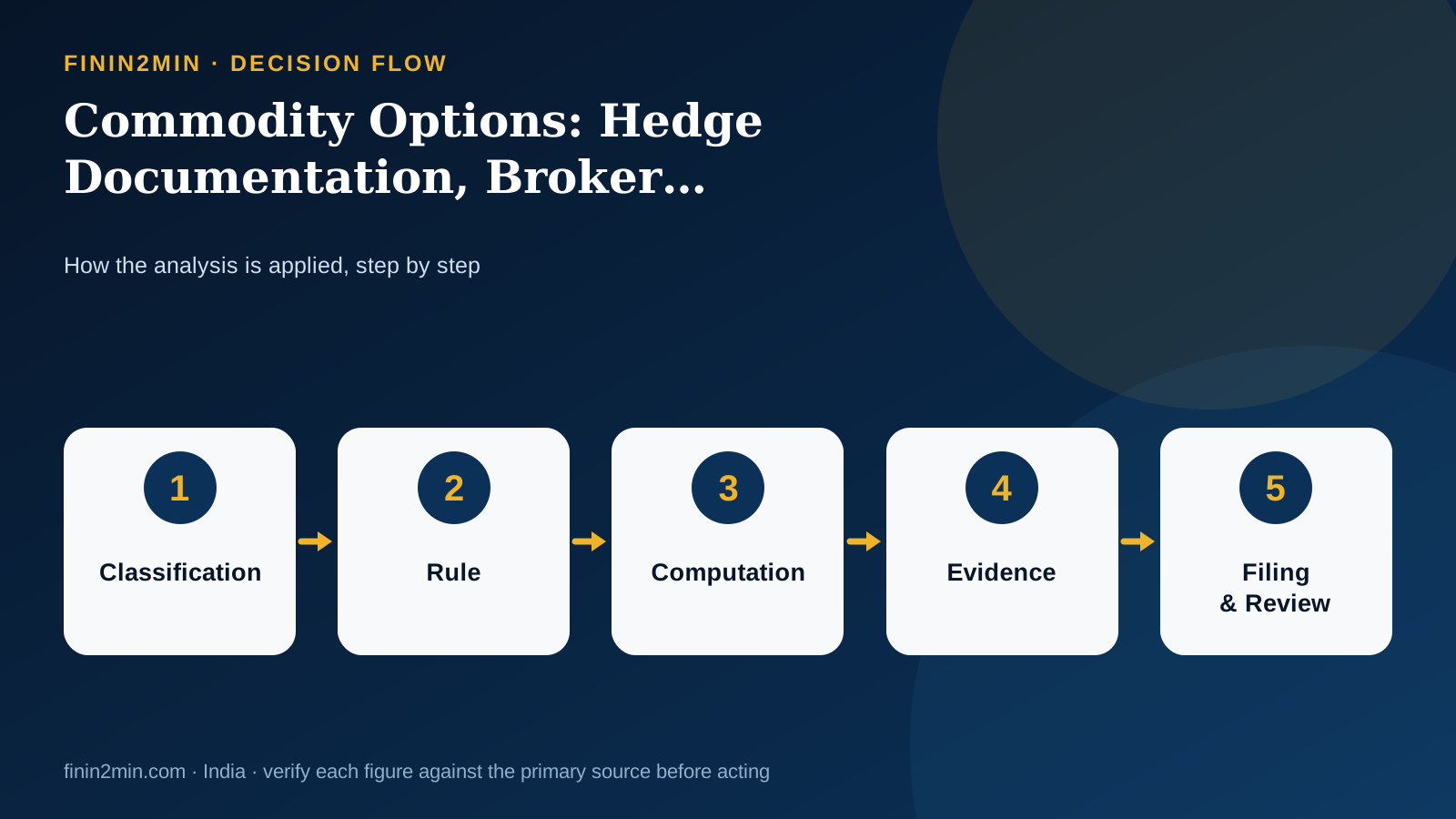
For Commodity Options: Hedge Documentation, Broker Reconciliation and Tax-Risk Controls, each workflow step should have a named evidence owner. Finance may own the ledger, legal may own contract/approval status, tax may own classification/return treatment and secretarial/compliance teams may own statutory registers and filings. The hand-off points should be recorded because an ownerless spreadsheet is not a control.
5. Worked example
Illustrative worked example
Facts. A jeweller buys commodity puts to protect bullion inventory and the options expire unused after spot prices rise.
Analysis. The premium outcome should be documented separately from inventory valuation and sales margin; the commercial hedge purpose does not eliminate the need for a derivative tax trail.
Finin2min control. This Commodity Options: Hedge Documentation, Broker Reconciliation and Tax-Risk Controls example is deliberately simplified. In a live transaction, add dates, counterparties, statutory status, taxes already withheld/paid, accounting entries and form/return references before treating the illustration as a filing position.
The Commodity Options: Hedge Documentation, Broker Reconciliation and Tax-Risk Controls worked example should be accompanied by a sensitivity note. Identify the profile-specific assumption most likely to change the result and show how the conclusion changes if it moves. The sensitivity should use the actual driver in this article — not a generic market variable — so management can monitor the fact that truly changes the legal, tax or model outcome.
6. Scenario analysis
| Scenario | What changes | Reviewer action |
|---|---|---|
| Green | Documents, computation and filed output agree | Release after independent review. |
| Amber | Judgement or conditional exemption/route is material | Add legal memo, approval owner and monitoring trigger. |
| Red | Deadline, route, valuation, evidence or eligibility condition is breached | Stop normal processing; quantify exposure and remedial path. |
| Future event | Exit, conversion, completion, admission, allotment or next funding can change outcome | Create a diary control and scenario refresh point. |
For Commodity Options: Hedge Documentation, Broker Reconciliation and Tax-Risk Controls, scenario analysis is a control for conditional law and model sensitivity rather than forecasting theatre. The scenario table should identify the fact that must be watched, the evidence that proves a change, and the action that follows when the fact crosses from the base case into an exception.
7. Documentation and audit trail
Core evidence file
- option contract notes
- premium ledger
- inventory exposure note
- expiry/exercise statement
- turnover working
- tax return file
Evidence standards
- Use final signed/executed documents, not only drafts.
- Preserve the version of valuations and models actually approved.
- Keep bank/portal acknowledgements and not just screenshots.
- Reconcile dates across agreement, ledger, register and filing.
- Record reviewer name/date and unresolved assumptions.
- Archive the current primary-source rule relied on.
For high-value or litigated Commodity Options: Hedge Documentation, Broker Reconciliation and Tax-Risk Controls matters, add a chronology and an issues index. The chronology should be factual and date-based; the issues index should state the rule, management position, contrary evidence and remediation owner. This makes future assessment, diligence or dispute work materially faster.
Evidence-to-conclusion matrix for Commodity Options: Hedge Documentation, Broker Reconciliation and Tax-Risk Controls
Use this Commodity Options: Hedge Documentation, Broker Reconciliation and Tax-Risk Controls matrix as a file-index template. It links each source record to a process step and a known failure mode, so evidence is collected for a reason rather than archived as an undifferentiated document dump.
| Evidence | Decision step | Reviewer test | Red flag |
|---|---|---|---|
| option contract notes | verify option contract eligibility | Confirm ownership, version, approval and retention of option contract notes; escalate if the evidence does not support verify option contract eligibility. | spot movement used instead of contract settlement |
| premium ledger | capture premium and settlement | Confirm ownership, version, approval and retention of premium ledger; escalate if the evidence does not support capture premium and settlement. | exercise chain lost |
| inventory exposure note | trace exercise/expiry outcome | Confirm ownership, version, approval and retention of inventory exposure note; escalate if the evidence does not support trace exercise/expiry outcome. | premium treated inconsistently |
| expiry/exercise statement | link hedge to physical exposure where relevant | Confirm ownership, version, approval and retention of expiry/exercise statement; escalate if the evidence does not support link hedge to physical exposure where relevant. | hedge documentation absent |
| turnover working | compute turnover/result | Confirm ownership, version, approval and retention of turnover working; escalate if the evidence does not support compute turnover/result. | exchange conditions not checked |
| tax return file | reconcile broker, inventory and return | Confirm ownership, version, approval and retention of tax return file; escalate if the evidence does not support reconcile broker, inventory and return. | spot movement used instead of contract settlement |
8. Risk controls and common mistakes
- spot movement used instead of contract settlement
- exercise chain lost
- premium treated inconsistently
- hedge documentation absent
- exchange conditions not checked
Most Commodity Options: Hedge Documentation, Broker Reconciliation and Tax-Risk Controls errors are not simple arithmetic errors. They arise when the right arithmetic is applied to the wrong legal bucket, a stale rule is used, a decisive date is missed, or commercial-system data is allowed to overwrite the statutory evidence trail. Controls should therefore target the specific risks listed above rather than merely recalculate the final total.
9. Professional review checklist
- Has instrument classification been resolved using the current framework for the actual transaction/process date?
- Can the conclusion be traced to option contract notes and premium ledger?
- Has the team separately documented income character and cost and holding period rather than assuming one answers the other?
- Are the dates needed for verify option contract eligibility and capture premium and settlement supported by source records?
- Has the specific red flag “spot movement used instead of contract settlement” been tested and closed?
- Do the working papers explain any difference among negotiated consideration, tax cost, statutory/deemed value, broker tax-lot value and cash settlement?
- Are the worked-example assumptions clearly separated from the actual Commodity Options: Hedge Documentation, Broker Reconciliation and Tax-Risk Controls fact pattern?
- Has a second reviewer checked the technical conclusion, arithmetic and evidence trail for Commodity Options: Hedge Documentation, Broker Reconciliation and Tax-Risk Controls?
For Commodity Options: Hedge Documentation, Broker Reconciliation and Tax-Risk Controls, a finance expert should review the economics and reconciliation; a tax/legal/secretarial professional should review the governing framework and filing; and the transaction owner should confirm that the factual assumptions used in the memo are actually true. The review is complete only when these perspectives agree on the same dated fact set and unresolved exceptions are explicitly assigned.
10. Frequently asked questions
What is the first question to ask?
Start with instrument classification for Commodity Options: Hedge Documentation, Broker Reconciliation and Tax-Risk Controls. A commercial label is not enough; identify the parties, the profile-specific legal/economic event, the decisive date and the governing regime before calculating or filing anything.
Which law should be cited for a 2026 transaction?
For Commodity Options: Hedge Documentation, Broker Reconciliation and Tax-Risk Controls, For Tax Year 2026-27 onward, current direct-tax analysis should begin with the Income-tax Act, 2025 and Income-tax Rules, 2026. Legacy section numbers are useful for historical periods and cross-referencing, but should not be presented as the operative 2026 provision. Capital-market conclusions also need the current SEBI framework for the instrument and transaction mechanism.
Can I rely only on a broker, ERP, portal or consultant report?
No. For Commodity Options: Hedge Documentation, Broker Reconciliation and Tax-Risk Controls, secondary reports are useful working evidence, but the final position should reconcile to the profile-specific source file — including option contract notes, premium ledger — and to the current primary-source rule.
What if two values are different?
For Commodity Options: Hedge Documentation, Broker Reconciliation and Tax-Risk Controls, do not force them to match. First identify whether they answer different questions. In this pillar, the relevant bridge may involve negotiated consideration, tax cost, statutory/deemed value, broker tax-lot value and cash settlement. Label each value by purpose, valuation date and source, then document why the difference is legitimate or what correction is required.
What is the biggest practical error?
spot movement used instead of contract settlement. The remedy is to resolve the classification and evidence before filing or closing.
How should I prepare for scrutiny or diligence?
For Commodity Options: Hedge Documentation, Broker Reconciliation and Tax-Risk Controls, maintain a dated technical memo and a file index that includes option contract notes, premium ledger, inventory exposure note. Preserve the calculation version, reviewer sign-off and the reconciliation from those source records to the statutory filing, model, board paper or financial statement that uses the conclusion.
Should the example be copied into my return or model?
No. The Commodity Options: Hedge Documentation, Broker Reconciliation and Tax-Risk Controls example demonstrates mechanics only. Replace each assumption with the actual dates, status, amounts and documents in your case, and re-check the current rule before using the result in a return, model, filing or decision memo.
When should the analysis be refreshed?
Refresh the Commodity Options: Hedge Documentation, Broker Reconciliation and Tax-Risk Controls analysis whenever a fact affecting instrument classification, income character or cost and holding period changes, or when the applicable law/regulation, approval status, transaction date or source evidence is updated.
11. Primary sources and validation basis
This article is anchored to primary/regulator material. Always check later amendments, notifications, circulars and transaction-specific facts before acting.
- Income-tax Act, 2025 (as amended by Finance Act, 2026)
- Income Tax Department — Income-tax Rules, 2026 forms guidance
- SEBI — current regulations and legal framework
- Income Tax Department — Finance Bill 2026 memorandum: commodity derivative definition in Section 66
- Income Tax Department — Form 3BB guidance under Rule 4, Income-tax Rules, 2026 / Section 66(33), Income-tax Act, 2025
Disclaimer: This Commodity Options: Hedge Documentation, Broker Reconciliation and Tax-Risk Controls guide is for general educational information and does not constitute legal, tax, accounting, investment or financial advice. Transaction-specific positions may differ based on facts, dates, jurisdiction, documentation and later amendments. Obtain professional advice before acting.