Alternative Investment Funds is not a topic where one headline rate or one commercial label is enough. The correct treatment depends on the operative law, the exact legal form of the transaction, the parties, timing, documentation and the way the amount is ultimately reported or accounted for.
Finin2min takeaway
- Start with the legal classification and the current rule—not a rate copied from an older example.
- Model tax/regulatory/accounting and cash-flow effects together where they interact.
- Reconcile the final position to source records, filing schedules and supporting evidence.
- Re-run the analysis when a controlling fact such as party status, date, valuation, contract term or regulatory category changes.
1. Current rule and the points that actually control the answer
AIF pass-through is category-specific
Section 224 of the Income-tax Act, 2025 (legacy Section 115UB) defines an “investment fund” around Category I and Category II AIFs. Income other than business income is broadly passed through with the same character in the investor’s hands; business income is retained and taxed at the fund level. Category III AIFs do not receive this general Section 224 of the Income-tax Act, 2025 (legacy Section 115UB) pass-through simply because they are AIFs.
For Alternative Investment Funds, this point can change the tax, regulatory, accounting or cash-flow result even when the commercial transaction looks unchanged. It should therefore be tested before the computation or filing is finalised.
- the statutory definition
- the legal form and parties
- the effective date of the rule
Category I/II tax character matters
For qualifying investment funds, the investor is generally taxed as though the underlying investment had been made directly. The character of income therefore matters: capital gains, interest and other streams can retain their nature, while business income follows the special fund-level rule.
For Alternative Investment Funds, this point can change the tax, regulatory, accounting or cash-flow result even when the commercial transaction looks unchanged. It should therefore be tested before the computation or filing is finalised.
- the statutory definition
- the legal form and parties
- the effective date of the rule
Who gets statutory pass-through
Section 224 of the Income-tax Act, 2025 (legacy Section 115UB) is built around Category I and Category II AIFs that satisfy the “investment fund” definition. For those funds, non-business income is generally taxed in the unit holder’s hands with its character preserved. Category III AIFs need a separate fund-structure and investor-level analysis; they do not obtain the same Section 224 of the Income-tax Act, 2025 (legacy Section 115UB) pass-through merely because SEBI classifies them as AIFs.
For Alternative Investment Funds, this point can change the tax, regulatory, accounting or cash-flow result even when the commercial transaction looks unchanged. It should therefore be tested before the computation or filing is finalised.
- the statutory definition
- the legal form and parties
- the effective date of the rule
Business income is the key exception
If a qualifying investment fund earns business income, that stream is not pushed out to investors under the normal pass-through rule. The fund-level tax consequence must be separated from capital gains, interest and other income before any investor tax statement is prepared.
For Alternative Investment Funds, this point can change the tax, regulatory, accounting or cash-flow result even when the commercial transaction looks unchanged. It should therefore be tested before the computation or filing is finalised.
- the statutory definition
- the legal form and parties
- the effective date of the rule
Loss pass-through is conditional
The loss rules under Section 224 of the Income-tax Act, 2025 (legacy Section 115UB) are more nuanced than the income rule. Business loss remains ring-fenced at the fund level, while non-business losses can pass through only subject to the statutory conditions, including the investor holding-period test. Investors should therefore reconcile the fund statement to their own return rather than simply netting every negative number.
For Alternative Investment Funds, this point can change the tax, regulatory, accounting or cash-flow result even when the commercial transaction looks unchanged. It should therefore be tested before the computation or filing is finalised.
- the tax character of each income/loss stream
- the permitted set-off or pass-through
- return reporting and withholding reconciliation
Why the 2026 position matters
SEBI’s AIF regulations were amended again in July 2026. Tax analysis should therefore be paired with the current fund category, scheme documents, unit-holder statements and any special tax regime available to non-resident investors or specified funds.
For Alternative Investment Funds, this point can change the tax, regulatory, accounting or cash-flow result even when the commercial transaction looks unchanged. It should therefore be tested before the computation or filing is finalised.
- the statutory definition
- the legal form and parties
- the effective date of the rule
Current-law control
For transactions and income in Tax Year 2026-27 onward, the Income-tax Act, 2025 and Income-tax Rules, 2026 are the operative direct-tax framework. The Income-tax Act, 1961 was repealed with effect from 1 April 2026; legacy section numbers are useful only when analysing earlier periods or tracing statutory correspondence.
- Section 224 of the Income-tax Act, 2025 carries the investment-fund pass-through framework for qualifying Category I and Category II AIFs; Category III AIFs do not receive that statutory pass-through merely because they are SEBI-registered AIFs.
- For qualifying investment funds, non-business income is generally taxed in the unit holder’s hands as if the underlying investment had been made directly, while the business-income stream follows the special fund-level treatment.
- Under the Income-tax Rules, 2026, Forms 78 and 79 replace the legacy Form 64C/64D reporting architecture for income distributed/credited by investment funds.
- SEBI’s AIF Regulations were last amended on 14 July 2026, so tax analysis should be paired with the current category, scheme documents and investor statements.
2. Detailed analysis: what a professional review should cover
The practical risk here lies in correctly classifying the instrument and each cash-flow component, applying the law in force for the relevant tax year, and reconciling acquisition cost, holding period, withholding and exit data to broker, issuer and return records.
Return & tax reconciliation
Do not stop at the investment P&L. Reconcile the legal character of each cash flow to the tax return schedule, withholding credit, cost basis and the documents that establish the acquisition and disposal dates.
Investor-specific variables
Residential status, holding period, entity type, treaty eligibility, special-rate provisions and whether the activity is investment or business can change the result. The article should be applied to the actual taxpayer, not a generic investor.
Portfolio-control angle
Maintain a transaction-level tax ledger rather than reconstructing positions at year-end. This is particularly important for multiple brokers, corporate actions, partial exits, foreign assets and pooled vehicles.
Article-specific decision matrix
| Decision point | Current-position question | Evidence to retain |
|---|---|---|
| AIF pass-through is category-specific | Section 224 of the Income-tax Act, 2025 (legacy Section 115UB) defines an “investment fund” around Category I and Category II AIFs. Income other than business income is broadly passed through with the same character in the investor’s hands; business income is … | scheme PPM and contribution agreement |
| Category I/II tax character matters | For qualifying investment funds, the investor is generally taxed as though the underlying investment had been made directly. The character of income therefore matters: capital gains, interest and other streams can retain their nature, while business income fol… | SEBI registration/category of the scheme |
| Who gets statutory pass-through | Section 224 of the Income-tax Act, 2025 (legacy Section 115UB) is built around Category I and Category II AIFs that satisfy the “investment fund” definition. For those funds, non-business income is generally taxed in the unit holder’s hands with its character … | capital account / distribution statement |
| Business income is the key exception | If a qualifying investment fund earns business income, that stream is not pushed out to investors under the normal pass-through rule. The fund-level tax consequence must be separated from capital gains, interest and other income before any investor tax stateme… | income-character and loss statement issued by the fund |
| Loss pass-through is conditional | The loss rules under Section 224 of the Income-tax Act, 2025 (legacy Section 115UB) are more nuanced than the income rule. Business loss remains ring-fenced at the fund level, while non-business losses can pass through only subject to the statutory conditions,… | contract notes / fund statements / grant documents |
Practical nuance
Section 224 of the Income-tax Act, 2025 carries the investment-fund pass-through framework for qualifying Category I and Category II AIFs; Category III AIFs do not receive that statutory pass-through merely because they are SEBI-registered AIFs.
Documentation nuance
For qualifying investment funds, non-business income is generally taxed in the unit holder’s hands as if the underlying investment had been made directly, while the business-income stream follows the special fund-level treatment.
Technical note 8
The practical test for pass-through taxability for category i, ii, and iii investors is to build a tax-year chronology: acquisition/allotment date, corporate actions, distributions, transfer/redemption event, withholding entries and final reporting. This prevents a current-year rule from being applied to a transaction governed by an earlier law or vice versa.
3. Step-by-step execution workflow
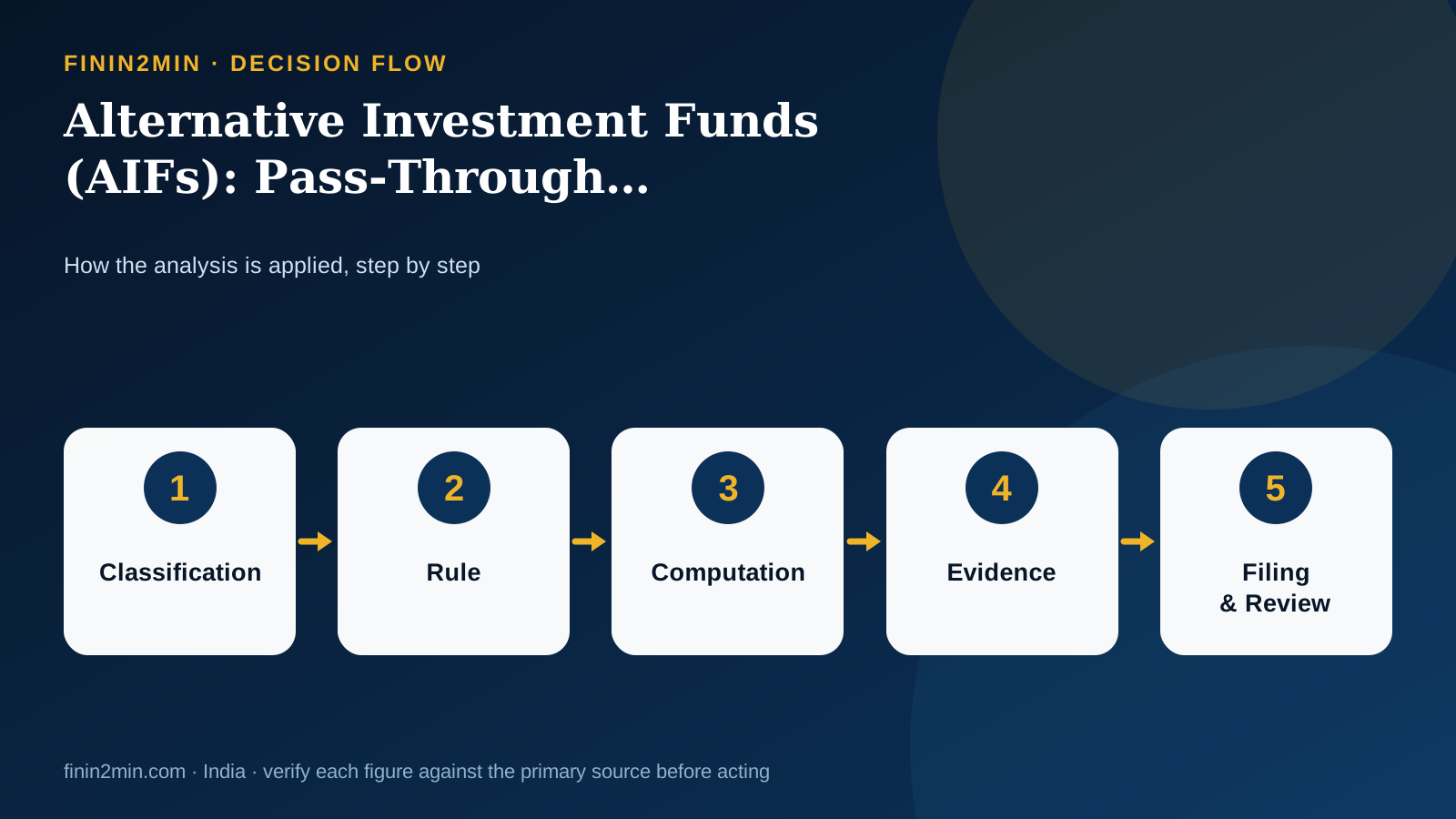
The six steps should be documented in sequence. If the final filing or accounting entry cannot be traced back through the workflow to the source document and legal provision, the position is not yet audit-ready.
4. Worked example and scenario analysis
Illustrative scenario — not a universal tax or legal result Assume a ₹10 lakh economic exposure to Alternative Investment Funds (AIFs) and a ₹14 lakh gross realisation/distribution before costs. Do not apply one headline tax rate. Break the ₹4 lakh economic gain into the legally relevant streams, map acquisition and exit dates, identify withholding already reported, and then compute each stream under the rule applicable to Tax Year 2026-27. The example is a workflow illustration; the tax answer changes if the legal character, investor status or transaction date changes.
Recalculate the conclusion for at least three variations: (1) a change in party/residential or regulatory status, (2) a change in transaction date or holding/tenure, and (3) a change in value, consideration or cash-flow structure. This reveals whether the result is robust or depends on a single fragile assumption.
For Alternative Investment Funds (AIFs): Pass-Through Taxability for Category I, II, and III Investors, a reviewer should be able to explain the result in four reconciled layers: the governing legal or accounting rule, the numerical working, the document that proves each input, and the exact filing / financial-statement / transaction output. Where the commercial outcome changes under a different date, party status, valuation basis or classification, the working paper should show that sensitivity explicitly rather than burying it in assumptions.
5. Evidence file, controls and common failure points
Evidence to retain
- scheme PPM and contribution agreement
- SEBI registration/category of the scheme
- capital account / distribution statement
- income-character and loss statement issued by the fund
- contract notes / fund statements / grant documents
- bank and broker ledgers
Red flags to review
- treating Category III as automatically pass-through
- netting business income with pass-through streams
- ignoring fund-level loss restrictions
Corporate actions — Bonus, split, merger, demerger, buy-back or conversion can alter cost, quantity or character. Reconcile the demat history before computing an exit. Multiple accounts — Do not assume a transfer between own demat/exchange/wallet accounts is a disposal. Separate ownership movement from taxable transfer. Withholding mismatch — TDS is a collection mechanism, not the final character or rate. Reconcile gross consideration and counterparty reporting before claiming credit. Non-resident / foreign asset layer — Residency, treaty, foreign tax credit and disclosure can change the result even when the instrument is identical. Old-year positions — For events before 1 April 2026, preserve the legacy 1961 Act analysis rather than retrofitting current section numbers to a past transaction.
What exactly is the asset or contractual right, and who is its legal owner? Which tax-year law applies to the acquisition, income stream and exit? Is any income stream business income, salary/perquisite, capital gain, dividend, interest or another category? Is there a special computation rule that overrides a generic capital-gain method? What withholding/TDS has already been reported and does it match the gross transaction value? Which losses, if any, can legally be set off or carried forward? Does the investor have foreign-asset, related-party, fund or issuer reporting in addition to the tax computation? Can every amount in the return be traced to a broker/fund/issuer/bank record?
Reviewer sign-off questions
- Is the legal provision current for the transaction / tax year being analysed?
- Does the classification in the working paper match the contract, ledger and filing?
- Are values, dates, rates and assumptions independently traceable to evidence?
- Has the team documented any judgement, exception, litigation risk or alternative interpretation?
- Would another reviewer be able to reproduce the result without asking for undocumented assumptions?
Implementation checklist: from analysis to an audit-ready file
For Alternative Investment Funds (AIFs): Pass-Through Taxability for Category I, II, and III Investors, the review should finish with a file that another professional can reproduce without relying on oral explanations. The following controls convert the technical conclusion into an execution-ready record.
Control 1: scheme PPM and contribution agreement
Retain scheme PPM and contribution agreement as a primary input, not merely as background support. The working paper should identify the relevant date, amount, party and legal character visible in that record, then cross-reference it to the computation and final filing / accounting output. Where the document does not directly prove an assumption, record the additional evidence or judgement used to bridge the gap.
Control 2: SEBI registration/category of the scheme
Retain SEBI registration/category of the scheme as a primary input, not merely as background support. The working paper should identify the relevant date, amount, party and legal character visible in that record, then cross-reference it to the computation and final filing / accounting output. Where the document does not directly prove an assumption, record the additional evidence or judgement used to bridge the gap.
Control 3: capital account / distribution statement
Retain capital account / distribution statement as a primary input, not merely as background support. The working paper should identify the relevant date, amount, party and legal character visible in that record, then cross-reference it to the computation and final filing / accounting output. Where the document does not directly prove an assumption, record the additional evidence or judgement used to bridge the gap.
Control 4: income-character and loss statement issued by the fund
Retain income-character and loss statement issued by the fund as a primary input, not merely as background support. The working paper should identify the relevant date, amount, party and legal character visible in that record, then cross-reference it to the computation and final filing / accounting output. Where the document does not directly prove an assumption, record the additional evidence or judgement used to bridge the gap.
Pre-sign-off challenge test
Before sign-off, challenge the conclusion specifically for: treating Category III as automatically pass-through; netting business income with pass-through streams; ignoring fund-level loss restrictions. If any of these conditions is present, re-open classification and computation rather than treating the issue as a disclosure-only point.
6. Frequently asked questions
What does “AIF pass-through is category-specific” mean for Alternative Investment Funds?
Section 224 of the Income-tax Act, 2025 (legacy Section 115UB) defines an “investment fund” around Category I and Category II AIFs. Income other than business income is broadly passed through with the same character in the investor’s hands; business income is retained and taxed at the fund level. Category III AIFs do not receive this general Section 224 of the Income-tax Act, 2025 (legacy Section 115UB) pass-through simply because they are AIFs.
What does “Category I/II tax character matters” mean for Alternative Investment Funds?
For qualifying investment funds, the investor is generally taxed as though the underlying investment had been made directly. The character of income therefore matters: capital gains, interest and other streams can retain their nature, while business income follows the special fund-level rule.
What does “Who gets statutory pass-through” mean for Alternative Investment Funds?
Section 224 of the Income-tax Act, 2025 (legacy Section 115UB) is built around Category I and Category II AIFs that satisfy the “investment fund” definition. For those funds, non-business income is generally taxed in the unit holder’s hands with its character preserved. Category III AIFs need a separate fund-structure and investor-level analysis; they do not obtain the same Section 224 of the Income-tax Act, 2025 (legacy Section 115UB) pass-through merely because SEBI classifies them as AIFs.
What should be documented before taking a position on Alternative Investment Funds?
At minimum, preserve scheme PPM and contribution agreement, SEBI registration/category of the scheme, capital account / distribution statement, income-character and loss statement issued by the fund. The calculation should be traceable from source records to the legal provision and the final return, filing, accounting entry or board decision.
What is the most common review risk?
The highest-risk errors include treating Category III as automatically pass-through, netting business income with pass-through streams, ignoring fund-level loss restrictions. A reviewer should test these items separately rather than relying on a single summary memo.
When should professional advice be obtained?
Seek transaction-specific advice where facts cross multiple regimes, involve material value, foreign parties, litigation, valuation judgement, restructuring, significant estimates or a position that is not clearly covered by the latest statutory text / regulator guidance.
7. Related Finin2min topics
- Pre-IPO Placements vs. Unlisted Shares: Fair Market Value under the 2026 Tax Rules
- Crypto & VDA Taxation: Reconciling the 1% TDS under Section 393 Across Multiple Exchanges
- Angel Tax After Abolition: Why Valuation Safeguards Still Matter for Startup Seed Funding Rounds
- REITs and InvITs: Tax Breakdown of Dividend, Interest, Rent and Other Distributions for Retail Investors
- Market-Linked Debentures (MLDs): How Section 76 Changes Debt Portfolio Taxation
Primary sources and validation basis
Use the linked official material as the starting point. Check the latest amendment / circular / notification applicable to the specific date and facts before filing or executing a transaction.
- SEBI — AIF Regulations, last amended 14 July 2026
- SEBI — Master Circular for AIFs (3 June 2026)
- Income-tax Act, 2025 — investment-fund pass-through framework