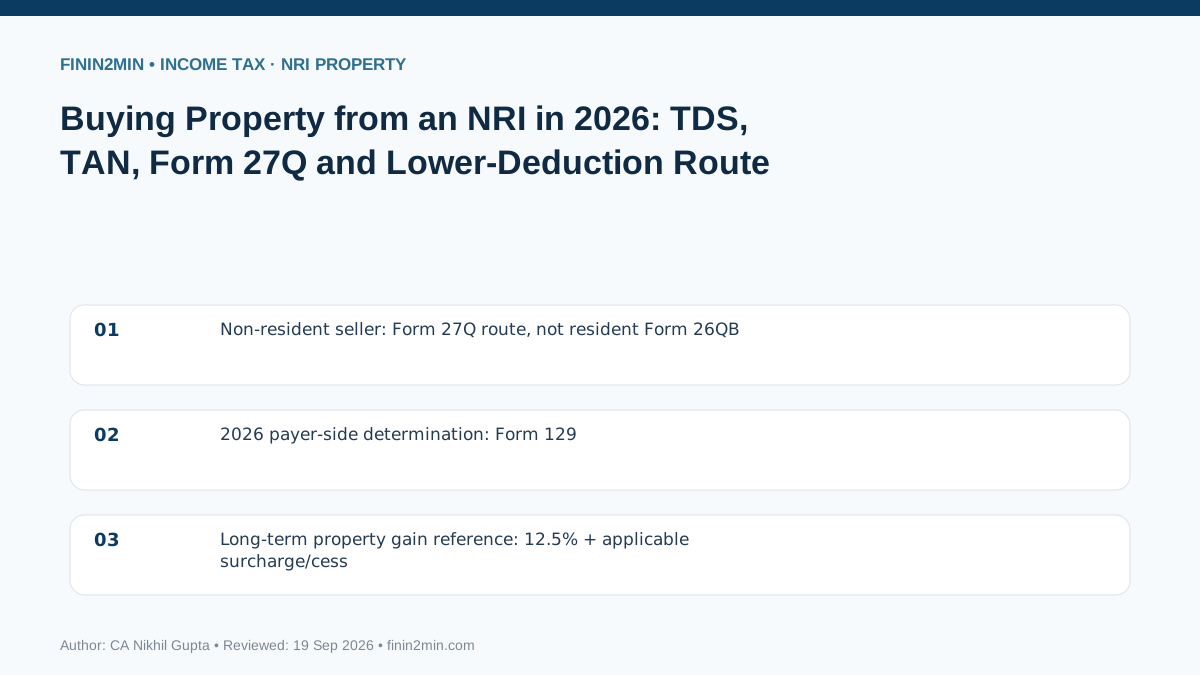
For a non-resident seller, the familiar 1% resident-property shortcut is the wrong starting point. The buyer must identify the non-resident withholding rule, determine the taxable amount/rate, complete the correct TDS reporting and coordinate any lower-deduction certificate before money is released.
The rule in one minute
When the seller is a non-resident, the buyer should not use the resident-seller mechanism merely because the asset is a flat, plot or house in India. The Income Tax Department’s e-Pay Tax FAQ distinguishes a resident deductee (old Form 26QB) from a non-resident one (old Form 27Q). For payments or credits on or after 1 April 2026, the Income-tax Rules, 2026 renumber these: the PAN-based challan-cum-statement for property, rent, contractor and VDA deductions is Form 141, and the quarterly statement for payments to non-residents is Form 144 (earlier Form 27Q). In practice, a buyer paying a non-resident seller has generally needed a TAN, a tax-payment trail and a Form 144 reporting process rather than the PAN-based Form 141 route used for a resident property seller — subject to the 1 October 2026 relief for resident individual and HUF buyers explained below.
For transfers governed by the Income-tax Act, 1961, the familiar charging/withholding reference is section 195. From 1 April 2026, payments or credits are governed by the corresponding Income-tax Act, 2025 provisions: the Department explains that non-salary TDS has been consolidated into section 393 and that transactions on or after 1 April 2026 should quote the relevant section 393 table item rather than old section numbers. Section 393(2), Table serial 17 covers interest or another sum chargeable under the Act paid to a non-resident or foreign company at the “rates in force”.
What rate should a buyer work with?
The Department’s non-resident FAQ gives a practical capital-gain reference. If immovable property is held for more than 24 months, it is long-term. For transfers on or after 23 July 2024, the long-term capital-gains rate stated in the FAQ is 12.5%; for transfers before that date, it was 20%. For a short-term gain, the FAQ states 30% for an individual/firm and 35% for a foreign company. Surcharge and 4% Health and Education Cess can increase the effective withholding rate.
That does not mean a buyer should casually apply 12.5% to the entire sale price. The non-resident payment rule is concerned with the sum chargeable to tax. The difficulty at closing is that a buyer may not safely know the seller’s cost, improvement cost, exemptions, treaty position or final taxable gain. This is exactly why the law provides a route for determination/lower deduction rather than inviting the buyer to invent the taxable component.
| Question | Practical treatment |
|---|---|
| Seller is resident | Evaluate the resident-property TDS rule; Form 26QB/PAN-only workflow may apply. |
| Seller is non-resident | Use the non-resident withholding framework; Form 144 (earlier Form 27Q) is the quarterly statement for payments from 1 April 2026. |
| Property held >24 months | Long-term classification; Department FAQ states 12.5% LTCG rate for transfers on/after 23 July 2024, plus applicable surcharge and cess. |
| Buyer wants certainty on taxable portion | For 2026 Act payments, Form 129 is the payer-side application for AO determination under sections 395(2)/400(3). |
| Seller already has a valid lower/nil certificate | Check the certificate number, payee, payer/payment coverage, validity period and rate before applying it. |
2026 change: Form 129 replaces the old payer-side Form 15E route
The Income-tax Rules, 2026 introduced Form 129 for a payer who wants the Assessing Officer to determine the portion of a non-resident payment chargeable to tax. The Department’s Form 129 note maps it to old Form 15E and old section 195(2)/(7), and identifies the new statutory references as sections 395(2) and 400(3). The form is event-based, has no prescribed annual filing cap and must be sought before the remittance for which the determination is required.
This is useful in a property transaction where the consideration can be far larger than the actual taxable gain. A seller may separately use the applicable payee-side lower/nil certificate process. Whichever route is used, the closing team should not treat an email calculation by the seller or broker as if it were a certificate issued under the Act.
Documents that make the determination workable
- registered/expected sale agreement and payment schedule;
- seller PAN, passport/overseas address and evidence supporting non-resident status;
- original purchase deed and cost records;
- capital improvement invoices where relied upon;
- computation of capital gain and any exemption/reinvestment claim;
- prior-payment details, because TDS timing follows credit/payment rather than only registration day;
- certificate/application acknowledgement and validity details where lower deduction is sought.
Worked closing example: why a certificate can matter
Facts. A resident buyer agrees to buy an apartment from an NRI individual for ₹1.80 crore. Assume the seller’s verified taxable long-term gain, after allowable cost but before any separate exemption, is ₹60 lakh. Ignore surcharge for this illustration and apply 4% cess to a 12.5% base rate.
Tax on the illustrated gain: ₹60,00,000 × 12.5% = ₹7,50,000. Cess at 4% = ₹30,000. Illustrated tax = ₹7,80,000.
Why the sale price matters operationally: if the buyer incorrectly treats 12.5% + cess as a flat withholding percentage on the full ₹1.80 crore, the cash withheld would be ₹23.40 lakh — three times the illustrated tax on the gain. That is the commercial reason to obtain an appropriate determination/certificate instead of guessing the chargeable portion.
This is a mechanics example, not a substitute for the actual rate-in-force computation. Surcharge, treaty provisions, exemptions and the seller’s legal status can change the final number.
Instalment trap
If ₹20 lakh is paid as an advance months before registration, do not assume TDS can wait until the deed is signed. The non-resident withholding rule generally operates at credit or payment, whichever is earlier. The tax plan therefore has to be ready before the first taxable payment event.
TAN, payment and Form 144 (earlier Form 27Q) — the buyer’s file
The Department’s TDS material places non-salary payments to non-residents in Form 27Q up to the quarter ended 31 March 2026 and in Form 144 for payments from 1 April 2026 (first quarter of tax year 2026-27 due 31 July 2026). It also lists quarterly statement due dates of 31 July, 31 October, 31 January and 31 May for quarters ending June, September, December and March respectively, with the TDS certificate (Form 16A under the old rules; use the certificate form shown on the portal for 2026-27) generally due 15 days after the statement due date. The legacy material also explains the normal challan deposit timeline: seven days from the end of the month of deduction, with March deductions payable by 30 April. For a 2026 transaction, use the current portal/rules and section codes because the new Act changed form numbering and section references even where policy remains similar.
- Obtain TAN early enough to make the first required deposit.
- Validate seller PAN/name and non-resident status.
- Map each instalment to the applicable withholding event.
- Apply the rate/determination actually supported by law or certificate.
- Deposit tax and preserve the CIN/challan.
- Report the transaction in the prescribed non-resident TDS statement.
- Issue/download the TDS certificate and reconcile it with Form 26AS/AIS where applicable.
TAN or PAN? The 1 October 2026 relief for resident individual and HUF buyers
Budget 2026 proposed, and the Finance Act 2026 amendment to section 397(1)(c) of the Income-tax Act, 2025 provides, that a resident individual or HUF deducting tax under section 393(2) on the consideration for immovable property bought from a non-resident is not required to obtain a TAN. The buyer deducts on the buyer’s own PAN and reports the deduction, quoting the seller’s PAN, in a PAN-based challan-cum-statement. The amendment takes effect on 1 October 2026.
What this means at a closing in September or October 2026: a payment or credit before 1 October 2026 follows the TAN and Form 144 route; a buyer who is a company, LLP or firm continues to need a TAN in any case; and an individual or HUF buyer whose payment falls on or after 1 October 2026 should check the portal’s current PAN-based workflow before relying on the relief. The relief removes the TAN step only — it does not change the withholding rate, the need for a lower-deduction determination where the taxable gain is far below the sale price, or the deposit deadline.
Defaults can become the buyer’s liability
A property buyer is a deductor, not merely a conduit. The Department’s TDS guidance describes interest for non-deduction/short deduction and for delayed deposit, late-statement fees and additional penalty exposure. Under the legacy framework, interest is stated at 1% per month or part for non/late deduction and 1.5% per month or part after deduction but before deposit; late filing fee under section 234E is ₹200 per day subject to the statutory cap. For a post-1 April 2026 transaction, use the equivalent provisions and current portal calculation rather than copying old section labels into the return.
The safest purchase agreement therefore contains a tax-withholding clause, requires the seller to cooperate with certificate applications, allows the buyer to retain statutory tax and defines what happens if the seller’s status or certificate changes before a later instalment.
Closing-day checklist
- Seller’s tax residency confirmed for the relevant tax year.
- PAN and identity match across deed, certificate and portal.
- Holding period and acquisition date documented.
- TAN/portal access ready before first taxable instalment.
- Lower-deduction/determination certificate, if any, checked for payer, payee, amount, rate and validity.
- Payment schedule reconciled to TDS deposit dates.
- Sale deed states gross consideration and statutory withholding clearly.
- Challan and quarterly statement responsibilities assigned to a named person.
- Seller receives TDS certificate and payment reconciliation after filing.
Sale agreement drafting: build the withholding into the cash-flow
A non-resident property deal can become unnecessarily contentious when the agreement mentions only a net amount payable to the seller. The drafting should instead separate the gross consideration, the amount to be deposited as tax, and the net remittance to the seller. If a lower-deduction or determination certificate is expected, the agreement should state what happens if the certificate arrives after an advance is due, is issued for only part of the consideration, or names only one of several buyers.
Consider a ₹1.50 crore purchase with two scheduled instalments of ₹30 lakh and ₹1.20 crore. If the seller is applying for a determination that would support lower withholding, the first ₹30 lakh cannot simply be paid gross on the assumption that the certificate will eventually arrive. The withholding event is linked to credit/payment. The parties can either obtain the certificate before the relevant instalment or structure the agreement so that the buyer retains the statutory amount until the legally supportable rate is clear. This is a commercial drafting issue as much as a tax issue.
| Closing document | What the buyer should verify |
|---|---|
| Seller residency declaration | Status for the relevant tax period, overseas address and supporting facts; do not rely only on citizenship. |
| PAN / TAN data | Names and identifiers should match the deed, challan, certificate and TDS statement. |
| Lower-deduction / determination order | Payer, payee, rate, amount ceiling, validity period and the transaction covered. |
| Payment schedule | Advance, milestone and registration payments mapped separately to withholding and deposit actions. |
| Capital-gain working | Useful for commercial review, but not a substitute for an AO determination where the buyer needs statutory protection. |
Three edge cases that change the file
Multiple buyers: every buyer should understand who is deducting, depositing and reporting tax against the portion paid or credited by that buyer. A certificate or challan should not be assumed to cover another payer unless its terms do so. Multiple sellers: residency and tax treatment can differ seller by seller even when the property is sold through one deed. The payment allocation in the deed should therefore be clear. Power of attorney: payment to an attorney or Indian bank account does not by itself convert a non-resident seller into a resident payee; the underlying seller and chargeability still drive the analysis.
Also separate the buyer's withholding problem from the seller's repatriation problem. The seller may later need banking/FEMA documentation to remit the sale proceeds. That downstream process does not remove the buyer's TDS obligations at closing. Keeping the tax challan, Form 144 (or, for pre-April 2026 payments, Form 27Q) acknowledgement, TDS certificate, deed, certificate/order and bank trail in one permanent folder helps both sides when the bank, tax portal or assessment team asks for the transaction history years later.
Frequently asked questions
Can I use Form 26QB because the asset is a house?
Not merely because it is immovable property. The e-Pay Tax FAQ treats the resident-deductee route (old Form 26QB, now Form 141) separately from a non-resident payee, whose quarterly statement was Form 27Q and is Form 144 for payments from 1 April 2026.
Is TDS always 12.5% of the sale consideration?
No. The 12.5% figure is a long-term capital-gains tax rate reference for transfers on/after 23 July 2024. The non-resident withholding obligation concerns the sum chargeable to tax and can require surcharge/cess, treaty review or an AO/certificate determination.
What changed from 1 April 2026?
The Income-tax Act, 2025 became operative for payments/credits from that date. The Department says non-salary TDS is consolidated in section 393; the payer-side determination formerly associated with Form 15E is now Form 129 under the 2026 Rules.
Should TAN be obtained?
Yes, for the regular non-resident route (Form 144) TAN is part of the deductor compliance framework. Budget 2026 changed this for one category: the Finance Act 2026 amendment to section 397(1)(c) lets a resident individual or HUF buying immovable property from a non-resident deduct tax on the buyer’s PAN and report it in a PAN-based challan-cum-statement, with effect from 1 October 2026. Until then, and for companies, LLPs and firms, obtain a TAN; confirm the portal workflow on the closing date.
Can the seller give me a self-made capital-gain computation instead of a certificate?
The computation is useful evidence, but it does not by itself carry the legal force of an AO determination or valid lower/nil deduction certificate.
What if consideration is paid in several instalments?
Build withholding into every relevant payment/credit event. Waiting for registration can create a default where an advance itself triggered deduction.
Primary sources
Use the cited instrument or regulator guidance for the proposition described above; check later amendments and transaction-date rules before acting.
- Income Tax Department — NRI property-sale TDS FAQ
- Income Tax Department — e-Pay Tax FAQ: resident vs non-resident deductee forms
- Income Tax Department — Section 393, Income-tax Act, 2025
- Income Tax Department — Form 129: payer application for non-resident payment
- Income Tax Department — Tax payments / transition to Income-tax Act, 2025
- Income Tax Department — TDS/TCS statement forms and due dates
Educational information only. Tax, legal, banking and insurance outcomes depend on facts, dates and the instrument/policy in force. Obtain professional advice for material transactions.