Operating leverage measures how sensitive operating profit is to changes in revenue when a business has fixed operating costs. It can create attractive upside after break-even but severe downside when volume falls, so the model should distinguish structural fixed cost, step-fixed cost and truly variable cost.
Finin2min takeaway
- Define the model purpose before computing.
- Use source data and accounting/valuation assumptions applicable to the model reference date.
- Separate accounting measures, management metrics, valuation assumptions and cash-flow effects.
- Reconcile every material output to source data, formulas, sensitivities and the decision paper.
1. Overview — what exactly are we analysing?
Operating leverage measures how sensitive operating profit is to changes in revenue when a business has fixed operating costs. It can create attractive upside after break-even but severe downside when volume falls, so the model should distinguish structural fixed cost, step-fixed cost and truly variable cost.
This version focuses on controls, audit defence, governance, scenario testing and failure points. For Operating Leverage: Governance, Documentation and Audit Trail, the objective is not to produce a one-line rate or checklist answer. The objective is to make the position reproducible: another reviewer should be able to identify the model decision point, apply the chosen methodology, rebuild the calculation and trace the result into the relevant model output, financial-statement reconciliation or board paper.
What makes this topic difficult?
For Operating Leverage: Governance, Documentation and Audit Trail, the difficult part is linking model purpose and source data to formula architecture and then proving the result through P&L and management accounts. A commercially similar transaction can produce a different outcome when the profile-specific facts change. The first failure mode to guard against is presenting degree of operating leverage as a constant across all revenue levels, so this guide starts with classification and evidence rather than a headline percentage.
2. Current framework — 5 September 2026
Current-position note for Operating Leverage: Governance, Documentation and Audit Trail. This balance batch closes the modeling pillar with contribution margin, operating leverage, merger models, accretion/dilution and synergy modeling. These are decision models, not accounting standards by themselves. Every model should state units, valuation/reference date, scenario assumptions, source data and reconciliation to reported financials. Transaction models should bridge enterprise value to equity value, purchase consideration to funding, share count to EPS and synergy assumptions to implementation timing, tax and one-off costs; outputs should be presented as sensitivities rather than false precision.
State the operating-leverage measure used—such as contribution/EBIT at a given revenue point—and do not present one ratio as constant across all volumes. This point is the first technical checkpoint because a wrong classification at this stage contaminates every later calculation. If the fact changes, the team should rerun the conclusion rather than preserve the old answer for convenience.
Separate fixed, variable and step-fixed costs using operational drivers; lease, payroll, cloud commitments and outsourced capacity can change classification over different horizons. In practice, finance teams often discover this issue only during return preparation or diligence; the better control is to resolve it when the transaction is designed. The practical consequence is that the same source fact can produce a different legal, tax, accounting or valuation result when the governing classification or measurement basis changes.
Reconcile model EBIT to the financial statements, including depreciation, stock-based compensation and one-offs, and label any management-adjusted metric. The supporting memo should state the factual assumption that makes the rule relevant and identify the document that proves that assumption. This is also where audit defence is won: consistent contracts, registers, bank evidence and filed forms are stronger than a later explanatory note.
Model capacity additions and hiring thresholds as step changes rather than smooth percentages when the business cannot scale continuously. A reviewer should be able to reproduce the conclusion from the source records without relying on a management explanation or a spreadsheet note. The article therefore treats this as a decision rule, not as a generic caution.
Use downside scenarios to identify covenant/cash-buffer pressure because operating leverage can convert a modest revenue miss into a disproportionate EBIT decline. Where a contract, ledger, model or business label uses broad terminology, the analysis should translate it into the topic-specific legal, tax, accounting or valuation concept before applying a rate, formula or filing rule. For Operating Leverage: Governance, Documentation and Audit Trail, that means the computation file should show the classification step separately from the amount calculation.
For Operating Leverage: Governance, Documentation and Audit Trail, where an older accounting policy, transaction assumption, forecast version or valuation methodology is relevant to an earlier period, preserve it in the version history and label it clearly. The current model should not silently mix assumptions from different reference dates.
3. Detailed mechanics
Control and audit-defence focus
This version focuses on controls, audit defence, governance, scenario testing and failure points. For Operating Leverage: Governance, Documentation and Audit Trail, the strongest control is preventive: allocate responsibility for model classification, accounting entry, tax computation, filing and evidence at transaction inception. A year-end reviewer should not have to reconstruct the contract or ask which version of a valuation, calculation, agreement, statutory register or regulatory form was actually relied on.
For Operating Leverage: Governance, Documentation and Audit Trail, build a red/amber/green control sheet. Red means a statutory condition or deadline is missed; amber means the position is fact-sensitive or depends on judgement; green means primary documents, computation and approved output reconcile. This converts a long technical memo into a management-ready action plan without removing the underlying legal analysis.
How the mechanics should be documented
For Operating Leverage: Governance, Documentation and Audit Trail, create an assumption register with seven columns: model driver, reference period/date, source document or system, formula/method, base-case assumption, sensitivity range and owner. This prevents a correct-looking output from being supported by an undocumented assumption or the wrong source period.
For Operating Leverage: Governance, Documentation and Audit Trail, create a reconciliation bridge that begins with the source system or approved forecast and ends with the model or decision output. Differences should be explained, not manually forced to zero. In this article, the bridge may need to distinguish operating forecast, debt and cash-flow schedules, accounting carrying amounts, valuation inputs, enterprise value, equity value and decision-case outputs. The working should state the purpose, date and source of each value so a legitimate difference is not mistaken for an error — and an actual mismatch is not hidden as a “valuation difference”.
Practitioner deep dive — five topic-specific checkpoints
Control checkpoint 1
State the operating-leverage measure used—such as contribution/EBIT at a given revenue point—and do not present one ratio as constant across all volumes. In a control-focused review of Operating Leverage: Governance, Documentation and Audit Trail, assign this point to a named owner before "define EBIT/contribution basis and the revenue point at which leverage is measured" is completed. The control should require inspection of P&L and management accounts, not merely a verbal confirmation. Record who reviewed it, when it was reviewed, which version was relied on, and whether the conclusion is unconditional or depends on a future event.
Failure signal. A specific red flag is presenting degree of operating leverage as a constant across all revenue levels. If that signal appears, classify the matter as amber or red until the underlying facts are reconciled. For Operating Leverage: Governance, Documentation and Audit Trail, a defensible closure note should state the discrepancy, quantify any exposure or model impact where possible, identify the remedial filing/approval/recalculation needed, and preserve evidence of completion. That is stronger than a generic “reviewed” tick because it shows how the risk was actually resolved.
Control checkpoint 2
Separate fixed, variable and step-fixed costs using operational drivers; lease, payroll, cloud commitments and outsourced capacity can change classification over different horizons. In a control-focused review of Operating Leverage: Governance, Documentation and Audit Trail, assign this point to a named owner before "classify fixed, variable and step-fixed operating costs" is completed. The control should require inspection of cost-driver classification, not merely a verbal confirmation. Record who reviewed it, when it was reviewed, which version was relied on, and whether the conclusion is unconditional or depends on a future event.
Failure signal. A specific red flag is treating step-fixed costs as smoothly variable percentages. If that signal appears, classify the matter as amber or red until the underlying facts are reconciled. For Operating Leverage: Governance, Documentation and Audit Trail, a defensible closure note should state the discrepancy, quantify any exposure or model impact where possible, identify the remedial filing/approval/recalculation needed, and preserve evidence of completion. That is stronger than a generic “reviewed” tick because it shows how the risk was actually resolved.
Control checkpoint 3
Reconcile model EBIT to the financial statements, including depreciation, stock-based compensation and one-offs, and label any management-adjusted metric. In a control-focused review of Operating Leverage: Governance, Documentation and Audit Trail, assign this point to a named owner before "reconcile model EBIT to reported/management EBIT and identify adjustments" is completed. The control should require inspection of capacity/headcount schedule, not merely a verbal confirmation. Record who reviewed it, when it was reviewed, which version was relied on, and whether the conclusion is unconditional or depends on a future event.
Failure signal. A specific red flag is ignoring lease, payroll or cloud commitments when testing downside. If that signal appears, classify the matter as amber or red until the underlying facts are reconciled. For Operating Leverage: Governance, Documentation and Audit Trail, a defensible closure note should state the discrepancy, quantify any exposure or model impact where possible, identify the remedial filing/approval/recalculation needed, and preserve evidence of completion. That is stronger than a generic “reviewed” tick because it shows how the risk was actually resolved.
Control checkpoint 4
Model capacity additions and hiring thresholds as step changes rather than smooth percentages when the business cannot scale continuously. In a control-focused review of Operating Leverage: Governance, Documentation and Audit Trail, assign this point to a named owner before "map capacity, headcount and commitment thresholds that create step changes" is completed. The control should require inspection of lease/commitment schedule, not merely a verbal confirmation. Record who reviewed it, when it was reviewed, which version was relied on, and whether the conclusion is unconditional or depends on a future event.
Failure signal. A specific red flag is using adjusted EBIT without an explicit bridge to reported numbers. If that signal appears, classify the matter as amber or red until the underlying facts are reconciled. For Operating Leverage: Governance, Documentation and Audit Trail, a defensible closure note should state the discrepancy, quantify any exposure or model impact where possible, identify the remedial filing/approval/recalculation needed, and preserve evidence of completion. That is stronger than a generic “reviewed” tick because it shows how the risk was actually resolved.
Control checkpoint 5
Use downside scenarios to identify covenant/cash-buffer pressure because operating leverage can convert a modest revenue miss into a disproportionate EBIT decline. In a control-focused review of Operating Leverage: Governance, Documentation and Audit Trail, assign this point to a named owner before "compute local operating-leverage and downside cash/covenant sensitivities" is completed. The control should require inspection of EBIT bridge, not merely a verbal confirmation. Record who reviewed it, when it was reviewed, which version was relied on, and whether the conclusion is unconditional or depends on a future event.
Failure signal. A specific red flag is extrapolating a local leverage ratio far outside the relevant range. If that signal appears, classify the matter as amber or red until the underlying facts are reconciled. For Operating Leverage: Governance, Documentation and Audit Trail, a defensible closure note should state the discrepancy, quantify any exposure or model impact where possible, identify the remedial filing/approval/recalculation needed, and preserve evidence of completion. That is stronger than a generic “reviewed” tick because it shows how the risk was actually resolved.
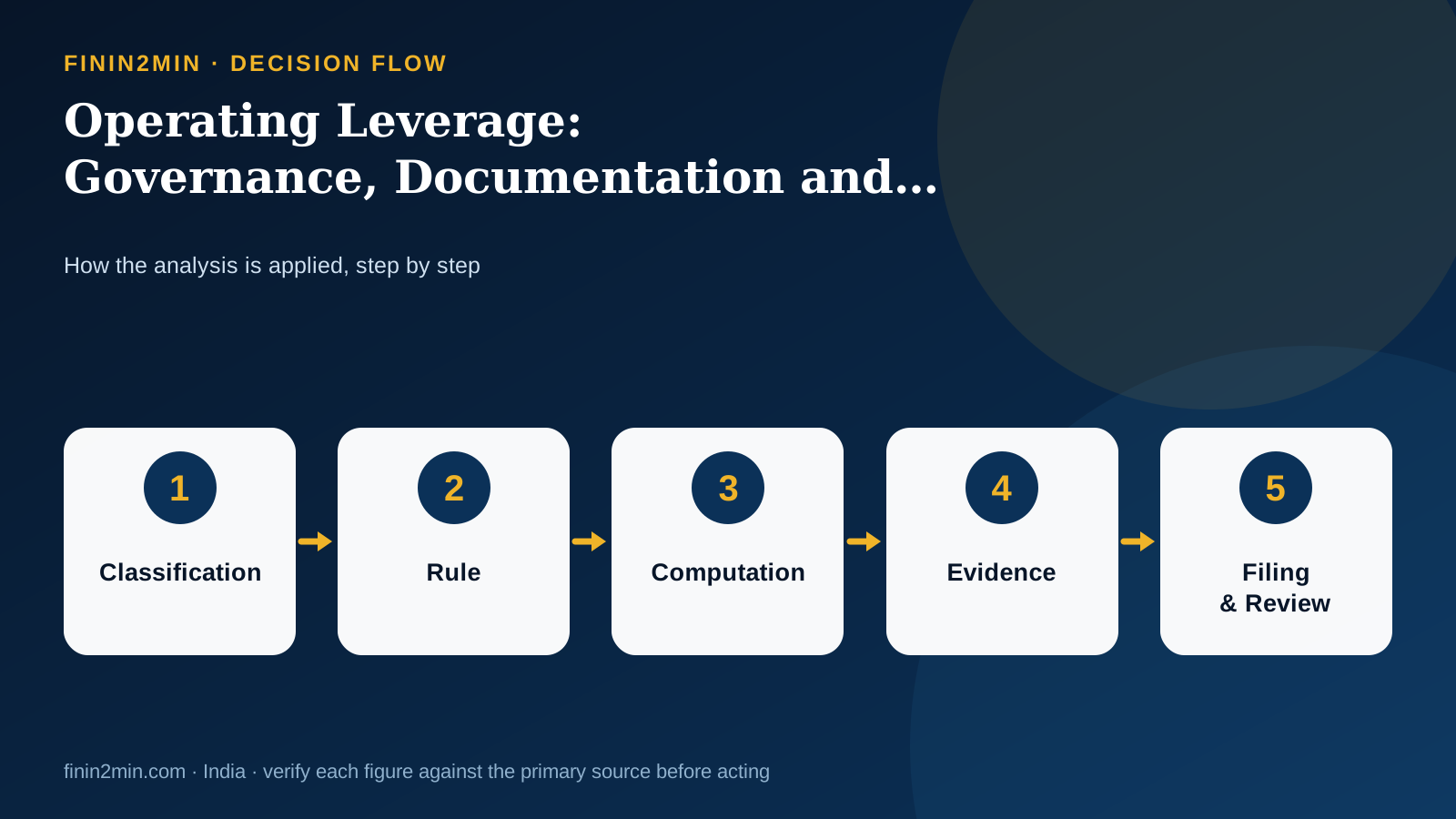
4. Decision workflow
For Operating Leverage: Governance, Documentation and Audit Trail, each workflow step should have a named model and evidence owner. Finance/FP&A may own the source P&L and forecast, treasury may own financing inputs, M&A/strategy may own deal assumptions, and accounting/valuation reviewers may own methodology and reconciliation. Hand-offs and model versions should be recorded because an ownerless spreadsheet is not a control.
5. Worked example
Illustrative worked example
Facts. A business has ₹20 crore contribution and ₹15 crore fixed operating cost, producing ₹5 crore EBIT.
Analysis. Degree of operating leverage at that point is roughly 4x on a contribution/EBIT basis. A 5% adverse change in contribution can therefore have a much larger percentage effect on EBIT; the model should show this locally rather than extrapolate 4x forever.
Finin2min control. This Operating Leverage: Governance, Documentation and Audit Trail example is deliberately simplified. In a live case, replace every illustrative assumption with the actual dates, amounts, classifications, source documents, approvals and filings relevant to this topic before relying on the result.
The Operating Leverage: Governance, Documentation and Audit Trail worked example should be accompanied by a sensitivity note. Identify the profile-specific assumption most likely to change the result and show how the conclusion changes if it moves. The sensitivity should use the actual driver in this article — not a generic market variable — so management can monitor the driver that genuinely changes the model or decision outcome.
6. Scenario analysis
| Scenario | What changes | Reviewer action |
|---|---|---|
| Green | Documents, computation and approved output agree | Release after independent review. |
| Amber | Judgement or conditional exemption/route is material | Add legal memo, approval owner and monitoring trigger. |
| Red | Deadline, route, valuation, evidence or eligibility condition is breached | Stop normal processing; quantify exposure and remedial path. |
| Future event | Exit, conversion, completion, admission, allotment or next funding can change outcome | Create a diary control and scenario refresh point. |
For Operating Leverage: Governance, Documentation and Audit Trail, scenario analysis is a control for model sensitivity and decision uncertainty rather than forecasting theatre. The scenario table should identify the fact that must be watched, the evidence that proves a change, and the action that follows when the fact crosses from the base case into an exception.
7. Documentation and audit trail
Core evidence file
- P&L and management accounts
- cost-driver classification
- capacity/headcount schedule
- lease/commitment schedule
- EBIT bridge
- scenario/covenant model
Evidence standards
- Use approved source data and executed transaction documents where applicable.
- Preserve the exact model and valuation version actually reviewed or approved.
- Keep system extracts, calculation schedules and approval records—not only screenshots.
- Reconcile dates and periods across source data, forecast, model and decision paper.
- Record reviewer name/date and unresolved assumptions.
- Archive the methodology, source data and sensitivity set relied on.
For material decision-use or transaction Operating Leverage: Governance, Documentation and Audit Trail models, add a version history and an assumption/issues index. The index should state the driver, management assumption, source evidence, sensitivity and owner. This makes board review, diligence and post-deal tracking materially faster.
Evidence-to-conclusion matrix for Operating Leverage: Governance, Documentation and Audit Trail
Use this Operating Leverage: Governance, Documentation and Audit Trail matrix as a file-index template. It links each source record to a process step and a known failure mode, so evidence is collected for a reason rather than archived as an undifferentiated document dump.
| Evidence | Decision step | Reviewer test | Red flag |
|---|---|---|---|
| P&L and management accounts | define EBIT/contribution basis and the revenue point at which leverage is measured | Confirm ownership, version, approval and retention of P&L and management accounts; escalate if the evidence does not support define EBIT/contribution basis and the revenue point at which leverage is measured. | presenting degree of operating leverage as a constant across all revenue levels |
| cost-driver classification | classify fixed, variable and step-fixed operating costs | Confirm ownership, version, approval and retention of cost-driver classification; escalate if the evidence does not support classify fixed, variable and step-fixed operating costs. | treating step-fixed costs as smoothly variable percentages |
| capacity/headcount schedule | reconcile model EBIT to reported/management EBIT and identify adjustments | Confirm ownership, version, approval and retention of capacity/headcount schedule; escalate if the evidence does not support reconcile model EBIT to reported/management EBIT and identify adjustments. | ignoring lease, payroll or cloud commitments when testing downside |
| lease/commitment schedule | map capacity, headcount and commitment thresholds that create step changes | Confirm ownership, version, approval and retention of lease/commitment schedule; escalate if the evidence does not support map capacity, headcount and commitment thresholds that create step changes. | using adjusted EBIT without an explicit bridge to reported numbers |
| EBIT bridge | compute local operating-leverage and downside cash/covenant sensitivities | Confirm ownership, version, approval and retention of EBIT bridge; escalate if the evidence does not support compute local operating-leverage and downside cash/covenant sensitivities. | extrapolating a local leverage ratio far outside the relevant range |
| scenario/covenant model | document the relevant range and refresh the ratio when the cost structure changes | Confirm ownership, version, approval and retention of scenario/covenant model; escalate if the evidence does not support document the relevant range and refresh the ratio when the cost structure changes. | failing to connect operating-leverage downside to liquidity or covenant headroom |
8. Risk controls and common mistakes
- presenting degree of operating leverage as a constant across all revenue levels
- treating step-fixed costs as smoothly variable percentages
- ignoring lease, payroll or cloud commitments when testing downside
- using adjusted EBIT without an explicit bridge to reported numbers
- extrapolating a local leverage ratio far outside the relevant range
- failing to connect operating-leverage downside to liquidity or covenant headroom
Most Operating Leverage: Governance, Documentation and Audit Trail errors are rarely simple arithmetic mistakes. They more often arise from a wrong driver classification, stale forecast, inconsistent reference date, hidden hard-code, double-counted assumption or an output that does not reconcile to source data. Controls should target those model risks rather than merely recalculate the final total.
9. Professional review checklist
- Has model purpose and source data been resolved using the current framework for the actual transaction/process date?
- Can the conclusion be traced to P&L and management accounts and cost-driver classification?
- Has the team separately documented formula architecture and valuation/accounting consistency rather than assuming one answers the other?
- Are the dates needed for define EBIT/contribution basis and the revenue point at which leverage is measured and classify fixed, variable and step-fixed operating costs supported by source records?
- Has the specific red flag “presenting degree of operating leverage as a constant across all revenue levels” been tested and closed?
- Do the working papers explain any difference among operating forecast, debt and cash-flow schedules, accounting carrying amounts, valuation inputs, enterprise value, equity value and decision-case outputs?
- Are the worked-example assumptions clearly separated from the actual Operating Leverage: Governance, Documentation and Audit Trail fact pattern?
- Has a second reviewer checked the technical conclusion, arithmetic and evidence trail for Operating Leverage: Governance, Documentation and Audit Trail?
For Operating Leverage: Governance, Documentation and Audit Trail, a finance/FP&A expert should review the economics and reconciliation; an accounting, valuation or M&A professional should review methodology and transaction assumptions; and the business owner should confirm that the operating assumptions used in the model are actually achievable. The review is complete only when these perspectives agree on the same dated fact set and unresolved exceptions are explicitly assigned.
10. Frequently asked questions
What is the first question to ask?
Start with model purpose and source data for Operating Leverage: Governance, Documentation and Audit Trail. A commercial label is not enough; identify the parties, the model objective, decision horizon, reference date and governing accounting/valuation context before calculating or presenting an output.
Which framework and sources should be used for a 2026 model?
For Operating Leverage: Governance, Documentation and Audit Trail, This balance batch closes the modeling pillar with contribution margin, operating leverage, merger models, accretion/dilution and synergy modeling. These are decision models, not accounting standards by themselves. Every model should state units, valuation/reference date, scenario assumptions, source data and reconciliation to reported financials. Transaction models should bridge enterprise value to equity value, purchase consideration to funding, share count to EPS and synergy assumptions to implementation timing, tax and one-off costs; outputs should be presented as sensitivities rather than false precision.
Can I rely only on a broker, ERP, portal or consultant report?
No. For Operating Leverage: Governance, Documentation and Audit Trail, secondary reports are useful working evidence, but the final position should reconcile to the profile-specific source file — including P&L and management accounts, cost-driver classification — and to the current authoritative methodology or source framework.
What if two values are different?
For Operating Leverage: Governance, Documentation and Audit Trail, do not force them to match. First identify whether they answer different questions. In this pillar, the relevant bridge may involve operating forecast, debt and cash-flow schedules, accounting carrying amounts, valuation inputs, enterprise value, equity value and decision-case outputs. Label each value by purpose, valuation date and source, then document why the difference is legitimate or what correction is required.
What is the biggest practical error?
presenting degree of operating leverage as a constant across all revenue levels. The remedy is to resolve the classification and evidence before approving or using the model.
How should I prepare for scrutiny or diligence?
For Operating Leverage: Governance, Documentation and Audit Trail, maintain a dated technical memo and a file index that includes P&L and management accounts, cost-driver classification, capacity/headcount schedule. Preserve the calculation version, reviewer sign-off and the reconciliation from those source records to the model, board paper, valuation memo or financial-statement reconciliation that uses the conclusion.
Should the example be copied into my return or model?
No. The Operating Leverage: Governance, Documentation and Audit Trail example demonstrates mechanics only. Replace each assumption with the actual dates, status, amounts and documents in your case, and re-check the current rule before using the result in a model, board paper, valuation memo or decision pack.
When should the analysis be refreshed?
Refresh the Operating Leverage: Governance, Documentation and Audit Trail analysis whenever a fact affecting model purpose and source data, formula architecture or valuation/accounting consistency changes, or when the accounting/valuation framework, approval status, reference date, forecast or source evidence is updated.
11. Sources and validation basis
This article is anchored to primary or authoritative material. Always check later amendments, notifications, circulars and transaction-specific facts before acting.
Disclaimer: This Operating Leverage: Governance, Documentation and Audit Trail guide is for general educational information and does not constitute legal, tax, accounting, investment or financial advice. Transaction-specific positions may differ based on facts, dates, jurisdiction, documentation and later amendments. Obtain professional advice before acting.